
Archive
Book Review: Rewinder by Brett Battles (Audiobook narrated by Vikas Adam)
 Summary:
It’s 2015, and Denny Younger of New Cardiff, California, is a caste of 8. He loves reading and studying but he knows he will probably end up working in the shops just like his father. But when he takes his placement test, he’s offered a position that he is promised is better, but he can’t know anything about it until he starts working, and he must leave his family behind. Denny’s family life is in pieces, so he eagerly agrees. Before he knows it, he is re-caste as a 5 and soon discovers that he will be traveling through time as an observer, recording family histories for the elite. Even the smallest error in time-travel can have far-reaching consequences, and before he knows it, Denny finds himself racing against time (and other time-travelers) to fix everything. But what does fixing everything actually mean?
Review:
I love a good time-travel book, so when Audible offered this one up to me for review, I eagerly agreed. This is an action-packed book but with far less time-travel than it originally appears and much more parallel universes.
The basic premise of the book is that this is the year 2015 in a wold where the American Revolution never occurred. Without the American Revolution, the British Empire ended up taking over most of the world (except East Asia). Everyone is sorted into extremely strict castes, and family history is everything. These people haven’t made it to the moon yet, but they have managed to discover time-travel. And they use this discovery solely to send people called “rewinders” back in time to verify people’s ancestry to solidify their ranking in this world. Now, this was my first major problem with the book, and it’s a plot point I just never was able to let go of. This society acknowledges the risk of the butterfly effect and yet they brazenly send people willy-nilly through time risking everything for what? Geneaology. And this has been going on for decades with no ill effects. Perhaps other readers can get past the idea that a federally (er, royally) backed agency would do this, but I simply could not.
Naturally, when our brave hero goes back in time, he is the first to woops his way into a butterfly effect. He knows he’s probably done it (he causes someone to leave a location 12 seconds late), but he still pops back up into the present to check on things. Once there, it takes him days to figure out that he’s changed history. Daaaaays. It should really not take him this long to figure this thing out. Denny causes a change. Denny pops up to the present. Denny has troubling connecting to his companion (a person in the present who grounds the person time-traveling), so he gets sick for a few days. Denny then wanders through our universe’s New York City and can’t figure out what’s going on. It takes traveling to California’s New Cardiff (in our world, Los Angeles) and seeing that his family home is gone to figure out what’s happened. Really? A person who has been trained in time-travel takes this long to figure out this very basic time-travel problem? It’s hard to believe, especially after we’ve been told repeatedly how smart Denny is, that he could be that stupid.
Denny then starts living in Los Angeles to investigate this parallel universe. He naturally meets a girl and falls for her. He then has trouble deciding whether to put everything back or not. And of course there are other rewinders out there he must contend with.
The basic plot idea is interesting. What would have happened if there had been no American Revolution and how would a person from that society react if they discovered a different option for their lives? But how the author gets there isn’t fully thought-out or fleshed-out enough. There are too many logical fallacies, such as the ones I’ve laid out above. That said, it was a fun read with a different plot than what has been coming from a lot of YA recently. I was glad to see a scifi that contains some history for YA readers. I also appreciated how many women characters are present in the book, including Denny’s trainer and his nemesis. Similarly, Denny’s world is extremely lacking in diversity due to the success of the British empire and its traditionalism. When he travels to our world, he immediately encounters greater diversity, both of race and of sexuality, and he seems to appreciate that, which is a nice touch.
The narrator does a good job both keeping a good pace and setting the tone for the book. While I understand why the narrator uses a British accent for the British characters from the 1700s, the history geek in me was frustrated, since the stereotypical modern “British accent” didn’t exist back then. (I knew this from my History BA, but here’s an article that explains what I’m talking about).
Overall, this book has an interesting premise and fast-moving plot. It has some romance, but is thankfully free of any love triangles. Time-travel fans may be frustrated by how easily characters brush off the real presence of time-travel issues. The science of time-travel is simply not explored enough, nor is history. However, YA readers looking for a quick read and something different in the genre will most likely enjoy it.
If you found this review helpful, please consider tipping me on ko-fi, checking out my digital items available in my ko-fi shop, buying one of my publications, or using one of my referral/coupon codes. Thank you for your support!
3 out of 5 stars
Length: 300 pages – average but on the shorter side
Source: Free download from Audible in exchange for my honest review

Book Review: Ticker by Lisa Mantchev
 Summary:
Penny Farthing, member of the wealthy elite, is full of tons of energy she mostly uses to ride her motorized high wheel bicycle and collect robotic butterflies. Unfortunately, her clockwork heart doesn’t always entirely keep up with her. Plus she has to wind it. Much more troubling to her, though, is the fact that the creator of her clockwork heart, Calvin Warwick, is now on trial for murdering dozens of people he abducted from the street to practice on before giving her her new heart. When there is an explosion at her family’s factory and Warwick escapes prison immediately after being found guilty of murder (oh, and her parents disappear), Penny and her twin brother and two of their closest friends embark on a journey of intrigue to bring her parents home and Warwick to justice.
Review:
I rarely am actually interested in anything in the Kindle First email (a once-monthly email that informs Kindle owners as to four books they can access ahead of publication for free). I am also not often into most steampunk books. It’s an idea I love, but I often find isn’t executed as well as it should be. When this one popped up, though, I was intrigued for its transhumanist explorations. The book definitely explores the concept of transhumanism via the steampunk idea of augmentation, but it mostly is a story about a young girl’s first love and a bit of a mystery/thriller search for a murderer.
The basic premise that a teenager finds out that the medical device that saved her life was the result of the brutal torture and murder of dozens of people is awesome. This is a more extreme version of the types of realizations that young adults often have. (For instance, I will never forget the first time I realized that sometimes scientists must experiment on innocent animals in the pursuit of cures and the ethical quandary that resulted for me). It works quite well because it is set in an alternate universe. This allows the reader to have some distance to view the ethical issue through but the alternate universe is still similar enough to our own that it is relatable. Penny is always firmly against any unwilling human experimentation (as she should be) but she is left wondering how much responsibility and guilt she should feel for the tortures and murders when she herself was indirectly responsible. She is so grateful to be not only alive but able to function better than she could before. But she is also traumatized at the thought of how she got there. This is the book’s real strength, and I am glad it is out there for the YA audience to read. That said, there are other elements of the book that just don’t quite work for me.
First, the level of steampunk is sometimes a bit ridiculous and isn’t explained well enough. For instance, the world seems to have only robotic butterflies and horses. Why is that? For that matter, it’s deeply confusing to me why this culture would develop a robotic horse and carriage, particularly when they also have motorized bicycles (I won’t call them motorcycles, because they definitely are not nearly so eloquent nor sexy as motorcycles). It’s not a far leap to car from there. The reasons behind the steampunk features are simply never explored. They just are. This may be fine to some readers, but I found it dissatisfying. I particularly really needed to know why the animals are robots.
Second, the society Penny lives in is clearly meant to be a parallel to the British Empire in its heyday. It is highly stratified, classist, regal, and feels oppressive (except for Penny and her family of course *eye-roll*). I have no problem with a book containing this type of society but it is not only never questioned it seems to be held up as an excellent way of living. It’s great that the military just jumps right on in and solves everyone’s problems (including abducting civilians up to their sky fort). It’s oh so wonderful that Penny’s family has all this wealth. It’s tragic for Penny’s family that they lose some product in the factory explosion but the workers and their injuries and lives are barely touched upon. It ends up feeling like whenever any of the elite people in the book (and most of the main and secondary characters are elite, with the exception of one young girl who is saved from her poor destitute life by the military) discusses anything bad about being the lower class, they do so in a “See, I’m a good person because I care about them” tone but not out of any sincerity. None of them have any desire to actually change or fix anything. Indeed, one of the main characters excitedly jumps right in when they are asked to become an honorary member of the military. The book has the tone that the only thing wrong with this alternate universe is the fact that Warwick is a very bad man who experiments on people he snatched from the street. Everything else is fine! When it clearly is not.
Finally, I just don’t particularly care for the main character, Penny Farthing. First there’s her name, which is exactly the same as the name of the style of bicycle she rides (only motorized) (info on the penny farthing). That’s just a bit too cutesy for me. Second, she is a person who is oblivious to her privilege of wealth and access to medical care, even when it is smacking her in the face. She never learns, changes, or grows (beyond falling in love). She briefly realizes “hey, maybe things have been rough on my twin brother too,” but she glosses over that quite quickly. She also eats incessantly in a way that reminds me very much of The Gilmore Girls (here is a great article that talks about why this trope is annoying as hell). Basically, she eats whatever she wants, whenever she wants, primarily junk food, and everyone finds it “oh so adorable” that she is constantly hungry. Oh that Penny Farthing! And she does this all while staying the classic western media ideal of what is attractive! Without working out! So basically she never does that annoying thing women can sometimes do which is to eat a salad and never eat a burger because she’s watching her figure (which men find annoying) but she also is definitely not fat (which men also find annoying). She is the best of both worlds. In Penny’s case, this mystery is explained as the fact that she needs to eat to keep her clockwork heart going. The “science” of that drives me absolutely batty, by the way. My best guess is that the author was possibly going for the idea of how some people, such as people with diabetes, need to eat at evenly spaced times to keep their blood sugar even. However, no one would tell a person with diabetes to eat primarily sugary baked goods at those intervals, which is what Penny mostly eats. Also, diabetes does not equal heart disease so…..the “science” of this makes very little sense. It reads as an excuse to use the Gilmore Girls junk food trope. Finally, it really bothers me that she collects the robotic butterflies. Yes, I know people do this in the real world with real butterflies, but it has always struck me as cruel, and I think it says a lot about her character that she seems so cool with trapping what in her world are perceived of as essentially living creatures for her own amusement and collection.
All of that said, the plot and mystery of Warwick, his escape, and finding Penny’s parents is fast-paced and unpredictable without ever verging into the land of plots that make no sense. It’s an interesting world with an engaging plot built around a cool premise. Where it is weak is primarily in the elements that were either not sufficiently well thought-out, explored, or explained, such as the robotic animals, the functioning of Penny’s heart, etc…
Overall, this has an interesting premise and an engaging plot. It unfortunately doesn’t explore the workings of the society or the steampunk it has created enough, and the main character can be a bit annoying and hard to root for at times. However, those who love steampunk with a dash of mystery and romance will likely enjoy adding it to their repertoire, provided they are ok with the issues outlined above.
If you found this review helpful, please consider tipping me on ko-fi, checking out my digital items available in my ko-fi shop, buying one of my publications, or using one of my referral/coupon codes. Thank you for your support!
3 out of 5 stars
Length: 276 pages – average but on the shorter side
Source: Amazon Kindle First (Free copy of the book provided by Amazon to those with kindles who request it. Requesters are under no obligation to provide a review).

Book Review: The Shade of the Moon by Susan Beth Pfeffer (Series, #4)
 Summary:
Jon Evans has spent the last two years living in an enclave as a slip — someone who received a VIP pass to get into an enclave that was originally intended for someone else. His stepmother and half brother live there as well, while his mother and older sister, Miranda, and her husband, Alex, live just outside of the enclave, working and serving it while living in filth. Jon isn’t like the rest of them. He can barely remember a time before the apocalypse of the moon being hit out of orbit. The enclave and its ways seem increasingly normal, even if he is haunted by the memories of what happened in the years between the apocalypse and the arrival at the enclave.
Review:
I was a bit startled to see that this book featured yet another new perspective, particularly after the return to Miranda’s diary in the third book. I was expecting a turn back to Alex, but instead we get Miranda’s little brother Jon’s perspective. I can understand the reasoning for this shift. Jon is the only young person from the original group living in the enclave. He is a bit of an antihero throughout most of the book, providing a unique look at the privileged elite in this post-apocalyptic society but one that could be alienating to some readers.
Whereas the first two books focused on the actual apocalypse and the third on the immediate aftermath, this book looks at the new society emerging from that wasteland, and it’s not good. It’s quite dystopian. Not everyone who enjoys apocalyptic and post-apocalyptic worlds also enjoy dystopian ones, so this is a bit of a risky move for a series, although it makes logical sense for the plot to progress this way. The dystopia that Pfeffer imagines is interesting. The elite have built up enclaves and use those who are not elite to work supporting them, basically killing themselves slowly mining coal and growing food while the elite stay safe and educated in the enclaves. It allows for a look at social class taken to the extreme while still seeming realistic within the world Pfeffer has created.
Jon also is a realistic character. He’s a bit spoiled rotten, after all, his brother, sister, and mother all routinely gave him extra food while they starved when the apocalypse first occurred. He’s the result of all the coddling they gave the youngest in an effort to keep him alive and healthiest. That said, some readers will be turned off by Jon. He’s unequivocally a jerk throughout at least half of the book before he eventually snaps out of it. While I personally enjoy a good antihero every now and then, not all readers will like visiting one, particularly after the more heroic presence of Miranda and Alex in the first two books.
There is one aspect of Jon’s character that really bothers me, and it has nothing to do with his snobbishness and antihero nature early on in the book.
*spoilers*
He lets on early on in the book that something bad happened to Alex’s sister Julie. He at one point misleads a female character to believe that he raped Julie to drive her away from him. This is done to protect her, and the reader is led to believe through this scene that Jon obviously didn’t rape Julie. Yet when we find out what actually happened, it’s not quite so crystal clear. Jon basically was making out with Julie and not stopping when she asked him to the first time. She then runs out into the storm and is killed in the tornado. Jon states that of course he would have stopped, he was just slow about it and reluctant because he didn’t think Julie’s protests were real. He thought she wanted him but wasn’t letting herself want him because of her religion. This is clearly many levels of fucked up. The reader is supposed to just believe Jon that he would have stopped because he says so? The reader is supposed to believe that Julie 100% over-reacted because Jon claims she did? It’s a squicky scene to read about, partially because it comes across as that the reader is supposed to absolve Jon from any guilt since he clearly didn’t rape Julie. He’s also upsetting because no one in the book treats this like the serious issue it is. Everyone just kind of shrugs and goes oh Julie over-reacted and goes on their merry way. Even if Jon really was about to stop when Julie ran out, he clearly needs to be spoken to about listening to your partner immediately, about seeking out enthusiastic consent, and about not victim blaming. Particularly given that this is a YA book and what an important issue this is, the way it’s glossed over left a really sour taste in my mouth.
*end spoilers*
I’m not against the presence of an antihero, including in a YA book, but I do think that Jon’s worse qualities could have been handled with a bit more deftness. His presence instead dances around the edges of certain issues, rather than drawing them out for examination within the context of a fun dystopia.
The plot gets a bit nuts, and one character in particularly has an ending that is rather anticlimactic. However, the plot does eventually move everyone into a new area of the dystopia that is quite fascinating and sets the series up well for another book that will hopefully be free of Jon’s perspective, if Pfeffer does decide to write one.
Overall, readers of the beginning of the series will enjoy seeing what ultimately happens to Miranda and Alex, although they may be frustrated to have to do it through Jon’s eyes. Jon is an antihero who may irritate some readers, and his presence brings up some issues that are then glossed over, rather than dealt with. Recommended to readers who really want to see more of Miranda and Alex who don’t mind spending some time with an antihero.
If you found this review helpful, please consider tipping me on ko-fi, checking out my digital items available in my ko-fi shop, buying one of my publications, or using one of my referral/coupon codes. Thank you for your support!
2 out of 5 stars
Length: 304 pages – average but on the longer side
Source: Library
Buy It (Amazon or Bookshop.org)
Previous Books in Series:
Life As We Knew It
The Dead and The Gone
This World We Live In
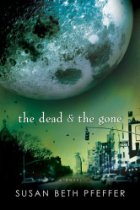
Book Review: The Dead and the Gone by Susan Beth Pfeffer (Series, #2)
 Summary:
Seventeen-year-old Alex Morales works hard with his eyes on a good college. He even works in a local pizza joint to pay for his own private Catholic school uniforms to help his Mami and Papi. Papi is in Puerto Rico for his mother’s funeral and Mami is working late when an asteroid strikes the moon and everything changes. New York City is struck by flooding and loss of infrastructure. Alex is left alone to care for his two younger sisters, Julie and Briana, and slowly he begins to think that maybe things will always be this bad. Maybe Mami and Papi will never come back, the moon will never look right again, and there will never be a world where he can go to college and not be left caring for his little sisters.
Review:
I inhaled the first book in this series, in spite of the scientific flaws (which I addressed in my review of the first book). Miranda’s journal ends so abruptly that I was eager to get to the next book right away. I was surprised, then, when the second book starts back before the moon is struck with an entirely different family in a different area of the country. This book shows Pfeffer’s abilities as a writer by showing the same apocalyptic event seen in the first book from the perspective of an entirely different family.
Miranda’s family is suburban-rural, agnostic/atheist humanist, blended (divorced parents with one remarried), and white. Alex’s family is urban (NYC), Latino, and devotedly Catholic. Both families are given room to have strengths and flaws, most of which have nothing to do with where they live, their ethnicities, or their religions (or lack of one). I honestly was startled to see Alex and his and his sisters’ strong faith treated with such respect in this book after Miranda’s lack of faith was treated with equal respect in the first. It’s easy, particularly in a book written as a journal, to mistake a character’s beliefs for an author’s, and Miranda, a teenage girl, has very strong beliefs. This book reminded me that those beliefs were just Miranda’s, just as Alex’s beliefs are just his, and it shows how well Pfeffer is able to write characters.
Some readers may find it odd and frustrating to go back in time to relive the apocalypse over again with different characters. I personally enjoyed it, because the world falling apart is one of the best parts of post-apocalyptic fiction for me. I also liked having the opportunity to see differences in how the apocalypse plays out based both on the location (suburban/rural versus urban) and the characters’ personalities and reactions. However, that said, I can see how this set-up of two vastly different sets of characters in books one and two could be off-putting to certain readers. Some religious readers may be turned off by the first book and Miranda’s staunch atheism. Those who read the first book and enjoy it for precisely that reason may similarly be turned off by the second book’s heavy Catholicism and faith. The diversity is a good thing but it also makes it hard to pinpoint an audience for the series. Those who are open to and accepting of other belief systems would ultimately be the best match but that’s a demographic that can sometimes be difficult to find or market to. However, if a reader is particularly looking for a diverse set of viewpoints of the apocalypse that is more than just characters’ appearances, this series will be a great match for them.
It should also be mentioned that this book is not a journal. It is told in third person, from Alex’s viewpoint, although the dates are still mentioned. It makes sense to do it this way, since Alex definitely does not come across as a character with the time or the inclination to keep a journal. It would have been interesting to view the apocalypse from the viewpoint of a boy who did keep a journal, however.
The plot makes sense and brings in enough danger without being overly ridiculous. It would have been nice to have maybe started the book just a bit earlier in the week to see more of Alex’s day-to-day life before the disaster. Instead, we learn about it through flashbacks, which makes it a bit harder to get to know him than it was to get to know Miranda.
Overall, this is a surprising and enjoyable second book in this post-apocalyptic series that lets readers relive the apocalypse from the first book over again with a different set of characters. This approach lends diversity to the series, as well as bringing in a greater variety of scenarios for those who enjoy the apocalypse process. Recommended to those looking for a diverse presentation of beliefs and how those impact how characters deal with an apocalypse.
If you found this review helpful, please consider tipping me on ko-fi, checking out my digital items available in my ko-fi shop, buying one of my publications, or using one of my referral/coupon codes. Thank you for your support!
4 out of 5 stars
Length: 341 pages – average but on the longer side
Source: Library
Previous Books in Series:
Life As We Knew It
Book Review: Life As We Knew It by Susan Beth Pfeffer (Series, #1) (Bottom of TBR Pile Challenge)
 Summary:
Miranda’s journal starts out like any other teenage girl’s diary. Worries about school, her after-curricular activities, and wondering how her family will work out with her dad having a brand-new baby with his new wife. But when a meteor strikes the moon things start to change. Slowly at first but with ever-increasing speed. Tsunamis wipe out the coasts. Volcanoes erupt. And soon Miranda finds herself, her mother, and her two brothers struggling to survive in a world that increasingly bares no resemblance to the one she once knew.
Review:
I’m a sucker for journal entry books, even though I know rationally that no diary ever has as much content and exposition as is contained in these fictional works. In addition to the journal format, I liked the premise for the dystopian world Miranda finds herself in. It’s very different from a lot of the other ones out there, since it’s 100% gradual natural disaster. This book lives up to the expectations set by its summary, offering a fun journal entry take on a natural disaster that turns into a dystopia.
Miranda, who lives in semi-suburban Pennsylvania, starts out the journal as a very average teenage girl, adapting to her parents’ divorce and father’s subsequent re-marriage, her older brother being away for his first year of college, and hoping to convince her mother to let her take up ice skating again. The book clearly yet subtly shows her development from this young, carefree teenager through angst and denial and selfishness in the face of the disaster to finally being a young woman willing to make sacrifices for her family. Miranda is written quite three-dimensionally. She neither handles the disaster perfectly nor acts too young for her age. While she sometimes is mature and sees the bigger picture at other times she simply wants her own room and doesn’t understand why she can’t have that. Pfeffer eloquently shows how the changes force Miranda to grow up quickly, and this is neither demonized nor elevated on a pedestal. Miranda’s character development is the best part of the book, whether the reader likes her the best at the beginning, middle or end, it’s still fascinating to read and watch.
Miranda also doesn’t have the perfect family or the perfect parents, which is nice to see a piece of young adult literature. Her parents try, but they make a lot of mistakes. Miranda’s mother becomes so pessimistic about everything that she starts to hone in on the idea of only one of them surviving, being therefore tougher on Miranda and her older brother than on the youngest one. Miranda’s father chooses to leave with his new wife to go find her parents, a decision that is perhaps understandable but still feels like total abandonment to Miranda. Since Miranda is the middle child, she also has a lot of conflict between being not the youngest and so sheltered from as much as possible and also not the oldest so not treated as a semi-equal by her mother like her oldest brother is. This imperfect family will be relatable to many readers.
Miranda’s mother is staunchly atheist/agnostic/humanist and liberal, and this seeps into Miranda’s journal. For those looking for a non-religious take on disaster to give to a non-religious reader or a religious reader looking for another perspective on how to handle disasters, this is a wonderful addition to the YA dystopian set. However, if a reader has the potential to be offended by a disaster without any reliance on god or liberal leanings spelled out in the text, they may want to look elsewhere.
I know much more about medical science than Earth science or astronomy, but I will say that when I was reading this book, the science of it seemed a bit ridiculous. An asteroid knocks the moon out of orbit (maybe) so the tides rise (that makes sense) and magma gets pulled out of the Earth causing volcanoes and volcanic ash leading to temperature drops Earth-wide (whaaaat). So I looked it up, and according to astronomers, an asteroid is too small to hit the moon out of orbit. If it was large enough to, it would destroy the moon in the process. Even if for some reason scientists were wrong and the moon could be knocked out of orbit, even in that scenario, the only thing that would happen would be the tides would be higher. (source 1, source 2) I know dystopian lit is entirely what if scenarios, but I do generally prefer them to be based a bit more strongly in science. I would recommend that reading this book thus be accompanied by some non-fiction reading on astronomy and volcanology. At the very least, it’s good to know that you can safely tell young readers that this most likely would not happen precisely this way, and this book is a great opening dialogue on disasters and disaster preparedness.
Overall, this is a fun take on the dystopian YA genre, featuring the journal of the protagonist and dystopia caused primarily by nature rather than humans. Potential readers should be aware that the science of this disaster is a bit shaky. The story featuring an agnostic humanist post-divorce family makes it a welcome diversifying addition to this area of YA lit.
If you found this review helpful, please consider tipping me on ko-fi, checking out my digital items available in my ko-fi shop, buying one of my publications, or using one of my referral/coupon codes. Thank you for your support!
4 out of 5 stars
Length: 337 pages – average but on the longer side
Source: PaperBackSwap
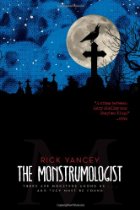
Series Review: The Monstrumologist Series by Rick Yancey
Introduction:
I post series reviews after completing reading an entire series of books. It gives me a chance to reflect on and analyze the series as a whole. These series reviews are designed to also be useful for people who: A) have read the series too and would like to read other thoughts on it or discuss it with others OR B) have not read the series yet but would like a full idea of what the series is like, including possible spoilers, prior to reading it themselves or buying it for another. Please be aware that series reviews necessarily contain some spoilers.
 Summary:
A nursing home contacts a researcher. An elderly man has passed away. He identified himself to them as Will Henry, but they can’t find any record of him or living relatives. He left behind four folios, telling what he claimed to be his life story. The first folio begins when his parents die in a fire, and he is left in the care of his father’s employer, Dr. Warthrop. In the 1800s. Over 100 years ago. And Dr. Warthrop is a Monstrumologist. He specializes in the study of aberrant biology, or monsters. And Will is now his apprentice. The first thing Dr. Warthrop tells Will is that Will Henry contracted a parasite from his father. Normally deadly, he is mysteriously a safe host. The parasite will make him abnormally long-living, and any contact that is too close will make him pass it along to another.
What follows over the course of the folios is the tale of the monsters Will Henry faced alongside and because of Dr. Warthrop. The anthropophagi–headless creatures with mouths in their stomachs. The wendigo–similar to a werewolf. The Typheus Magnificum–the Holy Grail of Monstrumology that may or may not exist. And finally the Titanoboa Cerrejonensis–a giant snake. There are these monsters, yes. But there are also the questionable choices and personalities of the various Monstrumologists, and the slowly unwinding monster inside a boy who has seen too much and been loved too little.
The question left for the researcher is how can Will Henry continue along an increasingly dark path when all signs indicate he eventually happily married his childhood sweetheart? And are these ramblings true or just the fairy tale of an elderly man?
Monsters and madness encircle Will Henry, Dr. Warthrop, the researcher, and the reader as the folios slowly reveal all.
 Review:
There is a lot going for this series that makes it unique and highly recommendable, particularly among its competitors in YA.
It’s horror based in the realms of science and the grotesque. Wanton blood and guts, serial killers, etc… won’t be found but it also doesn’t shy away from bits of the criminal underworld or real bodily danger. Will Henry loses a finger at one point. The monsters are real and frequently either eat people or turn people themselves into monsters. It combines to elicit horror in the reader in the tradition of Frankenstein. It’s perfect for readers who shy away from slashers or crime novels but still want a dash of terror.
In lieu of a romance, the relationship at the center of the series is between Will and his guardian, Dr. Warthrop. Yes, the series repeats the common YA trope of an orphan, thereby getting rid of the parents, but just because there are no parents doesn’t mean that there’s no guardian/young person conflict. In fact, I think that having the conflict be between Will and a, to him, incomprehensible older guardian allows for a more free exploration of the difficulties that can arise in this relationship. The fact that Dr. Warthrop is not his father means that Yancey is freer to quickly move into the mixed emotions and misunderstandings that can so easily happen in this type of relationship. Dr. Warthrop has many flaws as a guardian, but he does truly love and care for Will. Will at first feels lost and no connection with Dr. Warthrop, then he grows to love him in spite of his flaws, then he slowly starts to loathe him. Whether or not this loathing is warranted is left up to the reader to decide, and I do think that Yancey succeeds at making it a gray area that each reader will reach a different conclusion on. This relationship gets just as much, if not more, time as the monsters, and it’s one of the things that makes the series worth reading.
 Yancey isn’t afraid to not just use, but embrace poetic language and literary allusions. I was truly stunned at the beauty of the language when reading the first book, and that beauty continues throughout the series. It’s like reading an old, Gothic novel, setting the perfect tone for the world building. A YA reader who perhaps hadn’t previously experienced narration like this might after reading it be inclined to seek out similar writing, thus finding some classics. And even if they don’t, it’s a wonderful change of pace for YA.
Setting the story of Will and Dr. Warthrop in the context of the mystery of the modern elderly man, his folios, and the researcher looking into them lends an extra layer to the story that increases its complexity. The researcher is just as curious as the reader to find out more. He also provides some necessary historical facts and questions the veracity of some of Will Henry’s statements. Throughout the series, the researcher is wondering if this actually happened or if it’s all just the imaginings of an elderly man. The ultimate reveal still leaves this a bit of a mystery, letting the reader decide for themselves what they would prefer to be the answer.
The strength of the monsters varies throughout the series. Some are perfectly crafted, such as the anthropophagi. Others can be a bit less frightening or too predictable to be as engaging. This definitely lends to an uneven pace of suspense in the series and could be disappointing to a reader who is more invested in monsters than in the character development.
 The ending. The ending must be discussed. *spoiler warning* Will Henry in the last book has turned into a dark, lawless, desperate character. He has been changed by what he has seen. His childhood sweetheart, Lily Bates, finds him frightening and lacking in morals. He blames Dr. Warthrop for all of his issues. While Dr. Warthrop definitely is at fault for not treating Will Henry like an adult and keeping him in the loop for his schemes, Dr. Warthrop also never taught Will to be so cold, desperate, or that it’s ok to wantonly kill. Will ultimately goes on an opiate and sex binge in a prostitution house. Dr. Warthrop finds him and pulls him out, in an attempt to save him. It is then that Willl finds out that the parasites he is infected with will spread with sexual intercourse and kill his partner in a truly grotesque manner, eating them from the inside out. Will gives up on Dr. Warthrop and all relationships and proceeds to travel the world aimlessly. The researcher ultimately discovers that Will later runs into Lily with her new husband. It is then that he reveals that Lily’s husband’s name was Will Henry, and he stole it as a pseudonym for these stories. So he never married Lily. Was never happy. He is now nameless. It’s an incredibly dark ending that leaves the researcher, and the reader, reeling. It was honestly a bit too hopeless for me. It felt as if Yancey was saying Will got sucked down into the monsters in his soul and could find no escape. I prefer to have a bit more hope in the world than that, particularly after spending four books with a character and growing to care for them. *end spoilers*
While I can still appreciate what Yancey was doing and what he was going for–a truly dark book–I feel that any potential readers or gift givers should be aware that it starts dark, gets darker, and there is no light at the end of the tunnel.
There is also a bit of a dearth of female characters in the series. In the two middle books, we get brief exposures to Dr. Warthrop’s old sweetheart and Lily Bates. That’s pretty much it. I’m ok with that, since much of the time is devoted to Will Henry and Dr. Warthrop. I also understand that the time period in which it is set definitely would not have had a female monstrumologist. I think Yancey tries to make up for this by having Lily be determined to be the first female monstrumologist, but I also think he steps back from this plotline in the final book, which disappointed me a bit. Essentially, be aware that if you’re looking for a strong female presence in the plot of your series, look elsewhere.
Overall, this is a unique series that deserves to be in any YA collection. It address young adult/guardian relationships in the rich wrapping of Gothic style horror narrated with a beautiful poetic language. Its historical setting and focus on the boy and his guardian doesn’t lend itself to a strong female presence in the series, although the female characters that do exist are good ones. Its darkness increases throughout the series, so don’t come into this expecting a happy ending. I’m pleased I took the time to read the entire series, and could see reading it again. Recommended to both YA fans looking for something different and Gothic horror fans who don’t normally do YA.
4.5 out of 5 stars
Source: Gift, Audible, and Amazon
Books in Series:
The Monstrumologist
The Curse of the Wendigo
The Isle of Blood
The Final Descent
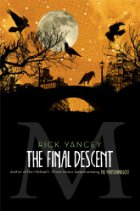
Book Review: The Final Descent by Rick Yancey (Series, #4)
Summary:
The man investigating the folios found with an elderly man who claimed to be over a hundred years old and named Will Henry has reached the final folio containing what this elderly man claimed to have been his life story. The final folio is discombobulated and poetic, and so the investigator arranges it for us to read following the style of Dante’s Inferno. And what a story it tells.
Will Henry is now a bitter, cold teenager still serving Dr. Warthrop. When a man shows up at the door claiming to have a previously thought extinct monstrous snake’s egg for sale, Will Henry takes the acquisition into his own hands. When they bring the egg to New York City for the annual meeting of Monstrumologists, Dr. Warthrop begins to question Will Henry’s loyalty, and Will Henry increasingly ignores all advice, going off on his own bloody ideas. What direction will Will Henry’s and Dr. Warthrop’s lives ultimately take?
Review:
There were hints throughout the Monstrumologist series that it was going to continually descend to a dark place. But I must admit I was slightly fooled by the idea put forth multiple times that Will Henry at least for part of his life is happily married. I thought there would be a glimmer of hope in the ending. Boy was I wrong. This is an incredibly dark book, and a series ending that surprised me. While still a strong read, it didn’t hold all the all-encompassing power and grotesque beauty I found in the first two entries in the series.
Yancey takes the poetic language found in the first three books and kicks it up a notch with the inclusion of the Dante-styled method for dividing the book into sections. Beyond that, the language itself becomes increasingly poetic. One line that is repeated a few times throughout the book is:
Time is a line. But we are circles. (page 4)
I found both the structure and the language interesting and gorgeous, and I really appreciate their inclusion in YA literature. I can imagine that many of the younger readers of the book might never have read Dante and seeing this structure in this book might spur them on to check it out. One thing that I’ve enjoyed throughout the series is that Yancey doesn’t shy away from challenging YA readers, and I’m glad to see that continued here.
The monster in this story is delightfully terrifying. An egg that hatches a snake that eats its prey from the inside out? There’s nothing not terrifying about that. Plus the monster is revealed early on, a nice change of pace from The Isle of Blood
The plot is quite complex, and yet also makes sense when various aspects of it are revealed. It also manages to still be fresh, even though The Curse of the Wendigo
The book spends a lot of time wondering both what makes a monster and if madness can be avoided or escaped. The first is a question addressed earlier in the series, and I think Yancey deals with it eloquently. The second takes quite a dark turn in this book, and I was left feeling empty, hopeless, and saddened.
Madness is a wholly human malady borne in a brain too evolved—or not quite evolved enough—to bear the awful burden of its own existence. (page 170)
It’s certainly valid to view madness as an inescapable pariah for some. I suppose I just have more hope for the world than that. That’s what left me disappointed with the ending. I wanted more hope. Other readers might be less bothered by the tragic end.
Overall, this is a strong final entry in the acclaimed Monstrumologist series. The poetic language is beefed up with a Dante style structure, and the plot is complex, following the ultimate impact on Will Henry of growing up as Dr. Warthrop’s apprentice in Monstrumology. Some readers may be disappointed or overly saddened by the ending lacking a glimmer of hope but others will enjoy its incredibly dark turn. Readers of the previous three books should not miss this one.
4 out of 5 stars
Source: Amazon
Previous Books in Series:
The Monstrumologist
The Curse of the Wendigo
The Isle of Blood
Book Review: Initiate by Tara Maya (Series, #1)
 Summary:
Dindi is about to undergo her people’s initiation test and ceremony that not only welcomes her to adulthood but also will determine whether or not she is a member of the Tavaedi. The Tavaedi are a mix of religious leader, healer, and warrior who cast magic spells by dancing. Since Dindi can see the pixies and other fae, she thinks she has a chance. But no one in her clan has ever successfully become a Tavaedi. Meanwhile, an exiled warrior, Kavio, is attempting to shed his old life and the haunting of his father’s wars and his mother’s powers. But he slowly discovers a deadly plot that brings him directly to Dindi’s initiation ceremony.
Review:
It takes something special for me to pick up either a YA or a fantasy book, and this one is both. But Jessica’s review over on The Bookworm Chronicles had me intrigued. A fantasy series based on Polynesian tales and traditions is unique in fantasy. Plus the idea of magic from dancing really appealed to the dancer in me (years of tap and jazz, also many lessons in ballroom, zumba, etc…). When I found out the first book in the series is free on the Kindle, I had to try it out, and I’m glad I did! I really enjoyed the book, and its presence highlights many of the strengths of indie publishing.
The world is richly imagined and well described. The tribes and clans have clearly defined and described cultures that vary from stable farming to warrior to cannibal. The structure of the societies make sense and are rich without being overly detailed. I particularly appreciated that this is a tribal culture fantasy without ever claiming to be the real or imagined history of any known to exist (or to have existed) tribe. It is inspired by Polynesian culture but it is still a fantasy, similar to how medieval fantasy is inspired by the real Middle Ages but never claims to be what happened. This lends itself to rich world building without ever venturing off into ridiculous “historical” fiction.
The plot slowly builds Dindi’s story and Kavio’s story, gradually bringing them together. This is good since Dindi is still young enough that she doesn’t see much of the intrigue going on around her. Dindi’s perspective shows us the day-to-day existence of people in this world, whereas Kavio shows us the higher-ranking intrigue. It didn’t bother me that Dindi starts out a bit innocent because it is clear she will grow in knowledge with time. Meanwhile, bringing in Kavio’s perspective helps establish the world for the reader. There were also enough smaller clashes and twists that I never felt that I knew precisely what was going to happen next.
Although the characters at first seem two-dimensional, they truly are not. Everyone is more than what immediately meets the eye, and I liked that this lesson occurs repeatedly. It’s a good thing to see in YA lit. Dindi is strong, kind, and talented, but she still has her flaws. She is good but she’s not perfect, which makes her a good main character. I also appreciate that what will clearly be a romance eventually between Kavio and Dindi starts out so slowly with longing glances from afar. It’s nice that Dindi and Kavio get a chance to be established as individuals prior to meeting each other, plus the slowly building romance is a nice change of pace for YA lit.
Sometimes the chapter transitions were a bit abrupt or left me a bit lost. With changing perspectives like this, it would be helpful if the chapter titles were a bit less artistic and gave a bit more setting. It’s nice that when perspective changes the cue of the character’s name is given, no matter where it happens, but a bit more than that would be nice at the chapter beginnings. Similarly in scene changes, the break is three pound signs. I think using a bunch of centered tildes or even a customized drawing, such as of pixies, would be nicer. At first when I saw these I thought there was some coding error in the ebook. There also are a few editing mistakes that should not have made it through the final edit, such as saying “suffercate” for suffocate (page 144). As an indie author myself, I know it is incredibly difficult to edit your own book, so I give a pass to minor typos and things like that. However, the entirely wrong word for what the author is trying to say should be fixed. There were few enough that I still enjoyed the book, but I hope that there are less in the future installments of the series.
Overall, this is a unique piece of YA fantasy set in a tribal world inspired by Polynesia. The romance is light and slow-building, and the focus is primarily on growing up and becoming an adult. A few minor formatting and editing issues detract from it being a perfect escape read, but it is still highly enjoyable. I intend to read more of the series, and I recommend it to fantasy and YA fans alike.
4 out of 5 stars
Source: Amazon
Buy It
Note: the Kindle edition is free

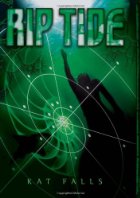
Book Review: Rip Tide by Kat Falls (Series, #2) (Audiobook narrated by Keith Nobbs)
 Summary:
Ty lives with his pioneer family subsea but he can’t convince his crush Gemma to leave Topside. Why is she so afraid of subsea? This was his biggest problem until his parents get kidnapped by surfs when they attempt to do a trade. Plus, Gemma wants to convince her fugitive brother to let her tag along with him. And townships keep disappearing, only to turn up later, chained up and anchored subsea with everyone dead inside. It’s a giant web of mysteries but do they intertwine at all?
Review:
I absolutely loved the first entry in this scifi series, which is unusual for me, since it’s YA. Not generally my genre. So I was excited to see the sequel available on Audible. It’s still an exciting adventure and interesting world but not quite as tightly and expertly constructed as last time.
Whereas Ty’s voice worked perfectly in the first book, in this one he reads a bit young. He went through a lot in the first entry, he should have presumably matured a bit more than he has. Similarly, Gemma hasn’t developed much since the first book either. I think these characters should have been given more space to grow more. Particularly in a YA series, it’s important to let the characters develop and mature at a more rapid rate. That’s the reality for teenagers after all.
Plot-wise, I honestly felt that there was a bit of a deus ex machina at work that also didn’t fully play into the rules of the world as originally set up. Still, though, the mystery is well-plotted and difficult to predict. It includes real danger without being too violent. It’s the perfect level of thriller for a YA reader who’s not so into the gore. On the other hand, I also found it frustrating that Ty’s parents aren’t around for most of the book. One of the things refreshing about the first one was that his parents were actually present and helpful without being too pushy or overshadowing. This time around, Falls went the more popular YA adventure route and just flat-out got rid of them for most of the book.
But the world Falls has built is still rich and unique, and she expanded upon it. We now get to see more of what the surf life is like, in addition to more of the shady side of things, such as the boxing/fighting rings. We also see some more of the government and law enforcement and have a better understanding of the world as a whole. It’s all richly imagined and drawn, right down to what styles of clothes different groups wear to what they eat. One detail I particularly enjoyed was that the surfs, a poor outcast lot, eat a lot of fish and blubber because it’s easy to catch, whereas Ty’s family eats a lot of vegetables because they grow them. Details like that really make a world.
The audiobook narrator, Keith Nobbs, read the whole thing a bit flat for my taste. He didn’t have as much enthusiasm and inflection as I thought was appropriate for a book about a subsea adventure starring two young teenagers! The production quality was high, he was easy to understand, but he didn’t really bring Ty to life. I’d recommend reading the print book over the audio, honestly.
Overall, then, the characters are a bit slow in their development and the plot feels a bit lazier than last time, but the characters are still well-rounded and the plot maintains an appropriate level of mystery. Toss in the richly imagined and describe post-apocalyptic and very wet world, and it’s well worth the read.
4 out of 5 stars
Source: Audible

 ,
, Book Review: The Isle of Blood by Rick Yancey (Audiobook narrated by Steven Boyer) (Series, #3)
Summary:
Will Henry states that this is a story that Dr. Warthrop did not want told…and proceeds to tell it anyway. When a British man shows up with a package being delivered under duress, Dr. Warthrop is ecstatic to realize it is the nest of the Magnificum–the holy grail of monstrumology. Dr. Warthrop decides to leave Will Henry in New York while he pursues this beast. But when his monstrumologist companion returns claiming that Warthrop is dead, Will Henry and two fellow monstrumologists travel to Europe to track him–or his body–down.
Review:
Not as engaging or thought-provoking as the first two books in the series, I can only hope that this third entry is suffering from the common penultimate book malady where the book which must set everything up for the finale of the series can sometimes drag.
There are two problems in this entry that make it fail to be as engaging or thrilling as the first two books. First, Will Henry is left behind in New York for a significant portion of the novel. We are thus left with a whiny teenager bemoaning Warthrop’s choice to be responsible for once and keep him out of danger. We also are left with very little action for far too large a portion of the book. The second issue is perhaps a bit of a spoiler but suffice to say that the monster is disappointing and its disappointment is easily predicted. If we had a lot of action with a disappointing monster, that’s still engaging. If we had less excitement with a surprising, phenomenal monster, that’s still thrilling. The combination of the two, though, prevents this thriller from being as thrilling and engaging as it should be.
Of course there are other elements that still worked, which is why I kept reading it. Yancey’s writing is, as ever, beautiful to read (or listen to) and contains much depth.
“So many times we express our fear as anger…, and now I think I wasn’t angry at all, but afraid. Terribly, terribly afraid.”
The settings are unique, and the characters are strong and leap off of the pages. Will Henry becomes more fully fleshed-out in this entry as we start to see his descent into a love affair with monstrumology. We also get to see Warthrop at what he himself perceives of as his lowest point. It’s a dark bit of characterization but it works very well for the story Yancey is telling.
Overall, I was a bit disappointed, purely because the first two entries in the series were so phenomenal. The third book is still a very good book. Fans might be a bit disappointed, depending on how attached they are to the unique thriller aspect of the series, but the characters and writing still make this well worth the time. Fans will remain in eager anticipation of the final entry in the series.
4 out of 5 stars
Source: Audible

Previous Books in Series
The Monstrumologist
The Curse of the Wendigo
 Support my work with a tip or browse my shop for curated book club guides, how to guides, cross-stitch patterns, and more!


This work by Amanda Nevius is licensed under a Creative Commons Attribution-Noncommercial-No Derivative Works 3.0 United States License.
 Opinions of a Wolf