
Archive
Book Review: My Body Is Not a Prayer Request: Disability Justice in the Church by Amy Kenny

A disabled Christian woman shares her experiences with ableism in the church and offers solutions and actionable steps for fostering disability justice and inclusion.
Summary:
Much of the church has forgotten that we worship a disabled God whose wounds survived resurrection, says Amy Kenny. It is time for the church to start treating disabled people as full members of the body of Christ who have much more to offer than a miraculous cure narrative and to learn from their embodied experiences. Written by a disabled Christian, this book shows that the church is missing out on the prophetic witness and blessing of disability. Kenny reflects on her experiences inside the church to expose unintentional ableism and cast a new vision for Christian communities to engage disability justice. She shows that until we cultivate church spaces where people with disabilities can fully belong, flourish, and lead, we are not valuing the diverse members of the body of Christ. Offering a unique blend of personal storytelling, fresh and compelling writing, biblical exegesis, and practical application, this book invites listeners to participate in disability justice and create a more inclusive community in church and parachurch spaces. Engaging content such as reflection questions and top-ten lists are included.
Review:
Intertwining memoir, Biblical commentary, and disability justice scholarship, the author explores disability within the US American Christian church.I picked this book up as research for the second book in my closed-door paranormal romance series, which uses werewolfism as a metaphor for disability (look for it this year!). You can grab the first book on Amazon, Bookshop.org, or other retailers, or request an advanced copy of the sequel.
The book is organized into ten chapters—seven of which start with the title “disability” and three with “disabled.” Each chapter begins with a memoir vignette and delves into the theme of the chapter. One chapter I particularly resonated with is “Disability Blessings.” It opens with the author singing a pop song during a medical procedure, before discussing the societal pressure to “fix” disabled bodies rather than support them. She then brings the conversation to the Bible, exploring the story of Jacob, who becomes disabled after wrestling with God. This disability, Kenny argues, is a sign of blessing, not something to be eradicated.
Faith, then looks like wrestling–all night long–and emerging with a healing limp….I treasure this image, because it allows me to envision my limp as part of my healing instead of something that must be cured or killed off in hopes of inspiring nondisabled people. (page 51)
She ends each chapter with bullet-point listed calls to action for disability justice. For example, in this chapter, the reader is invited to re-explore disability narratives in the Bible and view them through a lens of celebrating disabled people. After this, she features a “top ten” list of things people have actually said to her as a disabled person with each chapter on a theme. The theme of this chapter is “I know how you feel,” with the message being, of course, no one really knows how anyone else actually feels to live in their body.
The themes of the rest of the chapters are curatives, discrimination, doubters, justice, mosquitoes, lessons, disabled foundations, disabled God, and disabled church. The most controversial seems to be that of disabled God, but I found it rather inspiring. For example, the resurrected Christ, God incarnate, has the marks of the nails on his hands and a hole in his side. He invites Thomas to touch these places. Jesus was not resurrected with a “perfect” body, so why is there so much pressure on disabled Christians to “faith their way” to one?
Sometimes the author’s writing challenged me, but I viewed it as an invitation to sit with the discomfort. Why was what the author was saying making me uncomfortable? Was it really how she was saying it or was it just an entirely new perspective being brought to me? For example, I didn’t like that she didn’t disclose exactly what condition she has. But I sat with that and wondered why I felt the right to know?
As someone who is writing about disability through metaphor myself, this book encouraged me to consider my character viewing his werewolfism as a blessing, not a curse. Of course, there is nuance to this. For example, Kenny points out that of course she would prefer to not be in pain. But it’s possible to both dislike the negatives of a disability while also seeing the blessings that come with it. This is a perspective I’m striving to bring to my own book.
Overall, this is an interesting mix of memoir, Christian exegesis, and disability justice. Recommended to Christian readers looking to become better disability justice advocates and disability justice advocates looking to understand the Christian perspective.
If you found this review helpful, please consider tipping me on ko-fi, checking out my digital items available in my ko-fi shop, buying one of my publications, using one of my referral/coupon codes, or signing up for my free microfiction monthly newsletter. Thank you for your support!
4 out of 5 stars
Length: 208 pages – average but on the shorter side
Source: Library
Buy It (Amazon or Bookshop.org)
Book Review: Monsterland: Encounters with UFOS, Bigfoot, and Orange Orbs by Ronny Le Blanc

Explore the Bigfoot sightings, UFO encounters, and mysterious phenomena of Leominster, Massachusetts—dubbed ‘Monsterland’—through the eyes of author and researcher Ronny Le Blanc.
Summary:
There is an area known to the locals of Leominster, Massachusetts as MONSTERLAND. There are sightings of UFOS, Bigfoot and Orange Orbs. They have been coming and going for years. But where are they coming from? Why are they here? It seems that the state of Massachusetts has had a long history of sightings and encounters with these mysterious entities and they are occurring in the present day. Could all of these events somehow be connected? What is so special about Leominster that they have plagued the area for so long? Author and Researcher Ronny Le Blanc of Leominster thinks that he might have the answers to some of these questions. But the answers received lead to a whole new understanding of the unknown…. Welcome to MONSTERLAND.
Review:
Believe it or not, I picked up Monsterland as research for the second book in my paranormal romance series (Get the first book here). Paranormal romance thrives on supernatural creatures, and I wanted to infuse more local flavor by diving into the biggest tall tales of the area. Ronny Le Blanc is something of a local celebrity here in Massachusetts. While reading this at a coffee shop, people literally pointed and said, “Is that Monsterland?!” with wide eyes. I don’t share Ronny’s true believer status, but I do approach these topics with an open mind.
Ronny grew up in Leominster and opens the book with his own childhood encounter with Bigfoot in the Leominster State Forest. This personal connection sets a relatable tone and serves as a thread he frequently returns to. From there, he dives into local legends, including those rooted in the histories of the Nipmuc – the people Indigenous to the area.
One of the most interesting parts of the book is Ronny’s breakdown of commonalities in Bigfoot sightings. He highlights recurring details: the eerie silence of wildlife right before a sighting, tracks appearing and vanishing mysteriously (sometimes even under rocks), and witnesses reporting immobilization, intense fear, and disorientation. According to Ronny, these phenomena are a defense mechanism of Bigfoot—which, he argues, explains the lack of high-quality footage. (Although he also talks about a Canadian man who’s allegedly been consistently communicating with Bigfeet on YouTube.)
The book takes a turn into the mysterious world of orange orbs. Admittedly, these chapters dragged for me, but they’re crucial to Ronny’s overarching theory: Bigfoot are not mere animals—they’re aliens or interdimensional beings. The orange orbs, he believes, represent an intermediary phase of Bigfoot, explaining the disappearing footprints. He also connects this idea to Choctaw and Yaqui cultural beliefs about spirit beings and orbs.
At one point, Ronny recounts speaking aloud to Bigfoot, asking for proof in the form of a marble—and later finding one inexplicably placed in the middle of his home.
My favorite chapters were the tighter, more focused ones. Some of the longer sections could have benefited from more editing to maintain pacing and clarity. That said, there’s something undeniably special about reading folklore rooted in places I know so well. Ronny does an excellent job drawing connections between stories and theories.
However, I noticed a slight anti-yeti bias—Ronny briefly mentions them as the “least intelligent” of Bigfoot species and then essentially drops the subject. I also think the book would have been stronger with an Indigenous co-author for the chapters exploring Native folklore.
Overall, this is an enjoyable read for both cryptid enthusiasts and open-minded skeptics. Ronny’s storytelling style is engaging, and the included photos add a nice visual layer to the experience. If you’re curious about Massachusetts’s Bigfoot sightings, UFO lore, and the unique believer culture of Leominster, this one’s worth picking up.
If you found this review helpful, please consider tipping me on ko-fi, checking out my digital items available in my ko-fi shop, buying one of my publications, using one of my referral/coupon codes, or signing up for my free microfiction monthly newsletter. Thank you for your support!
4 out of 5 stars
Length: 275 pages – average but on the shorter side
Source: Library
Buy It (Amazon or Bookshop.org)
Book Review: How Far the Light Reaches: A Life in Ten Sea Creatures by Sabrina Imbler

A powerful blend of memoir and marine biology exploring environmentalism, queer theory, and biracial identity through the lens of deep-sea creatures and personal reflection.
Summary:
A queer, mixed race writer working in a largely white, male field, science and conservation journalist Sabrina Imbler has always been drawn to the mystery of life in the sea, and particularly to creatures living in hostile or remote environments. Each essay in their debut collection profiles one such creature: the mother octopus who starves herself while watching over her eggs, the Chinese sturgeon whose migration route has been decimated by pollution and dams, the bizarre Bobbitt worm (named after Lorena), and other uncanny creatures lurking in the deep ocean, far below where the light reaches. Imbler discovers that some of the most radical models of family, community, and care can be found in the sea, from gelatinous chains that are both individual organisms and colonies of clones to deep-sea crabs that have no need for the sun, nourished instead by the chemicals and heat throbbing from the core of the Earth. Exploring themes of adaptation, survival, sexuality, and care, and weaving the wonders of marine biology with stories of their own family, relationships, and coming of age, How Far the Light Reaches is a book that invites us to envision wilder, grander, and more abundant possibilities for the way we live.
Review:
A queer memoir intertwined with fascinating ocean facts? Yes, please! This is a beautifully written exploration where each chapter examines a unique sea creature and, surprisingly, connects it to the author’s own life.
I learned so much about marine biology in an easily digestible way, and here are three of my favorite facts:
- Octopuses die after spawning and starve themselves while incubating their eggs.
- Hydrothermal vents come and go across the ocean floor, creating temporary ecosystems.
- Selps, a type of jellyfish, move together, but at different speeds.
What really stood out to me, though, was Sabrina Imbler’s introspective and self-aware reflections on their life. As a white person, I was moved by how candid they were about their experiences of being biracial. I appreciated how they expressed that being mixed-race is an identity that doesn’t need to be “resolved”—“I am Chinese. I am white.” This honest exploration of their mixed-race identity resonated with me far more than their exploration of queerness, which, while meaningful, didn’t linger as strongly in my memory. If you’re drawn to memoirs that delve deeper into queer identity, check out my review of A Queer and Pleasant Danger.)
Please be aware that this book addresses the sensitive topics of racism, environmental injustice, and animal abuse. Sabrina also explores an instance of sexual violence they experienced as a youth, reflecting on how it shifted from being a “joke” to something they realized was deeply troubling.
I listened to the audiobook version, narrated by Sabrina themselves, which was stellar. Their narration felt like listening to a close friend, making the experience even more immersive.
Overall, this is an incredibly moving and educational memoir. It’s a unique blend of personal reflection and marine biology, offering readers a fresh way to explore the world. Highly recommended for those interested in memoirs with a scientific twist and a deep dive into the complexities of identity.e of the author’s favorite subjects – marine biology. Recommended to those interested in a unique storytelling method in a memoir, as well as those with a personal interest in marine biology.
If you found this review helpful, please consider tipping me on ko-fi, checking out my digital items available in my ko-fi shop, buying one of my publications, using one of my referral/coupon codes, or signing up for my free microfiction monthly newsletter. Thank you for your support!
5 out of 5 stars
Length: 263 pages – average but on the shorter side
Source: Library
Buy It (Amazon or Bookshop.org)
Book Review: Slacks and Calluses: Our Summer in a Bomber Factory by Constance Bowman Reid & Clara Marie Allen

Explore the world of women working on airplane factory lines in this memoir with hand-drawn illustrations from 1944.
Summary:
In 1943 two spirited young teachers decided to do their part for the war effort by spending their summer vacation working the swing shift on a B-24 production line at a San Diego bomber plant. Welding torches and climbing into bomb bays, they learned to use tools that they had never seen before, live with aluminum shavings in their hair, and get along with supervisors and coworkers from all walks of life.
They also learned that wearing their factory slacks on the street caused men to treat them in a way for which their “dignified schoolteacher-hood” hadn’t prepared them. At times charming, hilarious, and incredibly perceptive, Slacks and Calluses brings into focus an overlooked part of the war effort, one that forever changed the way the women were viewed in America.
Review:
I knew the instant I flipped this book open it would be a new favorite. Two teacher friends set out to help the war effort in WWII in their summer off and document it. Constance was a writer, and Clara Marie (fondly called C.M. in the book) was an artist. The book maintains an upbeat tone throughout, in spite of being written prior to the authors having any knowledge of how the war would turn out.
This is an easy read. It feels like chatting with a friend about their unique summer. It starts off with a brief description of their friends’ reactions to their plan for their summer. It then goes through the process of signing up and their first day on the line. Subsequent chapters talk about specific issues. For example, the time the factory tried to make all the women employees fully cover their hair. Or what it was like to commute in pants. C and C.M. were surprised to find how differently they were treated in public in pants.
The characters are memorable, even with the authors doing due diligence to anonymize real people. In From the foremen to women colleagues to men colleagues to the folks they encounter on their commute. Everyone feels real. Some are of course more well-rounded than others. (The foremen or “Red Buttons” are particularly flat.) But this simply adds to the realness of the memoir. Isn’t that how we all encounter people in our lives? With some developing into full-fledged members of our lives and others staying two-dimensional background characters.
The illustrations are utterly charming and are throughout the book.

The authors reflect on things like the fact that while they will be returning to school in the fall, others will be working on factory lines throughout their life. They also consider the impact the war is having on gender roles in society, although not in academic language. They simply discuss things like how more women are wearing pants and how men treat them when they do. In general, though, the women try to keep the tone light.
Overall, this is a compelling primary document in memoir form of the women on the factory lines in WWII. It’s interesting they had the foresight to realize this was an important moment in history. Immediately writing the book and finding a publisher. They were published in 1944. Their factory work was just the year before in 1943. An easy gift for any WWII aficionado. Also, check out my other reviews of books dealing with WWII.
If you found this review helpful, please consider tipping me on ko-fi, checking out my digital items available in my ko-fi shop, buying one of my publications, using one of my referral/coupon codes, or signing up for my free microfiction monthly newsletter. Thank you for your support!
5 out of 5 stars
Length: 200 pages – average but on the shorter side
Source: Gift
Buy It (Amazon or Bookshop.org)
Book Review: My Husband by Maud Ventura

The view of one week in a French woman’s marriage gradually demonstrates the obsession she displays for her husband.
Summary:
At forty years old, she has an enviable life: a successful career, stunning looks, a beautiful house in the suburbs, two healthy children, and most importantly, an ideal husband. After fifteen years together, she is still besotted with him. But she’s never quite sure that her passion is reciprocated. After all, would a truly infatuated man ever let go of his wife’s hand when they’re sitting on the couch together?
Determined to keep their relationship perfect, she meticulously prepares for every encounter they have, always taking care to make her actions seem effortless. She watches him attentively, charting every mistake and punishing him accordingly to help him improve. And she tests him–setting traps to make sure that he still loves her just as much as he did when they first met.
Until one day she realizes she may have gone too far . . .
Review:
This was listed as a “readers also enjoyed” book for Rouge by Mona Awad. The title drew me in right away, and the description had me intrigued. From the first chapter, I was drawn in by the narrator.
It is immediately apparent that not all is right with either the marriage or the wife narrator. She acts like she is young in love. In other words, she’s obsessed with him. She’s uncertain about his love for her. In spite of the fact that they’ve been together many years and have two children together. It’s exhausting just reading about how she overthinks every little move he makes. This also begs the question. Is she really in love with him? Or is it an obsession?
As time progresses, the reader becomes increasingly uncomfortable with the narrator’s behavior and starts to worry about the husband. This all comes to a head at the end of the book. The twist didn’t shock me per se. I suspected it might be where it was going. Unlike some readers, though, I wasn’t disappointed by it. I felt it made for a richer overall picture of the marriage. This review sums up the issues others have with the ending. (Be warned it does disclose the twist.)
This is a book in translation. It was originally written in French. It also won France’s First Novel Prize in 2021. While I don’t know much about translation, I thought that the translator, Emma Ramadan, did a phenomenal job. The narrator of the book is a translator herself and teaches English in a high school. There are a few passages all about the differences between French and English. I can only imagine what a challenge that was when you can’t deliver the original lines in French! It still worked, though, and I was able to get the narrator’s point.
In spite of this book being relatively short, it did take me a while to read. It wasn’t quite as engaging or forward-moving as a thriller typically is for me. That could be down to it being translated. It could have something to do with the scenes of infidelity. (Not a spoiler, this happens early.) I don’t enjoy reading about infidelity. It can sometimes even make me put a book down entirely. In this case, it slowed me down a bit.
Overall, this is a different thriller. A mix of an analysis of a relationship with what one might expect from a psychological thriller. It is decidedly French. The translation hold up well. Recommended to those with an interest in different psychological thrillers and/or in modern French literature.
If you found this review helpful, please consider tipping me on ko-fi, checking out my digital items available in my ko-fi shop, buying one of my publications, using one of my referral/coupon codes, or signing up for my free microfiction monthly newsletter. Thank you for your support!
4 out of 5 stars
Length: 272 pages – average but on the shorter side
Source: Library
Buy It (Amazon or Bookshop.org)
Book Review: Dead Weight: Essays on Hunger and Harm by Emmeline Clein

A woman in eating disorder recovery explores the world of eating disorders and treatment in the west through a pop culture lens.
Summary:
Emmeline Clein tells the story of her own disordered eating alongside, and through, other women from history, pop culture and the girls she’s known and loved. Tracing the medical and cultural history of anorexia, bulimia, binge eating disorder, and orthorexia, Clein investigates the economic conditions underpinning our eating disorder epidemic, and illuminates the ways racism and today’s feminism have been complicit in propping up the thin ideal. While examining Goop, Simone Weil, pro-anorexia blogs, and the flawed logic of our current treatment methods, Clein grapples with the myriad ways disordered eating has affected her own friendships and romantic relationships.
Review:
This collection of essays consisting of research intertwined with memoir was an engaging read. I particularly liked how Clein approached talking about the negative aspects of Big Pharma in a historical context. That wasn’t something I was expecting in this book, and it was well done. Expect to learn about how amphetamines were marketed as a weight loss drug post WWII because the manufacturers needed a new market now that soldiers were no longer using them to stay awake. Or about how it was Big Pharma who advocated for the labeling of obesity as a disease in the early 2000s (so insurance would pay for drugs to “treat” it.) Or about how the company that originally marketed amphetamines for ADHD was fined for “inappropriate marketing.” (For more about the impact of big pharma on our everyday lives, see my review of Drugs for Life.)
Another thing I appreciated as a person in recovery from addiction was how Clein analyzed addiction and eating disorders as systemic, rather than personal, issues.
The addiction model still requires that we understand ourselves as addicts, rather than see our culture, our food systems, and drug and diet companies as conspiring to encourage addictive patterns. When we believe we are sinners and criminals who deserve to be punished because we are out of control, we don’t demand change to any of the underlying structures that are actually out of our control, controlled by corporations. In it current iteration, the addiction model still makes us blame ourselves and then retrofit our stories into some fictional hero’s journey of abstinence and discipline over the compulsion to consume–stories rooted in the very values at the heart of anorexia and its hold on so many minds.
There were a few things that I did not like about the book, though.
First, her take on the intersection of Irritable Bowel Syndrome (IBS) and eating disorders is woefully short-sighted and lacking empathy for not only those with IBS but other chronic illnesses that the medical industry offers little to nothing for. (Strange for a book that takes down big pharma so aggressively.) Clein presents the opinion that IBs is essentially always second to developing an eating disorder. That IBS symptoms are the body’s natural response to being starved or facing binges. But EDs can be and are triggered by IBS. The fact is, for many people, an ED develops in response to suffering from IBS.
Second, her choice to exclude men from a book about ED is troubling. The overall thesis seems to be that a minuscule number of men have EDs so it’s not worth talking about. In fact, approximately 1/3 of those known to have an ED are men, and there is concern that EDs in men are underreported. Even if it was the case that very few men have EDs (which again, it is not), leaving them out of the book hurts the overall arguments about EDs.
Third, Clein does not talk at all about the interplay between EDs and OCD. This is a more glaring lapse given how much space is given to discussing depression, anxiety, and EDs.
Fourth, while drinking is mentioned repeatedly, drunkorexia is not discussed at all, nor is alcoholism, something which, again, often comes hand-in-hand with EDs and is even seen in vignettes in the book but not addressed.
Fifth, there is a chapter about religion and ED. It completely ignores all other faiths except Judaism, Protestantism, and Catholicism. Clein does not understand Protestantism enough to discuss it in the ways that she does. Every time she brings up Protestantism, it’s clear she doesn’t have a high level understanding of it. She basically makes comments about Protestantism being all about asceticism and self-denial and then moves on. Unlike Catholicism, she does not limit her comments about Protestantism to only the chapter when she’s discussing religion explicitly either. It trickles in throughout the book. (She does also discuss Judaism throughout the book, but she is Jewish, and her faith comes up in the memoir portions, which makes sense.)
As you can perhaps tell from both the featured quote and how long this review is, this is a long and dense book. It seems to have attempted to do something very large when perhaps it might have been better served with a narrower focus and more memoir.
Overall, this book features important information on the intertwining of Big Pharma and eating disorders in the west but it does fall short of an inclusive portrait of eating disorders in the west.
If you found this review helpful, please consider tipping me on ko-fi, checking out my digital items available in my ko-fi shop, buying one of my publications, using one of my referral/coupon codes, or signing up for my free microfiction monthly newsletter. Thank you for your support!
3 out of 5 stars
Length: 288 pages – average but on the shorter side
Source: Library
Buy It (Amazon or Bookshop.org)
Book Review: Land of Milk and Honey by C Pam Zhang

An elderly woman recalls the time in her 20s as a young chef living through a worldwide food shortage.
Summary:
A smog has spread. Food crops are rapidly disappearing. A chef escapes her dying career in a dreary city to take a job at a decadent mountaintop colony seemingly free of the world’s troubles.
There, the sky is clear again. Rare ingredients abound. Her enigmatic employer and his visionary daughter have built a lush new life for the global elite, one that reawakens the chef to the pleasures of taste, touch, and her own body.
In this atmosphere of hidden wonders and cool, seductive violence, the chef’s boundaries undergo a thrilling erosion. Soon she is pushed to the center of a startling attempt to reshape the world far beyond the plate.
Review:
The central conflict in this book is that a young chef on the cusp of her career finds herself suddenly inhabiting a world full of food shortages thanks to smog. Day in, day out instead of cooking the food she wanted to, she’s having to find new ways to use the mung bean powder the government is providing. When an opportunity comes up for a high-paying job working as a chef at a wealthy newly formed, secretive nation-state with the promise of using traditional ingredients, she jumps at the chance. It’s a beautiful set-up for a book.
Another strength of this book is its depiction of Asian-American and Asian-European women. In a book with limited characters, one is Asian-American and one is Asian-European (biracial). These two women love each other and also face racism. One of them from her own father who is white. This book contains one of the most impactful depictions of the harm of exoticizing Asian women I’ve seen.
This is also a sapphic book. The main character has a relationship with another woman for part of the book. It’s not exactly a healthy relationship. It is not explicit. This isn’t a romance novel. It’s a scifi novel with a relationship in it.
What did not work for me was that the tense the story was told in removed all the tension. It’s told in first person past tense. It’s an elderly woman recalling her life, primarily during a great environmental crisis. But because she’s telling the story as an elderly woman, we know she survives everything. Right from the first page. It removed all tension for me.
Also, this is another book where quotation marks aren’t used. What is going on with this trend? It’s not for me. (This one uses italics for everything – whether it’s spoken or thought – making it difficult to understand certain scenes.)
Overall, this is an interesting set-up for a book exploring sustainability and what it is to exist as an Asian woman in a Western society. Recommended to those who are ok with a lack of tension in this type of read.
If you found this review helpful, please consider tipping me on ko-fi, checking out my digital items available in my ko-fi shop, buying one of my publications, using one of my referral/coupon codes, or signing up for my free microfiction monthly newsletter. Thank you for your support!
3 out of 5 stars
Length: 240 pages – average but on the shorter side
Source: Library
Buy It (Amazon or Bookshop.org)
Book Review: The Witch’s Lens by Luanne G. Smith
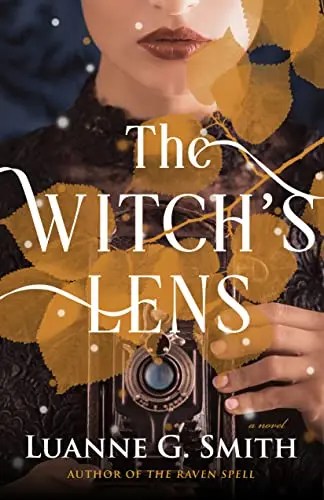
A witch finds herself recruited to WWI’s eastern front to fight a scourge of zombies.
Summary:
With her husband off fighting at World War I’s eastern front, Petra Kurková embraces her fleeting freedom, roaming the city at night with her camera. A born witch, she’s discovered that she can capture the souls of the dead on film. Her supernatural skills don’t go unnoticed by the enigmatic Josef Svoboda. He’s recruiting a team of sorcerers to infiltrate the front lines, where the bloodshed of combat has resurrected foul creatures. Petra’s unique abilities will be needed against the most dangerous enemies of all—those ever present, undead, and unseen.
Deep in the cursed Carpathian Mountains, the ragtag team meets with an emissary of an ancient organization founded to maintain balance between worlds. Photographing the escalating horrors is beyond anything Petra imagined. So are the secrets among her fellow witches. But Petra can’t turn back. Not before she discovers her husband’s fate and the myriad ways her magic is manifesting. To defeat an occult foe, Petra must release the power she’s been concealing for so long, or risk damning a war-torn world to ashes.
Review:
I came into this book expecting a lot of WWI with a dash of witches but it ended up being the other way around.
If it wasn’t for the book’s blurb mentioning WWI and one passing mention of the Archduke’s assassination, it would be possible to read this book and think the entire war was a fantasy. This becomes increasingly so as the book progresses. Perhaps I missed something but at first it sounds like the humans are fighting and unaware of any supernatural folks participating in the war pushing it one way or the other. Then later it seems like everyone knows about witches. So which is it?
The book starts slowly, showing Petra living on her own, lonely and bored, going out at night to take photos since she’s discovered the dead show up in them. I was intrigued by this and wondering why Petra can only see the dead in her photos, but the why is never revealed. The camera is useful to the plot but not in the way you would imagine from what we know it can do.
The zombies in the book are the fast type. (See more zombie recommendations from me.) They can move at superhuman speeds. An interesting unique take is that zombies can continue to exist among the living until they’re called upon by another power to act like a zombie. They’re basically Trojan horses among the soldiers.
There is some light romance in the book. Personally, it didn’t work for me because we see Petra starting to long for a man who isn’t her husband. That’s just not a plot point I personally enjoy. The romance is hinted at in the book. There is not even a kiss. I suspect it will get stronger in the sequel. Those who want to read for the romance should know this is a very slow burn.
If we ignore the confusing aspects of whether or not everyone in the world knows about the witches, the plot does escalate in a way that mostly make sense and things come to a head with quite a bit of action. But there is an element of “the chosen one,” which I find dull. Especially in a book about WWI. I wanted to see everyone coming together with unique strengths. Not one overpowered person.
Overall, this book wasn’t a match for me. I wanted a lot more WWI than was in it. Recommended to those interested in a witch’s war with a dash of light, slow-burn romance.
If you found this review helpful, please consider tipping me on ko-fi, checking out my digital items available in my ko-fi shop, buying one of my publications, using one of my referral/coupon codes, or signing up for my free microfiction monthly newsletter. Thank you for your support!
3 out of 5 stars
Length: 255 pages – average but on the shorter side
Source: Library
Buy It (Amazon or Bookshop.org)
Book Review: Peace Child by Don Richardson

Part history of the 20th century for the Sawi people of New Guinea, part personal memoir by the first missionary to live with them.
Summary:
In 1962, Don and Carol Richardson risked their lives to share the gospel with the Sawi people of New Guinea. Peace Child tells their unforgettable story of living among these headhunters and cannibals, who valued treachery through fattening victims with friendship before the slaughter. God gave Don and Carol the key to the Sawi hearts via a redemptive analogy from their own mythology. The “peace child” became the secret to unlocking a value system that had existed through generations. This analogy became a stepping-stone by which the gospel came into the Sawi culture and started both a spiritual and a social revolution from within. With an epilogue updating how the gospel has impacted the Sawi people, this missionary classic will inspire a new generation of readers who need to hear this remarkable story and the lessons it teaches us about communicating Christ in a meaningful way to those around us.
Review:
There’s a lot of controversy about modern mission work. Not to mention the known atrocities committed by missionaries in the US, Canada, and other places in historic times. I support Indigenous peoples and condemn the horrific means used by these supposed “missionaries.” (I personally do not consider these people to be true believers bringing the gospel but rather colonizers acting on behalf of a nation. For example, Jesus loved children and yet these people murdered them.) So I approached this book with quite a bit of trepidation. Yet slowly over the course of it, I came to see the picture of a very different type of mission work.
Unlike many missionary memoirs, the perspective of the first third of the book is actually that of a historical account of approximately one year in the life of the Sawi before the missionaries arrived. It immerses you into the world of New Guinea and also gives a neutral depiction of the cannibalism as it existed at that point in time. Because Sawi culture honored duplicitousness and treachery, the different villages were quite isolated and small. Betrayal with the end result being death and, yes, cannibalized, was a real consistent threat. There was a Sawi saying about honoring this treachery – “fatten with friendship for the slaughter.” Starting the book from the Sawi perspective sets the expectation that this book is really about the Sawi, not Don and his wife Carol.
Something Don makes clear early on is that other cultures were encroaching on the Sawi. They were not going to continue to be left untouched for long due to the political situation in New Guinea. Essentially, the people with the hands-off approach were departing. It was clear the ones incoming were going to go into the jungles themselves but also allow hunters, prospectors, etc… in. Don’s belief was that the first people the Sawi encountered shouldn’t be out to exploit them for anything but rather should be there to help them in as many ways as possible, not solely with the gospel but also to adjust to their world shifting more dramatically than it had in generations. Don and his wife brought medical care and information on how the outside world that was coming into contact with them would work. A story that particularly struck me was how Don and Carol taught Sawi how to be shopkeepers. You might, like me, think at first, oh no, he’s destroying their hunter/gather society with money. But when he explained his reasoning, I was humbled at how forward-thinking and selfless it was.
Educating Papuans without training some of them to be shopkeepers invites non-Papuans to come in and take control fo the supply and pricing of manufactured goods. As non-Papuans enrich themselves, they eventually gain ownership of land bequeathed to Papuans by their ancestors. Papuans thus tend to end up as exploitable cheap labor or, worse yet, as beggars foraging on garbage cast off by non-Papuans. Hoping to spare our Sawi friends such a fat, we trained some of them to be, yes, shopkeepers! Shopkeepers who charge prices lower than non-Papuans care to compete with! Shopkeepers who see no need to sell their land because their shops are doing quite well, thank you!
location 3632
Beyond helping the Sawi to prepare for meeting the world, Don’s perspective on mission work is essentially that the culture you are visiting already has inbuilt messaging from God about Jesus. You just have to find what it is to help them see it, since they haven’t heard the message before. In the case of the Sawi, that is the cultural tradition of the peace child. I won’t go into the details of how the peace child works in Sawi culture. I think that is most impactful by actually reading the book. What is interesting to me to note, however, is how his method of missions doesn’t supplant the culture or force another culture upon it. It rather takes an aspect of the culture that already exists and builds upon it. Now, all cultures have good and bad aspects. Essentially what Don does is he tries to help enhance what is good within the culture and tamp down what is only hurting the people. The Sawi inability to trust anyone because of treachery being so upheld as a positive trait is an easy to understand example of this. Once the Sawi understanding of a peace child was uplifted higher instead and became more achievable for anyone, then the Sawi were able to start trusting each other and uniting so that they might remain that way when facing the world. I frankly found myself wishing someone could come help my own culture in such a way to help us be better, more communal, versions of ourselves!
I was also surprised by how things turn out. Ultimately, the mission group withdraws from the Sawi villages, not in defeat, but because they feel the Sawi are ready to stand on their own within the extended world they now find themselves in. Updates on the Sawi indicate they are still doing well and have even sent their own missionaries to another Indigenous group, the Sumo, further inland. This article also talks about the fact that Don use the Indonesian characters to write down Sawi and translate the New Testament. This means that when the Sawi were newly required to go to government schools and learn Indonesian they could also automatically read Sawi, helping to preserve the language.
Overall, this is a very engaging and informative read about one Indigenous nation encountering the larger world in the 20th century. It also gave me a new appreciation for how mission work can be done ethically. While I understand that some may disagree and say there is no such thing as ethical mission work, I think how Don and his wife Carol helped the Sawi maintain control of their land and literacy in their own language is a strong counterpoint.
If you found this review helpful, please consider tipping me on ko-fi, checking out my digital items available in my ko-fi shop, buying one of my publications, using one of my referral/coupon codes, or signing up for my free microfiction monthly newsletter. Thank you for your support!
4 out of 5 stars
Length: 256 pages – average but on the shorter side
Source: Library
Buy It (Amazon or Bookshop.org)
Book Review: Death Valley by Melissa Broder

A woman dealing (or not dealing) with her husband’s and father’s medical conditions arrives in the desert to research her newest novel and has a fantastical experience.
Summary:
A woman arrives alone at a Best Western seeking respite from an emptiness that plagues her. She has fled to the California high desert to escape a cloud of sorrow—for both her father in the ICU and a husband whose illness is worsening. What the motel provides, however, is not peace but a path, thanks to a receptionist who recommends a nearby hike.
Out on the sun-scorched trail, the woman encounters a towering cactus whose size and shape mean it should not exist in California. Yet the cactus is there, with a gash through its side that beckons like a familiar door. So she enters it. What awaits her inside this mystical succulent sets her on a journey at once desolate and rich, hilarious and poignant.
Review:
I didn’t expect this to be a book that kept me up late at night because I needed to know how the plot resolved. I have not personally tended to experience much forward momentum in magical realism. But this was such a perfect mix of adventure plot and emotional magical realism that I simply couldn’t stop reading.
I love a cactus. This is a fact I don’t usually admit to because they’re so popular in design nowadays, and I’d rather support an underdog.
location 206
The main character was easy to bond with initially, which is critical to a plot that relies on the reader believing her experiences in the desert – even when they become fantastical. She’s a bisexual woman in long-term recovery from drugs and alcohol. She’s trying to finish her novel. Her husband has had a mysterious chronic illness for several years, and her father has been in the hospital for a long time after a car accident. The hospital keeps telling them that he’s dying, and then he wakes up and improves (only to have something else go wrong.) It’s a lot for anyone to handle. She has a dry wit that we hear inside her head but that rarely makes it outside. We can see how she’s barely keeping it together, and yet she continues to try because of how much she loves her loved ones.
Since my husband got sick, my words don’t mean what they are supposed to mean.
location 289
It’s interesting what a beautiful depiction of a marriage this book is when so little in it features the spouses together. Yet through the main character we see how her marriage and loving her husband, as she would say, isn’t just a feeling. It’s a choice. Perhaps some people would find it gauche to have a whole book focusing in on the impact of a chronic illness on the spouse who doesn’t have it. But that’s the rub of a marriage. What happens to one person is happening to both.
The setting of the book is also gorgeous. I’m not sure I’d have appreciate it as much as I did if I had never been to the desert. The beauty and danger and overwhelmingness of the desert is all encapsulated so beautifully from the coolness of her room in the Best Western to the magical cactus and everything in between. (Plus there’s both desert bunnies and multiple types of cactus from saguaro to teddy-bear cholla.)
If I was reading a review of this book, my main question would be – ok, ok, but how about the magical realism? Does it work? Yes, it works really well. By the time I finished the book, I couldn’t imagine the main character’s arc happening any other way. It makes sense in the context of that trip and that world, and that’s all that really matters. I wasn’t questioning it. I was on board from the first magical moment partway into the book.
Overall, this is an engaging story of one woman’s trip into the desert intertwined with her inner journey of continuing to choose to love her husband every day. It’s beautiful representation of the complexities of in sickness and in health. Recommended to readers interested in that journey with an open mind to magical realism.
If you found this review helpful, please consider tipping me on ko-fi, checking out my digital items available in my ko-fi shop, buying one of my publications, using one of my referral/coupon codes, or signing up for my free microfiction monthly newsletter. Thank you for your support!
5 out of 5 stars
Length: 240 pages – average but on the shorter side
Source: NetGalley
Buy It (Amazon or Bookshop.org)
 Support my work with a tip or browse my shop for curated book club guides, how to guides, cross-stitch patterns, and more!


This work by Amanda Nevius is licensed under a Creative Commons Attribution-Noncommercial-No Derivative Works 3.0 United States License.
 Opinions of a Wolf