
Archive
Book Review: The Girl Who Drew Butterflies: How Maria Merian’s Art Changed Science by Joyce Sidman

A beautifully illustrated middle grade biography of Maria Merian—the 17th-century artist-scientist who transformed our understanding of butterflies, nature, and the role of women in science.
Summary:
Bugs, of all kinds, were considered to be “born of mud” and to be “beasts of the devil.” Why would anyone, let alone a girl, want to study and observe them?
One of the first naturalists to observe live insects directly, Maria Sibylla Merian was also one of the first to document the metamorphosis of the butterfly. In this nonfiction biography, illustrated throughout with full-color original paintings by Merian herself, author Joyce Sidman paints her own picture of one of the first female entomologists and a woman who flouted convention in the pursuit of knowledge and her passion for insects.
Review:
For my birthday in 2024, I went to The Butterfly Place in Westford, Massachusetts—a magical indoor garden filled with butterflies. In the gift shop, I found this stunning book, and my husband bought it for me. It was gorgeous just sitting on my shelf, but when I finally read it, I was even more blown away.
Told in lyrical yet accessible prose, it is structured around the butterfly life cycle, with chapter titles that mirror each stage from egg to molting to flight. It begins with a short glossary of entomological terms that makes the rest of the book easier to navigate, especially for younger readers.
Every page includes illustrations—historic images that ground us in Maria’s time, reproductions of her own scientific watercolors, and thoughtfully placed modern visuals. The full-color format is truly stunning, making this a standout book for readers of any age.
Maria Merian was born in 1647 in Frankfurt, Germany, into a world where women were expected to remain in the home or quietly assist with family businesses. Her father was a publisher, and, after he passed away, her stepfather was a painter—giving her rare early exposure to both printing and art. Yet as a woman, she was denied access to many materials and was considered a “hobbyist,” painting in watercolors, which were viewed as an inferior medium.

From childhood, Maria was drawn to caterpillars and butterflies—despite the scientific consensus at the time that butterflies spontaneously emerged from mud. She collected caterpillars, documented their transformations, and painted them in astonishing detail. She published a caterpillar book that was well-received. Shortly after this, she left her husband and moved into a Labadist community – a secluded religious group. This allowed her to eventually achieve a divorce for religious reasons. Six years after joining the Labadist community, she left for Amsterdam where she established a business of art supplies, art, and preserved insects with her two daughters.
Years later in her 50s, she did the unthinkable—she self-funded a trip to Suriname to study tropical insects firsthand. The journey took a toll on her health, but she returned with the materials to publish her most famous scientific work. She died a few years later, having defied nearly every expectation placed on women of her time.
The writing is geared toward a middle grade audience. While accessible for the young, it’s also rich enough for adults. Difficult topics are handled with sensitivity: the challenges of being a woman in science, the expectations of motherhood, and Maria’s time in Dutch-colonized Surinam. The author acknowledges Maria’s reliance on local knowledge and her resistance to the sugar trade, while also honestly confronting her complicity in a system of enslavement.
While reading, I couldn’t help but imagine this book sitting on the shelf of one of the characters in Bloemetje, my own literary space fantasy about a Dutch company colonizing Venus—lush with plants, bees, and quiet rebellion. Perhaps I should have included a few more butterflies too.
Overall, this is a beautiful, immersive read that educates about butterflies, art, and women’s history all at once. It’s a remarkable tribute to a woman who saw the natural world differently—and helped change how the rest of us see it too. Highly recommended.
If you found this review helpful, please consider tipping me on ko-fi, checking out my digital items in my ko-fi shop, buying one of my publications, using one of my referral or coupon codes, signing up for my free microfiction monthly newsletter, or tuning into my podcast. Thank you for your support!
5 out of 5 stars
Length: 120 pages – short nonfiction
Source: Gift
Buy It (Amazon or Bookshop.org)
Book Review: The Importance of Being Earnest by Oscar Wilde

This witty farce cleverly comments on romance and class while offering a glimpse into the sharp mind of a writer who was silenced by society for his homosexuality.
Summary:
Cecily Cardew and Gwendolen Fairfax are both in love with the same mythical suitor. Jack Worthing has wooed Gwendolen as Ernest while Algernon has also posed as Ernest to win the heart of Jack’s ward, Cecily. When all four arrive at Jack’s country home on the same weekend the “rivals” to fight for Ernest’s undivided attention and the “Ernests” to claim their beloveds pandemonium breaks loose. Only a senile nursemaid and an old, discarded hand-bag can save the day!
Review:
I wasn’t sure if a play from 1895 could still make me laugh out loud, but this had me literally laughing out loud throughout. Wilde’s sharp wit transcends time, offering humor that still feels fresh and fun.
The bulk of the humor revolves around romance and relationships, themes that are just as relatable today. One of the young women insists she can only marry a man named Ernest because, well, it’s just such a perfect name. Honestly, it feels like something an influencer might say now. Ridiculous? Yes. But her love interest plays along—an endearing and absurd romance that hits just right. The second couple’s drama, involving letters and the oddity of never having met in person, feels like it could be pulled straight from a modern reality TV show like 90 Day Fiancé. It’s both comical and oddly relatable, even today.
Then, there’s Wilde’s satirical take on class—an aspect of the play that’s still tragically relevant. The scene where the two young women exchange polite (but cutting) quips over tea is perhaps my favorite. The tension between societal expectations and personal desires couldn’t be more brilliantly portrayed.
The final twist? Whip-smart and unexpected, it’s a game-changing moment that had me thinking, “This could fit perfectly into a psychological thriller.” It’s brilliant… and hilarious.
I listened to this as an audiobook (with a live reading featuring James Marsters—swoon!), and I highly recommend experiencing plays this way. The clever dialogue really shines in an audio format, bringing Wilde’s wordplay and humor to life in a way you can’t always capture on the page.
As for diversity, it’s worth noting that Wilde’s characters are overwhelmingly upper-crust white English folk. However, it’s important to remember that Wilde wrote this play before being imprisoned for “gross indecency” (a term used at the time to criminalize homosexuality). The Importance of Being Earnest was his last play, and it showcases his sharpest writing before homophobia curtailed his career. Reading it today offers a poignant reminder of his legacy and the oppressive forces that silenced him.
Overall, this remains a clever, sharp, and incredibly funny play—one that continues to satirize the British class system with a witty edge. It’s a must-read for fans of intellectual humor, fans of Wilde, and anyone who appreciates supporting LGBTQIA+ writers who defied the odds in their time.
If you found this review helpful, please consider tipping me on ko-fi, checking out my digital items available in my ko-fi shop, buying one of my publications, using one of my referral/coupon codes, or signing up for my free microfiction monthly newsletter. Thank you for your support!
5 out of 5 stars
Length: 89 pages – novella/short nonfiction
Source: Audible
Buy It (Amazon or Bookshop.org)
Book Review: The Serviceberry: Abundance and Reciprocity in the Natural World by Robin Wall Kimmerer
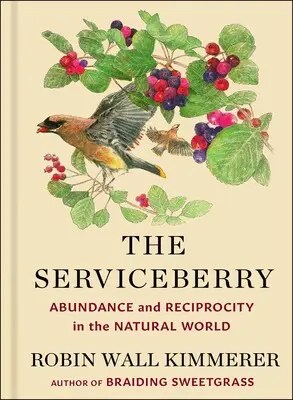
A Potawatomi author and botanist explores the concept of gift economies through the author’s reflections on nature, reciprocity, and the lessons of the serviceberry tree.
Summary:
As indigenous scientist and author of Braiding Sweetgrass Robin Wall Kimmerer harvests serviceberries alongside the birds, she considers the ethic of reciprocity that lies at the heart of the gift economy. How, she asks, can we learn from indigenous wisdom and the plant world to reimagine what we value most? Our economy is rooted in scarcity, competition, and the hoarding of resources, and we have surrendered our values to a system that actively harms what we love.
Meanwhile, the serviceberry’s relationship with the natural world is an embodiment of reciprocity, interconnectedness, and gratitude. The tree distributes its wealth—its abundance of sweet, juicy berries—to meet the needs of its natural community. And this distribution insures its own survival. As Kimmerer explains, “Serviceberries show us another model, one based upon reciprocity, where wealth comes from the quality of your relationships, not from the illusion of self-sufficiency.”
Review:
I was incredibly moved by Robin Wall Kimmerer’s Braiding Sweetgrass, which beautifully wove together the spiritual and the scientific. So, I was excited to dive into her new book, The Serviceberry, which blends natural biology with economics—yes, you read that right.
This short book is gorgeously illustrated by John Burgoyne with thematic line drawings that complement Kimmerer’s reflections. The story centers on her harvesting serviceberries, and this simple activity becomes the starting point for a profound exploration of economic systems.
I’ll admit, before reading this book, I didn’t know much about serviceberries, even though I spent my childhood picking wild berries. After reading Kimmerer’s description and researching more, I’m still not sure I’ve encountered them in the wild myself. I wonder if having a personal connection to the plant would have deepened my connection to the book, much like it did with many of the plants discussed in Braiding Sweetgrass.
The core of the book discusses gift economies—systems of mutual support that thrive on sharing abundance. Kimmerer writes:
Gift economies arise from an understanding of earthly abundance and the gratitude it generates. A perception of abundance, based on the notion that there is enough if we share it, underlies economies of mutual support. (page 75)
Kimmerer uses her own harvest of serviceberries as a metaphor: after gathering more than enough berries, she shares them with her neighbors, who might then return the generosity by baking a pie to share. She connects this to examples like Little Free Libraries and free stands giving away zucchini, offering a hopeful vision of a world where wealth is measured not by money, but by the relationships we build.
However, I struggled to fully embrace this vision. While I appreciate Kimmerer’s focus on the power of sharing, I was reading this book during a time of travel frustration—waiting overnight for a massively delayed airplane—and found myself questioning the likelihood of these ideas. The concept of abundance feels hard to grasp when faced with the reality of scarcity—especially when airlines don’t have enough seats for stranded travelers.
I also hear the idealistic rebuttal: in a gift economy, I wouldn’t need to travel far to see family because we’d all be close by, sharing our abundance. But my personal experience with things like Little Free Libraries, where people dump books in condition too bad for anyone to use, makes me question the idealism of this system. While Serviceberry presents a beautiful vision of generosity, it doesn’t address the real challenges of maintaining such systems at scale.
Despite this, I still value Kimmerer’s generosity in donating all her advance payments to support land protection, restoration, and justice. Her actions speak louder than words, and that’s something I deeply respect.
Overall, this is a quick read that challenges readers to think about economics, abundance, and reciprocity in new ways. While it didn’t convince me of the feasibility of the gift economy, it certainly provided food for thought. I recommend it to those who are interested in reimagining our current economic systems through a natural lens.
If you found this review helpful, please consider tipping me on ko-fi, checking out my digital items available in my ko-fi shop, buying one of my publications, using one of my referral/coupon codes, or signing up for my free microfiction monthly newsletter. Thank you for your support!
4 out of 5 stars
Length: 128 pages – novella/short nonfiction
Source: Library
Buy It (Amazon or Bookshop.org)
Book Review: The Ballad of Black Tom by Victor LaValle

Tommy is a hustler just taking care of himself and his dad in 1920s Harlem when an old white man invites him to play at his private shindig in his home.
Summary:
Charles Thomas Tester hustles to put food on the table, keep the roof over his father’s head, from Harlem to Flushing Meadows to Red Hook. He knows what magic a suit can cast, the invisibility a guitar case can provide, and the curse written on his skin that attracts the eye of wealthy white folks and their cops. But when he delivers an occult tome to a reclusive sorceress in the heart of Queens, Tom opens a door to a deeper realm of magic, and earns the attention of things best left sleeping.
A storm that might swallow the world is building in Brooklyn. Will Black Tom live to see it break?
Review:
The Lovecraft universe is a fascinating example of an author creating a world that then becomes the playground for a lot of other people’s imaginations. Legally! Beyond a story being technically set in a Lovecraft universe with Lovecraft characters, though, there’s an entire genre of speculative horror that sprung out of it called cosmic horror. Think Eldritch Gods. Secret societies. Tentacles.
I love cosmic horror. (I even have published a cosmic horror short story.) The thing is, though, most cosmic horror fans have a complex relationship with the genre because of Lovecraft’s blatant racism and xenophobia. So a lot of modern authors, fans of the universe itself but not the person, are writing their own cosmic horror stories that turn Lovecraft’s racism and xenophobia on its head. Enter The Ballad of Black Tom.
The author of this novella is a Black man who decided to take one of Lovecraft’s most xenophobic short stories (“The Horror at Red Hook“) and reapproach it from the perspective of a minor secondary character – Black Tom. Tommy lives in 1920s Harlem with a dad who’s a talented musician while he himself is not. He is, however, able to convince white folks outside of Harlem that he’s a talented musician and so he goes there to hustle them. He also has a variety of other side hustles including procuring magical items for people.
The first thing that struck me about this book was how it put a minoritized Lovecraft character front and center. I also noticed how Tommy doesn’t go by the name “Black Tom.” That comes later and, even when it does, Tommy is claiming the name from a place of power.
Part of the terror that Lovecraft’s characters often feel is that of potentially losing their place of privilege. Tommy is living in a blatantly racist society where he can’t even take a train too far out of his neighborhood without someone questioning or harassing him. Instead, what he has to lose is his community in Harlem. Something it takes him a while to figure out. Some of what tears that away from him is the cosmic horror. But some of that is the day-to-day horror of being Black man in 1920s Harlem. (Warning for police brutality in this book).
This novella hits all the notes a reader might want in a cosmic horror – existential dread, elder gods, a little blood, cult rituals. But it does it without the cringe-inducing racist asides. I found it easier to empathize with Tommy than I had with a main character in a cosmic horror in a while. Of course he wants the elder gods to come tear things up. Of course he does. What I wasn’t expecting was the note of…what have I done?…at the end or that I would agree with that too.
I will say, I didn’t enjoy was when the perspective shifted to that of the police officer. I would have preferred remaining in Tommy’s perspective throughout. There was also a hint that a song Tommy’s dad taught him would come back up in a meaningful way, and it didn’t. Perhaps I missed it.
Overall, this is a wonderful entry into the Lovecraft universe that gives voice to a character Lovecraft had maligned, written from an own voices perspective.
If you found this review helpful, please consider tipping me on ko-fi, checking out my digital items available in my ko-fi shop, buying one of my publications, using one of my referral/coupon codes, or signing up for my free microfiction monthly newsletter. Thank you for your support!
4 out of 5 stars
Length: 149 pages – novella
Source: Library
Buy It (Amazon or Bookshop.org)
Get the Book Club Discussion Guide
A beautifully graphic designed 2 page PDF that contains: 1 icebreaker, 9 discussion questions arranged from least to most challenging, 1 wrap-up question, and 3 read-a-like book suggestions
View a list of all my Book Club Guides.
Book Review: Daniel Boone’s Own Story & The Adventures of Daniel Boone by Daniel Boone and Francis L. Hawks
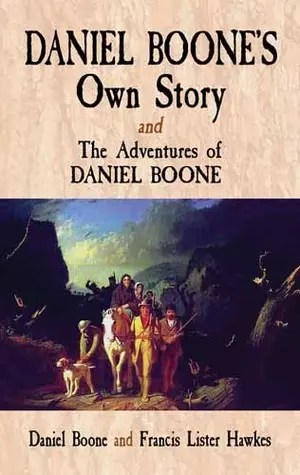
This book presents Daniel Boone’s summary of his adventures in the late 1700s and early 1800s plus a biography of his life first published in 1844.
Summary:
Daniel Boone blazed the Wilderness Road through the Cumberland Gap. Thousands followed, settling in Boonesborough, Kentucky, to form one of the first English-speaking communities west of the Appalachians. This two-part tale of the legendary frontiersman’s life begins with a brief profile by Boone himself, covering his exploits in the Kentucky wilderness from 1769 to 1784. The second part chronicles Boone’s life from cradle to grave, with exciting accounts of his capture and adoption by the Shawnee and his service as a militiaman during the Revolutionary War.
Review:
Growing up, I’d heard the legends of Daniel Boone and saw a few episodes of the (wildly historically inaccurate) tv show. I was raised with the mainstream US belief that westward expansion and colonization was great. It wasn’t until I was in college that I started to really learn about the true history of colonization. So I wasn’t too surprised when I read these period accounts to find that things were not the glowing hero account I’d heard. Not even when you take what happened at face value from the mouth of the man who lived it or from the biography that came shortly after his death.
Let’s start with what was true. Daniel Boone was, by all accounts, a talented hunter. He didn’t like to have many people around him, so he was constantly on the lookout for land that appeared to him to be empty (more on that later). He was taken captive by the Shawnee and adopted by them, living with them for two years before escaping. He was a critical tipping point person in the settlement (and stealing) of Kentucky by white Americans.
Here’s what stuck out to me when reading these accounts, though, with my twenty-first century eye. Daniel Boone and the other settlers considered Kentucky to be open space and fair game. However, even the early 1800s biographer pointed out that this land was being used as hunting grounds by multiple different Indigenous nations. So even folks of the time realized that the land was in use, just not in the same way as how white people would use it. When I dug into this more, though, I found this fascinating article about the idea of Kentucky being a “dark and bloody ground” aka land that was being fought over and contested by Indigenous nations with no one really living on it the way European settlers viewed living on land, as a myth propagated to be able to view the land as “free game” to then sell to settlers without even the pretense of a treaty with or purchasing from the Indigenous folks.
Reader should be aware that these period pieces use multiple slurs to refer to Indigenous peoples. Beyond the slurs, there’s this odd depiction of Indigenous peoples. On the one hand, they’re depicted as backwards and not very bright. But on the other hand they’re depicted as terrifying enemies difficult to overcome.
It’s interesting to me how both authors consistently view white folks as superior and more “civilized,” in spite of telling stories that make it look very much the contrary. For example, there’s a scene in which an Indigenous group of warriors takes a bunch of white women captive. They are in a boat and they line the women around the edges of the boat. The narrator says that they did such a thing to ensure safe passage for themselves, assuming the white men would never fire on the white women. But the white men do, and the narrator defends this, saying it’s better for the white women to be dead than to be held captive by the Indigenous people. This statement is extra confusing as we had just seen earlier in the book that Daniel Boone was taken captive and then adopted and treated as one of the tribe. Now, of course, not all captives were adopted. Some were murdered and, yes, some were tortured. (How captives were treated varied wildly.) But the point remains that the men fired on their own women and considered that to be a “civilized” act.
As it is women’s history month, I wanted to draw out some information on Daniel Boone’s wife, Rebecca. He brought her out to Kentucky, and on the trip there, one of their children is killed by Indigenous folks defending their land. (Because it WAS their land.) Then later her daughter is kidnapped. (Daniel retrieves her.) Ultimately, six of their ten children died early deaths, largely in the war between the Indigenous and the settlers. We also can’t forget when Daniel was captured and adopted. He was gone for so long that Rebecca gave up hope and went home to North Carolina, only to have Daniel show up, back from what she thought was the dead, and bring her back to the frontier. I can’t imagine living my life that way. I realize she had her own agency, and we must acknowledge the complicity of white women in the theft of the land. But I do wonder what it must have felt like to give birth to ten children, only to have six of them die in the bloody battle for land. Did she think it was worth it? What made her go back with Daniel when he showed up after being missing for two years? These are things we’ll never know because women’s stories simply were not recorded for us.
I would not call this a fun or easy read. It was an informative one. There’s a lot of value in reading firsthand accounts of history. Of course we’ll never get the whole truth from any one such account. But it is informative into how people in that time period thought and behaved. How they perceived it then and how we perceive it now.
Recommended to those with an interest in primary resources from the colonization of the US.
If you found this review helpful, please consider tipping me on ko-fi, checking out my digital items available in my ko-fi shop, buying one of my publications, using one of my referral/coupon codes, or signing up for my free microfiction monthly newsletter. Thank you for your support!
3 out of 5 stars
Length: 128 pages – short nonfiction
Source: Gift
Buy It (Amazon or Bookshop.org)
Publication Announcement: Novella – Ecstatic Evil – Second Edition

I am thrilled to announce the publication of the second edition of my novella Ecstatic Evil. I published the first edition 11 years ago in 2011. I have completed major updates throughout the second edition, as well as added an author’s note and a content note. You can view both of the notes in their entirety by using the preview book feature on its Amazon page.
I have also added a paperback version for those readers who prefer to read in print. Both the electronic and paperback versions are available internationally.
Here is the updated blurb:
Tova Gallagher isn’t just your average, grumpy Bostonian. She also happens to be half-demon, and the demons have just issued a deadline for her all-important half-demon decision. She has just two weeks to choose whether to lean into her demon side by signing on with them wholeheartedly or never use her powers again under the tutelage of an assigned angel. But it’s hard to worry about the battle of good versus evil when she’s just met a sexy, sunshiny stranger on the edge of the Charles River.
Reviews of the first edition of this grumpy/sunshine paranormal romance call it a “quick, captivating read” with a romantic pairing that are “so sweet to each other.”
This newly expanded second edition includes edits throughout the book, as well as an author’s note and content note.
If this book was a movie, it would be rated PG13 for adult situations and sensuality.
The spiciness level is 2 or 3 chili peppers, depending upon which system you use. It is lightly spicy. There is foreplay and some clothes come off, but the camera pans away before more intimate moments.
There is no adult language. On-screen violence is minimal (shoving, gripping someone’s arm too tightly.) One supernatural being attacks another off-screen.
Today and tomorrow (November 9th-10th 2023, Pacific Time), the ebook is free for everyone. Please consider downloading your copy today!
If you previously purchased the first edition, note that Amazon does not send the second edition to your kindle. Please send me an email at mcneil.author@gmail.com letting me know you own the first edition and would like the second, and I will send you a copy.
If you are a book reviewer and would like a reviewer copy, please email me at mcneil.author@gmail.com with links to where you review books.
Please be sure to check out my Publications Page for my other work.
Two 1980s Horse Girl Books Face Off
Will The Horse that Came to Breakfast or Maggies Wish win?
I’m doing something a little bit different this week. I’ve been going through my bookshelves to determine what to keep and get rid of. If it’s a book I don’t really remember very well, I’m re-reading it to help decide. As a person born in the 1980s, I just so happened to have two middle grade horse girl books first published in the 1980s on the shelf. I didn’t remember anything about them. So I re-read both of them. Each re-read took about an hour. Let’s get into it.

First up we have The Horse that Came to Breakfast by Marilyn D. Anderson, first published in 1987. I picked this one up first because how could I not with that title? I was intrigued! The first sentence didn’t exactly draw me in because it referred to their home as a “house trailer.” I grew up with friends who lived in trailer parks, and my dad lived in one in the last few years of his life. I’ve never heard anyone call them a “house trailer.” The only thing I can think, based on the strong horse presence in the rest of the book, was the author mainly thought of horse trailers when she heard the word trailer and so thought she needed to differentiate. But really it’s the other way around. Trailer (where people live) and horse trailer (what you use to move horses).
Anyway, the basic plot of this book is that this little girl really wants a horse but her parents just got divorced, her dad is now completely out of the picture, her mom had to move them to a trailer, and money is very tight. But one day (in literally the first page of the book) a horse shows up in their yard. It’s a miracle! But her mom points out this horse must have an owner and makes her look for it. It turns out the horse is from a struggling horse riding instruction place. The little girl ends up collecting cans on the side of the road to pay for lessons on the horse. There’s a mean girl who shouldn’t get to ride the horse. The horse’s life is in danger. The little girl has to save him. Etc…
While I was skeptical of this book at first, it really did draw me in. In spite of certain aspects being dated (like how often this little girl was completely unsupervised and doing things like collecting cans along the side of the road or performing chores for random strangers she just met), the overall plot was thoughtful and heartwarming. There was no judgment of her mother for the divorce or the current financial situation, but it also empathically depicted how difficult it can be for kids to adjust to new life situations. It also highlighted caring for your neighbors and building a sense of community. Plus, there’s a happy ending for the girl and the horse. What more can you ask for?

Next up is Maggie’s Wish, first published in 1984. I’ll be honest. I didn’t notice until right now that the author is the same as for The Horse that Came to Breakfast! It felt like two totally different people wrote these books.
The basic plot of this one is that Maggie lives on a working farm with her mom and dad. She’s been asking for a pony to no avail. But one day her dad says the farm is getting something she’s going to really enjoy. She thinks it’s going to be a pony but it turns out to be two large draft horses for working the farm. The dad thinks this will be more fun than tractors. Maggie is disappointed but grows to love the draft horses only for her dad to sell them and ultimately buy her a pony.
The overall message of this book was bizarre. I’m still not sure what it was. Only when you learn to love the disappointing thing will you get what you really wanted? Don’t worry, when your father makes one poor financial decision he’ll continue to make them meaning you’ll ultimately get your pony one day? The family in this have a not great dynamic. The mother is kind of constantly making fun of the father. Of course, it’s a little hard to blame her for being frustrated when he really is making poor financial decisions with the family business without consulting her (his business partner) at all first. But those conversations should be had away from the daughter and not through passive-aggressive comments. I’m also having a hard time understanding how a farmer in 1984 could possibly think using two draft horses would be better than using a tractor. There’s also a scene where the dad spanks his daughter and her cousins (not his own kids) for running off unsupervised and almost getting hurt when he sends the dog to find them who then spooks a cow who almost runs them over. If you know you have a farm with cows who are spooked by dogs and you’re not sure where the children are, why would you send a dog after them? I understand spanking had a different cultural understanding in the 1980s but it’s hard to sympathize with the dad here when he was at least partially responsible for the whole near death experience.
The winner is…..
The Horse that Came to Breakfast! This is the one I decided to keep. Maggie’s Wish went to the local Little Free Library.
This is a great example of how one author can grow and change over time. Anderson’s characters acted with much more logic, even when making mistakes, in her later book. The overall plot was also more complex with elements I didn’t get into for the sake of space here. The message was clear and sound, backed up by memorable characters and intertwining plots. Maybe if the first book you pick up by an author is from early in their career, consider picking up one of the later books just to see.
Somewhat infuriatingly, I will note when I went to get the purchase links, Maggie’s Wish is available both digitally and as new printings. But The Horse that Came to Breakfast is only available as used vintage copies. Why? Why?
If you found this review helpful, please consider tipping me on ko-fi, checking out my digital items available in my ko-fi shop, buying one of my publications, using one of my referral/coupon codes, or signing up for my free microfiction monthly newsletter. Thank you for your support!
Length The Horse that Came to Breakfast: 96 pages – novella/short nonfiction
Length Maggie’s Wish: 96 pages – novella/short nonfiction
Buy The Horse that Came to Breakfast (Amazon, not available on Bookshop.org)
Buy Maggie’s Wish (Amazon or Bookshop.org)
Source: I’ve owned both books since childhood.
Publication Announcement: Novelette – Bloemetje: a speculative retelling of Hans Christian Andersen’s Thumbelina fairy tale

I am thrilled to announce the publication of my new novelette Bloemetje: a speculative retelling of Hans Christian Andersen’s Thumbelina fairy tale!!!
One miniature girl leads her human and fairy people to decolonize Venus in this speculative, queer-inclusive reimagining of Thumbelina.
A Dutch company known as The Bedrijf commences colonizing Venus via the construction of a dome filled with plants that convert its natural air into something breathable by humans. Since all workers are granted permission to bear a child, a woman and her spouse join the crew. But the woman soon discovers she is plagued with infertility. When her spouse illegally brings home a tulip from the garden, they discover a miniature baby inside who they name Bloemetje – little bloom. As the baby grows in mere days into a teenager, pushing her boundaries, she illuminates the true horrors of colonization and leads them all on a journey to decolonize.
This retelling takes the original Thumbelina’s focus on marriage and flips it on its head, granting the miniature girl a strong voice of her own and questioning her removal from the fairy world. Exploring themes of childlessness, adoption, being childfree by choice, colonization, decolonization, negative impacts of capitalism, and what LGBTQIA+ inclusive societies can look like, this novelette comes in 17 bite-sized episodes perfect for reading in the small snippets of time available to modern individuals and families.
Early readers called this “transporting” and “intriguing.” The “journey is beautiful,” and the ending is “deeply satisfying.” “A great escape read that also made me think, and it’s both quick and engrossing.”
*A portion of proceeds will be donated to the Massachusetts Center for Native American Awareness, a Native American-led 501(c)(3) nonprofit.
The ebook is available for pre-order now and will be delivered on May 18th. If you want to sneak in a little earlier, you can order the paperback or hardcover versions and get them delivered at your usual Amazon shipping speed.
If you would like to read a sneak peek of the first episode (chapter), sign up for my newsletter. I will be sending that sneak peek out on Monday, May 15th.
Pre-orders really matter for books, so please do consider pre-ordering if you know you want to purchase a copy. I also sincerely appreciate you passing the link on to anyone you know who might be interested in the book. Word of mouth is vital for indie authors.
Thank you for your support!
Book Review: The Saga of the Bloody Benders by Rick Geary

A true crime graphic novel telling of a family of serial killers in the 1870s.
Summary:
Out on a deserted stretch of Kansas road linking newly forming towns, a mysterious family stakes a claim and builds an inn for weary visitors. Soon, reports multiply of disappearances around that area. Generally, those who disappear have plenty of cash on them. A delicious tale of a gruesome family fronted by a beguiling lass who led their victims on…
Review:
I first heard about the Bloody Benders in an American Indians in Children’s Literature blog post about what Laura Ingalls Wilder left out of the Little House books. Essentially, Laura said she left out some aspects of her childhood because she didn’t think they belonged in a book written for children,…one of which is how Pa probably participated in mob justice against the Benders. American Indians in Children’s Literature does a great job breaking down how problematic it is that depicting white serial killers in her books wasn’t ok but depicting the horrifying treatment of Indigenous peoples was. In any case, I got curious about the Bloody Benders, and the internet said this was one of the better books written about the topic, so I picked it up from my public library.
The artwork is nice. I particularly enjoyed this depicted of the Bender family’s one-room grocery and inn to demonstrate how they pulled off the serial killings.
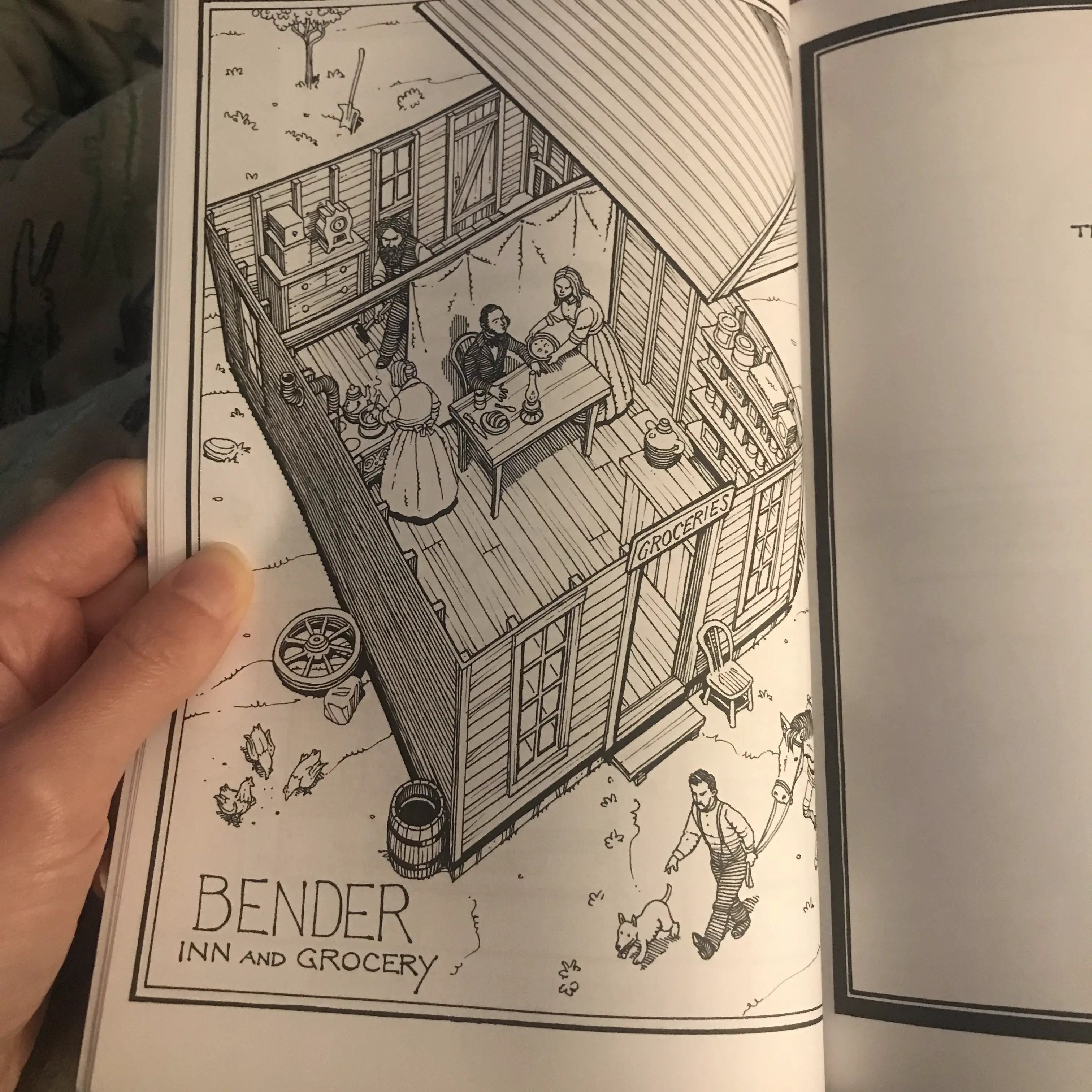
The content is factual and is careful to steer clear of using quotes in the panels when we don’t actually know what anyone said.
What made me dislike the book, though, was how it treated both Indigenous peoples and women. I understand that sometimes in historic nonfiction if a quote is being used or documents from the time period that it will use offensive language. However, this book used offensive language in parts that were narration written by the modern day author. It was published in 2007, and I truly feel someone on this book team should have been more thoughtful. A near-victim of the Benders was a Catholic missionary to the Osage people. Instead of saying it this way, though, the book says he, “dedicated his life to converting the savages.” This is the use of both a dehumanizing term and a glossing over of how missionary work was used as a weapon against Indigenous peoples in the Americas. This is a book about serial killers – I think whoever is reading it should be able to handle at least a footnote illuminating the complexities of this person’s missionary work.
With regards to the treatment of women, this is mostly in regards to how Kate Bender is discussed in the book. She is one of the four Bloody Benders, so I certainly don’t expect her to be discussed kindly, however while most of the book strives to stick closely to the truth as far as we know it, there is one part of the book that breaks down how folks determined the Benders pulled off their killings, based on the layout of the room, the trap door found, and reports of survivors. Most of this sticks to the facts, but then it gets to the part where Kate feeds the person sitting down at the guest table and says, “Does Kate also offer sexual favors as part of the package? No certain answer will ever be known.” What an unnecessarily and misogynistic supposition. Nothing that we know about Kate from survivors and those who knew her suggests she was promiscuous at all. In fact, earlier in the book it mentions she entertained suitors who ran errands for her but the suitors were never successful with her. Later when the book discusses possible endings for the various Benders that the rumor mills supposed, one proposed for Kate is as “a whore in Montana.” I trust that this was a true rumor, but it could have very easily said prostitute or sex worker.
True crime writing has the opportunity to analyze a crime and the society that surrounded it through a current lens. It can highlight both the good and the bad of that society and look at how this crime managed to occur, and, in the case of some crimes, go unstopped for so long. This book doesn’t do that, making it a beautifully illustrated reporting of what happened, lacking any analytical meat.
If you found this review helpful, please consider tipping me on ko-fi, checking out my digital items available in my ko-fi shop, buying one of my publications, or using one of my referral/coupon codes. Thank you for your support!
2 out of 5 stars
Length: 76 pages – short nonfiction
Source: Library
Buy It (Amazon or Bookshop.org)
Book Review: Long Story Short: 100 Classic Books in 3 Panels by Lisa Brown
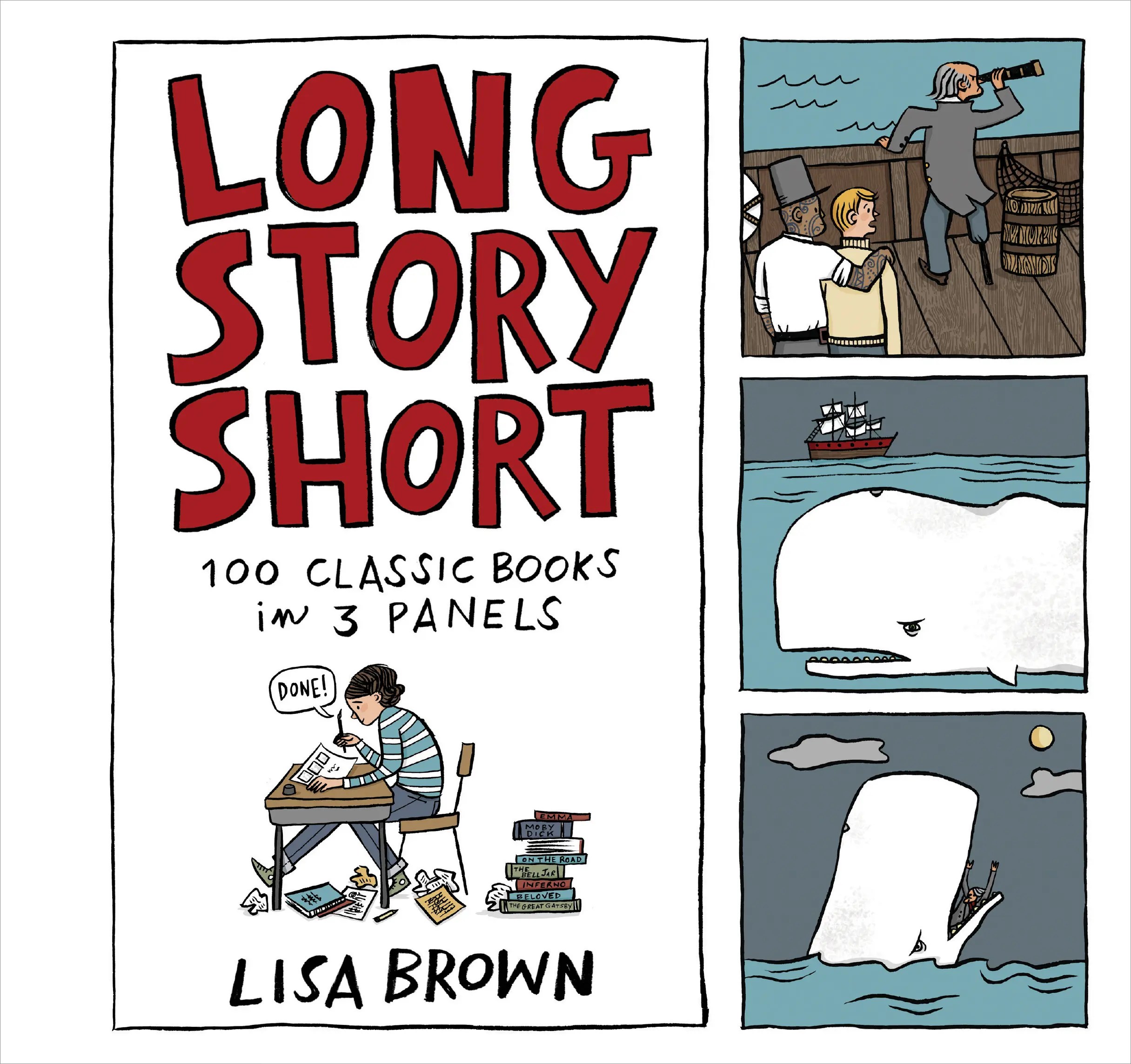
For English literature lovers who want to explain why they loved…or hated…a classic in one comic.
Summary:
100 pithy and skewering three-panel literary summaries, from curriculum classics like Don Quixote, Lord of the Flies, and Jane Eyre to modern favorites like Beloved, The Brief Wondrous Life of Oscar Wao, and Atonement, conveniently organized by subjects including “Love,” “Sex,” “Death,” and “Female Trouble.”
Review:
I became interested in this book because the amazing website American Indians in Children’s Literature described the comic about Little House on the Prairie but when I checked out the link I found the comic gone and a prompt about the book. In fairness, it had been more than 12 years since that article was published so I’m not too surprised Lisa Brown got a book deal in the meantime. It came in quite quickly for me from the library, and I read it in less than 30 minutes.
Rather than being organized by time period, the classics are organized by topic like “Love” and “Death.” This is also an inclusive definition of classics including ancient literature like Beowulf to modern pieces like The Fault in Our Stars. I like her illustration style. It’s colorful and engaging. You can see examples of actual panels from the book on her website. (It doesn’t include the Little House one but it does include one of my other favorites from the book – Edgar Allan Poe.)
You might think this is a way to Sparknotes your way through 100 books. This is not the case. The comics that were the funniest and most meaningful were the ones for books I had read. The ones for pieces I hadn’t fell kind of flat for me. This is actually sort of like a collection of inside jokes from one reader to another, and in order for the inside joke to make sense, you have to have read the book in question. That said, a couple of the comics for books I had read fell flat for me because I felt like they missed the point of the book. For example, I felt like the comic summary of Their Eyes Were Watching God was a very poor summary of an absolutely amazing book. So my experience of the comics was kind of all over the place.
Overall, this is an interesting collection of short comics drawn in an engaging manner. Recommended to big readers who want a couple of inside joke style chuckles. It could also make a good gift to a big reader you know.
If you found this review helpful, please consider tipping me on ko-fi, checking out my digital items available in my ko-fi shop, buying one of my publications, or using one of my referral/coupon codes. Thank you for your support!
3 out of 5 stars
Length: 80 pages – novella
Source: Library
Buy It (Amazon or Bookshop.org)
 Support my work with a tip or browse my shop for curated book club guides, how to guides, cross-stitch patterns, and more!


This work by Amanda Nevius is licensed under a Creative Commons Attribution-Noncommercial-No Derivative Works 3.0 United States License.
 Opinions of a Wolf