
Archive
Book Review: A Bánh Mì for Two by Trinity Nguyen
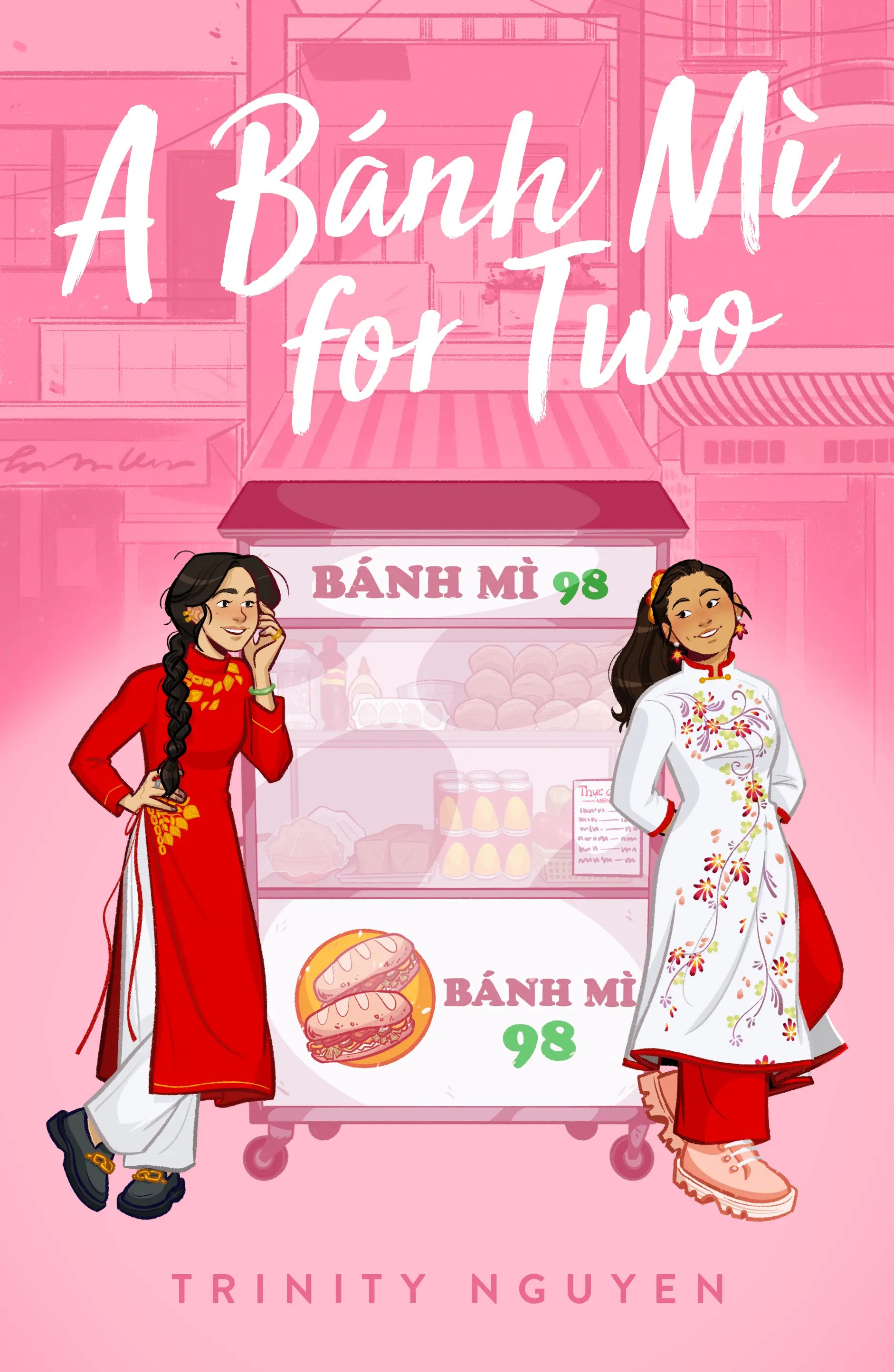
A sweet, closed-door sapphic romance set in Sài Gòn, where two foodie 18-year-olds fall for each other while uncovering family secrets and rekindling a love of food writing.
Summary:
In Sài Gòn, Lan is always trying to be the perfect daughter, dependable and willing to care for her widowed mother and their bánh mì stall. Her secret passion, however, is A Bánh Mì for Two, the food blog she started with her father but has stopped updating since his passing.
Meanwhile, Vietnamese American Vivi Huynh, has never been to Việt Nam. Her parents rarely talk about the homeland that clearly haunts them. So Vivi secretly goes to Vietnam for a study abroad program her freshman year of college. She’s determined to figure out why her parents left, and to try everything she’s seen on her favorite food blog, A Bánh Mì for Two.
When Vivi and Lan meet in Sài Gòn, they strike a deal. Lan will show Vivi around the city, helping her piece together her mother’s story through crumbling photographs and old memories. Vivi will help Lan start writing again so she can enter a food blogging contest. And slowly, as they explore the city and their pasts, Vivi and Lan fall in love.
Review:
I love a sweet, closed-door sapphic romance (see my review of Hani and Ishu’s Guide to Fake Dating), so when I heard about A Bánh Mì for Two, it was an easy add to my wishlist. The focus on food blogging and Vietnamese street food—both eating it and running a street food cart—was just the icing on the cake. This story strikes a delicate yet exquisite balance between lighthearted sweetness and the very real multigenerational trauma caused by the Vietnam War (referred to in Vietnam as The War Against the Americans to Save the Nation).
Told in alternating first-person perspectives between Lan and Vivi, the book avoids the common pitfall of muddled voices. While both characters are kind and thoughtful, they each have distinct ways of seeing the world, which keeps their narration clear and engaging. The romance is a sweet, slow burn, beginning with Vivi’s admiration of Lan’s food blog and blossoming into real-world chemistry after a chance encounter in Sài Gòn.
I especially appreciated the queer representation. There’s no on-page angst about being queer. Vivi does talk briefly with her friend Cindy (a Mexican American character) about how coming out can be complicated with conservative parents, but by the time the story begins, both girls’ families are accepting. It was also refreshing to see Vivi clearly identify as bisexual—representation that could’ve been easily overlooked since her only relationship in the book is with Lan. It’s affirming and intentional, which I loved.
The food descriptions are vivid but never overdone. They strike just the right balance between informing the reader (especially for dishes that might be unfamiliar) and keeping the flow natural. (I’ve eaten many a bánh mì in my life, and still found the food writing delightful!) I also really appreciated that this is a story about two 18-year-olds, and college isn’t presented as the only post–high school option. Lan’s mom encourages her to pursue school if she wants to, but also supports her jumping right into a career—a rare and welcome take in YA-adjacent fiction.
Vivi’s experience as a Vietnamese American studying abroad in Vietnam adds a beautiful emotional layer. She’s not a tourist—she’s searching for a kind of homecoming. She’s exploring why her mother kept so many details about Vietnam and their family a secret. This process is a powerful lens for the reader to learn about the war’s impact on Vietnamese families without the book ever feeling preachy. The historical context emerges naturally—through conversations, shared meals, and street encounters. It’s excellent writing.
The romantic progression between Lan and Vivi is tender and believable. One of my favorite parts was the motorbike rides around Sài Gòn—evocative, cinematic, and intimate. Even the third-act conflict felt justified. It wasn’t a contrived misunderstanding but a believable clash of cultural differences and personal pain. No one is villainized, and the resolution feels earned.
That said, a few elements pulled me out of the story. For example, Vivi’s study abroad program is mentioned as her reason for being in Vietnam, but we never actually see her attend class or study. This absence feels like a missed opportunity—readers might expect the study abroad setting to include some academic context. Similarly, while the book opens with several references to Vivi lying to her mom about her location—including photoshopping photos—the tension fades away later in the book. I found it a bit hard to believe that her mom wouldn’t catch on sooner.
The book is richly diverse, featuring Vietnamese and Vietnamese American characters, a Mexican American side character, and a sapphic romance at the center. Lan’s mother has a chronic illness, and her father passed away young from a stroke. The book also explores difficult family dynamics, grief, and healing across generations.
Overall, this is a fun, sweet sapphic romance featuring the beloved tropes of slow burn and study abroad, while offering thoughtful reflections on Vietnamese culture, family history, and the legacy of war. It’s beautifully steeped in food, healing, and love. Recommended for anyone looking for a sweet, queer romance with emotional depth, cross-cultural exploration, and heartwarming food moments.
If you found this review helpful, please consider tipping me on ko-fi, checking out my digital items in my ko-fi shop, buying one of my publications, using one of my referral or coupon codes, signing up for my free microfiction monthly newsletter, or tuning into my podcast. Thank you for your support!
4 out of 5 stars
Length: 224 pages – average but on the shorter side
Source: Library
Buy It (Amazon or Bookshop.org)
Book Review: Darling Girls by Sally Hepworth

When bones are discovered beneath their childhood home, three adult, Australian foster sisters are forced to confront their past as key witnesses—or prime suspects—in a dark family secret.
Summary:
For as long as they can remember, Jessica, Norah, and Alicia have been told how lucky they are. As young girls they were rescued from family tragedies and raised by a loving foster mother, Miss Fairchild, on an idyllic farming estate and given an elusive second chance at a happy family life.
But their childhood wasn’t the fairy tale everyone thinks it was. Miss Fairchild had rules. Miss Fairchild could be unpredictable. And Miss Fairchild was never, ever to be crossed. In a moment of desperation, the three broke away from Miss Fairchild and thought they were free. Even though they never saw her again, she was always somewhere in the shadows of their minds. When a body is discovered under the home they grew up in, the foster sisters find themselves thrust into the spotlight as key witnesses. Or are they prime suspects?
Review:
I’ve read most of Sally Hepworth’s books and enjoyed them, so I was excited to receive a review copy of her newest release.
The story features three narrators, each alternating between the present and their childhood. While that could be confusing, it’s actually well-executed, with the shifts between timelines feeling seamless. The timing of these shifts works well, never feeling contrived for the sake of holding back secrets for a twist.
And those twists? They’re big, and one in particular made me gasp out loud. While they were surprising, they made perfect sense, leaving me thinking, “I should have seen that coming.” That said, I did feel a bit frustrated by the final twist. I’m starting to tire of a specific depiction of women that seems to be a recurring theme in psychological thrillers, and this book doesn’t escape that trope.
In terms of representation, there’s a lack of racial or ethnic diversity. However, the book does feature one bisexual sister pursuing a relationship with a woman, and one sister dealing with substance use issues, while another has anger management struggles. I found the portrayal of foster care and the foster system is both realistic and sensitive, and especially appreciated learning that Hepworth conducted research with adults raised in the foster system. As someone who works in addiction and recovery, I found the representation of substance use disorder to be authentic and tasteful.
Overall, this is a gripping psychological thriller set in Australia, with enough twists and intriguing characters to keep you turning the pages. While readers may not relate to all of the characters, the juicy plot is sure to keep them engaged. Recommended for fans of psychological thrillers.
If you found this review helpful, please consider tipping me on ko-fi, checking out my digital items available in my ko-fi shop, buying one of my publications, using one of my referral/coupon codes, or signing up for my free microfiction monthly newsletter. Thank you for your support!
4 out of 5 stars
Length: 359 pages – average but on the longer side
Source: NetGalley
Buy It (Amazon or Bookshop.org)
Book Review: Land of Milk and Honey by C Pam Zhang

An elderly woman recalls the time in her 20s as a young chef living through a worldwide food shortage.
Summary:
A smog has spread. Food crops are rapidly disappearing. A chef escapes her dying career in a dreary city to take a job at a decadent mountaintop colony seemingly free of the world’s troubles.
There, the sky is clear again. Rare ingredients abound. Her enigmatic employer and his visionary daughter have built a lush new life for the global elite, one that reawakens the chef to the pleasures of taste, touch, and her own body.
In this atmosphere of hidden wonders and cool, seductive violence, the chef’s boundaries undergo a thrilling erosion. Soon she is pushed to the center of a startling attempt to reshape the world far beyond the plate.
Review:
The central conflict in this book is that a young chef on the cusp of her career finds herself suddenly inhabiting a world full of food shortages thanks to smog. Day in, day out instead of cooking the food she wanted to, she’s having to find new ways to use the mung bean powder the government is providing. When an opportunity comes up for a high-paying job working as a chef at a wealthy newly formed, secretive nation-state with the promise of using traditional ingredients, she jumps at the chance. It’s a beautiful set-up for a book.
Another strength of this book is its depiction of Asian-American and Asian-European women. In a book with limited characters, one is Asian-American and one is Asian-European (biracial). These two women love each other and also face racism. One of them from her own father who is white. This book contains one of the most impactful depictions of the harm of exoticizing Asian women I’ve seen.
This is also a sapphic book. The main character has a relationship with another woman for part of the book. It’s not exactly a healthy relationship. It is not explicit. This isn’t a romance novel. It’s a scifi novel with a relationship in it.
What did not work for me was that the tense the story was told in removed all the tension. It’s told in first person past tense. It’s an elderly woman recalling her life, primarily during a great environmental crisis. But because she’s telling the story as an elderly woman, we know she survives everything. Right from the first page. It removed all tension for me.
Also, this is another book where quotation marks aren’t used. What is going on with this trend? It’s not for me. (This one uses italics for everything – whether it’s spoken or thought – making it difficult to understand certain scenes.)
Overall, this is an interesting set-up for a book exploring sustainability and what it is to exist as an Asian woman in a Western society. Recommended to those who are ok with a lack of tension in this type of read.
If you found this review helpful, please consider tipping me on ko-fi, checking out my digital items available in my ko-fi shop, buying one of my publications, using one of my referral/coupon codes, or signing up for my free microfiction monthly newsletter. Thank you for your support!
3 out of 5 stars
Length: 240 pages – average but on the shorter side
Source: Library
Buy It (Amazon or Bookshop.org)
Book Review: Pixels of You by Ananth Hirsh, Yuko Ota, J.R. Doyle

Two interns, one human and one AI, dislike each other so naturally they’re forced to work together on a new project.
Summary:
In a near future, augmentation and AI changed everything and nothing. Indira is a human girl who has been cybernetically augmented after a tragic accident, and Fawn is one of the first human-presenting AI. They have the same internship at a gallery, but neither thinks much of the other’s photography. But after a huge public blowout, their mentor gives them an ultimatum. Work together on a project or leave her gallery forever. Grudgingly, the two begin to collaborate, and what comes out of it is astounding and revealing for both of them.
Review:
This forced proximity sapphic romance idea featuring a human and an AI is such a good one. The near-future world it is set in is fascinating. But both the relationship and the world weren’t explored enough for me.
AI in art is a really big issue right now. While it is also beginning to show up in written art, it has become a large issue much more quickly in graphic arts. So I was of course intrigued by a graphic novel exploring AI in a near future where a human artist is an intern side-by-side with an AI artist. But the book doesn’t really dig into the nitty gritty of whether what the AI produces can count as art or not. Even though the summary says that human-presenting AI like Fawn is new, no one seems particularly taken aback by Fawn. The most controversy she faces is other AI being jealous of her human-like skin. Given that Fawn is a photographer using solely her AI eye, there is a huge opportunity for exploration of what makes art, art. Yet this isn’t really explored at all. Similarly, Indira has a robotic eye to replace one she lost in an accident. It causes her chronic pain, but how having a robotic eye impacts her art as a photographer also isn’t really explored.
While I easily believed the forced proximity romance plot of Fawn and Indira if they were both human, I struggled to believe its rapidity given that Fawn is AI and Indira’s own background to her accident. (Which is a spoiler, but suffice to say one would imagine it would predispose her to negative feelings about AI.) I’m not saying these feelings couldn’t be overcome and the romance couldn’t happen, but it needed more time to develop. With regards to the spice of the romance, there’s some kissing and nothing more explicit than that.
The art in this graphic novel is beautiful. It has nice contrast that makes it easy to follow and suits the storyline.
Overall this is a pretty read and a fun world to visit, although it may leave you wishing for more.
If you found this review helpful, please consider tipping me on ko-fi, checking out my digital items available in my ko-fi shop, buying one of my publications, or using one of my referral/coupon codes. Thank you for your support!
3 out of 5 stars
Length: 172 pages – average but on the shorter side
Source: Library
Buy It (Amazon or Bookshop.org)
Book Review: Killing Me by Michelle Gagnon
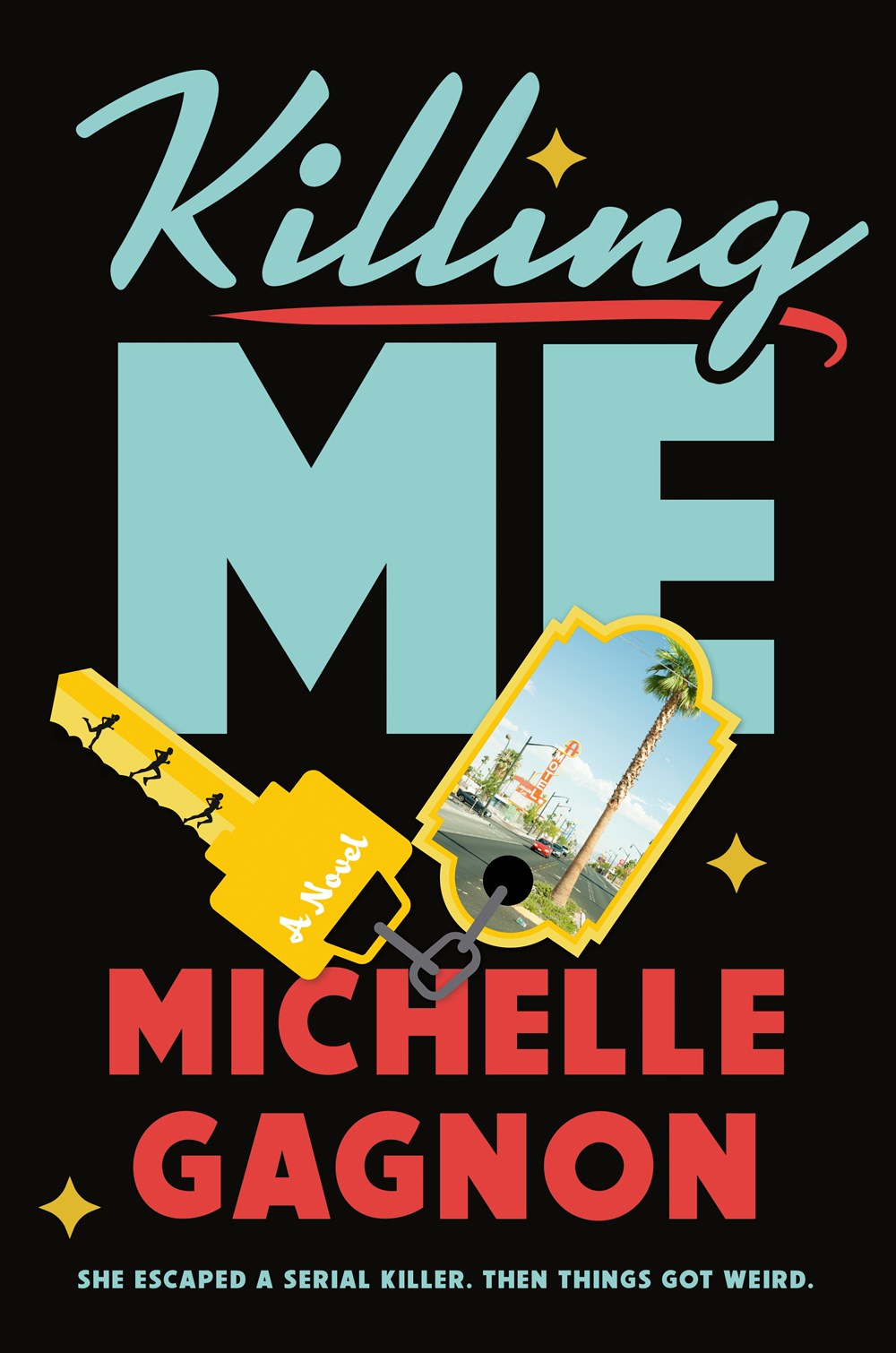
A laugh out loud thriller about women out-smarting a serial killer.
Summary:
Amber Jamison cannot believe she’s about to become the latest victim of a serial killer-she’s savvy and street smart, so when she gets pushed into, of all things, a white windowless van, she’s more angry than afraid. Things get even weirder when she’s miraculously saved by a mysterious woman…who promptly disappears. Who was she? And why is she hunting serial killers?
Review:
When I saw this on NetGalley, I was intrigued by the Final Girls-esque vibe – the women who would be the killer’s victims turning on him. I was skeptical I would find it humorous because, honestly, my funny bone is a little particular. But I actually found myself chortling on page one.
If you’re the type of person with an internal dialogue of self-deprecating humor about bizarre situations you find yourself in, then you’ll probably enjoy the sense of humor in this book. Regardless, you’ll be able to tell quickly if it’s for you or not, because the humor comes so quickly in the book, and that style is what’s present throughout the rest.
This is primarily told in the first person from Amber’s perspective, and she’s dry, acerbic, self-deprecating, but also whip-smart. (There are a few third person chapters that let us see things Amber doesn’t know about.) Amber is simultaneously problematic (she’s a con artist) and easy to root for. She’s richly three-dimensional. The main secondary characters are also rich and well-imagined. It would have been so easy to see a caricature of a sex worker, seedy motel owner, an Evangelical roommate, etc… yet they all are allowed to be more than what they might seem to be at first.
The Las Vegas setting rang very true to me. It depicted both the tourist bits and the seedier local areas quite well. I especially loved the run-down yet beloved film noir stylized motel as compared to the one recently made over to appeal to Gen Z and Millennials. That had me chortling.
I also really appreciated that this is a book whose main character is a lesbian but the plot has absolutely nothing to do with her being a lesbian. You could have almost the exact same book with a heterosexual main character. It’s just Amber so happens to like women. I like having this type of representation. It doesn’t always have to be about the difficulties of coming out or a romance to feature queer people.
The mystery itself was decent. The plot was certainly unique compared to other thrillers I’ve read, and I did not guess the ending. There was one twist that annoyed me only because it was solely a twist because Amber held something back from the reader. But I was willing to forgive it because she sort of breaks the fourth wall and acknowledges that she did it…which was funny.
I hope there’s a sequel, because I think there’s a lot left to explore with Amber, and she has a very interesting set-up at the end of the book.
Overall, I really recommend this to thriller lovers looking for something different. The humor and the plot really deliver.
If you found this review helpful, please consider tipping me on ko-fi, checking out my digital items available in my ko-fi shop, buying one of my publications, or using one of my referral/coupon codes. Thank you for your support!
4 out of 5 stars
Length: 336 pages – average but on the longer side
Source: NetGalley
Buy It (Amazon or Bookshop.org)
Book Review: Hani and Ishu’s Guide to Fake Dating by Adiba Jaigirdar

In this Bangladeshi-Irish YA romance, Hani needs to convince her two best friends that she’s really bisexual. She lies and tells them she’s dating academically focused and acerbic Ishu who agrees to fake date in exchange for help being elected Head Girl.
Summary:
Everyone likes Humaira “Hani” Khan—she’s easy going and one of the most popular girls at school. But when she comes out to her friends as bisexual, they invalidate her identity, saying she can’t be bi if she’s only dated guys. Panicked, Hani blurts out that she’s in a relationship…with a girl her friends absolutely hate—Ishita “Ishu” Dey. Ishu is the complete opposite of Hani. She’s an academic overachiever who hopes that becoming head girl will set her on the right track for college. But Ishita agrees to help Hani, if Hani will help her become more popular so that she stands a chance of being elected head girl.
Despite their mutually beneficial pact, they start developing real feelings for each other. But relationships are complicated, and some people will do anything to stop two Bengali girls from achieving happily ever after.
Review:
I have a soft spot for Irish literature, and when I heard about this book by a Bangladeshi-Irish queer Muslim author with a bisexual main character, it landed on my tbr list very quickly. This was a quick read with an easy to follow story and a sweet, very low spice romance.
I enjoyed Hani and Ishu each separately as character. They take turns narrating in the first person, and I never lost track of who was speaking. This book uses the grumpy/sweet trope quite well. Ishu is only grumpy because she’s focused and willing to speak her mind. Hani quickly sees through that. Hani and Ishu’s cultures are intertwined beautifully in the book. I like it when a book doesn’t feel the need to stop and explain cultural things to the reader. It’s on us to look it up if we want to, and that’s when I really learn things. (Like when Hani makes Ishu porota for breakfast. I looked that up right away. Yum!)
As a bisexual person, I appreciated how the story highlights the specific issues for Hani in coming out as bisexual. It’s clear that her friends would have fairly rapidly accepted her as a lesbian, but they view bisexual as being either confused or attention-seeking. They also don’t believe her because they’ve never seen her date a girl. This is a very realistic depiction of biphobia. Hani is quite confident about who she is and what labels she chooses. In contrast, Ishu is uninterested in labels, although she’s definitely attracted to Hani. It’s not clear if she’s only ever been interested in girls or more or if it’s just that Hani is the first person she’s ever been interested in. But that doesn’t matter to Ishu, and it doesn’t matter to Hani either.
When this book first came out, it was praised for depicting a queer Muslim character. (This article goes into depth about representation for South Asian queer women and interviews the author as well.) There is a perception that you cannot be both queer and Muslim. Both Muslims and non-Muslims hold this viewpoint. Yet people like Jaigirdar are both and depicting this in her books is important to Jaigirdar. Thus, we see Hani engaging with her faith. She goes to the Mosque. She reads the Quran. She eats halal. There is also a perception among many non-Muslims that if someone is serious about Islam and a woman then they will wear the hijab. But it is possible for someone to be devoutly engaging with her faith and also not wearing hijab. The author depicts this in Hani, as well as how she must struggle against the perception that she must not be a “serious” Muslim because she doesn’t wear hijab.
So this book covers a lot of seriously important representation well, and the romance is sweet and believable. What didn’t work for me was the secondary characters. Whereas Hani and Ishu felt well-rounded and interesting, everyone else felt flat and two-dimensional. There also were some kind of big issues that Hani and Ishu seemed to just gloss over. Now, they’re teenagers, so maybe that’s realistic. But Ishu having to hide the relationship from her parents long-term was concerning to me. Also, we never see the characters talk about being in an interfaith relationship. We do hear that Ishu appreciates Hani’s devotion to her faith as part of her. But Ishu is atheist, and we never really hear Hani’s thoughts on that.
Overall, this was a fun read with a lot of important representation. Recommended to readers who enjoy the fake dating and/or grumpy/sweet tropes.
If you found this review helpful, please consider tipping me on ko-fi, checking out my digital items available in my ko-fi shop, buying one of my publications, or using one of my referral/coupon codes. Thank you for your support!
3 out of 5 stars
Length: 352 pages – average but on the longer side
Source: Library
Buy It (Amazon or Bookshop.org)
Get the Reading Group / Book Club Discussion Guide
A beautifully graphic designed 2 page PDF that contains: 1 icebreaker, 9 discussion questions arranged from least to most challenging, 1 wrap-up question, and 3 read-a-like book suggestions
View a list of all my Discussion Guides.
Book Review: Never Ever Getting Back Together by Sophie Gonzales

If you’ve ever wished that two of the women – any two of the women – on a reality tv dating show would just get with each other instead of pining over the questionable man they’re supposedly there for, this one is for you.
Summary:
It’s been two years since Maya’s ex-boyfriend cheated on her, and she still can’t escape him: his sister married the crown prince of a minor European country and he captured hearts as her charming younger brother. If the world only knew the real Jordy, the manipulative liar who broke Maya’s heart.
Skye Kaplan was always cautious with her heart until Jordy said all the right things and earned her trust. Now his face is all over the media and Skye is still wondering why he stopped calling.
When Maya and Skye are invited to star on the reality dating show Second-Chance Romance, they’re whisked away to a beautiful mansion—along with four more of Jordy’s exes— to compete for his affections while the whole world watches. Skye wonders if she and Jordy can recapture the spark she knows they had, but Maya has other plans: exposing Jordy and getting revenge. As they navigate the competition, Skye and Maya discover that their real happily ever after is nothing they could have scripted.
Review:
I’m revealing my age here, but in high school I definitely watched the very first season of The Bachelor (and a few of the following ones). I wasn’t yet out to myself, but even so found myself wondering why the women were such better catches than the man. Apparently, long after I stopped watching, in 2016 two of the women contestants got together with each other. But this happens far less frequently than one might imagine. In any case, when I saw the plot description for this book, let me tell you, I smashed the request button on NetGalley without paying too much attention beyond – two women on a reality tv dating show get together.
Beyond the reality tv show wrapping, this uses the enemies to lovers romance trope. I’ve historically avoided this trope because I had a hard time conceptualizing how I could root for someone to get together with someone they start off disliking strongly. This book showed me otherwise, though. Although it starts in Maya’s perspective in just a couple of chapters it shifts to Skye’s so it becomes easy to see how these two women have come to dislike each other based on a bad misunderstanding. So there’s not actually something enemy-worthy about either of them. That said, both of them are flawed (as are well all) but with the enemies to lovers they start out only seeing the flaws then start to see what’s great about each other. It makes for a really realistic depiction of a healthy relationship at the end, because it’s not all rose-colored glasses. Also, I really like how they move from enemies to women supporting women to women loving each other.
This book is also hysterically funny. I legitimately laughed out loud multiple times while reading it. Representation is decent. Two of the secondary characters are people of color, and one is gay. Both Skye and Maya are bisexual. Because Jordy hid his two-timing ways easily since his family moved all over the world, his exes are also international. Chalonne is funnily contrived in much the way Genovia from The Princess Diaries was. (Incidentally, this got me to wondering if European writers set books in fake countries in the Americas the way we seem to make up fake European monarchies. It seems like most of them that do exist are more of an alternate history where either fascism takes over or the colonies never won independence sort.)
There were three things I wasn’t so keen on in the book that held me back from five stars. First, I just didn’t feel like these characters were 18. They read as more like just out of college than just out of high school to me. It was easy for me to give that a pass, though, because I just headcanoned them older. Related to my mistaken belief that they were older when I started reading it, in the first scene, Maya is at a bar and not drinking. Oh nice! I thought. Representation of sobriety in a romance. But no. She was just under the drinking age in the US. As soon as she gets to Chalonne, where the drinking age is 18, she starts drinking. A lot. Just not wine because she thinks it’s icky. So that was disappointing to me. I also wish that the scene where she has too many vodka jello shots was more realistic. Binge drinking for people assigned female at birth is 4 drinks in one sitting. She has way more than that. She should have been very sick as opposed to having a mild hangover that passed by lunchish. I refuse to believe this reality tv show would have gone light on the vodka when we all know they like for contestants to get drunk. To be clear, while I personally would like to see more romances depicting sober people, I understand it’s realistic to show people drinking. But if we’re going to show them drinking and drinking too much in one night is a plot point, let’s be realistic about how much is too much for a person in a body assigned female at birth. Last, while I get it that Jordy needs to be the bad guy, he’s such a bad guy that I struggled to understand how all these nice women fell for him at all to begin with. I understand from Maya’s perspective he’s gross for valid non-physical reasons (the cheating, the lying, etc…) but we do have the chance to see Skye’s perspective as well, and it’s not clear to me from hers what she sees in him either. Maybe even if just in one of the first scenes where Jordy takes his shirt off Maya found herself attracted to him in spite of knowing his douchey ways, that would have helped me to understand. But she even seems to be turned off by his looks. It left me scratching my head a bit.
Overall, this book was a breath of fresh air, featuring two women bisexual leads who fall for each other surrounded by a very humorous reality tv setting. While some of that setting was a bit difficult to believe, the enemies to lovers plot was so enjoyable that it was easy enough to just focus on them.
If you found this review helpful, please consider tipping me on ko-fi, checking out my digital items available in my ko-fi shop, buying one of my publications, or using one of my referral/coupon codes. Thank you for your support!
4 out of 5 stars
Length: 384 pages – average but on the longer side
Source: NetGalley
Buy It (Amazon or Bookshop.org)
Book Review: A Song for a New Day by Sarah Pinsker

An eerily prescient book that came out in September of 2019 that looks at a future where stay at home orders in response to both bombing attacks and a deadly virus mean performing music live for a crowd is illegal.
Summary:
In the Before, when the government didn’t prohibit large public gatherings, Luce Cannon was on top of the world. One of her songs had just taken off and she was on her way to becoming a star. Now, in the After, terror attacks and deadly viruses have led the government to ban concerts, and Luce’s connection to the world—her music, her purpose—is closed off forever. She does what she has to do: she performs in illegal concerts to a small but passionate community, always evading the law.
Rosemary Laws barely remembers the Before times. She spends her days in Hoodspace, helping customers order all of their goods online for drone delivery—no physical contact with humans needed. By lucky chance, she finds a new job and a new calling: discover amazing musicians and bring their concerts to everyone via virtual reality. The only catch is that she’ll have to do something she’s never done before and go out in public. Find the illegal concerts and bring musicians into the limelight they deserve. But when she sees how the world could actually be, that won’t be enough.
Review:
I wouldn’t have been too surprised if this vision of a dystopian future was written during the height of the pandemic then came out recently. What intrigued me about this book was that it was published in September of 2019. It both predicted stay at home orders and density rules and imagines what would have happened if they’d never been lifted. In an interview in Marie Claire, Pinsker graciously states that this is simply a risk of writing about the near future. Indeed, she’s correct. Near future scifi is about paying attention to the current and predicting where we might end up soon – whether dystopic, hopepunk, or somewhere in-between. Pinsker certainly had her finger on the pulse of both risks and what responses to those risks might be given our technology.
She was a note that hadn’t ever known it fit into a chord.
page 213
While the book is certainly about the risk/reward balance and how to live in a satisfying way, it also is drenched in music and musical references. It was obvious to me that Pinsker is a musician, and I wasn’t surprised at all to look it up later and see she’s an indie rocker. If you’re a musician who wants to see music accurately represented in fiction, just stop reading this review now and go pick up this book. It’s the best integration of music from a musician’s perspective I’ve ever seen in a fiction book.
Another element of this book that is a wise storytelling choice is the dual perspective from Luce and Rosemary. Luce remembers the Before very well. The bombings and pandemic ripped away her success just as she was taking off. Rosemary barely remembers the Before, because she’s about 15 years younger than Luce. She remembers a baseball game at a stadium. But mostly she remembers being in the hospital with the Pox. Luce is able to remember all that was good and not actually that dangerous about Before. But Rosemary is able to see the parts of Now that are good – and there are parts that are. For example, the ability of rural people and people who can’t travel to go see Graceland (and other cultural places) in Hoodspace. There’s one scene in particular where Rosemary argues with Luce about how Hoodspace isn’t all bad that reminded me of some people speaking excitedly about being able to go back to conferences just the way they were before, while people with disabilities tried to get them to listen to the fact that joining things remotely meant they weren’t being left out any longer and how much they didn’t want to lose that. Without spoilers, an important part of the plot is Luce and Rosemary having to figure out together how to take the best from both and make a better future.
An important theme of the book is the balance of staying safe with still being able to live a fulfilling life. Who gets to decide what’s too risky? What actually is too risky? And isn’t that something that’s fluid? Are things that were once risky always risky? And aren’t things that were once safe sometimes too risky for a time? This is definitely a book that comes down on the side of part of life is taking some risks.
Now she understood how much she’d missed; how much had been taken from her in the name of safety and control.
page 268
While this isn’t a book about being queer, it is a book by a queer author full of queer characters. Luce and Rosemary both are attracted to women. Their relationships are mentioned when relevant to the plot but there’s no big coming out arc for either. Also, you can tell this was written by a queer person because Luce and Rosemary are not automatically attracted to each other just because they both happen to be women who are into women. Love to see that. A flaw I often see in books with queer characters by straight author is this idea that all women who are into women are automatically attracted to each other. That’s….not how it works. So I found the representation to be quite authentic. It’s just people living their lives who happen to be queer.
I also want to mention that Luce is Jewish, originally from an Orthodox community that she became ostracized from due to her sexuality. The author is herself Jewish, and I trust people to represent their own faiths and cultures well. I will say, much like the queer representation, there was one scene where Luce thinks about Rosh Hashanah’s in the past after seeing some people throwing paper into the river, and I found it very moving.
Overall, this is a scifi book about a dystopian future written by a queer, Jewish musician. It thus brings authentic representation to all three of these and tells a universal story about balancing safety with risk and using technology to accentuate our lives.
If you found this review helpful, please consider tipping me on ko-fi, checking out my digital items available in my ko-fi shop, buying one of my publications, or using one of my referral/coupon codes. Thank you for your support!
4 out of 5 stars
Length: 384 pages – average but on the longer side
Source: Library
Buy It (Amazon or Bookshop.org)
Book Review: Can’t Spell Treason Without Tea by Rebecca Thorne

A sapphic (wlw) cozy fantasy where a woman commits treason by running away from her lifelong job as the Queen’s private guard to start a remote tea shop with her girlfriend.
Summary:
After an assassin takes Reyna hostage, she decides she’s thoroughly done risking her life for a self-centered queen. Her girlfriend Kianthe, the most important mage in all of the land, seizes the chance to flee responsibility. Together, they settle in Tawney, a town nestled in the icy tundra of dragon country, and open the shop of their dreams.
What follows is a cozy tale of mishaps, mysteries, and a murderous queen throwing the realm’s biggest temper tantrum. In a story brimming with hurt/comfort and quiet fireside conversations, these two women will discover just what they mean to each other… and the world.
Review:
This might be the first time I’ve ever impulse read a book on my kindle’s “recommended for you” list. I was precisely in the mood for something lighthearted and escapist, and none of my library books or currently owned ebooks fit that bill. When I saw this title, I laughed. Then I read the description and, delighted to see it was a cozy fantasy, decided to give it a whirl. (What exactly is cozy fantasy? It’s a newly defined genre, but I like the devoted Reddit subgroup’s definition. The Kenosha Public Library is a little more specific in their definition.)
I mostly expected a plot about opening a tea shop in a fantastical land with dragons. That was really one of three plots. The other two involve Reyna’s treason and Kianthe’s role as the most powerful mage. It was a little more high stakes than I was expecting. People’s lives are at stake at quite a few points. It didn’t particularly stress me out, but I guess I was expecting something more along the lines of – oh no we’re out of honey and can’t get anymore for a month because the dragons are blocking supply chains – sort of thing. That said, even though it wasn’t quite what I was expecting, it was still a relaxing, escapist read to me.
I like the main couple. They have a sweet dynamic with things to overcome. Mainly that Reyna was raised to a role of servitude to those born to power, and Kianthe was born to power. Reyna has to come to understand her worth, and Kianthe does amazingly supporting her through that. I also loved the dragons and griffons. There are two nonbinary secondary characters, both of whom use they/them pronouns. Although the word isn’t used, it’s strongly hinted at that a secondary character who is a woman married to a man is bisexual.
Kianthe is a woman of color, although I personally was left confused by what exactly her skin tone is. It is described as “the color of drying clay” (page 42). I checked on Writing With Color’s skin tone guide, and they do suggest clay as a reference. From the picture on their page, I think it’s supposed to denote reddish-brown. For me, though, when I was reading, I thought of gray clay. Writing With Color does state that creative descriptions can be confusing to the reader and suggests using additional descriptives to help. I don’t think drying brings much clarity to the sentence. Who’s really stood around watching clay dry? They also suggest to consider the associations that come up with a word. Clay is malleable, and I think Kianthe is anything but. Similarly, while Reyna’s hair is described many times as the typical shimmery blonde, I’m still not sure what Kianthe’s looked like due to a lack of description.
The tea shop itself ends up being a giant room full of plants that Kianthe keeps magically alive in the cold climate. I loved that aspect of it. The tea itself is largely inspired by our own world’s tea, and the goodies are essentially the same as here as well. The only exception being bagels with “creamed cheese.” The bagels are treated as kind of exotic and that confused me. Why are bagels exotic and not the scones? Why is cream cheese spelled differently and not bagels? One other thing that bugged me so much I ran an Instagram poll about it is that the tea shop owners make tea incorrectly. They add tea bags to cups of hot water. While this is totally fine in one’s own home when using a microwave and in a hurry, the proper way to make tea is by pouring the hot water over the leaves. Only one respondent in my entire poll said they do it the other way around, and they messaged me to tell me they do it that way because they have to microwave their water. This is a nice tea shop, and Reyna and Kianthe don’t make tea correctly! It hurt my escapism a bit. I wanted scenes of making various types of tea in the various different ways required. I wanted a matcha whisk and special timers for different steep times and different pots for black tea and green tea and herbal tisanes. I wanted Kianthe and Reyna to offer to make special mixes for customers based on something about them like this one tea shop in Portland, Maine did for me once. Essentially, I wanted less book time spent on the stakes and more on the tea. Bonus points if there was a fantastical tea with some wild steep requirements like, I don’t know, you have to add a molted scale from a dragon.
Overall, this is a different fantasy read featuring a w/w couple at the lead. It’s a fun universe to visit and was escapist for me. Recommended to readers looking for a quick, light read who don’t mind some stakes in their cozy.
If you found this review helpful, please consider tipping me on ko-fi, checking out my digital items available in my ko-fi shop, buying one of my publications, or using one of my referral/coupon codes. Thank you for your support!
4 out of 5 stars
Length: 339 pages – average but on the longer side
Source: Kindle Unlimited
Buy It (Amazon or Bookshop.org)
Book Review: A Restless Truth by Freya Marske (Series, #2)

A murder mystery on an ocean liner cruising from the US to the UK in the early 1900s being solved by two women – one of whom is a magician. Both of whom are into each other. Things get spicy…and dangerous.
Summary:
When Maud voyages from the US to the UK on RMS Lyric, she finds a dead body, a disrespectful parrot, and a beautiful stranger in Violet Debenham, who is everything—a magician, an actress, a scandal—Maud has been trained to fear and has learned to desire. Surrounded by the open sea and a ship full of loathsome, aristocratic suspects, they must solve a murder and untangle a conspiracy that began generations before them.
Review:
I’m not sure how I ended up with an advanced copy of the second book in The Last Binding series – when I hadn’t read the first. I’m assuming either I requested it, not realizing it was a second book or it was sent to me based on my reading history with the assumption it didn’t matter. The series aspect is less “the story happens in a row” and more “everyone featured is living in these alternate history version of the early 1900s plus magic.” Apparently the first book in the series features a m/m pairing (Amazon, Bookshop.org), whereas this one stars a f/f pair.
I didn’t struggle too much to figure out what’s going on. The author does refrain from explaining much for the first chapter or two. But that’s because the book starts essentially in media res – with the murder happening. After that has occurred we slow down for a minute, and there’s a refresher of the rules of the universe. It didn’t take me too long to catch up and get into it.
One thing that did surprise me was the spice level of this romance. I was expecting very light spice with most encounters occurring off-screen after a fade to dark. That is not the case. Things get very explicit. Let’s put it this way….at least one of the scenes would have had to have been cut to manage to squeak in an R rating for explicitness. There are three scenes total, and each takes up a whole chapter. To me, this much spice feels like erotica jammed into a romance. I prefer the two separately.
The pairing here is grumpy/cheery. Violet is the grumpy, and I adored her. I liked Maud too, but Violet was someone I could see a whole book’s perspective on. Perhaps I’m biased since Violet is bisexual and the quintessential theater geek. I just really enjoyed her. But Maud is nice enough too. I liked their pairing well enough.
The mystery is substantial enough to hold up a plot. I enjoyed the animals and sneaking around the boat. I did think a bit more attention could have been paid to the class and race issues that sort of came up and got a bit glossed over. I don’t expect preaching in a book but it might have been interesting to at least have Maud and Violet see the second or third class areas of the ship on one of their many attempts to outrun their pursuers. (Somehow they always seemed to end up in the cargo hold instead). Maud talks with disdain of her parents only giving charity when others can see it, but Maud herself doesn’t seem to do much giving either. Violet, at least, offers to become the patron of an all-Black opera. (The real history of Black opera.)
Overall, I liked getting to know Violet, and it was an interesting world to visit. But the spice level was far too hot for what I personally prefer in romance, sliding more into an erotica category in my opinion. It also seems to me that the first book may have been quite different from this one, so readers of the first should come in aware of these differences.
If you found this review helpful, please consider tipping me on ko-fi, checking out my digital items available in my ko-fi shop, buying one of my publications, or using one of my referral/coupon codes. Thank you for your support!
3 out of 5 stars
Length: 388 pages – average but on the longer side
Source: NetGalley
Buy It (Amazon or Bookshop.org)
 Support my work with a tip or browse my shop for curated book club guides, how to guides, cross-stitch patterns, and more!


This work by Amanda Nevius is licensed under a Creative Commons Attribution-Noncommercial-No Derivative Works 3.0 United States License.
 Opinions of a Wolf