
Archive
Book Review: Flung Out of Space: Inspired by the Indecent Adventures of Patricia Highsmith by Grace Ellis and Hannah Templer

Summary:
Flung Out of Space is both a love letter to the essential lesbian novel, The Price of Salt, and an examination of its notorious author, Patricia Highsmith. Veteran comics creators Grace Ellis and Hannah Templer have teamed up to tell this story through Highsmith’s eyes—reimagining the events that inspired her to write the story that would become a foundational piece of queer literature.
This is not just the story behind a classic queer book, but of a queer artist who was deeply flawed. It’s a comic about what it was like to write comics in the 1950s, but also about what it means to be a writer at any time in history, struggling to find your voice.
Author Grace Ellis contextualizes Patricia Highsmith as both an unintentional queer icon and a figure whose problematic views and noted anti-Semitism have cemented her controversial legacy. Highsmith’s life imitated her art with results as devastating as the plot twists that brought her fame and fortune.
Review:
I found this thanks to the Bitches on Comics podcast and was pleasantly surprised that my library had a copy. I have not myself yet read The Price of Salt. Although I have watched Strangers on a Train and loved it. I was shocked to discover the same author who wrote that classic piece of noir also wrote the first published lesbian book with a happy ending.
I love the content note at the beginning of this graphic novel. It’s too long to post here, but the authors eloquently describe the difficult task of loving literature written by a deeply flawed person. They also warn about what to expect in the book. Most of what they depict is Highsmith’s well-known anti-Semitism (using no slurs).
The art in this book is gorgeous. I especially love the pages where Highsmith is writing at her typewriter and scenes of what she’s writing are depicted around her. I love noir, and these images are just…well they’re so beautiful, I would frame them and hang them up in my home.
Something that was interesting to me was how Highsmith got her start writing in comics but loathed them and didn’t want her name put on them. I was tickled by the fact this handling of her life was itself a comic.
As a writer myself, I found the scenes about her struggles to get her first book deal (Strangers on a Train) quite relatable. Not surprising given that authors wrote this too.
Two things held this back from five stars for me. The first is a scene where a ring is thrown into a pond, and a duck is gazing at it. I was so distressed at the idea of the cute duck eating it, I couldn’t enjoy the scene. The second, and what others might find more important, was that, from what I’ve read since about Highsmith, she preferred the company of men but was only sexually attracted to women. In my reading of the comic, she seemed to loathe men and like the company of women. This is extra odd because she’s even been called a misogynist. Maybe the authors of this graphic novel have a different interpretation of her after reading all the primary sources. I’d have liked a note about that from them, if so.
Overall, this is a quick read with gorgeous art that eloquently explores a flawed human being who impacted both mainstream and queer 20th century literature.
If you found this review helpful, please consider tipping me on ko-fi, checking out my digital items available in my ko-fi shop, buying one of my publications, or using one of my referral/coupon codes. Thank you for your support!
4 out of 5 stars
Length: 208 pages – average but on the shorter side
Source: Library
Buy It (Amazon or Bookshop.org)
Book Review: Stage Dreams by Melanie Gillman
Summary:
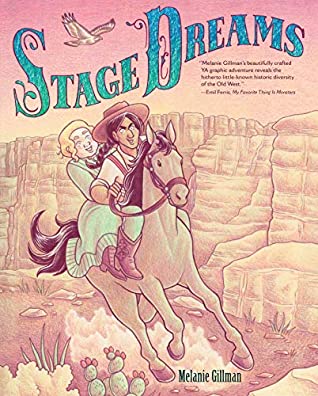
In this rollicking queer western adventure, acclaimed cartoonist Melanie Gillman (Stonewall Award Honor Book As the Crow Flies) puts readers in the saddle alongside Flor and Grace, a Latina outlaw and a trans runaway, as they team up to thwart a Confederate plot in the New Mexico Territory. When Flor—also known as the notorious Ghost Hawk—robs the stagecoach that Grace has used to escape her Georgia home, the first thing on her mind is ransom. But when the two get to talking about Flor’s plan to crash a Confederate gala and steal some crucial documents, Grace convinces Flor to let her join the heist.
Review:
This is a graphic novel for readers who love Westerns but are tired of them erasing BIPOC and queer people. In this read you get all the fun of a Western but it’s peopled with both BIPOC and queer people.
The book starts with a stagecoach robbery by Flor (a Latina woman) and her pet hawk. She kidnaps a white damsel (Grace) who turns out to be a young trans woman on the run both to avoid her family’s wish for her to serve in the Confederate army and to seek out performing on the stage. Grace convinces Flor to let her help in a plot to spy on some Confederate documents.
Since this is a short book, there aren’t a ton of characters. It’s mostly the other folks on the stagecoach with Grace (all deliciously hateable), the tailor who helps them get ready for the Confederate gala, and the Confederate gala attendees. This doesn’t leave a ton of room for additional BIPOC in the story, but the tailor is Luis who is Black and completely supportive of Grace.
The book does an artful job of establishing that Grace is trans without ever using the word or deadnaming her. I had been concerned that Grace’s visible depiction might fall into the cringer category of visibly “man in a dress” like in the old movies when male characters dress as women to escape something. This absolutely does not happen with Grace. She simply looks like a larger woman. (Larger than Flor, close in size to the men in the stagecoach). There are also multiple times when the existence of other trans people are established. Luis says Grace isn’t the only larger woman he’s designed for. Flor discusses other women like Grace performing on stage out west.
I enjoyed Flor but wanted a little more backstory on her. What made her start robbing stagecoaches? How did she get the pet hawk? How does she know Luis? I get it she’s a more close-lipped character, but Luis could have dropped a few tidbits about the two of them, and I get the vibe from Grace that she might be the type to be able to lure information out of people with her charm.
The spying plot worked and fit into the small amount of space allotted. I liked that it gave Grace and Flor a reason to team up and showed them as active rather than passive. I did wish for a little more detail in these scenes, though. Specifically, when someone recognizes Grace, what is their relationship to her?
I love the art and thought it worked great for a Western story. Only when I looked it up later did I discover Gillman does everything by hand with colored pencils. Truly amazing and translated into a book that was beautiful to read.
Overall, this was a fun, beautifully drawn, sapphic read with a lot of diversity that establishes trans people as existing in history. It just left me wishing for more – more background and for Flor and Grace’s adventures to continue.
If you found this review helpful, please consider tipping me on ko-fi, checking out my digital items available in my ko-fi shop, buying one of my publications, or using one of my referral/coupon codes. Thank you for your support!
4 out of 5 stars
Length: 104 pages – novella
Source: Library
Buy It (Amazon or Bookshop.org)
Get the Reading Group / Book Club Discussion Guide
A beautifully graphic designed 2 page PDF that contains: 1 icebreaker, 9 discussion questions arranged from least to most challenging, 1 wrap-up question, and 3 read-a-like book suggestions
View a list of all my Discussion Guides.
Book Review: Fiebre Tropical by Juliana Delgado Lopera

Summary:
Lit by the neon glow of Miami, this heady, Spanglish debut novel follows a Colombian teenager’s coming-of-age and coming out as she plunges headfirst into lust and evangelism.
Uprooted from Bogotá into an ant-infested Miami townhouse, fifteen-year-old Francisca is miserable in her strange new city. Her alienation grows when her mother is swept up in an Evangelical church, replete with abstinent salsa dancers and baptisms for the dead. But there, Francisca meets the magnetic Carmen: head of the youth group and the pastor’s daughter. As her mother’s mental health deteriorates, Francisca is saved and falls for Carmen, even as their relationship hurtles toward a shattering conclusion.
Review:
I’ve been learning Spanish off-and-of since I was nine or so, only getting more serious in the last few years. I thought this delightful mix of queerness, Miami, and being an evangelical teenager would be the perfect match for my first dive into a Spanglish book. It absolutely held my interest with its unique and engaging storyline.
I was raised varying flavors of Evangelical, so the thing that struck me immediately when reading this was how easy it was for me to decipher certain bits of Spanish just from what my own churches said. (Out of curiosity, I double-checked with a dictionary, and I was indeed correct). The depiction of Evangelicalism is just so spot on. The only thing that seemed odd to me was the idea of baptizing a dead baby – major plot point of the beginning of the book. I’ve literally never heard of this being done in any Evangelical church. But an aspect of being Evangelical (non-denominational) is each church interprets the Bible in their own way, so I gave this a pass as being a quirk of this particular church that seems to be largely made up of converts from Catholicism.
What was most engaging to me about the book was Francisca’s slow sexual awakening. How she’s not sure if what she’s feeling when alone with Carmen is Jesucristo or perhaps the Espíritu Santo or perhaps something else? This all leads up to a scene between Carmen and Francisca that I found absolutely simultaneously erotic and moving and yet they don’t actually do anything sexual. What this book does a great job depicting, actually, is how emotional and spiritual intimacy can hold so much more realness than sexual touching.
There are also two chapters in the book dedicated to Francisca’s mother’s teen years (Mami) and Francisca’s grandmother’s teen years (Tata). I found myself with much more empathy for Mami than Tata after reading these. But I also appreciated how they demonstrated the spiritual and relationship struggles across generations.
One thing that did turn me off from the characters was how the whole family seems to have a dislike for animals (as in living animals, not as in they don’t eat them). This just…confuses me. How can you dislike all animals? For Tata, the dislike extends beyond mere preference in a way I couldn’t forgive. With Francisca, I tried to brush her dislike of the local ducks off as general teenage grumpiness, especially at being uprooted from home in Bogotá, but after seeing how Tata was as a teenager, I suspect it just is the way the family is. I’m a big lover of animals, so that made it harder for me to relate to the characters.
Some reviews dislike the unanswered questions in the book – like why did the family have to leave Bogotá? I forgave this because it’s narrated by a teenager. When there’s upheaval in the family life of teens, many of them won’t go into great details about it. They’ll just be like – this is happening and it’s terrible. So I found that to be quite authentic to the teenaged narrator’s voice. Someone else pointed out that they never go to school in Miami. I would say…school is never discussed. But the more I think about it, the more this makes sense to me. The church is all-encompassing to Francisca. Of course it’s all she talks about to us. It’s all that matters. Nothing important happened at school. In contrast in Bogotá her entire life was school because school was also the church for her, as she attended Catholic school. It makes sense to me.
My experience of this book as a Spanish language learner was that it was just the right mix of things I understood, things I could guess from context, and things I had to look up (many of which turned out to be Colombian slang). I can’t guess what your experience would be if you are bilingual or routinely speak Spanglish yourself. I’d be interested to hear your experience if that describes you. Did you find the Spanglish authentic? If you don’t know any Spanish, I’d say that you can still get the jist of the story without looking up every single word, but you’ll miss some of Francisca’s sense of humor and personality. It might be worth looking up at least some of the longer sentences or repeated words (which are usually swear words) to get some context.
Overall, this is a unique read with a fun setting and a well-rounded main character. I didn’t always like her but I found myself rooting for her nonetheless, and I enjoyed practicing my Spanish along the way.
If you found this review helpful, please consider checking out my digital items available in my ko-fi shop, buying one of my publications, using one of my referral/coupon codes, or tipping me on ko-fi. Thank you for your support!
4 out of 5 stars
Length: 240 pages – average but on the shorter side
Source: library
Buy It (Amazon or Bookshop.org)
Book Review: On a Grey Thread by Elsa Gidlow

Summary:
Published in 1923, this poetry collection was the first in North American history to openly express lesbian desire. Both personal and political, Gidlow’s poems express the poet’s complex feelings as a young woman whose political ideology and sexual identity ran counter to the traditional values of her time.
Review:
For Pride Month, I wanted to push myself a little by reading from a genre I read less often – poetry. I’ve also been striving to connect more with queer history, so I thought this groundbreaking collection was a great match.
The poems are collected into four sections – Youth, Grain and Grapes, Inner Chamber, and In Passing. If you are here for women loving women content…skip to the Inner Chamber section. Although, I am glad I read them all in order, because I do feel like they told a subtle overarching story.
The first poem in the collection beautifully explores the meaning of life and what makes us who we are via beads on a grey thread. Other poems consider the beauty of nature and sadness/loneliness (in a way that reminded me of 90s emo culture). In fact, I think what struck me the most when reading these was just how of the moment and today they felt, in spite of being written almost 100 years ago.
Since the entire collection is out of copyright, let me close my review by sharing my favorite in its entirety.
“Episode”
I have robbed the garrulous streets,
Thieved a fair girl from their blight,
I have stolen her for a sacrifice
That I shall make to this mysteried night.I have brought her, laughing,
To my quietly sinister garden.
For what will be done there
I ask no man’s pardon.I brush the rouge from her cheeks,
Clean the black kohl from the rims
Of her eyes; loose her hair;
Uncover the glimmering, shy limbs.I break wild roses, scatter them over her.
The thorns between us sing like love’s pain.
Her flesh, bitter and salt to my tongue,
I taste with endless kisses and taste again.At dawn I leave her
Asleep in my wakening garden
(For what was done there
I ask no man’s pardon.)
I hope this review entices you to read some (more) classic queer poetry.
If you found this review helpful, please consider tipping me on ko-fi, checking out my digital items available in my ko-fi shop, buying one of my publications, or using one of my referral/coupon codes. Thank you for your support!
4 out of 5 stars
Length: 73 pages – novella
Source: Archive.org
Buy It (Amazon or Bookshop.org)
Get the Reading Group / Book Club Discussion Guide
A beautifully graphic designed 2 page PDF that contains: 1 icebreaker, 9 discussion questions arranged from least to most challenging, 1 wrap-up question, and 3 read-a-like book suggestions
View a list of all my Discussion Guides.
Book Review: Solo Dance by Li Kotomi, translated by Arthur Reiji Morris

Summary:
Cho Norie, twenty-seven and originally from Taiwan, is working an office job in Tokyo. While her colleagues worry about the economy, life-insurance policies, marriage, and children, she is forced to keep her unconventional life hidden—including her sexuality and the violent attack that prompted her move to Japan. There is also her unusual fascination with death: she knows from personal experience how devastating death can be, but for her it is also creative fuel. Solo Dance depicts the painful coming of age of a queer person in Taiwan and corporate Japan. This striking debut is an intimate and powerful account of a search for hope after trauma.
Review:
This is a gut-wrenchingly beautiful read that I couldn’t put down.
The story starts with Cho in Japan. We learn what led to her emigration from Taiwan through a combination of flashbacks and her rereading her own college journal entries. Cho is a writer who has been obsessed with death from a young age. But she also went through a devastating trauma. The PTSD from that event destroyed her budding relationship with another young woman and haunts her to this day.
I think it’s important for anyone considering this book to know coming into it what the devastating trauma was. It’s central to the book and can be quite triggering for some. Cho was raped by a stranger who specifically targeted her due to her same-sex relationship. Although Cho does encounter kind and understanding people who validate how wounded she is from this experience, there are others who expect her to just get over it. Worse, some people blame her for it. She feels shame for what has happened to her. While this is realistic, it is painful to read about.
So this book is about many complex things. It’s about how Cho was obsessed with death from a young age. Why is that? Is it ok to feel that kind of emo way? It’s also about the systemic exclusion of queer and trans people. Cho also travels the world and sees how queerness and Pride and love exist in many countries. While she wants a sense of belonging, just what is the right way to belong is a question left for the reader. Ultimately, though, this is a book about trauma and healing from trauma. How trauma isolates a person, even when other people try, imperfectly, to reach out.
It’s easy as a queer westerner to get caught up in what queerness means in the west. It’s important to dive into what queerness means and looks like in other cultures in order to better grasp how we might create a community that’s more inclusive of all types of origins and experiences.
Although this novella is challenging, it’s also beautiful. If you feel ready to engage with the realistic trauma depicted in it, I encourage you to pick up a copy.
If you found this review helpful, please consider tipping me on ko-fi, checking out my digital items available in my ko-fi shop, buying one of my publications, or using one of my referral/coupon codes. Thank you for your support!
4 out of 5 stars
Length: 149 pages – novella
Source: NetGalley
Buy It (Amazon. This book is not available yet on Bookshop.org)
Get the Reading Group / Book Club Discussion Guide
A beautifully graphic designed 2 page PDF that contains: 1 icebreaker, 9 discussion questions arranged from least to most challenging, 1 wrap-up question, and 3 read-a-like book suggestions
View a list of all my Discussion Guides.
Book Review: Burn Down, Rise Up by Vincent Tirado

Summary:
For over a year, the Bronx has been plagued by sudden disappearances that no one can explain. Sixteen-year-old Raquel does her best to ignore it. After all, the police only look for the white kids. But when her crush Charlize’s cousin goes missing, Raquel starts to pay attention—especially when her own mom comes down with a mysterious illness that seems linked to the disappearances. Raquel and Charlize team up to investigate, but they soon discover that everything is tied to a viral worldwide game called the Echo Game. If you play it wrong, it can trap you in an echo – a parallel universe based on one of the worst times your particular region has seen.
Review:
I love a horror based around a bunch of people doing something that tempts the supernatural into coming to get them, and then being surprised when it does. (And when I say “love” I mean I will literally throw you out of my house if you say Candyman at a mirror twice). When I saw there was a sapphic version of this trope coming out, you bet I smashed the request button on NetGalley so hard.
The first hurdle any horror like this has to get over is giving us a horrifying scene right off-the-bat that’s scary even though we don’t really know what’s going on. This book does a great job at that. Charlize’s cousin, Cisco, has been missing. He comes back from being missing “wrong” and accidentally gives “something” that’s clearly supernatural to Raquel’s mom, who’s a nurse. This beautifully sets up both Charlize and Raquel to be heavily invested in what exactly is going on in their neighborhood. They used to be close friends but now they’ve drifted to acquaintances, and Raquel has the hots for Charlize. It’s just the right set-up.
The next hurdle the book has to get over is why are the Black kids sneaking out at night to play this viral game tempting the supernatural at 3am? The book takes this head-on with the characters acknowledging doing such a thing doesn’t go with their culture. Charlize and Raquel are motivated to save their family members, but what about Cisco? We learn he befriended a bunch of white theater kids who asked him to come along and do it as part of some theater kids bonding activity. I have to say, as a once upon a time theater kid myself, this sort of thing rang as very true.
So is the horror scary? Yes, largely because it’s starting to reach out into the Bronx even among those who aren’t playing the Echo Game. But I will say, I didn’t think it was terrifyingly scary. If this was a movie, I could sleep after it. Unlike The Ring, which made me terrified of being in the same room with my own television for two weeks. So I’d say it’s moderate on the scary scale. It’s definitely kind of gory, and the peril is real.
The relationships are interesting, realistic, and Raquel has just the right amount of them. She has her best friend, his brother, Charlize, Cisco, her father, and her mother. The fact that she was living with her mother and has to move in with her bachelor pad father while her mother is ill was one of my favorite parts of the book. Her dad clearly loves her and they were absolutely part of each other’s lives before, but there’s a difference between the dad who loyally pays child support who you see a few times a month and the dad you live with. I appreciated how that difference was drawn out, acknowledging the awkwardness without blaming either of them. I also liked how her dad both brought out the Latinx aspect of the story, as well as giving her a direct connection to when the Bronx burned in the 1970s. (This time period, of course, is when the echo draws from).
The Charlize/Raquel situation was cute. I liked how Raquel’s best friend, Aaron, also likes Charlize, and he just wants Raquel to be honest with him about liking her as well. I was a little bit confused about why Raquel has some internalized homophobia making it hard for her to accept that she likes Charlize. It was unclear to me if this was coming from her family (who seemed very accepting) or if it was just worrying how her peers would react or what exactly. I think a richer development of that would have helped make the scenes where Raquel works on accepting herself more powerful.
Overall, this is a fun take on the viral game tempting the supernatural trope. The setting of the Bronx and the main character’s Afro-Latinx culture are both well developed. It’s a medium scary read that will certainly appeal to YA readers.
If you found this review helpful, please consider tipping me on ko-fi, checking out my digital items available in my ko-fi shop, buying one of my publications, or using one of my referral/coupon codes. Thank you for your support!
4 out of 5 stars
Length: 352 pages – average but on the longer side
Source: NetGalley
Buy It (Amazon or Bookshop.org)
Get the Reading Group / Book Club Discussion Guide
A beautifully graphic designed 2 page PDF that contains: 1 icebreaker, 9 discussion questions arranged from least to most challenging, 1 wrap-up question, and 3 read-a-like book suggestions
View a list of all my Discussion Guides.
Publication Announcement: Short Story “The University of Late-Night Moans”
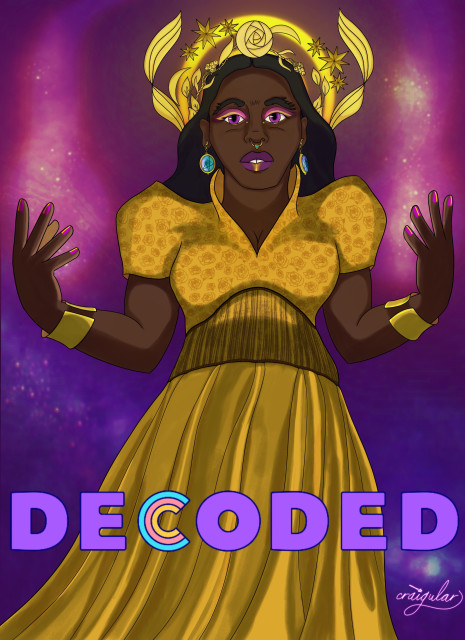
I am thrilled to announce that I have a short story coming up in issue 3 of Decoded Pride: A science fiction, fantasy, and horror story-a-day anthology for Pride month!
This is a really cool project. The editors worked hard to select and curate a collection of flash fiction, short stories, longer fiction, and comics by queer and trans authors with queer and trans themes to celebrate Pride month. Have you been frustrated with how corporate Pride has become? Are you a more introverted queer person? Then this is the ideal way to celebrate Pride this year!
The way it works is you pay the $14.99 subscription fee, and then you have access to the website where all the creative works drop each day. In the late summer or early fall, you’ll be sent a color PDF of all the stories plus interviews with all 30 authors (yes, including me!) You can subscribe at any point throughout the month and get retroactive access to the previous stories. After the month is over, you can still purchase the PDF. As a thank you for being one of my supporters, now through June 30th you can get $2 off your purchase with the discount code FrienzNFam at check-out.
My short story will published on Thursday, June 9th. It’s a sapphic fantasy romance. That means expect something supernatural. Expect women loving women. And I promise you a happy ever after. Also, expect some 90s nostalgia.
Here’s the blurb:
It’s 1998, and Leonora’s friend Virginia is helping her investigate the moans coming from the cemetery across the train tracks from her dorm.
Please be sure to check out my Publications Page for my other work.
Book Review: Rubyfruit Jungle by Rita Mae Brown

Summary:
This bawdy book originally published in 1973 tells the story of Molly Bolt, the adoptive daughter of a dirt-poor Southern couple who boldly forges her own path in America. With her startling beauty and crackling wit, Molly finds that women are drawn to her wherever she goes – and she refuses to apologize for loving them back.
Review:
I’ve been trying to read more queer classics and not solely limit myself to modern queer books. I stumbled upon this when looking for other books published around the same time as Tales of the City (review). While I absolutely appreciate how groundbreaking this was at the time, it didn’t work for me. I’ll have to give a couple of spoilers to be able to discuss why, so be forewarned!
Let’s start with what I did like. The prose calls out the racism of the north at a time when Jim Crow was still around in the south. Just because things may be better from a legal perspective doesn’t mean they actually are any less racist. This isn’t done in a preachy way. It comes about smoothly as Molly’s family moves from the hills of Pennsylvania to Florida. I really liked Molly’s dad, and the arc of her relationship with him. I loved how Molly’s first crush in middle school on another little girl named Leota is depicted. I appreciated how key moments in Molly’s life makes it clear she has to conform to succeed, and she refuses to do it. It hauntingly shows how minoritized people are kept down.
This is told in the first person, and Molly isn’t, to me, particularly likeable. I really wanted to like her. But I didn’t. She’s crass, abrasive, quite reactionary. She looks down on other people even while insisting she doesn’t. Ok, so for most of the book she’s a teenager or a young adult working her way through college. No one is perfect, and she has a lot stacked against her. But I would say she just becomes more full of herself as the novel progresses. I didn’t feel like she really learned anything. I suspect I’m supposed to think she did based on her final film school project, but it was hard for me to be moved by a film I didn’t see.
Something about Molly that particularly bothered me was an instance that really reminded me of some movies from the 70s I’ve seen, where a woman will say no to sex, but then the guy gets a little rough, gets her a little drunk, and later she basically says she’s grateful he took “advantage of her” because she really wanted it deep down (aka he raped her but she liked it). Well, Molly takes on the role of the aggressor in just such a situation in this book.I get it that this was a common trope at the time this book was written, and I’m imagining the goal was to show the same scene but with two women. But just because something was commonly shown in media at the time doesn’t make it right. I just can’t view Molly as a heroine when that’s how she engages with other women.
The other thing that’s problematic about Molly is that, since she’s adopted, she likes to say she doesn’t technically know her race. She bases this on having dark hair. At the end of the book she finds out she’s half…wait for it…French. She sees a photo of her father, and he’s French with dark hair. She never confronts herself about why she had this weird obsession with imagining herself as partially another minoritized race.
One more thing I feel I ought to mention is that Molly has a tendency to speak very negatively about butch presenting lesbians. It’s ok to not be into dating butches yourself. It’s even ok if you yourself find the butch/femme dynamic odd (although why you should care is beyond me). What bothers me, though, is how she describes butch women every single time she sees them. It’s downright insulting. You can be kind to other queer people you aren’t attracted to.
Again, I don’t expect characters to be perfect. Indeed, I think first person books with an imperfect main character are important for understanding other people’s perspective. But I do expect some growth and development over time. I felt throughout the book like Molly had no interest in self-improvement or reflection, and she never even has an epiphany that maybe she should.
Overall, why I understand why this book was groundbreaking, and it certainly had some memorable scenes, I felt the main character is unlikeable and doesn’t grow or change over time. I really liked her dad though. He was a morally flawed, complex character who I really felt could have held up his own fascinating book.
If you found this review helpful, please consider tipping me on ko-fi, checking out my digital items available in my ko-fi shop, buying one of my publications, or using one of my referral/coupon codes. Thank you for your support!
3 out of 5 stars
Length: 221 pages – average but on the shorter side
Source: Library
Buy It (Amazon or Bookshop.org)
Book Review: Tales of the City by Armistead Maupin (Series, #1)

Summary:
San Francisco, 1976. A naïve young secretary, fresh out of Cleveland, tumbles headlong into a brave new world of laundromat Lotharios, pot-growing landladies, cut throat debutantes, and Jockey Shorts dance contests. The saga that ensues is manic, romantic, tawdry, touching, and outrageous
Review:
This was first published as a novel in 1978, although it was published prior to that as a serialized story in a San Francisco newspaper. It is considered a classic of LGBTQIA+ literature. The first tv show miniseries based upon it that premiered in 1994 had a same-sex kiss made history and was also protested (source). The Netflix reboot/update in 2019 brought fresh attention to it, and I thought it was high-time I read the classic.
It’s clear that some restraints were placed upon Maupin, either by the newspaper or simply the culture of the time. Our window into the queer world in San Francisco is given to us by Mary Ann Singleton – a single cis straight woman who comes from Cleveland for a visit and decides to stay. She’s invited into Barbary Lane and declared one of us, although why exactly she’s considered part of the found family is not resolved in the first book.
The book is definitely a product of the 1970s. 1970s fashion and freewheeling culture are everywhere. Lack of acceptance of queer people is a real threat and concern, and the AIDS crisis had not yet hit. It’s an interesting snapshot of a very particular point in time.
While characters are quite loose about who they will sleep with, there’s also a lack of diversity in the cast of main characters that’s jarring. Especially for a story set in a city that’s so diverse. Particularly noticeable to me was how the Asian-American characters are all peripheral, even with this being San Francisco. I don’t think this lack of diversity is a product of its time – there were other very forward-thinking works of fiction at the same time as this. This lack of diversity is something to keep in mind when approaching the book.
There are also two plot twists that revolve around race, and I don’t think either is handled with particular grace. The race of someone’s lover is identified by pointing to a yellow flower. This is obviously offensive. While it seems to me that the character who does this is someone we’re supposed to think badly of, on the other hand, it seemed to me that this was supposed to be a funny moment. And it definitely was not. In the other case, a character reveals that they believe that the only way to become a successful model is to be Black. It is unclear what the other character they are speaking to thinks of that. I think this instance may be intentionally leaving it up to the reader to decide what they think, but it’s also a strange plot point in a book that’s mostly about hookups and very little about careers.
This reminded me very much of other books and tv shows that have dramatic, gasp-inducing storylines with large casts of characters whose lives intertwine and overlap in mysterious ways. Think Jane the Virgin or Desperate Housewives just with fewer identical twins and less murder (so far…..) and more queer characters. If you like that type of storytelling, then you’ll likely find this hilarious and engaging. If you don’t, then you probably won’t.
I personally found it to be a rapid read with an engaging storyline and funny chapter titles. I wished it had been more forward-thinking and intersectional, but I also respect that the mere depiction of queer people in a soap opera like story was quite groundbreaking. I appreciate it for what it is, and it was a fun, quick read.
4 out of 5 stars
Length: 386 pages – average but on the longer side
Source: Library
Buy It (Amazon or Bookshop.org)
Get the Reading Group / Book Club Discussion Guide
A beautifully graphic designed 2 page PDF that contains: 1 icebreaker, 9 discussion questions arranged from least to most challenging, 1 wrap-up question, and 3 read-a-like book suggestions
View a list of all my Discussion Guides.
If you found this review helpful, please consider tipping me on ko-fi, checking out my digital items available in my ko-fi shop, buying one of my publications, or using one of my referral/coupon codes. Thank you for your support!
Book Review: Getting Clean with Stevie Green by Swan Huntley

Summary:
At thirty-seven, Stevie Green has had it with binge drinking and sleeping with strange men. She’s confused about her sexuality and her purpose in life. When her mother asks her to return to her hometown of La Jolla to help her move into a new house, she’s desperate enough to say yes. The move goes so well that Stevie decides to start her own decluttering business. She stops drinking. She hires her formerly estranged sister, Bonnie, to be her business partner. She rekindles a romance with her high school sweetheart, Brad. Things are better than ever—except for the complicated past that Stevie can’t seem to outrun.
Who was responsible for the high school scandal that caused her life to take a nosedive twenty years earlier? Why is she so secretive about the circumstances of her father’s death? Why are her feelings for her ex-best friend, Chris, so mystifying? If she’s done drinking, then why can’t she seem to declutter the mini wine bottles from her car?
Review:
I smashed the request button on NetGalley when I read this description. A mixture of quit lit (literature about addiction and recovery) and decluttering? Sign me up! And it did not disappoint. In fact, it surprised me with delightful queer content I wasn’t expecting.
It’s important to know that Stevie’s ex-best friend Chris is a woman. Chris also came out in high school as a lesbian around the time of the scandal that so traumatized Stevie. Stevie has also slept with women, although only the men are mentioned in the description. The only hang-ups about Stevie’s sexuality seen in her circle of family, friends, and even lovers, come from Stevie herself. This is a great example of how addiction can freeze someone’s self-awareness and self-acceptance. Stevie began drinking in high school, and it’s a trueism in recovery circles that you freeze at the age of development you were at when you began drinking until you stop. Then you can begin maturing again. So is it a bit frustrating that Stevie is 37 and kind of acting like a teenager? Yes. But is it realistic? Also yes.
When we meet Stevie she is newly sober and running her decluttering business. I loved the depiction of how Type A Stevie is about her days and routines. This is so accurate to early recovery. One of my favorite parts is how she starts every day by standing in a Wonder Woman pose and saying affirmations to herself repeatedly.
How had I become a woman who chanted affirmations to herself while doing this ridiculous pose? Because it was supposed to make me feel better. I would have done anything to feel better.
location 806
Early recovery really is this incredible moment of being willing to do anything to feel better, and this is wonderfully depicted here.
The scenes with Stevie decluttering with her clients also shine. I’m a fan of decluttering YouTube videos and tv shows, and these gave me the same thrill as watching those. I loved seeing the variety of types of clutter the clients had, their personalities, and how Stevie interacted with them. She also quickly ends up working with her sister, Bonnie, who is also going through it after her boyfriend of 15 years left her for a younger woman. Bonnie and Stevie have great sisterly chemistry, and her addition to the business helps keep the pace moving forward.
Ultimately, it’s only when Stevie fully faces both her past and her father’s death that she can really begin to heal and move on. I thought this requirement hit her in the right way and with the right force. The pacing of this book really was quite good. And while there’s always the concern when reading queer lit that there will be a tragic ending, don’t worry, readers, there’s a happy ever after for Stevie. This is truly a lighthearted queer romance that also tackles the serious topic of recovery. It was like eating a salted caramel ice cream – sweet with just the right amount of savory.
4 out of 5 stars
Length: 304 pages – average but on the longer side
Source: NetGalley
Buy It (Amazon or Bookshop.org)
Get the Reading Group / Book Club Discussion Guide
A beautifully graphic designed 2 page PDF that contains: 1 icebreaker, 9 discussion questions arranged from least to most challenging, 1 wrap-up question, and 3 read-a-like book suggestions
View a list of all my Discussion Guides.
If you found this review helpful, please consider tipping me on ko-fi, checking out my digital items available in my ko-fi shop, buying one of my publications, or using one of my referral/coupon codes. Thank you for your support!
 Support my work with a tip or browse my shop for curated book club guides, how to guides, cross-stitch patterns, and more!


This work by Amanda Nevius is licensed under a Creative Commons Attribution-Noncommercial-No Derivative Works 3.0 United States License.
 Opinions of a Wolf