
Archive
Book Review: She Who Became the Sun by Shelley Parker-Chan
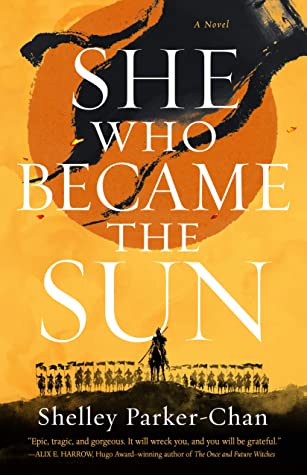
Summary:
In China in 1345, a little peasant girl barely surviving a famine hears her brother will have a great fate but she is fated to nothingness. When their father dies and her brother chooses to die with him, she lays claim to his fate, going to a monastery and pretending to be a boy for survival. When she grows up, she finds herself pursuing her brother’s great fate and clashing repeatedly with Ouyang – a man who survived an order to kill his entire male line by being forcibly turned into a eunuch. As the Mongols and the Nanren clash for dominance in China, Ouyang and the person known as Zhu Chongba find their fates clashing.
Review:
This is being marketed as the queer Mulan, and I just have to say that Mulan was already queer. Li Shang Mulan regardless of what gender she is presenting as. But there’s plenty of room for more than one queer ancient China war drama. :-)
I loved the beginning of this book. The famine and Zhu’s entire time in the monastery just spoke to me. I was engrossed. But then when Zhu leaves the monastery the tone and setting of the book changed, and it worked less for me. To me the beginning of the book is about choosing your own destiny, and the clash of desire and faith. The end of the book is about being the best warlord with your brains instead of brawn, which just was less compelling to me personally. Actually, I think this quote from the book sums up how Zhu is at the end of the book, even though this is actually Zhu describing someone else:
[T]he ferocious, irreligious joy of a man who has willingly cast aside any chance of nirvana for the sake of his attachment to life.
(location 843)
The fantasy elements of this book include that Zhu and some others can see ghosts – hungry ghosts specifically, which is a Buddhist concept. Leaders also have a mandate from heaven, which presents itself as a visible fire they can summon into their hands. Different leaders have fire of different colors. It’s interesting to note that many sides seem to have a real mandate of heaven. Why is an interesting question that I hope the sequel will explore.
The queer elements in the book include both gender and sexuality. Zhu seems to experience some gender dysphoria – this is not presented simply as a cis woman passing as a man. It’s more complex than that. However, I do wish this was explored more deeply. For example, the omniscient narrator refers to Zhu as “she” regardless of how Zhu seems to feel about their gender at any point. Ouyang is a eunuch, and eunuchs fall under the queer umbrella. Ouyang has romantic feelings for another man. It was unclear to me if these feelings were ever consummated. Zhu falls for a woman, and they have sexual relations onscreen. For me, Ouyang’s relationship was a classic queer tragedy. Zhu’s is more complex, and I’m interested to see where it goes in the sequel.
There is a character who loses a limb in this book. The moment of the limb loss is presented as a turning point for this character. It lets them become who they need to be. I felt negatively about this. It read to me as a bit like disability inspiration p*rn. I understand that, for this character, their relationship with their body is complex. But I wish another way had been found to help the character come into their own rather than this.
Overall, I really enjoyed that this fantasy was set in a culture steeped in Buddhism as a nice change of pace for fantasy. Queer characters are central, rather than as tragic sidekicks. The qualms I had did not keep me from enjoying the book as a whole, and I am interested in its sequel. Recommended to fantasy lovers looking for a change or to those who don’t usually read fantasy but might enjoy it for the representation.
4 out of 5 stars
Length: 416 pages – average but on the longer side
Source: NetGalley
Buy It (Amazon or Bookshop.org)
If you found this review helpful, please consider tipping me on ko-fi, checking out my digital items available in my ko-fi shop, buying one of my publications, or using one of my referral/coupon codes. Thank you for your support!
Book Review: They Never Learn by Layne Fargo

Summary:
Scarlett Clark is an exceptional English professor. But she’s even better at getting away with murder. Every year, she searches for the worst man at Gorman University and plots his well-deserved demise. But as she’s preparing for her biggest kill yet, the school starts probing into the growing body count on campus. Determined to keep her enemies close, Scarlett insinuates herself into the investigation and charms the woman in charge, Dr. Mina Pierce.
Meanwhile, Gorman student Carly Schiller is just trying to survive her freshman year – and her crush on her roommate, Allison. When Allison is sexually assaulted at a party, Carly becomes obsessed with making the attacker pay.
Review:
This felt like a woman-centered, queer Dexter, and I really enjoyed it.
The book seems straight-forward at first, but midway there is a plot twist that made me make the shocked Pikachu face. From there on, the plot just kept surprising me. In a good way. It’s not exactly what it seems it might be at first.
Although my own ethics don’t agree with revenge seeking, this is just the right mix of campy social commentary and revenge violence to work for me. I was able to view it as a cautionary tale of what could happen if we don’t start working to solve the academia culture that breeds violence against women. There are certain moments when the tide could have been turned if someone, anyone, had listened to the violated women. To me, this is what the takeaway from the book really is supposed to be.
For me, the queer content was delightful. There are multiple bisexual women characters. This means, instead of suffering from tokenism, bisexual characters get to come into full expressions of themselves. The word bisexual is used frequently in the book (or the short version bi). There are even multiple coming out stories present in the book.
I read this in audiobook format, and the narration of both voices was well done. It was easy to tell them apart but also not jarring to switch back and forth. I also thought both actresses did a solid job with accents.
A quick content warning that sexual assault, violence and murder are all described on-screen in this book.
Overall, the plot compelled and surprised me, and the characters were engaging with multiple different bisexual women present. A delightful addition to the thriller genre.
4 out of 5 stars
Length: 378 pages – average but on the longer side
Source: Audible
Buy It (Amazon or Bookshop.org)
If you found this review helpful, please consider tipping me on ko-fi, checking out my digital items available in my ko-fi shop, buying one of my publications, or using one of my referral/coupon codes. Thank you for your support!
Book Review: One Last Stop by Casey McQuiston (Plus Reading Group / Book Club Discussion Guide)

Summary:
Twenty-four-year-old August has struggled to find her place in life. She’s now transferred to her third college, this time in Brooklyn, and she hopes it’ll stick. She finds a room in an apartment that comes with a delightful mix of found friends all also a part of the queer community, and they set her up with a job at the local diner. August thinks maybe it’s finally time to fit in and start to feel like she’s living a normal life, but then she meets a stunningly cute Chinese-American girl on the Q train. And meets here again. And again. Slowly she discovers that this girl might not be quite what she seems to be – in fact she’s a punk rock lesbian from the 1970s displaced out of time. Can August solve the case of how she got displaced and not lose her heart in the process?
Review:
I heard this described somewhere as a queer romance similar to the movie Kate & Leopold. That’s one of my favorite romantic comedies, so I was sold. I can definitely understand the comparison. They’re both set in New York and feature a love interest displaced out of their own time. While I love Kate & Leopold though, I have to admit I didn’t quite love this book.
Let’s start with what I liked. The main character, August, is bisexual and says it (more than once) with confidence. There is no biphobia expressed in this book by any of the characters she cares about. I also really appreciated seeing a bisexual main character who is a virgin and yet still declares this. An important moment of representation that one does not need to sleep with people to know one’s sexuality
August’s roommates and new friends are eclectic and fun while still feeling real. There is representation of gay and trans* folks especially. One of the roommates is Black (with Chinese adoptive parents), one is Greek-American, and one is Jewish. There’s a lot of diversity here. Part of what made them all feel real is that all of them had their own different families and issues. It wasn’t one queer story but many. I also really liked how real the local drag club felt, and I appreciated the representation of someone in recovery (the chef at the pancake restaurant).
I thought there was a lot of sizzle between August and the girl on the train – Biyu. Now at first she goes by Jane but over the course of the book she comes to ask to go by her birth name, Biyu, rather than her Americanized nickname. I want to be respectful of that. I also enjoyed the mystery of how she came to be on the train, and how August goes about solving it.
I felt pretty neutrally about the sex scenes. They were steamy without being explicit, but they weren’t anything particularly memorable for me. Some readers, I know, were turned off by the fact some of the sex happens on the train. That didn’t bother me because it makes sense for the characters. But be forewarned!
Now what I liked less. I don’t think the book handled racism and homophobia as directly or clearly as it should have. Biyu is from the 1970s and is a Chinese-American who is visibly lesbian. She literally had run-ins with the cops over wearing men’s clothes in her time period. But being jetted forward 40 years doesn’t solve the problems of homophobia and racism. I think the book acknowledges this by having Biyu have a run-in with someone who says something both racist and homophobic to her (the words are not said in the book and the incident appears off-screen). Yet August responds by saying, “most people aren’t like that anymore” (I can’t give an exact page number as this was a review copy but it occurs in Chapter 12). This does lead into a large fight between Biyu and August, which I think implies that August was wrong in what she said. However, I think August needed a bigger I was wrong moment, where she acknowledges that she did a very poor job of both being there for Biyu in that moment and of describing the complexity of how racism and homophobia are simultaneously different and yet not in modern times. I think readers also would have benefited from a nuanced discussion of how, for example, same-sex marriage is now legal and yet hate crimes against Asian-Americans and Pacific Islanders have increased dramatically in the last year, especially against Chinese-Americans (source). I think this book wanted to say something big and interesting about sexuality and queerness especially in the 1970s versus now, but in my opinion it falls short of accomplishing this.
Additionally, I know I was supposed to find the ending satisfying but it left me dissatisfied. I think for similar reasons – it’s a complex situation and the book doesn’t dig deep enough or hard enough into these complexities. Things are kept at the surface level. While it is a book in the spirit of a romcom, romcoms can say big and difficult things while not losing the romcom feel. Confessions of a Shopaholic springs to mind – it deals with the very serious issue of shopping addiction while still feeling like a very fun romcom.
Overall, this book is fun and lighthearted. It features a realistic bisexual lead and steamy, yet not explicit, f/f scenes. The queer found family is delightful. But it could have stood to have dug a bit deeper into the serious issues it brought up. They are important conversations to have that wouldn’t have messed up the lightheartedness of the romcom vibe.
4 out of 5 stars
Length: 422 pages – average but on the longer side
Source: NetGalley
Buy It (Amazon or Bookshop.org)
Get the Reading Group / Book Club Discussion Guide
A beautifully graphic designed 2 page PDF that contains: 1 icebreaker, 9 discussion questions arranged from least to most challenging, 1 wrap-up question, 3 read-a-like book suggestions
View a list of all my Discussion Guides.
If you found this review helpful, please consider tipping me on ko-fi, checking out my digital items available in my ko-fi shop, buying one of my publications, or using one of my referral/coupon codes. Thank you for your support!
Book Review: The Queen of the Cicadas / La Reina de las Chicharras by V. Castro

Summary:
You’ve heard of Bloody Mary and Candyman but have you heard of La Reina de las Chicharras? The legacy says she’s a Mexican farmworker named Milagros who was brutally murdered in 1950s Texas then given new supernatural life by the Aztec goddess of death, Mictecacíhuatl. In 2018, Belinda Alvarez arrives in Texas for a friend’s wedding on the farm that inspired the legacy of La Reina de las Chicharras. But is it just a legacy or is it real?
Review:
I’m a woman of a certain age. I know that shit isn’t always right.
Chapter 9
This struck me as a Latinx, female-led version of Candyman, only, over time, La Reina de las Chicharras comes to protect the downtrodden who call her.
Milagros’s life story that leads to her becoming La Reina is told in parallel with Belinda’s discovering her story and coming into her own realizations about Mictecacíhuatl. I really resonated with the Milagros chapters but struggled to relate to Belinda. She needed more depth and roundness to seem as real as Milagros. Some additional chapter breaks could also help with the jumping perspectives. In general, though, the dual perspectives worked and the uniqueness of the storyline kept me quite engaged to find out what would happen.
In addition to the strong Latinx content, the Indigenous history of Mexico is present. Milagros’s relationship especially to the Indigenous people who were brutally colonized is drawn clearly. There is also relatively significant queer content here. Milagros is a woman who loves women. There are two important gay male characters, and Belinda exhibits fluid sexuality, although she never gives a label to this.
Two things in this book were at ethical odds with me. First, Belinda is written as a woman in addiction who then never overcomes it (or even tries to) in spite of her character arc seeming to indicate that she has been transformed in a positive way. I’m ok with a realistic depiction that not everyone finds recovery, but it bothered me that it comes across as a positive transformation when she remains in addiction. It’s relatively clear that this is a bit of a vengeance fantasy. I understand the importance and role of having a place for anger at injustice to go. But my own spiritual beliefs uphold forgiveness over vengeance, so my world view differs.
If you like urban legend style horror and want to see women in the lead, then you will likely enjoy this read. Those offended or disturbed by the idea of the universe holding multiple gods and religions simultaneously should likely look elsewhere.
4 out of 5 stars
Length: 224 pages – average but on the shorter side
Source: NetGalley
Buy It (Amazon or Bookshop.org)
If you found this review helpful, please consider tipping me on ko-fi, checking out my digital items available in my ko-fi shop, buying one of my publications, or using one of my referral/coupon codes. Thank you for your support!
Book Review: The Deep by Rivers Solomon with Daveed Diggs, William Hutson, and Jonathan Snipes
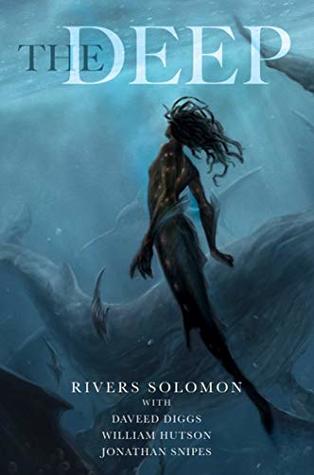
Summary:
Yetu is the historian for her people – the mermaid descendants of pregnant enslaved African women thrown overboard from slave-ships before they could give birth. As the historian, Yetu holds the painful memories of her people, helping them to experience them once a year. But the pain of holding the memories is more burdensome for Yetu than for previous historians, as she is more sensitive than any historian before her. One year, in the middle of the history ceremony, she flees for the surface in an act of self-preservation. Can she both preserve herself and not abandon her people?
Review:
This book wowed me, taking my breath away from start to finish. If you know you like mermaid stories and want a fresh take on them, just go pick this up immediately.
The number of authors is large because this book was inspired by a song by the hip-hop group, .clipping. I love that the song authors gave permission to Rivers Solomon to write this book inspired by the song, and Solomon in turn credited them for the book. It’s a beautiful collaboration, and the song is well-worth the listen.
No one ever says explicitly that Yetu is neurodiverse, but it’s clear that she is. Her neurodiversity both made her a candidate to be the historian but also made the task soul-crushing and life-destroying for her. I love that no one in the book ever decides that Yetu is the one at fault for this. In other words, Yetu is not blamed for this problem, rather the culture is questioned and it is wondered how sustainable this model is if it doesn’t work for everyone in the culture. Similarly, although Yetu on some level wants to break fully away from her society, she also feels a responsibility to them and wrestles with how to be loyal to both them and herself. The questions that Yetu asks herself in this process struck me as so poignant and painfully real.
Was there anything about her that wasn’t a performance for others’ gratification?
(location 17%)
Is this my curse? To be unfathomable?
(location 58%)
But this isn’t just a book about a culture being a space for those both neurotypical and neurodiverse, it’s also a myth that demonstrates the role of intergenerational trauma. It shows intergenerational trauma rather than telling, and that is powerful.
As with all of Rivers Solomon’s work, there is also queer content in this book. There is gender fluidity (in the mermaids) and a queer relationship between Yetu and a two-leg. I thought this was one of the more artful relationships between a mermaid and a land dweller I’ve seen.
Recommended for readers looking for Black mermaids, a neurodiverse main character, and/or a queer relationship between a mermaid and a land dweller.
5 out of 5 stars
Length: 192 pages – average but on the shorter side
Source: Library
Buy It (Amazon or Bookshop.org)
If you found this review helpful, please consider tipping me on ko-fi, checking out my digital items available in my ko-fi shop, buying one of my publications, or using one of my referral/coupon codes. Thank you for your support!
Book Review: Sorrowland by Rivers Solomon

Summary:
Vern desperately flees the strict, religious, Black Power compound she was raised on while she is heavily pregnant with twins. Giving birth shortly thereafter and raising her babies in the woods, she finds herself transforming inexplicably. But what is she transforming into? Why? And can she protect her children from both the compound and the world?
Review:
Another Rivers Solomon book was my favorite read of last year (An Unkindness of Ghosts, review), so when I saw their new book come available on NetGalley – featuring a religious, Black Power compound – I requested it immediately and was thrilled to receive a copy. Like all of Rivers Solomon’s work this book is a gorgeous, intertwining mixture of compelling and challenging.
I was startled by the focus on pregnancy and mothering at the beginning of the book. It hadn’t been the focus of the other Rivers Solomon books I’ve read, and I must admit as a person who has never been pregnant or a mother myself, I always struggle a bit more to connect to these characters. And, indeed, by the end of the book it was not Vern as mother I connected to but rather Vern as a person caught in a complex web of the world as we know it with her ability to right wrongs and change the future limited. That twist in the gut of being caught inside of something much bigger than yourself, that I was able to relate to.
Who cared who knew if the knowing didn’t prevent future occurrences?
location 5089
The fantastical elements are immediately engaging – beautiful and grotesque. I don’t want to give anything away, but suffice to say her transformation took my breath away in a manner that reminded me of my feelings watching Season 1 of Hannibal. I mean that as a complement. It’s a fantasy that both feels like a fantasy and also real and leaves one wondering if Vern is right in the head or not? Can the world really work like this? What is happening to her?
The social commentary in this book is astute and apt without being preachy. Characters say what they say because their very lives have lived it – these are their experiences and real feelings. What may to some readers seem the most out there about the book can easily be traced to real occurrences in US history. It’s not far-fetched but one hopes its realness will reach more people because of how it is couched in fantasy.
There is rich queer content in this book, both in the sense of gender and in the sense of sexual relationships. There is two sex scenes, one of which I would consider explicit with people of multiple genders participating. However, contrary to how some booksellers are listing it, I absolutely would not call it “er*tica.” This is a serious fantasy book about issues of justice that just happens to have queer characters have sex “on screen” twice. Queer sex is not automatically “er*tica.”
With regards to other representation, there are many Black and two Indigenous (Lakota) people. Two characters have albinism, and this book eloquently depicts the visual impairments that come with that.
Overall, this book delivers what I have come to expect from a Rivers Solomon book – an engaging fantastical imagining with queer content and different abilities represented that draws attention to social issues. Readers who are able to keep an open mind to the book potentially not going the places they were anticipating or hoping for but who are willing to let the book lead where it may will enjoy this one.
4 out of 5 stars
Length: 368 pages – average but on the longer side
Source: NetGalley
Buy It (Amazon or Bookshop.org)

Book Review: These Witches Don’t Burn by Isabel Sterling (Series, #1)

Summary:
Hannah loves her life in Salem, Massachusetts – working at the Fly By Night Cauldron store selling witchy items while secretly being the real deal herself – an Elemental witch. She’s about to enter her senior year of high school and things are a bit complicated of course – there’s her ex-girlfriend, Veronica, and fellow Elemental to deal with and the fact that her best friend is a Reg (non-witch) and can’t know. But when an end of year party ends with a blood ritual, Hannah becomes convinced there’s a dangerous Blood Witch in town, and she wants to find her before it’s too late. Plus there’s the cute ballerina, Morgan, she’s trying to date.
Review:
If you’re looking for queer representation in your YA fantasy, this book is here for you. Hannah is a lesbian, her coworker at the Cauldron is a gay trans man (in his first year of college), and Morgan is bisexual. The queer characters aren’t perfect, and they do gently educate each other with people apologizing to each other and strengthening friendships. I love how realistic that is. It’s not a fantasy land of everyone just perfectly knowing exactly what the right thing is to say, but it is a world of mutual respect and trying to be there for each other and correct mistakes. Speaking as a bisexual woman, I found the representation of Morgan accurate and kind, which is more than I can say about a lot of bisexual representation in literature.
The plot is less gentle and feel-good than you might expect. There is more violence and even death than I was expecting based on the plot summary and the fact that it’s the first book in a series. If you’re thinking about this one, know that you will be getting a mixture of feel-good and real danger. This is also definitely a book that’s setting up the next book in the series. I immediately put the next book on hold in the library, and kind of wished I’d done it sooner so I could have read them one right after the other.
While there are witches who are Black and People of Color in the book, they all seem to come from outside of Salem. While it is true that Salem is 70.8% white and non-Hispanic (Data USA), I think even if one was using the argument that Salem is very white in real life, the lack of People of Color inside of Salem in the book isn’t accurate. I also think, personally, that we have a responsibility in literature but especially in YA where we’re trying to help youth feel seen and heard, to depict all types of diversity, not just diversity of the queer spectrum.
If you or someone you’re giving book recommendations to is looking for a YA book rich in fantasy and queer characters, this may be the right read. I would recommend being prepared to have a conversation about why greater diversity matters and ensure the reader is ok with some violence (not just of the magic kind). I’d also be prepared to just pick up both books right away as this one really leads right to the next one.
4 out of 5 stars
Length: 336 pages – average but on the longer side
Source: Library
Buy It (Amazon or Bookshop.org)
If you found this review helpful, please consider tipping me on ko-fi, checking out my digital items available in my ko-fi shop, buying one of my publications, or using one of my referral/coupon codes. Thank you for your support!
Book Review: An Accident of Stars by Foz Meadows (Series, #1)
 Summary:
When Saffron Coulter stumbles through a hole in reality, she finds herself trapped in Kena, a magical realm on the brink of civil war.
There, her fate becomes intertwined with that of three very different women: Zech, the fast-thinking acolyte of a cunning, powerful exile; Viya, the spoiled, runaway consort of the empire-building ruler, Vex Leoden; and Gwen, an Earth-born worldwalker whose greatest regret is putting Leoden on the throne. But Leoden has allies, too, chief among them the Vex’Mara Kadeja, a dangerous ex-priestess who shares his dreams of conquest.
Pursued by Leoden and aided by the Shavaktiin, a secretive order of storytellers and mystics, the rebels flee to Veksh, a neighboring matriarchy ruled by the fearsome Council of Queens. Saffron is out of her world and out of her depth, but the further she travels, the more she finds herself bound to her friends with ties of blood and magic.
Can one girl – an accidental worldwalker – really be the key to saving Kena? Or will she just die trying?
Review:
A fantasy written from a queer, female perspective that explores race and social justice featuring the common trope of multiple parallel worlds.
The basic plot is an intertwining of two common to fantasy: 1) there’s multiple parallel worlds 2) political intrigue warring societies etc… These are both done to a level I appreciate. They make sense without overwhelming me with world building and pages of explanations of how a society that doesn’t really exist works.
Both of these basic plots are used to explore queer viewpoints, feminism, and race, all through the lens of social justice. How much you’ll enjoy this lens depends upon the reader. I think the queer part is fairly well-done with a broad representation including: bisexual (by name!), lesbian, trans*, and polyamory. I’m not big on polyamory plots but I thought its inclusion in a parallel world made sense and was clearly not written from a perspective intended to purely titillate, rather, the emotional aspects of these relationships was explored. I do think the explorations of race lacked some of the subtlety present in the explorations of queerness. The white Australian girl being thrust into a parallel world where the majority race is black who is guided by another “worldwalker” who similarly fell through but decided to stay because she’s black and this world is better than Thatcher’s England struck me as a bit heavy-handed and overly simplistic. I’m also not sure how I felt about the black character being put into a secondary role as guide. I kept finding myself thinking how I would have preferred to have read her story. (You quickly find out she stayed in the world, gained some power, joined a polyamorous marriage, had a child, and more! What an interesting life!)
All of that said, I don’t often enjoy traditional style non-urban fantasy, and this one did keep me reading and interested. It’s fun to read a book about political intrigue and multiple worlds dominated by women, touched by dragons, and with no male gaze. I doubt I will seek out the second entry in the series, though, because I feel I’ve already got everything out of the story I’m going to get.
If you found this review helpful, please consider tipping me on ko-fi, checking out my digital items available in my ko-fi shop, buying one of my publications, or using one of my referral/coupon codes. Thank you for your support!
4 out of 5 stars
Length: 494 pages – chunkster
Source: NetGalley
Book Review: Not Otherwise Specified by Hannah Moskowitz
 Summary:
Etta is tired of dealing with all of the labels and categories that seem so important to everyone else in her small Nebraska hometown.
Everywhere she turns, someone feels she’s too fringe for the fringe. Not gay enough for the Dykes, her ex-clique, thanks to a recent relationship with a boy; not tiny and white enough for ballet, her first passion; and not sick enough to look anorexic (partially thanks to recovery). Etta doesn’t fit anywhere— until she meets Bianca, the straight, white, Christian, and seriously sick girl in Etta’s therapy group. Both girls are auditioning for Brentwood, a prestigious New York theater academy that is so not Nebraska. Bianca seems like Etta’s salvation, but how can Etta be saved by a girl who needs saving herself?
Review:
Etta is a character I wish I had been able to find in fiction when I was a teenager. She’s unashamedly herself, even when it hurts or it involves some floundering. She’s from a small town with dreams of the big city. She just doesn’t fit in her small town. She is so very real because she is so many intersectional elements at once. Most important to me is that she’s bisexual (and she actually SAYS the word), but she’s also female, black, and suffering from Eating Disorder Not Otherwise Specified (EDNOs), where the name of the book comes from.
What’s so great though is that, even with being all of these things, her main point of conflict actually has nothing to do with any of them. She desperately wants to live in NYC, and she sees a contest to get into a musical theater high school in NYC as just the chance to do that. She has a huge dream, and that is something any YA reader can relate to. So even if the reader happens to not relate to Etta on anything else (and honestly, who cares? kids like Etta have to reach really hard to relate to most of the literature out there so it’s about time the mainstream kids have to as well), but even if they don’t relate to her on anything else, they should be able to relate to her on this adolescent experience of The Big Dream.
I loved that Etta is allowed to be the person she is without speaking for All Bisexuals™. She very clearly presents herself as a bisexual person who is not representative of all bisexual people beyond the being attracted to more than one gender thing. I also appreciated that the complexity of the queer community is shown. Etta talks about being pushed into being an outsider by both the straights and the lesbians because both of them kind of just want her to “pick a side.” The book begins with the lesbians being angry at Etta for dating a boy. They’re acting like she was a “fake lesbian,” and this is how Etta feels about that:
And bi the way, I was never a lesbian, and I told the Dykes that all the time, but there isn’t a Banjo Bisexuals group or whatever. (location 54)
While a lot of the book eloquently deals with Etta’s sexuality, it also takes time to talk about race and racism. I lost the highlighted passage but essentially Etta is talking with a friend and discusses how hard it is to be part of so many minority groups and how she can never hide being black but she can hide being queer, and how that means she can never escape racism. On the other hand, she also points out how exhausting it can be to constantly be reminding people of her queerness. No one denies that she’s black but people keep trying to take her bisexual identity from her. It’s a non-preachy passage that introduces the complexities of intersexuality to a YA audience.
Finally, there’s the EDNOS. The best part about this is the book come in when Etta is in recovery. Most books about eating disorders come in during the downward spiral, but Etta has already gone to treatment and is working in recovery. We so often don’t get to see recovery and how messy it can be in literature, but we see it here. We get to see how mental illnesses don’t just go away, people just have strategies for staying in recovery.
There’s a ton that’s good about this book, but I must say that I did think the level of partying could sometimes be a bit over the top. While obviously not all kids are straight-edged I was a bit skeptical of the level of partying going on in Small Town USA (including high schoolers getting into a gay bar repeatedly). Perhaps what struck me as a bit less realitic, actually, was Etta’s intelligent and put-together mother who is clearly caring being somehow out of touch about the partying going on, whereas Etta’s sister is 100% aware. It wasn’t enough to truly bother me and I do think on some level some YA readers expect an unrealistic set of partying situations just for the interest level but in a book that had so much realistic about it, it just struck me as a bit out of place.
Overall, this is a great addition to contemporary YA with an out and proud main character and a timeless plot of a small town girl with big dreams. I requested it at my library to be added to the collection (and they did!), and if you can’t buy it yourself, I highly recommend you doing so as well. It bring so much different to the YA table.
If you found this review helpful, please consider tipping me on ko-fi, checking out my digital items available in my ko-fi shop, buying one of my publications, or using one of my referral/coupon codes. Thank you for your support!
4 out of 5 stars
Length: 304 pages – average but on the longer side
Source: Library
Counts For: Mental Illness Advocacy Reading Challenge #miarc
Specific Illness –> EDNOS
Book Review: Mermaid in Chelsea Creek by Michelle Tea (Series, #1)
 Summary:
Everyone in the broken-down town of Chelsea, Massachussetts, has a story too worn to repeat—from the girls who play the pass-out game just to feel like they’re somewhere else, to the packs of aimless teenage boys, to the old women from far away who left everything behind. But there’s one story they all still tell: the oldest and saddest but most hopeful story, the one about the girl who will be able to take their twisted world and straighten it out. The girl who will bring the magic.
Could Sophie Swankowski be that girl? With her tangled hair and grubby clothes, her weird habits and her visions of a filthy, swearing mermaid who comes to her when she’s unconscious, Sophie could be the one to uncover the power flowing beneath Chelsea’s potholed streets and sludge-filled rivers, and the one to fight the evil that flows there, too. Sophie might discover her destiny, and maybe even in time to save them all.
Review:
I feel like if you’re a queer person in New England, you’ve heard of this book. A magical realism read featuring queer characters and a diverse cast set not in Boston but in the nearby town of Chelsea (although they do go to Revere Beach, part of Boston, at one point). Its art is gorgeous, and I’ve spotted print versions of it in every single local bookstore. The locals are proud of this book, that’s for sure. With everything I’d heard and the pictures I’d seen when flipping through print copies, I was expecting something a bit different from what I got. Maybe more queer content? Maybe magical rules based in the here rather than in the “old world”? Regardless, I enjoyed it. It just wasn’t what I was expecting.
First, let’s talk about my favorite thing which was how much the author evokes the reality of the place of run-down New England towns in spite (or because of?) the magical content. My skin prickled when I read about Sophie and her best friend going to Revere Beach in the summer. It was just so damn accurate. I had a similar sensation when she talked about the feeling of being in a town that was once booming and now is struggling. There’s no doubt about it, the New England towns that were once booming from manufacturing and are now struggling simply feel dirty, and the author really evokes that. (I should know; I grew up in one). Oddly enough, this magical realism book brings out the feeling of small town struggling New England life more than a lot of realistic fiction I’ve read. If you want to know what it feels like to grow up in one of those towns, read this book.
Second, there’s the magical content. I was expecting something steeped in the local as well, but instead the magic was based entirely in countries parents and grandparents emigrated from. There’s nothing bad about that, it just wasn’t what I was expecting from a book so steeped in place. I also must admit that I found the whole vibe of “magic can only come from other places” to be a bit disappointing. America may be a young nation, but we have our own magic. I’d have liked to have seen a mix of both, rather than the magic be exlusively the domain of immigration.
Third, there’s the queer content. I think I was expecting it to take a more central role, particularly since this is ya (and was talked about a lot in the LGBTQ book reading community) but actually I found it to be more like how the local PCP just so happens to be Asian-American. It’s a thing some people just happen to be and not much is made of that. That’s not a bad thing, again, it just wasn’t what I was expecting.
Overall, this is a fun read steeped in local flavor that I recommend to anyone seeking a fantastical twist on struggling New England town life. That said, the second book in the series promises a journey to Europe, and personally what I liked best about this book was the local flavor, so I don’t think I’ll be continuing along.
If you found this review helpful, please consider tipping me on ko-fi, checking out my digital items available in my ko-fi shop, buying one of my publications, or using one of my referral/coupon codes. Thank you for your support!
4 out of 5 stars
Length: 331 pages – average but on the longer side
Source: Library
 Support my work with a tip or browse my shop for curated book club guides, how to guides, cross-stitch patterns, and more!


This work by Amanda Nevius is licensed under a Creative Commons Attribution-Noncommercial-No Derivative Works 3.0 United States License.
 Opinions of a Wolf