
Archive
Book Review: Sula by Toni Morrison

A lyrical and haunting novel about two Black women whose lifelong friendship is tested by betrayal, love, and the weight of their small-town community’s judgment.
Summary:
Sula and Nel are two young black girls: clever and poor. They grow up together sharing their secrets, dreams and happiness. Then Sula breaks free from their small-town community in the uplands of Ohio to roam the cities of America. When she returns ten years later much has changed. Including Nel, who now has a husband and three children. The friendship between the two women becomes strained and the whole town grows wary as Sula continues in her wayward, vagabond and uncompromising ways.
Review:
This was my second Toni Morrison novel—the first being The Bluest Eye, which I read back in college. Morrison’s prose is deeply lyrical, which makes her books swift reads on the surface, even when they delve into painful and challenging themes. Sula is no exception.
Each chapter is titled with the year it takes place in, but only covers a brief vignette from that year. Despite spanning several decades, this is a short novel, structurally and in page count. Though the title suggests a singular character focus, Sula is as much about a place—the Bottom, a Black neighborhood in a Southern state situated on the hillside, land the white residents had no interest in. The reason for its ironic name is revealed in the first chapter through a racist tale, setting the tone for the book’s critique of systemic racism.
Indeed, one of the novel’s most striking accomplishments is how clearly it shows that systemic racism ruins lives, whether characters comply with social expectations or resist them. For me, Nel represents compliance while Sula represents defiance—yet neither of them leads a life free from pain. Every person in their orbit suffers in some way, and that suffering is deeply entangled with the racist systems surrounding them.
The edition I read included an introduction in which Morrison writes: “Female freedom always means sexual freedom, even when—especially when—it is seen through the prism of economic freedom.” While I respect Morrison’s craft, I don’t personally agree with this framing. Throughout the book, the freest female characters are also the most sexually unrestrained, choosing partners without regard to consequences. For me, this reflects the central tensions I’ve often felt when reading Morrison’s work: I recognize the literary prowess but don’t agree with this belief. As someone who values intentionality in relationships and ethical sexuality, I believe there is freedom in discernment. My personal worldview differs from Morrison’s here, and I think that’s worth naming—especially since this quote helped me finally articulate why I sometimes feel at odds with what I’m “supposed” to take away from her narratives.
Of course, I also acknowledge that I am not Morrison’s intended audience. She has stated clearly that she writes for Black people—and I am a white woman. I honor that intention, while also appreciating the beauty, lyricism, and cultural specificity of this novel. Morrison evokes a place, a time, and a community with precision and poetry, showing rather than telling how racial injustice permeates generations.
For readers in recovery, or those who love someone with substance use disorder or alcohol use disorder, be advised that this book contains a disturbing scene involving the violent death of a character who struggles with addiction. A mother sets her son on fire, intentionally killing him because of his drug use. It’s a horrific and deeply stigmatizing portrayal. While I understand that literature doesn’t require characters to always make the “right” choices, scenes like this can be deeply harmful and may reinforce stigma around addiction. To anyone reading this who is struggling: You don’t deserve to die. You are not disposable. You can recover. We do recover. I acknowledge that the story is set in a time when resources for addiction recovery were nearly nonexistent, especially for a Black man. But violence is never the answer, and stories like this can perpetuate dangerous beliefs about addiction and worth.
With regards to diversity, the book explores colorism in the Black community, as well as racism faced by Black folks coming from immigrant white communities. It has multiple characters who fought in World War I who struggle with mental health afterwards. It also has a character who uses a wheelchair and is missing a limb. There is not any LGBTQIA+ representation that I noticed.
This is a novel that quietly devastates, not through high drama, but through its unflinching portrayal of how systemic racism, personal grief, and societal expectations shape lives over time. It’s beautifully written, deeply character-driven, and emotionally complex. Whether or not you’re part of Morrison’s intended audience, Sula is a compelling and powerful read. If you’re in recovery or close to someone who is, approach with care due to the painful and stigmatizing depiction of addiction. For those looking for fiction that treats mental health and recovery with care, check out my novel Waiting for Daybreak.
If you found this review helpful, please consider tipping me on ko-fi, checking out my digital items in my ko-fi shop, buying one of my publications, using one of my referral or coupon codes, signing up for my free microfiction monthly newsletter, or tuning into my podcast. Thank you for your support!
3 out of 5 stars
Length: 174 pages – average but on the shorter side
Source: Library
Buy It (Amazon or Bookshop.org)
Get the Book Club Discussion Guide
A beautifully graphic designed 2 page PDF that contains: 1 icebreaker, 9 discussion questions arranged from least to most challenging, 1 wrap-up question, and 3 read-a-like book suggestions
View a list of all my Book Club Guides.
Book Review: Dead Weight: Essays on Hunger and Harm by Emmeline Clein

A woman in eating disorder recovery explores the world of eating disorders and treatment in the west through a pop culture lens.
Summary:
Emmeline Clein tells the story of her own disordered eating alongside, and through, other women from history, pop culture and the girls she’s known and loved. Tracing the medical and cultural history of anorexia, bulimia, binge eating disorder, and orthorexia, Clein investigates the economic conditions underpinning our eating disorder epidemic, and illuminates the ways racism and today’s feminism have been complicit in propping up the thin ideal. While examining Goop, Simone Weil, pro-anorexia blogs, and the flawed logic of our current treatment methods, Clein grapples with the myriad ways disordered eating has affected her own friendships and romantic relationships.
Review:
This collection of essays consisting of research intertwined with memoir was an engaging read. I particularly liked how Clein approached talking about the negative aspects of Big Pharma in a historical context. That wasn’t something I was expecting in this book, and it was well done. Expect to learn about how amphetamines were marketed as a weight loss drug post WWII because the manufacturers needed a new market now that soldiers were no longer using them to stay awake. Or about how it was Big Pharma who advocated for the labeling of obesity as a disease in the early 2000s (so insurance would pay for drugs to “treat” it.) Or about how the company that originally marketed amphetamines for ADHD was fined for “inappropriate marketing.” (For more about the impact of big pharma on our everyday lives, see my review of Drugs for Life.)
Another thing I appreciated as a person in recovery from addiction was how Clein analyzed addiction and eating disorders as systemic, rather than personal, issues.
The addiction model still requires that we understand ourselves as addicts, rather than see our culture, our food systems, and drug and diet companies as conspiring to encourage addictive patterns. When we believe we are sinners and criminals who deserve to be punished because we are out of control, we don’t demand change to any of the underlying structures that are actually out of our control, controlled by corporations. In it current iteration, the addiction model still makes us blame ourselves and then retrofit our stories into some fictional hero’s journey of abstinence and discipline over the compulsion to consume–stories rooted in the very values at the heart of anorexia and its hold on so many minds.
There were a few things that I did not like about the book, though.
First, her take on the intersection of Irritable Bowel Syndrome (IBS) and eating disorders is woefully short-sighted and lacking empathy for not only those with IBS but other chronic illnesses that the medical industry offers little to nothing for. (Strange for a book that takes down big pharma so aggressively.) Clein presents the opinion that IBs is essentially always second to developing an eating disorder. That IBS symptoms are the body’s natural response to being starved or facing binges. But EDs can be and are triggered by IBS. The fact is, for many people, an ED develops in response to suffering from IBS.
Second, her choice to exclude men from a book about ED is troubling. The overall thesis seems to be that a minuscule number of men have EDs so it’s not worth talking about. In fact, approximately 1/3 of those known to have an ED are men, and there is concern that EDs in men are underreported. Even if it was the case that very few men have EDs (which again, it is not), leaving them out of the book hurts the overall arguments about EDs.
Third, Clein does not talk at all about the interplay between EDs and OCD. This is a more glaring lapse given how much space is given to discussing depression, anxiety, and EDs.
Fourth, while drinking is mentioned repeatedly, drunkorexia is not discussed at all, nor is alcoholism, something which, again, often comes hand-in-hand with EDs and is even seen in vignettes in the book but not addressed.
Fifth, there is a chapter about religion and ED. It completely ignores all other faiths except Judaism, Protestantism, and Catholicism. Clein does not understand Protestantism enough to discuss it in the ways that she does. Every time she brings up Protestantism, it’s clear she doesn’t have a high level understanding of it. She basically makes comments about Protestantism being all about asceticism and self-denial and then moves on. Unlike Catholicism, she does not limit her comments about Protestantism to only the chapter when she’s discussing religion explicitly either. It trickles in throughout the book. (She does also discuss Judaism throughout the book, but she is Jewish, and her faith comes up in the memoir portions, which makes sense.)
As you can perhaps tell from both the featured quote and how long this review is, this is a long and dense book. It seems to have attempted to do something very large when perhaps it might have been better served with a narrower focus and more memoir.
Overall, this book features important information on the intertwining of Big Pharma and eating disorders in the west but it does fall short of an inclusive portrait of eating disorders in the west.
If you found this review helpful, please consider tipping me on ko-fi, checking out my digital items available in my ko-fi shop, buying one of my publications, using one of my referral/coupon codes, or signing up for my free microfiction monthly newsletter. Thank you for your support!
3 out of 5 stars
Length: 288 pages – average but on the shorter side
Source: Library
Buy It (Amazon or Bookshop.org)
Book Review: Deep Work: Rules for Focused Success in a Distracted World by Cal Newport
A computer science professor discusses why working distraction-free can set you apart and how he applied these techniques in his own career.
Summary:
Deep work is the ability to focus without distraction on a cognitively demanding task. Dividing this book into two parts, the author first makes the case that in almost any profession, cultivating a deep work ethic will produce massive benefits. He then presents a rigorous training regimen, presented as a series of four “rules,” for transforming your mind and habits to support this skill.
A mix of cultural criticism and actionable advice, Deep Work takes the reader on a journey through memorable stories-from Carl Jung building a stone tower in the woods to focus his mind, to a social media pioneer buying a round-trip business class ticket to Tokyo to write a book free from distraction in the air-and no-nonsense advice, such as the claim that most serious professionals should quit social media and that you should practice being bored.
Review:
A drive for traditional academic and corporate success tinges the majority of this book. But if you are able to see past it, there are some good facts and tips as well.
It’s easy to feel plagued by distraction in this world, no matter if your goals are traditional or nontraditional. Part of that is by design. Most of us at this point carry a smartphone, and they’re designed to be addictive. Even if your goal is to relax watching a movie with a loved one, you might find yourself reaching for your smartphone repeatedly throughout the movie instead of focusing on enjoying simply the movie and the moment with your loved one. Times of deep focus is what this book terms “deep work.”
A strength of this book is the discussion of the benefits of spending some time in a deep work (focus) state. It lets you master difficult things at a faster rate. It leads to greater satisfaction because when we’re unfocused we skew more toward pessimism rather than optimism. And, something I personally think should be talked about more, our worldview is based on what we pay attention to. So, we should be more mindful about what we are paying attention to. These are all good points and motivators to take the power back from addictive devices over our time. But then the author goes into a work-obsessed left field.
There is a palpable sense throughout this book that any negativity a worker may feel about their workplace is all down to the worker not focusing in the correct way. Even a simple mismatch between the worker and the work’s goals is somehow something the worker can just focus past in the author’s mind.
You don’t need a rarified job; you need instead a rarified approach to your work.
loc 1012
People deserve to do work that makes them feel good. And we are all blessed with different talents, skills, and gifts. A job might not suit one person but suit another. A job doesn’t need to be rarified to be satisfying. And a worker doesn’t need to be rarified to excel at their job. I might also question, why the pressure to excel? Why can’t we simply do our jobs well and complete the day satisfied?
Toward the end of the book, the author describes a year in which he really pushed himself as he was about to come up for tenure. He states that during this year he was “a deep work machine” (loc 2908). He literally thought about work in every spare moment – when going on walks, when raking leaves. He had at least one young child at home, and he still spent all this time engaged in deep thinking…about work. Why? Because he didn’t get an opportunity his colleagues did. He does at one point express that maybe he went a little too far, but he also discusses how much work success it brought him and seems generally pleased with the outcome. I find it interesting that he talks so much about bringing focus to his job but not about spending focused time with his child or wife, for example. In spite of the fact that the same techniques for focus he uses for work could be applied to many other aspects of our lives. But he only seems to see their use in climbing the academic crab bucket.
If we choose to see past the toxic application of focus in only career, what are the tips given in this book for developing focus? These are what stuck out to me. Schedule times of deep focus. When in your scheduled deep focus times, focus on things that are, to you, wildly important. Keep a tally of the deep focus time you have accomplished – not the tasks, but the time. Review this weekly to help yourself understand what’s interfering with your deep focus time and adapt. On the flip-side of scheduled focus times, schedule times for distraction. So, for example, pick a 30 minute window where you will browse Instagram, and that’s the only time you do it that day. To hone your skills, select a task you want to accomplish and set a timer for slightly less time to finish it than you think you will need. See if you can beat that time. This will help you focus more deeply and become faster over time.
Overall this book has some interesting explanations of why focus matters and tips on how to bring more focus into your life. But you will need to look past the lack of work/life balance present in many of the examples given, instead extracting solely what is best for your own focus goals in your own, well-balanced life.
If you found this review helpful, please consider tipping me on ko-fi, checking out my digital items available in my ko-fi shop, buying one of my publications, or using one of my referral/coupon codes. Thank you for your support!
3 out of 5 stars
Length: 296 pages – average but on the shorter side
Source: Library
Buy It (Amazon or Bookshop.org)
Book Review: I’ll Be You by Janelle Brown

Summary:
Two identical twin sisters and former child actors have grown apart—until one disappears, and the other is forced to confront the secrets they’ve kept from each other.
Review:
I previously read Janelle Brown’s Pretty Things and really enjoyed its delightful thriller take on Instagram influencers. I was excited to see another of her books on NetGalley and even more excited to see it using a child star identical twins plot. I smashed that request button, let me tell you, and this did not disappoint. In fact, between the two sisters, it covered two of my other favorite plots – a person with addiction in recovery and a person falling for a cult.
Imagine if the Olsen twins were identical (they’re not) and had a falling out right after they stopped acting. That’s the basic set-up of this book. Sam continues to try to act and also continues to fall into a hole of addiction. Elli pursues a regular life, going to college, setting up a florist business, and marrying. We find this all out in flashbacks, as the book starts with a bang with Sam, who we quickly find out is just past a year in recovery, getting a phone call from her parents to come help take care of her niece. Elli brought her newly adopted toddler daughter to them to go on a quick spa retreat in Ojai, but is gone longer than expected. Sam is shocked by all of this because she and Elli haven’t spoken in over a year for ominous reasons we don’t know yet.
I loved this book. I was immediately enamored with Sam. What a tough situation to get plopped in your lap just over a year into recovery. She suspects something is amiss with Ellie, but Ellie has always been the stable one and Sam the untrustworthy addict, so her parents don’t take her concerns seriously. But we, the readers, quickly see that Sam is likely right. There’s something fishy going on. Why would Ellie and her husband suddenly separate right when they adopt after years of infertility? How likely is it that a woman who struggled with infertility for years would suddenly disappear to a retreat for more than a week, barely speaking to those caring for her long hoped-for daughter? Why won’t Sam and Elli’s mom and dad admit something is off? There’s a lot of delicious suspense immediately.
Most of the beginning of the book is from Sam’s perspective, but partway through we swap to Elli’s. I wasn’t sure how I’d feel about this, because I was so invested in Sam, but it worked. Eventually, we swap back to Sam’s toward the end. Sam’s characterization is just so strong and relatable to me, whereas Elli’s is a more difficult character for me to relate to. But the reason it worked is Sam needs to come to understand Elli and so, getting inside Elli’s head and perspective helped me see that, so that I started to root for Sam’s attempts to rebond with Elli in a way I hadn’t before.
The only reason this is getting four stars and not five from me is because of one scene where a secondary lesbian character is biphobic. It was hurtful to me to read that scene, and I just didn’t think it was necessary to the plot of the book. I’m ok with characters being imperfect when it serves needs of character and plot development, but the exact same plot device could have worked without the biphobia. (Essentially, this character exacts revenge on her ex-wife. While the revenge is spurred on by multiple things the ex-wife did, the tipping point is that she got together with a man after the divorce, and the character is extra upset because it’s a man and she’d “hid” being bisexual from her. Ick. We could have just….had something else be the tipping point. There are plenty of options. An example of biphobia I would have been ok with seeing would have been if Sam and Elli’s big fight was about one of them being bisexual and the other not being able to handle it. That’s important character development. This wasn’t.)
Overall, this was a fun, different read with a main character I really enjoyed and a different take on some common thriller plot devices. I recommend it, and I think I myself might go back and read more of Janelle Brown’s back catalog.
If you found this review helpful, please consider tipping me on ko-fi, checking out my digital items available in my ko-fi shop, buying one of my publications, or using one of my referral/coupon codes. Thank you for your support!
4 out of 5 stars
Length: 368 pages – average but on the longer side
Source: NetGalley
Buy It (Amazon or Bookshop.org)
Book Review: The Stolen Sisters by Louise Jensen

Summary:
Leah’s perfect marriage isn’t what it seems but the biggest lie of all is that she’s learned to live with what happened all those years ago. Marie drinks a bit too much to help her forget. And Carly has never forgiven herself for not keeping them safe.
Twenty years ago The Sinclair Sisters were taken. But what came after their return was far worse. Can a family ever recover, especially when not everyone is telling the truth…?
Review:
I really enjoyed this twist on the abducted children thriller trope. Instead of being told linearly from the moment of abduction forward, we meet the children as adults. We know they survived, but we also see what emotional and mental health impact being abducted had on them. Chapters alternate among characters and also among timelines . We see both the past and the present, and how they converge together at the 20th anniversary of their abduction.
In a way it may seem this twist removes all suspense – we know the sisters survived the abduction and were returned. But in fact it was still quite a suspenseful read. There’s still a lot of mystery. For example, we at first don’t know who did the abduction or why. We don’t know exactly what happened to the sisters when they were abducted and why that might have led to their current behaviors. And we also don’t know if Leah especially is correct to be anxious about something nefarious happening on the 20th anniversary or if it’s her PTSD and OCD tricking her.
I like how this book goes about exploring that what makes something traumatic isn’t necessarily the exact degree of physical trauma experienced but rather each individual’s own perception of the situation. Trauma is very personal, and what traumatizes some and not others is also personal. We see this very clearly in the sisters who had varying degrees of physical harm during the abduction, and yet their long-term trauma responses differed but not in direct proportion to the traumas they experienced. This is a very trauma-informed read.
The book also explores family and sisters. What makes us call someone a sister, and what makes us call someone family? Who gets to truly be our family and who doesn’t. What impact do those relationships have on us.
In general Leah’s OCD is well represented, although her magical number is a little low at 3. I understand why Leah’s number is 3 but a higher number is more common and obviously a higher magical number is more invasive in day to day life. Leah, for example, feels a compulsion to clean the floor 3 times. Cleaning the floor 10 times for a magical number of 10 is obviously more invasive in daily life. I also personally feel that she puts too much blame on herself for her OCD, and those around her let her. I’m fine with this happening but I’d like for it to be corrected by the end of the book. Instead she continues to blame herself for causing those around her to suffer from her OCD rather than understanding it’s not her fault.
Marie’s addiction is not explored as thoroughly as I would have liked but that’s my own personal preference. What is there is well-done. Carly’s feelings as the oldest who took on a lot of responsibility even at the age of 13 I found well-done.
Overall this is a creative exploration of the abducted children thriller trope that turns it on its head, following them as adults with flashbacks to childhood that still maintains suspense throughout. Recommended to those seeking a thriller more focused on the psychological than physical risks.
4 out of 5 stars
Length: 400 pages – average but on the longer side
Source: NetGalley
Buy It (Amazon or Bookshop.org)
If you found this review helpful, please consider tipping me on ko-fi, checking out my digital items available in my ko-fi shop, buying one of my publications, or using one of my referral/coupon codes. Thank you for your support!
Publication Announcement: Monologue: “One Glass of Wine with Dinner”
I am thrilled to say that a monologue I wrote – “One Glass of Wine with Dinner” – was produced by De Frente Productions as part of their Monologue Marathon on December 5th with a lovely performance by Casey Marie Ecker.
View the monologue here for free.
Be sure to check out my Publications Page for my other work.
Liked my piece? Then….
If you found this review helpful, please consider tipping me on ko-fi, checking out my digital items available in my ko-fi shop, buying one of my publications, or using one of my referral/coupon codes. Thank you for your support!
Book Review: The Five: The Untold Lives of the Women Killed by Jack the Ripper by Hallie Rubenhold
First, a note….
If you’ve subscribed to this blog, bless you for still being around. I hadn’t posted since July 2018! I’ve still been actively discussing books but mostly on my Instagram where I’ve been enjoying the bookstagram community. However, I have missed having a more permanent, long-form place to talk about books. I wasn’t enjoying the monthly round-ups I was doing but I also simply cannot devote the time to blog post about every book I read. So I’ve decided to aim for reviewing one book a month – the book I found most meaningful to read in some way in the month prior. Maybe sometimes I’ll review more, maybe less, but no longer take this blog to be a record of every single book I read. Moving right along.
 Summary:
You’ve heard of Jack the Ripper – the serial killer who murdered five women in London in 1888. Most people know the name Jack the Ripper but what about the names of his victims? Here, meet the women whose lives were cut short by Jack the Ripper – Polly, Annie, Elizabeth, Catherine and Mary. Get to know their world, their personal struggles, and come to see them as people rather than simply victims.
Review:
I learned so much reading this book, and none of it was dry. It was entirely fascinating. I liked the structure very much – Rubenhold goes through the intricacies of the lives of each of the women in the order they were murdered. She also doesn’t just stop at the moment they died – she follows through with who identified the body, who grieved for them (and every single one had someone grieving for them).
A large misconception is that all five of the women murdered by Jack the Ripper were homeless prostitutes. Of course even if that were the case it wouldn’t make the murders less tragic. However, it is simply not true of these women. Four of the five were not prostitutes but rather were simply sleeping on the street because they were homeless. The fifth (Mary Jane) was a prostitute but had a home and was murdered in it.
I found it very interesting how different all of their lives began and yet how most of them ended up on the street regardless. In a way this is really the story of how society failed these women long before it failed to find their killer by allowing them to end up living on the streets to begin with.
I personally found Annie’s story to be the most meaningful, but I think everyone will connect with a different woman in a different way. Annie ended up on the street due to a failed battle with alcoholism. She had a loving family, had climbed up to the middle class, and even did a stint in rehab. But she still lost the battle with her addiction.
Interestingly, her sisters chose the sobriety movement and prospered from it. I found this to be a meaningful passage:
The complete rejection of alcohol resonated with those who found themselves balanced precariously on the edge of middle-class life. By eschewing drink, a hardworking man or woman could save money and build a better life for themself and their family. Annie’s sisters not only adhered to this creed but prospered by it financially. (27% location)
Although her sisters were able to give up the drink, Annie was not. Her brother also still drank alcohol at the time of her murder. Even though she was on the street, he would still see her sometimes and imbibe with her. After her murder, he left the UK for Texas and achieved sobriety.
This hit me hard:
What her murderer claimed on that night was simply all that remained of what drink had left behind. (33% location)
To me, Annie’s full life story was sorrowful, although some beauty did come out of it in that her brother’s life was saved by observing her downfall. I still reflect on her story sometimes. I hope through Rubenhold’s work, Annie’s unfortunate downfall will come to affect change in more people than solely Annie’s brother’s.
I’ve spoken at length about the woman’s story I found the most personally moving and meaningful, but there is also a story of an immigrant, a woman scorned by her husband, a prostitute and the man she loved, and a working class woman who worked in a tin factory and ran from an abusive husband. I am sure you will find one that connects with you and that you will find meaningful.
Those who are disturbed by the gruesome will be pleased to note that there are not gruesome details in this book. The focus is on the women’s lives, not their deaths.
If you found this review helpful, please consider tipping me on ko-fi, checking out my digital items available in my ko-fi shop, buying one of my publications, or using one of my referral/coupon codes. Thank you for your support!
5 out of 5 stars
Length: 336 pages – average but on the longer side
Source: Library
August 2017 Reads – #nonfiction, #scifi, #thriller

For more shots check out my bookstagram
August saw me picking back up some nonfiction (yay!) as well as a thriller and a scifi.
The first nonfiction actually wasn’t on purpose. I logged onto my library’s website and they have a collection of “rarely available” which basically means there’s currently a copy available which is unusual because this book is usually checked out. I checked out the nonfiction Marie Kondo’s The Life-Changing Magic of Tidying Up for amusement but guys…it actually has affected my life. I think of myself as being a pretty organized person but something about her method helped me take it to the next level. I reviewed this read in haiku format here.
(4 out of 5 stars, buy it)
(source: library)
Next I saw a book had come out by one an author I like – John Twelve Hawks. It’s the scifi Spark. This follows the agent in a secret special services section of a multinational corporation who also just so happens to have Cotard’s Syndrome – he believes he is dead. The themes are similar to those of author of Twelve Hawks’s works (beware of The Man, no matter who is currently in control) but the focus is on one main character instead of many/the whole world.
(4 out of 5 stars, buy it)
(source: library)
Throughout the month I read a thriller in audiobook format called Don’t Close Your Eyes by Holly Seddon. This book follows twin sisters who haven’t spoken in years. One lives as a shut-in and the other has been kicked out by her husband and denied access to her young daughter. My enjoyment of this book was hurt by the audio recording. The two sisters were read by two different performers and while one was excellent the other was very stale and boring to listen to. It kept me from getting too wrapped up in the story. That said, I thought the thriller had some unnecessary red herrings, took a bit too long to get where it was going, and I honestly thought the ending was too kind to a particular villain.
(3 out of 5 stars, buy it)
(source: Audible)
I finished up the month with In the Realm of Hungry Ghosts: Close Encounters with Addiction by Gabor Mate. In this work, Dr. Mate examines addiction in the context of his longtime work with the addicts living in Vancouver’s notorious Downtown Eastside. The perspective of someone working so closely with victims of addiction is an important one to have. Dr. Mate sees the realities day in and day out. He’s also honest about how sometimes he is able to feel compassion and how other times he gets frustrated. Woven in with his recollections of particular patients are discussions of the science of addiction and Dr. Mate’s own take on it. I did feel that Dr. Mate sometimes got a bit too wrapped up in himself. I found his attempts to compare his music cd buying issues with drug and alcohol addiction to be a bit ill-tasting in my mouth and revisited too often. I also felt it muddied the waters of the people whose stories he was telling and the science he was presenting. The academic in me also wondered how he went about getting permission to include certain people in the book (for instance, those who have passed away). However, regardless this was an important read for anyone interested in the current addiction crisis.
(4 out of 5 stars, buy it)
(source: library)
My total for the month of August 2017:
- 5 books
- 2 fiction; 2 nonfiction
- 2 female authors; 2 male authors
- 3 ebooks; 0 print books; 1 audiobook
If you found this helpful, please consider tipping me on ko-fi, checking out my digital items available in my ko-fi shop, buying one of my publications, or using one of my referral/coupon codes. Thank you for your support!
Book Review: Blackout: Remembering the Things I Drank to Forget by Sarah Hepola (Audiobook narrated by Sarah Hepola)
 Summary:
“It’s such a savage thing to lose your memory, but the crazy thing is, it doesn’t hurt one bit. A blackout doesn’t sting, or stab, or leave a scar when it robs you. Close your eyes and open them again. That’s what a blackout feels like.”
For years Sarah Hepola ignored her blackouts. She was a young woman with a successful writing career living in New York City. She was empowered, and part of embracing equality was drinking like one of the guys. But while littering her writing with references to drinking and laughing off her drunken escapades, she actually spent her daytimes cleaning up after her blackouts. Figuring out how she scraped up her knees or tracking down her purse. Eventually, she realized that drinking wasn’t making her the life of the party and one of the guys. It was stealing who she was, and it was time to get herself back.
Review:
I have a thing for addiction memoirs (and addiction documentaries….movies…tv shows…). But I have often found myself puzzled by the female drinking memoir. Often presented as a woman (usually a wife and mother) who appears to have it all and hides all of her drinking because women don’t drink. I’m sorry, but as a Millennial, that’s not the kind of drinking I’ve seen women in my generation partake in. Drinking was considered unladylike by generations even as recent as the one right before ours (that my brother is in). But in mine? What I often saw was women proving their coolness by keeping up with the guys. These women would never hide wine. They’d take shots and get praised for it. So when I saw this memoir talking about the impact on women of drinking like one of the guys; of how this equality of substance abuse is really impacting women, I had a sense it was going to be something good and insightful, and I was right.
Sarah Hepola shows the reader through a clear lens exactly how the different perceptions of women and alcohol impacted her drinking, and thus how they might impact other women. The book starts with some context of how young women are both encouraged by their peers to binge drink but then are also blamed by them when bad things happen to them when they are drunk. She then moves on to talking about her own childhood when she would steal sips of beer from open cans in the fridge, and how her parents never suspected she was sneaking beer because little girls wouldn’t do that. She then gradually brings us up through time and shows us how with drinking she was subconsciously trying to pursue both fitting in and equality. She drank to fit in and be cool in college. She drank with co-workers on her male-dominated first job to be one of the guys and get the same networking opportunities they got after work by going out for beers. She liked that it wasn’t necessarily feminine. She liked feeling strong and empowered.
By embracing something that is perceived of by the culture as hyper-masculine, like binge drinking, women are seeking to be taken seriously and viewed as equals. Women do this in other areas too. Just look at power suits or the short haircuts preferred by women in positions of power. Our culture devalues what is perceived of as feminine and elevates what is perceived of as masculine. There are many issues with this, which I can’t go into in a short book review, but what matters about this for women and alcohol is that women’s bodies just don’t biologically process alcohol the same way men’s bodies do. Sarah Hepola goes into this in quite some detail, but essentially, women get drunker faster on less alcohol than men do, which means women black out more easily, and blackouts are dangerous. They make anyone vulnerable, but they make women particularly vulnerable to things like date rape.
Sarah Hepola does a much more eloquent job in the book than I am doing here in the review of illuminating how gender and alcohol mix to make the modern alcoholic young woman. And the book doesn’t just detail the dramatics of her youthful drinking. She also goes into great detail about what it was like to stop. To find the empowerment of being completely in control again and not losing parts of herself and her life to blackouts. She talks about her sober life and how exciting it is, and she even talks about finding some spirituality. Most importantly to me, she discusses how women in western culture today are often told we are equal but are able to sense that things that are feminine are just not taken seriously. So they pursue the masculine to be taken more seriously and in some cases the masculine is simply not helpful. It is harmful. Sometimes, in cases like with binge drinking, it’s even more dangerous for women than for men. I believe the book offers some hope when Hepola talks about finding strength in her sober living and in her accomplishments at facing life as a single woman.
Those listening to the audiobook will be entranced by Hepola’s own voice telling the story. I couldn’t stop listening and listened every second I could. One of the more haunting moments of the audiobook is when toward the end Hepola introduces a tape recording she made as a teenager discussing a sexual encounter she had while drunk with a much older boy. Hearing the incredibly young voice of a woman already being drawn into the harmful world of addiction was heartbreaking to listen to and made me want to fix things, even though I wasn’t totally sure how.
This book left me realizing that the reality of women and alcohol has changed, and the cultural narrative needs to catch up with it. Women aren’t drinking in closets to dull their feminine mystique pain anymore. They’re drinking loud and proud because they want to be empowered and taken seriously and yes, even perceived of as cool. While we can talk about finding more positive ways of empowerment, I think it’s also important that we as a culture strive to stop putting innate positive value on the masculine and negative on the feminine. Things should be valued based on their impact on the world and not on the gender norm of who does it. And young women will stop feeling pressured to act like a man when men and women are equally valued. All of these things I am saying play into male drinking as well. If you think zero young men are binge drinking to be seen of as more of a man, you’re very wrong. We just see less of the immediate negative impact of male binge drinking because women black out so much more easily.
Hepola wrote a brave book that illuminates the issue of binge drinking among young women today. It’s both personal and with an eye to the culture as a whole, thinking beyond just the author herself. Readers will be haunted both by the voice of the young Sarah and by the thought of young women seeking to empower themselves actually making themselves more vulnerable. A key read for anyone who works with or cares about these younger generations of women.
If you found this review helpful, please consider tipping me on ko-fi, checking out my digital items available in my ko-fi shop, buying one of my publications, or using one of my referral/coupon codes. Thank you for your support!
5 out of 5 stars
Length: 230 pages – average but on the longer side
Source: Audible

Counts For:

Illness(es) featured: Addictive Disorders
Wolfy’s Favorites – Episode 1
Hello my lovely readers!
I had a few things from the month of February that I wanted to tell you all about, but all of them were kind of short for their own posts. I got to thinking how a lot of bloggers have a favorites post they do once a month, and I thought that’s such a great idea! It’ll be a monthly feature that will showcase a range of things I’ve enjoyed in the last month.
We’ll start off with the two biggest things.

Screenshot of a quick video I took about a new book I received on PaperBackSwap. That little wolf is my periodic “Wolfy” representative for myself in videos or pics (although you *do* get to see the real life non-Wolfy me sometimes too!)
Snapchat (username: opinionsofawolf)
I finally got on the Snapchat train! After hearing so much about it, I just had to download the app and see what all the fuss is about. I have to admit, I love it. For those who don’t know, Snapchat lets you post photos or videos (and annotate on top of them) that last a maximum of 24 hours before they disappear. It’s very stream-of-consciousness, and I love having a new format to talk about books, writing, and life in. (And there are definitely some videos of my cat). If you have (or get) Snapchat, friend me! My username is opinionsofawolf.

Instagram collage of my reading location one weekend when I attended my friend’s wedding. The lower left is the wallpaper in the hotel room, the upper left is the view, and on the right is my kindle with the two mugs that were our wedding favors.
Instagram lets you easily manage multiple accounts. Finally!
I’ve had a personal Instagram account for years (sorry, you can’t have that username!), but I found trying to manage a personal and a professional/hobby one to be frustrating, because the app forced you to log out entirely of one account before logging into the next one. There was no simple tapping back and forth between accounts. Well, this month Instagram finally fixed that! So I get to join my fellow book bloggers in the virtual world of #bookstagram. Please do check it out for shots of reading locations, real time mini-reviews and pictures of books as I finish them, and quotes from books as I read them, among other things! Username: opinionsofawolf.
Next up, two smaller, but still exciting to me, things this month.
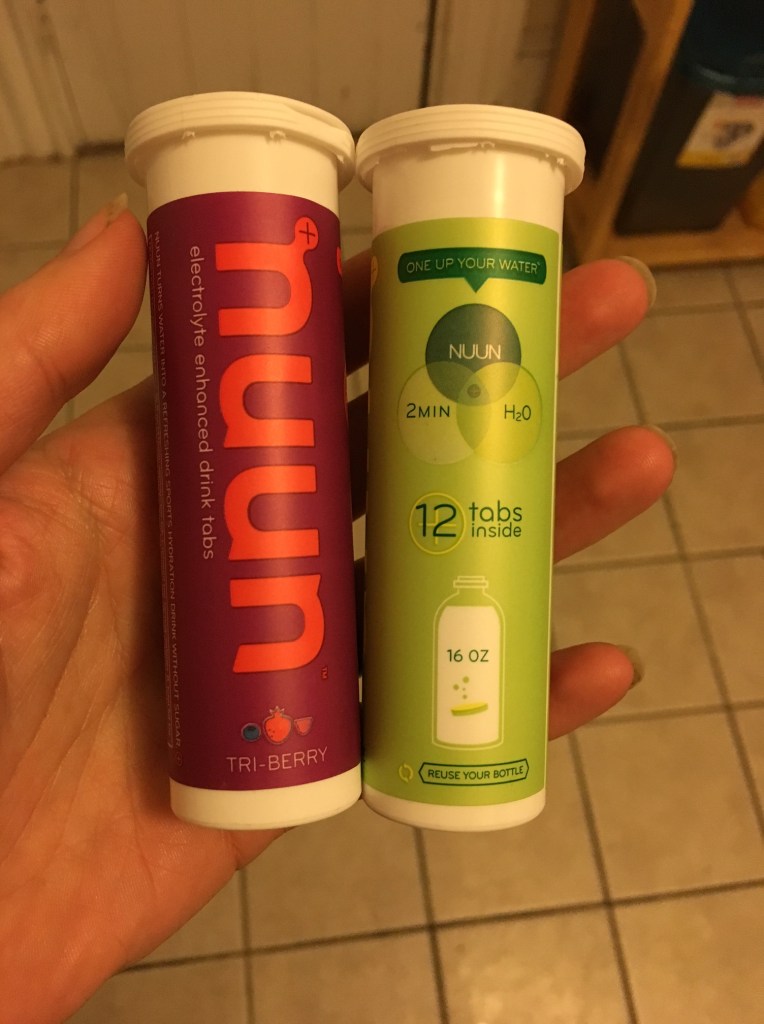
I actually have another book blogger to thank for this discovery. The awesome Running ‘N’ Reading posted a few times about the recovery drink Nuun. Replenishing electrolytes and rehydrating are very important after working out. It helps with muscle recovery and just general hydration. I’ve struggled because I’m not really a fan of Powerade and Gatorade, especially for the calorie content. (The ones with zero calories don’t taste good to me). I love coconut water, but it’s full of calories and expensive to buy. Nuun comes in tubes that each contain 12 tablets. You drop the tablet into water, and in two minutes it dissolves into a drink. Each tablet contains 8 calories. The tablets make it easy to order online and stockpile into your home, as well as convenient to take with you on longer fitness excursions. My husband and I are both pretty addicted to them now! And we’ve both noticed less DOMS (delayed-onset muscle soreness) after hard workout days. Our favorite flavors are lemon-lime and tri-berry.

Bunnies at HomeGoods!
I love bunnies, and this month HomeGoods stocked up their spring holdings. I was hard-pressed to select only a few items (I’ll find almost anything with a bunny on it adorable), but I did my best to stick to what we need. My husband and I each have our own bowl for mealtimes (they do not match) but mine was a bit small for meals like soup or stew. So I picked up one that is about the same size as his. We also had large plates and small plates but no medium-sized ones, so I picked up two of those. Finally, I can always use more kitchen towels, so I got a set of two with this cute bunny on them.
Finally, a book!

Blackout: Remembering the Things I Drank to Forget by Sarah Hepola
I want to wrap up these monthly favorites posts with a quick comment about my favorite read of the month. I devoured Blackout in a mere two days in audiobook format. I basically was searching for any task I could do as an excuse to listen to it. It’s that good. First five star read of the year! Review to come.
So that’s it for February. Be sure to tune in next month for episode 2 of Wolfy’s Favorites!
What were some of your favorite things in the month of February? Have you tried out any of the things I’ve mentioned? Tell us about your experience in the comments! (Especially feel free to let me know your Snapchat or Instagram usernames).
 Support my work with a tip or browse my shop for curated book club guides, how to guides, cross-stitch patterns, and more!


This work by Amanda Nevius is licensed under a Creative Commons Attribution-Noncommercial-No Derivative Works 3.0 United States License.
 Opinions of a Wolf