
Archive
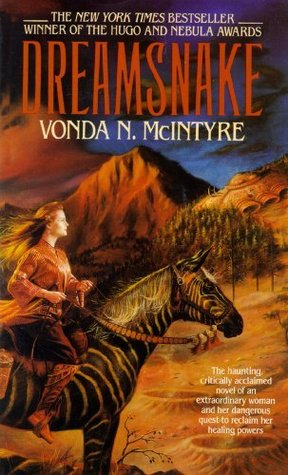
Book Review: Dreamsnake by Vonda N. McIntyre (Audiobook narrated by Anna Fields)
 Summary:
On a far future Earth destroyed by nuclear warfare, most people have reverted to tribal living on the desert. These people rely on roaming healers armed with three snakes whose venom help provide healing relief. Snake is on her first year of bringing roving healing, but when a misunderstanding ends in the death of her dreamsnake, she is determined not to return home to the healers until she finds a way to replace him. It is almost impossible to breed dreamsnakes, but maybe the city will be able to help. The city that keeps the tribes mostly locked out and communicates with the people who live in outer space.
Review:
This book made it onto my tbr for three reasons. It’s 1970s scifi by a woman author, known for being feminist, and is supposed to be able to change your mind about snakes. I was surprised to find it on Audible but elated, especially when I heard the sample of the narrator’s voice. She speaks at the perfect speed and tone for my listening taste. What I found, upon listening, was a book that brought everything I had been promised in a unique plot that I still find myself thinking about periodically. It is just so different, and different is good in my scifi.
You can’t talk about this book without talking about the snakes. I have a gut negative reaction to snakes; one that most likely was learned before I have memories, I’m sure. Both my husband and a close friend think snakes are super cute, so I was hoping this book might change my perception to at least be less negative. Interestingly, a key part of the plot revolves around a person minsinterpreting a snake as dangerous and reacting violently to it. Snakes are not seen as not dangerous, just that only certain snakes have truly dangerous venom, and people are encouraged to get immunized against this venom and to be cautious in areas where they might frighten a snake into striking. I came to care about Snake’s snakes and by the end of the book, where there is a scene that normally would have haunted my dreams (it involves someone in a pit full of snakes), I actually was able to react rationally to the situation and be more concerned about the evil of the person who threw the person in the pit and whether the person would be able to get out of the pit eventually than really be concerned about the snakes themselves. The book presents snakes much like other animals. They’re a living creature that can be dangerous or harmless or some mixture of both, and it’s about building your own knowledge so you know how to handle them more so than just being gut afraid of them. If that was all this book gave me, I would have been impressed, but it gave me so much more.
The plot leads through multiple different tribes and cultures, and all are imagined creatively and differently from each other. Cultural understanding is valued but only to the point where the culture is not actively harming innocents. As mentioned earlier, the whole book centers around a cultural misunderstading, and everyone on both sides of it takes responsibility for the situation. There’s a love interest for Snake who seeks to help her but she also helps herself (along with others). There’s a positive representation of adoption, as well as multiple sexualities and women and men both being responsible for birth control. Without giving anything away, the ultimate conclusion is about how changing your viewpoint can bring a solution, which is kind of the other side of the coin of the original cultural misunderstanding. It’s a smart book, largely about how different people interact and how humility and willingness to listen can move everyone forward.
Overall, this is a unique piece of scifi with an engaging plot that will change your mind about snakes. It left me wishing there was a sequel so I could revisit this world.
If you found this review helpful, please consider tipping me on ko-fi, checking out my digital items available in my ko-fi shop, buying one of my publications, or using one of my referral/coupon codes. Thank you for your support!
5 out of 5 stars
Length: 312 pages – average but on the longer side
Source: Audible

Trigger Warning:
Readers who are sensitive to discussions of rape of a child should be aware it is discussed as something that occurred in the past to a character, although not depicted, and the victim is ultimately empowered.
Audiobook Review: The 5th Wave by Rick Yancey (Series, #1) (Audiobook narrated by Brandon Espinoza and Phoebe Strole)
 Summary:
When a giant spaceship showed up above Earth that wasn’t ours, Cassie and everyone else expected contact. What they didn’t expect was waves of attacks, everything from EMP to disease. Now, she’s at a refugee camp with her father and little brother wondering what the 5th wave of the attack might be. When it comes, will they even know?
Review:
I really enjoyed Rick Yancey’s other series (The Monstrumologist, series review). I must admit to being surprised that this is the series that got picked up into a movie. I didn’t find the blurb nearly as intriguing as that of The Monstrumologist. But since I liked the other series so much, I figured I’d give it a shot. While I can see why it’s taken off, I don’t find it to be as well-constructed or nearly as unique as Yancey’s other series.
The beginning of the book is very slow-paced. Cassie is off hiding in the woods on her own and through her diary where she tries to deal with what has happened the reader learns about the waves of the alien invasion. I like a diary book, but the slow pacing just really didn’t work for a book about an alien invasion.
At a certain point, this narration switches for one chapter to that of the perspective of an alien. Then it switches to the perspective of a boy from Cassie’s high school she had a crush on and his experiences with the alien invasion. Later it flips back to Cassie, only it’s now no longer her diary. Her diary just sort of gets dropped. While I can enjoy multiple narrators, I don’t think these are handled as well as they could have been. The chapter from the alien’s perspective ruins any tension or mystery that had been building around a certain event, in particular. Often switching between Cassie and Ben just feels like it’s convenient for world building and not adding very much to the plot. That said, I do like that the “star” position of this YA action is shared between a boy and a girl fairly equally.
The plot, although slow-moving, starts out strong. There is a plot twist that made me roll my eyes and that I think makes this less unique in YA literature than it started out.
Initially it appears that there will be no love triangle but there ends up being one. I can’t go into the details without some big spoilers but I will say that you make it through most of the book without a love triangle, and then there ends up being one in the last bit. It was disappointing, as I thought something more unique was being done (something akin to a crush turning into a real friendship…but that’s not what happens).
Ultimately the book ends up feeling less about aliens and more about the horrors of child soldiers and war stealing childhood. I definitely think scifi can bring a current issue such as this to people’s attention, but I also think the narration and various irritating and/or confusing plot points ultimately weakens the point. I doubt when I was a teen that such a book would have made me think about child soldiers. Instead I would have felt misled by the title and blurb and been irritated about that, distracting from the point.
All of that said, if a YA reader is looking for an apocalyptic setting featuring dual leads instead of one hero, this is a book that will fit that bill. Just be sure the reader is ok with some surprisingly slow-moving portions for a book with an action-packed blurb. However, I would suggest that a YA reader looking for something truly different check out Yancey’s other YA series: The Monstrumologist.
If you found this review helpful, please consider tipping me on ko-fi, checking out my digital items available in my ko-fi shop, buying one of my publications, or using one of my referral/coupon codes. Thank you for your support!
3 out of 5 stars
Length: 457 pages – chunkster
Source: Audible

Book Review: UnSouled by Neal Shusterman (Series, #3) (Audiobook narrated by Luke Daniels)
 Summary:
Connor and Lev are on the run from the Juvenile Authority but for once they’re running to something. Or rather, someone. They’re looking for a woman Proactive Citizenry has tried to erase from history, hoping she’ll have some answers about just how the world got to be the way it is. Meanwhile, Cam, the rewound boy, is plotting to take Proactive Citizenry down in the hopes of winning the heart of Risa.
Review:
This entry in the series really fizzled for me with the far-fetched ideas and shaky execution of a complex plot finally becoming too much for me to really enjoy the story.
On the one hand, this book is more of the same. There’s multiple characters in vastly different situations who will clearly all come together at some point in a convergence that should read like fate but oftentimes just reads as too convenient. On the other hand, the action this time is interspersed with some flashbacks to the scientist who discovered unwinding, and how it went from something to be used to save lives to something to keep adolescents in line. This plot was interesting, but its reveal was awkwardly handled. The flashbacks are from the perspectives of the scientists, just as we switch around among the perspectives of the teens in the story, rather than letting them naturally discover what happened. It’s a change that could have been used to build up more tension and excitement but instead just makes the pace awkward and changes the feel of the story from one told primarily by teens to one routinely interfered with by adult perspective.
The big reveal of how unwinding came to be failed to really strike a chord with me, and I believe this is partially because it’s still a bit unclear to me as to who exactly the big bad is. I do think it’s interesting that basically unwinding came to be because big business was trying to protect their investment in health care. I appreciate the angle of how health care needs to be more than just a business. However, I question the supposed solution for unwinding offered at the end of the book. I feel it is just more big business.
Overall, this book continued the issues with the second book, only more so. Too many plots that conveniently intersect and confusion over what exactly is going on in the world. Additionally, the far-fetched elements that challenged my ability to suspend disbelief in the first two books become at the center of the big overarching plot of the series. Given both of these issues, I will not be continuing reading the series, although I am glad that I read the first book, as it is an interesting and unique dystopian YA world. It’s just one that went off the rails a bit. This entry is recommended to those readers who simply must know how unwinding came to be and how the characters plan to stop it.
If you found this review helpful, please consider tipping me on ko-fi, checking out my digital items available in my ko-fi shop, buying one of my publications, or using one of my referral/coupon codes. Thank you for your support!
3 out of 5 stars
Length: 404 pages – average but on the longer side
Source: Audible
 ,
,  ,
, Book Review: If You Could Be Mine by Sara Farizan (Audiobook narrated by Negin Farsad)
 Summary:
Seventeen-year-old Sahar wants three things in life: 1) to become a doctor 2) for her widowed father to come out of his depression and be the Baba she once knew 3) to marry her best friend Nasrin. The problem is, she lives in Iran, and she and Nasrin could be imprisoned and beaten for just their stolen kisses in private, let alone if they tried to marry each other. When Nasrin’s parents announce that they’ve arranged a marriage for her to a well-to-do doctor, Sahar is heartbroken. Nasrin thinks they can continue on as they have been, but Sahar wants to love her exclusively, and she is determined to find a way.
Review:
This book was all the rage on GLBTQ book blogs a couple of years ago, and it’s been on my tbr pile ever since. When I saw it on Audible and heard a clip of the narration, I knew it was time to read it. I found an interesting, unique piece of YA.
First, let me say, if you at all enjoy audiobooks and have the chance to listen to this rather than read it in print, please do so. Farsad’s narration adds so much to the book. From her light Persian accent to her unique voice for each character to her perfect pronunciation of Persian words and Iranian place names, her narration made the reading of the book much more immersive than it would have been if I had read it in print. Plus, at just over 5 hours, you can read it very quickly. I finished my copy in under a week, thanks to commutes and runs.
Let’s start with the things in this book that really worked well for me. First, I really appreciated seeing a teenage girl’s relationship with her single father at the forefront. It’s difficult to find a YA book talking much about a girl’s relationship with her father, let alone a single father. The book pushes beyond even this though and addresses how a parent’s depression affects a teen. Part of why Sahar is so desperate and attached to Nasrin (bare in mind, they are only 17), is that her mother died and her father fell into a depression. He is there every day but it doesn’t feel like he is. At one point, Sahar skips school and says that her baba will not even notice. And he doesn’t. Until the school calls him directly. Her father’s depression is situational, not genetic or chemical, but it still affects him and their relationship, and I thought this and its resolution was well depicted.
The depiction of a non-western culture and issue in a book marketed to western teens is well-handled. Iran is not demonized. The good and bad sides of the country are depicted (and of course there are good and bad sides of every country). Teens who may not personally know someone from the Middle East will benefit greatly from seeing things like the fact that even Sahar’s mild father will sneak a bootleg copy of a DVD to watch but also will be intrigued by and appreciate elements of Iranian culture such as the well-protected oasis-like back yards. Farizan also does a good job establishing things like recent wars in Iran, how the current political situation came to be, etc… without infodumping.
While I sometimes found myself rolling my eyes at the level of emotion Sahar was showing, it was to the appropriate level for a teenager. Also, other people in Sahar’s life clearly see that she is acting like a teenager and attempt to lovingly and understandingly speak with her about what is going on.
Before I move into speaking about what didn’t work for me, I’d like to talk about the trans content. It’s no plot spoiler that Sahar seeks to keep Nasrin to herself by pursuing a sex reassignment (I am not calling it a gender confirming surgery because for her it is not). This is in the official book blurb, just not mine. Essentially, in Iran (and this is still true), having same-sex attractions is haram/forbidden but being transgender is not. The state will even pay for having the treatment and is known for pushing people with same-sex attraction to get a sex reassignment. Sahar meets Parveen, a transwoman, at her cousin’s party, and this plants the idea in her head that she could marry Nasrin if she gets the surgery. Now, I’m not a transperson, but I do think that the author does a good job depicting real trans people and contrasting that with Sahar’s rather adolescent idea to get to be with Nasrin. Sahar tells Parveen she thinks she’s trans, and Parveen brings her to a support group where most of the people are actually trans, except one woman, who we later find out was forced to get the sex change. Thus, both the genuine trans experience and the forced sex change experience are depicted in the book. Iran is lauded for its support of trans people (there is even one passage talking about how trans people have to pay for their own surgeries in the US unlike in Iran) but also it is clearly shown how harmful it is for the state to demonize same-sex attractions. Additionally, the trans characters do talk about how while the surgery is supported by the state, culturally they still face discrimination from some of their families, when dating, and when looking for jobs.
So what didn’t work for me? I get it that Sahar and Nasrin are adolescents, but I just could not get the appeal of Nasrin to Sahar. I felt I would have been much more empathetic to the whole situation if Nasrin hadn’t been so selfish and annoying. To be fair, multiple characters point out Nasrin’s selfishness to Sahar, and Sahar even at one point questions why she’s willing to risk so much for Nasrin. There is one scene that I believe is supposed to redeem Nasrin of her bad behavior, but I still struggled to like her or feel empathy for her. It bothers me that Sahar never tells her father about her sexual orientation, in spite of him being depicted as quite modern and understanding. I also felt that the ending didn’t push things far enough, compared to beginning of the book. I wanted more from and for Sahar. Perhaps the ending is more realistic, but it did disappoint me.
Overall, this is a unique piece of YA showing the GLBTQ experience in a non-western culture that will elicit both an understanding of a non-western culture and empathy for other life situations and experiences from YA readers. Readers will identify with Sahar’s genuine adolescent voice, which will draw them into the perhaps quite foreign-feeling situation.
If you found this review helpful, please consider tipping me on ko-fi, checking out my digital items available in my ko-fi shop, buying one of my publications, or using one of my referral/coupon codes. Thank you for your support!
4 out of 5 stars
Length: 256 pages – average but on the shorter side
Source: Audible
Book Review: Sharp Objects by Gillian Flynn (Audiobook narrated by Ann Marie Lee)
 Summary:
Camille Preaker, journalist to a small Chicago newspaper, recently out of a mental institution after an in-patient stay to address her long-standing inclination to cut words into her body, has been asked by her boss to go to her hometown. Two little girls have been found murdered–with their teeth pulled out. Camille is not inclined to go home. She’s barely spoken to her distant, southern belle mother since moving out years ago and hardly knows her half-sister, 13-year-old Amma. But home she goes, staying with her mother, step-father, and half-sister to save money, drinking to cope as her demons haunt her, and investigating the murders that have shaken the small town of Wind Gap, Missouri.
Review:
This book hit my radar around the time there were all those articles judging Gillian Flynn for writing female characters who are bad/evil. I immediately was supportive of Gillian Flynn (bad women exist, hello) and interested in more of her writing. I started with Gone Girl so I could read it before seeing the movie, but Sharp Objects has been in my sightlines for a long time. The mere idea of an adult self-injurer going to her hometown and facing her demons was something I would want to read even without knowing how much I enjoy Gillian Flynn’s work. What I found was a tightly-written, fast-paced mystery with multiple complex characters and simultaneously breath-taking and heart-breaking lead.
I thought through most of the book that I knew the solution to the mystery. Whodunit. That didn’t bother me. I liked everything leading up to what I thought was going to be the ultimate reveal. The plot twists, though, surprising myself and characters in the book. While part of me likes the twist, part of me felt it was more cliche than the original ending that I thought I was getting. Ultimately, while I didn’t necessarily find the resolution satisfying, I did find it surprising and something to chew on. It will stick with me in a I’m thinking about it way like eating something unusual you’re not sure if you liked, rather than in an I remember feeling so pleasantly satisfied way, like how you might look back on Thanksgiving dinner.
The pacing in the book is superb. I read it in audiobook format, and I found myself using time to listen to it as rewards for accomplishing other things. I listened to it every chance I had because the pacing was so spot on. It never felt too quick-moving or too slow. Every scene felt like it had a reason for being there and kept me on the edge of my seat.
There is a lot of mental illness represented in this book, and that is wrapped up in the characters. I’ll talk first about the spoiler-free mental illnesses.
Camille is a self-injurer who has had a stay in a mental hospital where her roommate managed to commit suicide. Camille never names more of a diagnosis the doctors gave her than self-injurer. However, much of her behavior, including her self-injury, points to PTSD from her childhood. This includes the foreboding feeling she gets when returning to her hometown. How she feels driven to drink herself numb for dealing with certain triggering situations. Her impulse to inflict hurt on herself, etc… All of that said, the representation of Camille as a cutter is superb. This is an adult woman who still struggles with the impulse to cut. Who talks about how most people think of it as an adolescent problem. Camille manages to describe her urges to cut, what drives her to cut, without ever actually definitively saying what causes it. And this is great because we don’t actually know. Camille is nuanced. She is a woman who used to (still wants to) cut herself but that is not, not by a long-shot, all she is.
The book also secondarily depicts alcoholism and drunkenness as a self-medication technique. Camille drinks as a lesser evil compared to cutting when she needs to relieve her stress and discomfort from dealing with terrible situations. It shows how alcohol and cutting both can end up being used as coping mechanisms when no healthier ones are learned or taught. It also shows how stressors can impact sobriety and health.
Despite being both a self-injurer in recovery and a woman who abuses alcohol, Camille is depicted as a heroine. Her investigative journalism helps break the case open. She exhibits care and concern for her half-sister and loyalty to her boss and career. She is ultimately depicted as resilient in spite of her struggles, and I loved seeing that.
If you are interested in reading about other depictions of mental illness in the book, they are in the spoiler section below.
*spoilers*
It is ultimately revealed that Adora, Camille’s mother, suffers from Munchausen by Proxy (MBP). This MBP is what ultimately killed Camille’s other little sister, Marion. Camille escaped this same fate because her mother didn’t love her and thus also didn’t really enjoy caring for her or garnering attention through her in this way. What Adora does is unforgivable and certainly causes a visceral reaction in the reader. However, there are scenes that discuss things such as how Adora’s mother didn’t love her. The implication is that some of the mental illness in the family is learned or a reaction to poor environment. It manages to keep Adora human rather than monstrous.
Similarly, it is ultimately learned that Amma is a sociopath. Camille seems to be uncertain if this is just Amma’s nature or a reaction to Adora’s “mothering” or some combination of the two. I feel that not enough time is given to analyzing Amma, once Camille learns her true nature. This depiction, compared to the others in the book, is just much flatter due to the lesser amount of time Camille and other characters spend pondering Amma.
The book ends with Camille wondering if she is able to love in a healthy way or if she’s doomed to repeat her mother’s unhealthy, hurtful mothering. Essentially, she wonders if MBP is inherited or if she can escape that. Some time is spent discussing what made Camille more resilient than either of her sisters. I think this is some of the more valuable portion of the book, as it really highlights the nuances of some of the things we still just don’t have a solid answer to about mental illness. What makes some people more resilient, more able to overcome bad childhoods and genetic tendencies than others? What makes some people better able to cope with a mental illness than others? They are important questions, and I like that they are addressed.
*end spoilers*
There are some scenes that will bother some readers. While rape is never depicted, it is discussed, as well as the idea of what counts as rape, with one female character arguing that a woman who is intoxicated is still responsible for any sexual activity that occurs. The character saying this was a victim of rape while intoxicated herself, so readers should bare in mind that this reframing of a rape as not a rape is very normal for rape victims who have not fully addressed the rape yet. Additionally, at one point one character has consensual sex with a character who has just barely turned 18. Also an adult partakes of illegal drugs and alcohol with characters who are extremely underage. All of these scenes work within the book and are necessary for the plot, however.
Overall, this is a fast-paced mystery with a strong yet flawed female lead and an engaging and thought-provoking plot that presents many different nuances of mental illness. Recommended to those looking for a fast-moving book with a unique depiction of self-injury who do not mind the violence or gray moral areas innate in a mystery revolving around serial killing.
If you found this review helpful, please consider tipping me on ko-fi, checking out my digital items available in my ko-fi shop, buying one of my publications, or using one of my referral/coupon codes. Thank you for your support!
4 out of 5 stars
Length: 254 pages – average but on the shorter side
Source: Audible

Counts For:

Book Review: UnWholly by Neal Shusterman (Series, #2) (Audiobook narrated by Luke Daniels)
 Summary:
Picking up where Unwind left off, UnWholly finds Risa and Connor managing the Graveyard full of unwinds themselves with no adults in site, and Lev struggling to find a purpose now that he’s both free of clapper chemicals and under the watchful eye of the government. Into the mix comes Cam, the first ever “rewind.” He’s been assembled completely from the parts of unwinds of every race and religion. And his creator intends to meddle with the runaway unwinds too.
Review:
I picked this up right after finishing the first on audiobook, because finding a fast-paced story with a good narrator can be harder than it sounds. So once I found that with the first book in the series and I saw the rest of it had the same narrator, I figured I may as well continue along with it. While I found the first book engaging and thought-provoking, I found myself periodically bored with the plot in this one, and also found it more difficult to suspend my disbelief than before.
The basic premise is that Connor is all torn up over having the arm of his once-rival (who also just so happened to threaten to rape his girlfriend, Risa). He thus holds Risa at arm’s-length (pun intended) because he’s afraid of what his own arm will do. While I appreciate the fact that it must be truly atrocious for your boyfriend to now have your attempted rapist’s arm, I think the fact that Connor lends the arm so much agency is a symptom of one particular idea in this world-building that just doesn’t work for me. The idea that body parts have their own spark of soul or agency or thought. It’s rife in this entry in the series, and it’s just plain weird to me. I can understand a character not bonding with a transplant that was forced upon him. I can understand it being weird for loved ones. I don’t, however, find myself able to suspend my disbelief enough to believe that someone’s arm has their personality in it so much that the person who it was transplanted onto would be afraid of it. It’s an arm, not a piece of brain or even a heart. The author does provide links to sources about transplant recipients feeling connected to the person whose body part they received or having memories or what have you. I appreciate that. But for me personally this plot point just does not work. Other readers may be able to suspend their disbelief better than I was able to. I for once can’t imagine not going near my own girlfriend because I was afraid of my arm. I also just disliked how much agency Connor removes from himself for his own temper. If he hits the wall when he’s angry it’s not him hitting the wall, it’s the arm hitting the wall. The arm got mad. The arm got out of control. There’s just a ridiculous lack of agency there, and I’m not super comfortable with that level of lack of agency being in a book marketed toward teenagers, who are at the best point in life for learning agency and responsibility.
I similarly have a hard time believing, from a neurological perspective, that the rewind boy, Cam, could exist. His brain is dozens’ of peoples all wound together. I could believe replacing a brain piece here or there with transplant technology, I couldn’t believe mish-mashing many together and having them actually function. Let alone with the only issue being that Cam struggles to learn to speak in words instead of metaphors. While Cam did strike me as grotesque, he mostly just struck me as an impossibility that I was then supposed to have sympathy for because he’s a person with his own feelings…but are they really? The whole thing was just a bit too bizarre for me.
On a related note, I found the scenes where Cam wakes up and learns to talk and slowly realizes what he is to be very tedious to read. They move slowly, and there is an attempt at building of suspense, but it is clear nearly immediately that Cam is a Frankenstein’s creature like experiment, even without Cam himself knowing it right away.
The other big new character is Starkey, a boy who was storked who is brought into the Graveyard. He’s basically exactly the same as Connor (he’s even still a white boy), the only difference being that was a stork and that he has no Risa to ease down his temper. I found his characterization to be uncreative, even if the building up of strife between the storks and the rest of the unwinds was a good plot point. It would have been better if the leader of the storks was more creative. Similarly, Starkey’s two main assistants are a black girl and an Indian-American boy. Just as with the first book, non-white people exist, but only as seconds to the white people. Why couldn’t either of them have been the leader of the storks?
All of these things said, there was still a lot of plot to keep the interest. I’ve barely touched on a couple of them. The world is still engaging, even if it’s hard to suspend the disbelief for it. I doubt I’d keep reading if I was reading this in print, but the audiobook narration makes it feel like listening to a movie, and it’s the perfect match for my commutes and doing dishes and such. Plus, now I’m curious as to where else the plot will go. I’m betting it will end up going in a direction I find it even harder to suspend my disbelief for, but it’ll be a fun ride seeing where that is.
Overall, fans of the first book may be disappointed by the slightly more meandering plot in this one. The addition of two new characters to follow will be distracting to some readers while others will find it adds to the interest and suspense. Some readers may be turned off by the continued lack of diversity in such a large cast of protagonists. The plot is engaging and the world is unique, though, so fans of YA dystopian scifi will probably still enjoy it.
If you found this review helpful, please consider tipping me on ko-fi, checking out my digital items available in my ko-fi shop, buying one of my publications, or using one of my referral/coupon codes. Thank you for your support!
3 out of 5 stars
Length: 416 pages – average but on the longer side
Source: Audible
Book Review: Unwind by Neal Shusterman (Series, #1) (Audiobook narrated by Luke Daniels)
 Summary:
In the near future, the Pro-Choice and Pro-Life debate explodes into a war called the Heartland War. The only way the war could reach a peace was to come to an agreement. There would be no abortion but when children are between the ages of 13 and 17 their parents can sign an order to have them unwound. New scientific technology allows doctors to transplant all of a person’s body parts. They will then “live on” in a “divided state.” Teens whose parents choose to sign an unwind order for them are rounded up by juvie cops and brought to Harvest Camps to await their fate. Some families, particularly from fundamentalist branches of all faiths, believe in tithing 10% of their children, and will have a child simply to raise them to be a tithe. Additionally, many children end up unwanted and living in State Homes, where they are all given the last name of Ward–for ward of the state.
Connor is a light-hearted bad boy who just accidentally found his own unwind orders in his parents’ desk and immediately goes on the run. Lev is a tithe who is on his way to Harvest Camp. Risa is a ward of the state, and she is on a bus to be unwound, because she isn’t deemed exceptional enough to justify her upkeep. A series of events throws them into each other’s lives and leaves whether or not they will be unwound in question.
Review:
This was recommended to me years ago, but when I first read the description I was skeptical that the book was anything but Pro-Life propaganda. Years later I decided to check it out again, and most reviews mentioned how neutral the book was. Additionally, I read some interviews with the author where he stated he genuinely was trying to present a neutral story that analyzes some tough questions, so I thought I would give it a shot. (I also found this fun short video interview where he talks about how he came up with the idea of the dystopian world.) Ultimately, the author has succeeded at creating a future world that is fascinating to visit and that also analyzes medical ethics in a creative way. I would honestly say the book is much more about medical ethics, particularly in regards to transplants, than it really is about abortion rights.
The basic plot is that three very different teenagers are supposed to be unwound but then find themselves on the run instead of actually at Harvest Camp. The book is in the third person but from the limited perspective of one character, and that one character switches around. It is predominantly Connor, Risa, or Lev, but it is also sometimes someone like a juvie cop or a parent. Sometimes this narrative structure works really well, providing many different perspectives on the same event or issue. Other times it feels too contrived. The perspective switches at just the right moment to keep the reader in the dark, or to reveal something we wouldn’t otherwise know. Sometimes this structure builds suspense and other times it kind of ruins it. Overall, though, I enjoyed the structure and found that the multiple perspectives really added to the world and the story.
This narrative structure is enhanced by clippings from real, modern-day newspaper articles and blogs, as well as fake advertisements and news from the future the book is set in. Partially due to the Audible narrator, who did a fantastic job at the ads, I really enjoyed these snippets of media from the future. They are very tongue-in-cheek and adult, but will still appeal to teens reading the book for their over-the-topness. I found the modern day news articles to be less interesting, and mostly felt a bit like scare mongering. They read as a bit heavy-handed in pushing the “this could really happen!” angle.
I did find it a bit frustrating that all three of the main characters are white and straight. While it is acknowledged that a few people (primarily adults) could be GLBTQ, the assumed norm is straight and cis, no matter what social organization is in control. Whether it’s mainstream society, rebels, or anyone in-between. The norm is always straight cis. Similarly, while the author does include non-white people to a much greater degree than non-straight/non-cis people (there are a wide variety of ethnicities and religions represented in the society), they are all secondary characters. One thing that really stuck out to me was that at one point in the book we meet a Chinese-American girl who is being unwound because her parents wanted a son, and they just kept trying until they got one and then picked a daughter to unwind, because they couldn’t afford all the kids. She’s also got an interesting punk aesthetic to her. What an interesting main character she would have been! Can you imagine her in the role of Connor? They are both running away from being unwound, and she could easily have taken that main character role. It just bothers me when a book has three main characters who are all in a similar situation due to society-wide problems, and yet they are so non-diverse, with just a nod at gender by having one female character.
With regards to the female character, Risa, I must say I was very disappointed to have one plot point be an attempted rape of her, and her then being saved by a male character. First, we only get one female main character and then she naturally is almost raped. Then naturally she must be saved by someone else. The whole scene sickened me, especially when I thought about teen girls reading it. It was just a completely unnecessary plot point. I once read an article that talked about how often rape scenes (or attempted rape scenes) are a sign of lack of creativity. I don’t think all of them are, but this one certainly came across that way. Unnecessary and a convenient plot point without thought to how it would affect the readers.
In spite of these characterization and style complaints though, the plot is very good, and the world is fascinating. Characters in a natural manner talk about and explore the ethics of life, when life begins, and who has the right to life, as well as who has the right to end it. The plot is fast-paced, and I read as quickly as I could to find out what happened. There are also a couple of twists at the end that rocked my socks off and left me immediately downloading the next book in the series.
All of that said, I have a few questions about the world that were never addressed. First, if everyone who is unwound is between the ages of 13 and 17, how does that work out with transplantation? People have not yet finished growing at 17, especially their minds. Does this mean a 67 year old woman would have a 15 year old’s arm if she needed a transplant? If so, that sounds very grotesque to me, and I wonder how society has learned to deal with something so mis-matched. This isn’t particularly addressed, except to say that sometimes it’s weird to look at someone with two eyes that don’t match. Similarly, the world at large isn’t really talked about at all. The kids who are trying to escape being unwound don’t even consider running into another country but they never explain why. How has the world at large reacted to the United States’ new law? Is there any country that would be a safe-haven for unwinds? Are there other countries following suit? The international impact is woefully underaddressed.
In spite of these various shortcomings, the plot and the world still sucked me in. It was a quick read that left me wanting more.
Overall, fans of dystopian ya looking for another series to whet their appetite will definitely enjoy this one. It’s a completely different dystopia from most of the ones that are already big, and I am sure YA readers who are currently teens themselves will find the idea of their parents being able to sign an unwind order on them chilling. Dystopian YA fans should definitely give this one a go.
If you found this review helpful, please consider tipping me on ko-fi, checking out my digital items available in my ko-fi shop, buying one of my publications, or using one of my referral/coupon codes. Thank you for your support!
4 out of 5 stars
Length: 337 pages – average but on the longer side
Source: Audible
Book Review: Thieves’ Quarry by D.B. Jackson (Series, #2) (Audiobook narrated by Jonathan Davis)
 Summary:
It’s September 1768 in Boston, Massachusetts, and the King’s navy has sailed into Boston Harbor to start an occupation in an attempt to restore order and stop the stewing rebellion. Conjurer and thieftaker Ethan Kaille isn’t sure how he feels about the occupation but he is sure how he feels about the large spells he’s started feeling in Boston–not good. He feels even worse he finds out that all the men on board one of the British ships have been killed by a conjuring. The British navy hires him to investigate, while the mayor of Boston threatens to have all conjurers hanged in mere days if he doesn’t find the culprit.
Review:
I loved the first book in this series. Urban fantasy set in a historical time period in the city I actually live in just appealed to me so much. (I really do wish there was more historical urban fantasy. It is awesome). This book failed to capture my attention the way the first in the series did, and I’m uncertain if it was due to the tone, the plot, or the audiobook narration.
Ethan comes across as a bit more insufferable in this entry than in the first. Perhaps as an American and a Bostonian I just simply struggle to understand Loyalist leanings, but Ethan siding with the Crown over and over again, in spite of a literal military occupation just rubbed me the wrong way. It takes him far too long to be irritated by this over-reaction from the Crown, in spite of being on good terms with some of the Patriot leaders. I suppose what it comes down to is that I could take his waffling in the first book when rebellion was just beginning to brew. I thought he was closer to being on the Patriots’ side by the time period of this book, and he wasn’t. This would bother some readers less than it bothered me, I am sure.
Similarly, I had a hard time caring about the plot. I cared about Ethan solving the mystery in time to save the conjurers, but I simply didn’t care who had killed the men on the occupation ship. Everyone in the book, even the Patriots leaders, seemed to think it was this huge evil thing, and I just didn’t care much one way or the other. Part of this could be because I don’t see the difference between casting a spell and murder in other ways, whereas the characters in the book do. Part of it is that the reader never gets a chance to get to know anyone on the ship in a way that would make them sympathize. It felt for a lot of the book like Ethan was investigating a calamity of war, rather than a crime, and that just made it a bit dull to me.
All of that said, this book is a poor fit for an audiobook. I am certain I would have enjoyed it better if I was reading it myself, in retrospect. The pacing just isn’t suited to an audiobook’s speed. I wanted it to go faster, and I did speed up the narration speed, but I couldn’t speed it up too much or I’d miss important things. It was a bit frustrating, in spite of the narrator’s talents at creating unique voices for each character, which is something I always appreciate.
The ending of the book does speed up its pace, and the solution to the mystery is fascinating. This saved the book for me, although I am uncertain if I will continue along in the series. I may need to poke around and see if Ethan goes fully Patriot in the next book before I venture to pick it up.
Overall, this entry in the series fails to live up to the first, although an interesting ending will still spur the reader on to the next entry in the series. Readers who will be turned off by Loyalist leanings in a Revolutionary War book may wish to look elsewhere. But those who simply enjoy seeing urban fantasy in a historic era will not be disappointed.
If you found this review helpful, please consider tipping me on ko-fi, checking out my digital items available in my ko-fi shop, buying one of my publications, or using one of my referral/coupon codes. Thank you for your support!
3 out of 5 stars
Length: 317 pages – average but on the longer side
Source: Audible

Previous Books in Series:
Thieftaker, review
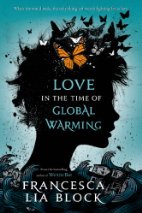
Book Review: Love in the Time of Global Warming by Francesca Lia Block (Series, #1) (Audiobook narrated by Julia Whelan)
 Summary:
Pen’s life was destroyed when an Earthshaker took away her family (even their dog) and destroyed the Los Angeles she once knew. She’s now on a quest to save them from the monstrous giants that rose up after (or with?) the Earthshaker. Along the way she finds other teens who’ve miraculously survived, each with secrets and talents of their own.
Review:
This book left me completely torn. I loved, oh how I loved, the representation of both bisexual (Pen) and trans (Hex, her boyfriend) teens. But the story to go with these teens failed to live up to both these wonderful characters and the beautiful title.
Let’s talk about the good first, because I don’t want it to be overshadowed by what didn’t work. Pen is a bookish teenager who generally prefers to stay in reading the Encyclopedia or The Odyssey to going out to parties. But she still has two close friends. She’s not a loner. She’s brave, open, loving, and sometimes makes rather short-sighted decisions. And it is gradually revealed throughout the book that she is also bisexual. The scenes exploring Pen’s bisexuality, and how it’s hard for her to be out about it, in spite of being completely comfortable with herself, are wonderfully done. Pen acknowledges that even though her parents have always told her that it doesn’t matter a whit if she is straight, lesbian, bisexual, or trans, that the world at large doesn’t always think that, and that’s part of what makes being out hard for her. The world is not always the welcoming place her family is.
The book early on establishes that Pen currently has a crush on a boy, so the reader may perhaps be surprised when she reminisces about an earlier crush on a girl, and how she first realized she liked girls too.
Thinking of how I once kissed Moira on the lips. We were drunk and dancing, and our lips just brushed for that electroshock nanosecond, and then she smiled at some boys who were watching us, laughed, and danced away from me like it was a joke. But I’d had an epiphany, even though I hadn’t fully accepted it at the time. I wanted to kiss girls. And it was no joke. (loc 2:14:53)
Similarly, Pen struggles with self-editing her past when telling Hex about her life before the Earthshaker. She is not sure if he’ll understand or accept the fact that she’s perfectly capable of having crushes on girls as well as boys like himself, so she edits herself when speaking to him. She’s telling him a story about a party she didn’t go to, and the picture that her friends sent her of a boy with her friend, Moira:
I went to sleep staring at the last image wondering not what his mouth tasted like but hers. This part, this last, I don’t tell Hex, although I trust him enough to tell him anything. Don’t I? So I’m not sure why I don’t. Because I don’t want him to know I had a crush on a girl? Or because I have a crush on him. (loc 1:39:44)
It’s rare to see a book explore so eloquently what it is to be bisexual, and these feelings Pen has while not universal still explore the difficulty of coming out and being out as a bisexual person, and they were so wonderful to see in a book that I had to restrain myself from jumping up and shouting “Yes!” when they showed up on my audiobook on the bus.
Similarly, Hex, Pen’s love interest and eventual boyfriend (this is not a spoiler, when Hex shows up he may as well have a giant neon “future boyfriend” sign over his head), is a FTM transman. Hex is just as nervous about being out to Pen and their other travel companions as Pen is about being out to him, probably more. Being cis myself, I can’t say as definitively about the quality of FTM representation as I could about bisexuality, however, the author certainly tries to broach topics that I believe would be of interest to a trans YA reader reading this book: acceptance (or not) by family members and impact on romantic relationships with other teens. Hex comes out to Pen as a transman only because she has fallen for him, and he wants her to know precisely who he is before anything more *ahem* romantic happens. Pen immediately accepts him and tells him he is clearly a boy to her, and this changes nothing about how she feels about him. They then have to navigate their sex life. Hex, like many trans people, is uncomfortable with his body. He would rather touch Pen than allow Pen to touch him. Eventually, they reach an arrangement that both supports and asserts Hex’s maleness and allows Pen to give the pleasure back to him that she wants to. I was glad to see a YA book “go there.” I frankly haven’t seen much of that even in adult literature including a trans person. It both addresses the “how do they….” question some YA readers would certainly have after learning about Hex and also serves a purpose in the story to demonstrate a mature, healthy, loving relationship between the two characters.
In addition to Hex and Pen, they also wind up with two male travel companions who become a couple. The characters themselves point out at one point how odd it is that the minority before the Earthshakers is now the majority (none of them are straight AND cis). I was glad the author acknowledged the quirk and had the characters process why that may be. The answer they decide upon is a positive one, rather than the potentially negative one of punishment.
So now let’s talk about what didn’t work. The plot and the setting. The book is meant to be a magical realism style story told in a non-linear way. This could have worked if in the end the overarching plot, when reassessed by the reader from beginning to end, made sense. But it doesn’t. For most of the book, Pen refers to everything in fantastical ways, such as saying “Earthshaker” for what appears to the reader to be an earthquake. Why is she saying “Earthshaker”? Was there something different about it? Does she just like prettying up her language? What is going on with that? Later it is revealed that an earthquake seems to have happened when some genetically engineered giants escaped (showed up? were released?). The whole world basically goes to shit overnight, though, and it just doesn’t seem logical that that would happen from just a few giants escaping. Similarly, there are other fantastical creatures who are never explained.
Similarly, although it is indicated early on that this is a modern retelling of The Odyssey, it doesn’t line up well with the original. In the original, Odysseus is trying to come home after a war and keeps getting swept into side-quests. In this book, Pen starts out at home and then quests away from home. It would have made more sense for Pen to be somewhere away from home (maybe on a school trip or something), have the disaster occur, and then have her have to find her way home encountering fantastical things along the way. Starting her at home just doesn’t work.
Several elements feel like they are just thrown in because they look pretty or work with the scene even though they don’t work with the book as a whole. For instance, butterflies appearing around people who can be trusted pops up in the middle of the book, but isn’t particularly present at the beginning or the end. Similarly, some characters are revealed to have magical powers toward the end of the book, with no foreshadowing about that, only to have them….not use them much beyond the scene where it’s revealed.
Also, I’m sorry, but the whole some evil scientist genetically engineered giants to be his children and now the giants are out to destroy us but also the whole world inexplicably now resembles a myth just really doesn’t work. First, it makes no sense why a scientist would even want to engineer a giant. To be his children? Really? Why would anyone want giant children? Second, to give the mystical elements that started this whole thing a scientific explanation but then leave the rest fantastical doesn’t work. Either they’re all explained by science or they’re all fantastical. I really felt the book went way downhill for me when there was suddenly a “scientific” explanation for the giants. But just the giants and nothing else.
Finally, we need to talk about the name of the book. It’s a beautiful title but it’s really wasted on this book. First, global warming doesn’t come into play in the book at all, so why is it mentioned in the title? Second, it’s clearly a send-up to Love in the Time of Cholera, but it has nothing in common with that book save both having elements of magical realism in them. It feels as if the author came up with a title that sounded pretty and couldn’t bring herself to let go of it in spite of it not fitting the book she actually wrote.
Overall, this is a short read featuring four well-rounded and written teen characters on the LGBTQ spectrum. YA readers looking for positive representations of bisexual and trans characters, in particular, and who don’t mind some inexplicable fantasy elements will enjoy this quick read. Readers who will easily be bothered by the title not matching the content, a mixture of magical realism and scientific explanations for things, and/or nonlinear plots that when told linearly don’t make sense should probably look elsewhere, in spite of the positive representations of underrepresented letters in the LGBTQ spectrum.
If you found this review helpful, please consider tipping me on ko-fi, checking out my digital items available in my ko-fi shop, buying one of my publications, or using one of my referral/coupon codes. Thank you for your support!
3 out of 5 stars
Length: 240 pages – average but on the shorter side
Source: Audible

Book Review: Altered Carbon by Richard K. Morgan (Series, #1) (Audiobook narrated by Todd McLaren)
 Summary:
In the future, people’s memories are backed up on sticks like external hard-drives, and when someone dies, they can just be put into a new body or resleeved. Criminals are put into the brain bank for a set period of time to serve their “prison” sentence before being resleeved. Kovacs is an ex-UN envoy but he’s also a criminal, and he wakes up one day in a new sleeve on Earth, not his home planet, before his sentence is up. A rich myth–someone who has been alive for centuries in the same body, due to their wealth–has been killed. After being resleeved, the local police told him it was suicide, but he doesn’t believe them. So he’s hired Kovacs to figure it out for him. If he solves the mystery, he’ll get sent back to his home planet and get a sleeve of his choice without serving any further sentence. If he doesn’t, he’ll serve out the rest of his sentence and get resleeved on Earth, far from home. Kovacs has no choice but to try to figure out who would waste their time killing a man who has endless sleeves to burn?
Review:
I love a good noir, and I liked the futuristic scifi sound of this one (the most famous futuristic scifi noir is Blade Runner/Do Androids Dream of Electric Sheep, in case you were wondering). Unfortunately, in spite of the very cool resleeving concept, I was left quite bored by the plot.
The setting and ideas for this future scifi world are fantastic. Earth has colonized various planets, and each planet was colonized by different mixes of cultures. Kovacs’ planet was colonized by the Japanese and Nordic cultures. When he was a UN envoy he fought on one colonized by Middle East cultures. So each planet has its own distinct culture, and, Kovacs at least, clearly feels that Earth is quite backwards. For instance, Earth has a cadre of people who believe that resleeving is unethical and sign documents saying they are ethically opposed to being resleeved. It sounds as if no other planets have that faction. Similarly, it sounds as if only Earth has people wealthy enough to become myths–people who can afford to be resleeved in new clones of their own bodies they grow and keep safe, as well as back up their brains at frequent intervals into a cloud. So Kovacs has some immediate culture shock, which is interesting to see.
Also, obviously, the idea of people’s brains being kept on usb sticks (basically) that you can just stick into the brain stem of another body and what implications that would have is just brilliant. It’s cool to read about, and it’s an interesting take on longevity. I also particularly appreciated that people *can* still die in various ways. For instance, if you shoot someone where this brain stick goes in, you ruin their stick and they therefore can’t be downloaded into a new body. This whole setting gives both a cool futuristic vibe and a complex environment for solving murders in. It’s hard to solve for murders when people can just be rebooted, basically.
There is a lot of realistic diversity in the book. The lead cop on the assignment is a Latina woman. Takeshi Kovacs is clearly intended to be biracial (white and Japanese). There is a big bad (who I won’t reveal) who is an Asian woman. The only other major characters are the myth and his wife, both of whom are white. However, the surrounding and minor characters all demonstrate a clear melting pot of race and creed. I appreciate it when futuristic scifi is realistic about the fact that all races and cultures and creeds would most likely be present.
One thing I do want to note, although I do think the book tries to address the obvious issue of what if a person gets resleeved into a race or gender different from their own, I’m not sure it was successful. Takeshi immediately notes that he is in a Caucasian sleeve, and that irritates him some. He continues to act like his own culture and exhibits a preference for the food of his home world but he doesn’t seem to be too bothered by being in someone else’s body. (Criminals get resleeved into other criminals at random. That is part of the punishment…not getting your own body back and knowing yours is out there being used by someone else). It is explained that Takeshi is able to deal with the dysphoria because he was trained for it in the UN Envoy but I do wish a bit more explanation was given to this issue. For instance, is being resleeved into a different race usually ok for the person? Or is it difficult just like every aspect of being resleeved into a new body is difficult? Does it vary person to person? This was unclear, largely because Takeshi’s Envoy training makes it a bit of a non-issue.
Similary, at one point a male character is resleeved into a female body, specifically because sleeving across genders is perceived of as an act of torture in this world (it is a bit unclear to me if this actually happened or if it’s virtual reality, but it is made very clear that virtual reality feels exactly the same as reality to the person in question, so the fact remains). I thought this was interesting and a nice send-up to trans issues. However, in the next breath, the character mentions that he can tell he’s in a woman’s body because he FEELS THINGS MORE EMOTIONALLY. *sighs* (I would provide you with a direct quote, but I don’t always manage to successfully bookmark passages in audiobooks, and this was one of those times). I get it that this passage is supposed to be a complement to women. The man in question talks at length about how women feel things so much more and isn’t that nice and what a burden it must be and men should understand it more. Yes, ok, fine, the character is being nice about it, but it’s still sexist. The character could have had the same experience and limited to just this sleeve without making it about all women, but no. He mentions that he’s been sleeved in women’s bodies before and this is how it always is.
On a related note, I just want to mention for anyone who might be triggered by such things that there is a rather graphic scene in which the same character inside a woman’s body is raped by torturers with a rod of hot iron. Just once I would like to get through a noir book without someone being raped, just saying. (If you appreciate warnings for this type of content, see my dedicated page here).
So the characters are interesting and diverse, and the scifi world is creative, but the plot is a bit ho-hum. Part of the problem is that I just honestly cannot make myself care about the rich myth and his problem. The second issue comes up though when Takeshi ends up having a problem that intertwines with the myth’s, and I just can’t care about his either, largely because it revolves around protecting someone who the reader meets for about two minutes of audiobook, so I’m imagining that’s only a few pages of the book. It’s basically big money all coming up against each other, and that’s a plot I personally struggle to really be interested in unless there’s at least one character I can really root for, and I just couldn’t root for any of these. I also think that it didn’t help that compared to how creative the world-building was, the plot is very average. So I was given high expectations with the world-building in the first few pages only to have a been there, seen that, reaction to the plot.
What lifted the book up from 3 stars to 4 for me was actually the audiobook narration. Todd McLaren does an awesome job of producing many different voices and accents for all the different characters, helping to keep complex scenes straight. He also has a great noir detective vibe to his voice when he speaks for Takeshi. I will note, though, that I did have to speed the audiobook up to 1.25x to match my listening speed. But I tend to listen fast, so other readers would probably prefer the slower speed.
Overall, scifi readers who also enjoy noir will most likely still enjoy the read, in spite of a seen it before plot, because the world-building is unique and creative. I would recommend that readers who enjoy both print and audiobook check out the audiobook, as I feel it elevates the story.
If you found this review helpful, please consider tipping me on ko-fi, checking out my digital items available in my ko-fi shop, buying one of my publications, or using one of my referral/coupon codes. Thank you for your support!
4 out of 5 stars
Length: 526 pages – chunkster
Source: Audible

 Support my work with a tip or browse my shop for curated book club guides, how to guides, cross-stitch patterns, and more!


This work by Amanda Nevius is licensed under a Creative Commons Attribution-Noncommercial-No Derivative Works 3.0 United States License.
 Opinions of a Wolf