
Archive
Book Review: Sula by Toni Morrison

A lyrical and haunting novel about two Black women whose lifelong friendship is tested by betrayal, love, and the weight of their small-town community’s judgment.
Summary:
Sula and Nel are two young black girls: clever and poor. They grow up together sharing their secrets, dreams and happiness. Then Sula breaks free from their small-town community in the uplands of Ohio to roam the cities of America. When she returns ten years later much has changed. Including Nel, who now has a husband and three children. The friendship between the two women becomes strained and the whole town grows wary as Sula continues in her wayward, vagabond and uncompromising ways.
Review:
This was my second Toni Morrison novel—the first being The Bluest Eye, which I read back in college. Morrison’s prose is deeply lyrical, which makes her books swift reads on the surface, even when they delve into painful and challenging themes. Sula is no exception.
Each chapter is titled with the year it takes place in, but only covers a brief vignette from that year. Despite spanning several decades, this is a short novel, structurally and in page count. Though the title suggests a singular character focus, Sula is as much about a place—the Bottom, a Black neighborhood in a Southern state situated on the hillside, land the white residents had no interest in. The reason for its ironic name is revealed in the first chapter through a racist tale, setting the tone for the book’s critique of systemic racism.
Indeed, one of the novel’s most striking accomplishments is how clearly it shows that systemic racism ruins lives, whether characters comply with social expectations or resist them. For me, Nel represents compliance while Sula represents defiance—yet neither of them leads a life free from pain. Every person in their orbit suffers in some way, and that suffering is deeply entangled with the racist systems surrounding them.
The edition I read included an introduction in which Morrison writes: “Female freedom always means sexual freedom, even when—especially when—it is seen through the prism of economic freedom.” While I respect Morrison’s craft, I don’t personally agree with this framing. Throughout the book, the freest female characters are also the most sexually unrestrained, choosing partners without regard to consequences. For me, this reflects the central tensions I’ve often felt when reading Morrison’s work: I recognize the literary prowess but don’t agree with this belief. As someone who values intentionality in relationships and ethical sexuality, I believe there is freedom in discernment. My personal worldview differs from Morrison’s here, and I think that’s worth naming—especially since this quote helped me finally articulate why I sometimes feel at odds with what I’m “supposed” to take away from her narratives.
Of course, I also acknowledge that I am not Morrison’s intended audience. She has stated clearly that she writes for Black people—and I am a white woman. I honor that intention, while also appreciating the beauty, lyricism, and cultural specificity of this novel. Morrison evokes a place, a time, and a community with precision and poetry, showing rather than telling how racial injustice permeates generations.
For readers in recovery, or those who love someone with substance use disorder or alcohol use disorder, be advised that this book contains a disturbing scene involving the violent death of a character who struggles with addiction. A mother sets her son on fire, intentionally killing him because of his drug use. It’s a horrific and deeply stigmatizing portrayal. While I understand that literature doesn’t require characters to always make the “right” choices, scenes like this can be deeply harmful and may reinforce stigma around addiction. To anyone reading this who is struggling: You don’t deserve to die. You are not disposable. You can recover. We do recover. I acknowledge that the story is set in a time when resources for addiction recovery were nearly nonexistent, especially for a Black man. But violence is never the answer, and stories like this can perpetuate dangerous beliefs about addiction and worth.
With regards to diversity, the book explores colorism in the Black community, as well as racism faced by Black folks coming from immigrant white communities. It has multiple characters who fought in World War I who struggle with mental health afterwards. It also has a character who uses a wheelchair and is missing a limb. There is not any LGBTQIA+ representation that I noticed.
This is a novel that quietly devastates, not through high drama, but through its unflinching portrayal of how systemic racism, personal grief, and societal expectations shape lives over time. It’s beautifully written, deeply character-driven, and emotionally complex. Whether or not you’re part of Morrison’s intended audience, Sula is a compelling and powerful read. If you’re in recovery or close to someone who is, approach with care due to the painful and stigmatizing depiction of addiction. For those looking for fiction that treats mental health and recovery with care, check out my novel Waiting for Daybreak.
If you found this review helpful, please consider tipping me on ko-fi, checking out my digital items in my ko-fi shop, buying one of my publications, using one of my referral or coupon codes, signing up for my free microfiction monthly newsletter, or tuning into my podcast. Thank you for your support!
3 out of 5 stars
Length: 174 pages – average but on the shorter side
Source: Library
Buy It (Amazon or Bookshop.org)
Get the Book Club Discussion Guide
A beautifully graphic designed 2 page PDF that contains: 1 icebreaker, 9 discussion questions arranged from least to most challenging, 1 wrap-up question, and 3 read-a-like book suggestions
View a list of all my Book Club Guides.
Book Review: She Who Knows by Nnedi Okorafor
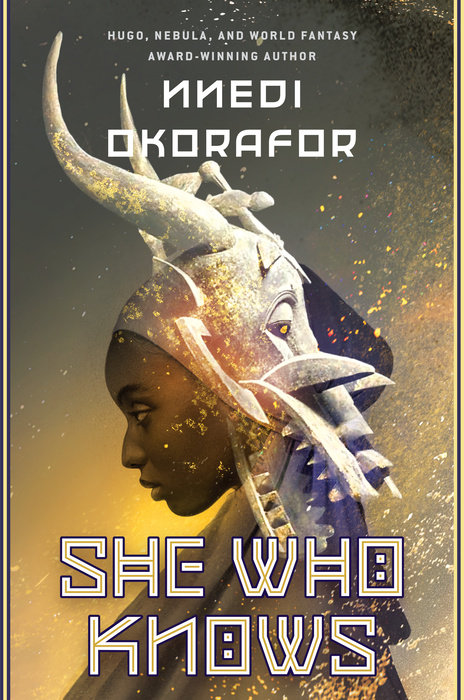
Blending science fiction and fantasy in a near future West African setting, this engaging prequel offers a compelling plot blended with a unique coming-of-age story in a quick read.
Summary:
Najeeba knows.
She has had The Call. But how can a 13-year-old girl have the Call? Only men and boys experience the annual call to the Salt Roads. What’s just happened to Najeeba has never happened in the history of her village. But it’s not a terrible thing, just strange. So when she leaves with her father and brothers to mine salt at the Dead Lake, there’s neither fanfare nor protest. For Najeeba, it’s a dream come true: travel by camel, open skies, and a chance to see a spectacular place she’s only heard about. However, there must have been something to the rule, because Najeeba’s presence on the road changes everything and her family will never be the same.
Review:
This short, powerful book packs quite a punch with its quickly established setting, a main character you can easily root for, and action scenes that will leave you breathless.
This is a perfect example of science fantasy (also called space fantasy), blending elements of both science fiction and fantasy seamlessly. The science fiction aspect is revealed through its post-apocalyptic future—something happened to reset the world. Paper books are rare and kept in a community building, and the salt fields that Najeeba’s people harvest from were created by a drying up of the water. The fantasy elements feel just as integrated, from the “Call” that Najeeba’s people receive when it’s time to go to the salt, to the supernatural powers some individuals can access. (For another science fantasy read, check out my retelling of Thumbelina set on Venus.)
Though part of a prequel series to Nnedi Okorafor’s Who Fears Death, you don’t need to have read that to enjoy this one. I hadn’t read it either, and I never felt lost or like I was missing crucial context. The initial conflict—Najeeba’s desire to do something that’s typically only for boys—is easy to grasp, and the world-building is subtle and effective. By the time the more unique and fantastical elements come into play, I was fully immersed in the world.
Set in a future version of West Africa, this features Black protagonists, with other characters who are Arab. While some of the abilities that develop in the story could be read as an allegory for developing a disability, none are explicitly represented.
The plot kept me hooked, and while I was satisfied with the ending, I found myself eager to explore more of this world. I’m excited to pick up the next book in the series when it’s available.
Overall, this is a quick, engaging read that brings science fantasy to a West African future setting. It’s a refreshing take on the near-future genre, offering a new perspective that I look forward to exploring further.
If you found this review helpful, please consider tipping me on ko-fi, checking out my digital items available in my ko-fi shop, buying one of my publications, using one of my referral/coupon codes, or signing up for my free microfiction monthly newsletter. Thank you for your support!
4 out of 5 stars
Length: 161 pages – average but on the shorter side
Source: Library
Buy It (Amazon or Bookshop.org)
Book Review: The Ballad of Black Tom by Victor LaValle

Tommy is a hustler just taking care of himself and his dad in 1920s Harlem when an old white man invites him to play at his private shindig in his home.
Summary:
Charles Thomas Tester hustles to put food on the table, keep the roof over his father’s head, from Harlem to Flushing Meadows to Red Hook. He knows what magic a suit can cast, the invisibility a guitar case can provide, and the curse written on his skin that attracts the eye of wealthy white folks and their cops. But when he delivers an occult tome to a reclusive sorceress in the heart of Queens, Tom opens a door to a deeper realm of magic, and earns the attention of things best left sleeping.
A storm that might swallow the world is building in Brooklyn. Will Black Tom live to see it break?
Review:
The Lovecraft universe is a fascinating example of an author creating a world that then becomes the playground for a lot of other people’s imaginations. Legally! Beyond a story being technically set in a Lovecraft universe with Lovecraft characters, though, there’s an entire genre of speculative horror that sprung out of it called cosmic horror. Think Eldritch Gods. Secret societies. Tentacles.
I love cosmic horror. (I even have published a cosmic horror short story.) The thing is, though, most cosmic horror fans have a complex relationship with the genre because of Lovecraft’s blatant racism and xenophobia. So a lot of modern authors, fans of the universe itself but not the person, are writing their own cosmic horror stories that turn Lovecraft’s racism and xenophobia on its head. Enter The Ballad of Black Tom.
The author of this novella is a Black man who decided to take one of Lovecraft’s most xenophobic short stories (“The Horror at Red Hook“) and reapproach it from the perspective of a minor secondary character – Black Tom. Tommy lives in 1920s Harlem with a dad who’s a talented musician while he himself is not. He is, however, able to convince white folks outside of Harlem that he’s a talented musician and so he goes there to hustle them. He also has a variety of other side hustles including procuring magical items for people.
The first thing that struck me about this book was how it put a minoritized Lovecraft character front and center. I also noticed how Tommy doesn’t go by the name “Black Tom.” That comes later and, even when it does, Tommy is claiming the name from a place of power.
Part of the terror that Lovecraft’s characters often feel is that of potentially losing their place of privilege. Tommy is living in a blatantly racist society where he can’t even take a train too far out of his neighborhood without someone questioning or harassing him. Instead, what he has to lose is his community in Harlem. Something it takes him a while to figure out. Some of what tears that away from him is the cosmic horror. But some of that is the day-to-day horror of being Black man in 1920s Harlem. (Warning for police brutality in this book).
This novella hits all the notes a reader might want in a cosmic horror – existential dread, elder gods, a little blood, cult rituals. But it does it without the cringe-inducing racist asides. I found it easier to empathize with Tommy than I had with a main character in a cosmic horror in a while. Of course he wants the elder gods to come tear things up. Of course he does. What I wasn’t expecting was the note of…what have I done?…at the end or that I would agree with that too.
I will say, I didn’t enjoy was when the perspective shifted to that of the police officer. I would have preferred remaining in Tommy’s perspective throughout. There was also a hint that a song Tommy’s dad taught him would come back up in a meaningful way, and it didn’t. Perhaps I missed it.
Overall, this is a wonderful entry into the Lovecraft universe that gives voice to a character Lovecraft had maligned, written from an own voices perspective.
If you found this review helpful, please consider tipping me on ko-fi, checking out my digital items available in my ko-fi shop, buying one of my publications, using one of my referral/coupon codes, or signing up for my free microfiction monthly newsletter. Thank you for your support!
4 out of 5 stars
Length: 149 pages – novella
Source: Library
Buy It (Amazon or Bookshop.org)
Get the Book Club Discussion Guide
A beautifully graphic designed 2 page PDF that contains: 1 icebreaker, 9 discussion questions arranged from least to most challenging, 1 wrap-up question, and 3 read-a-like book suggestions
View a list of all my Book Club Guides.
Book Review: The Unbroken by C.L. Clark (series, #1)

Summary:
Touraine is a soldier. Stolen as a child and raised to kill and die for the empire, her only loyalty is to her fellow conscripts. But now, her company has been sent back to her homeland to stop a rebellion, and the ties of blood may be stronger than she thought.
Luca needs a turncoat. Someone desperate enough to tiptoe the bayonet’s edge between treason and orders. Someone who can sway the rebels toward peace, while Luca focuses on what really matters: getting her uncle off her throne.
Through assassinations and massacres, in bedrooms and war rooms, Touraine and Luca will haggle over the price of a nation. But some things aren’t for sale.
Review:
I don’t read high fantasy very often, but when I do, I need it to be different and unique. When I heard about a military high fantasy with a Black woman lead, a sapphic subplot, and based roughly on North Africa, I knew I needed to read it.
This book took a little while to get up to speed. There’s a lot to introduce, and. it is a chunkster to be fair. By about the 25% mark, I felt like the plot was really moving, and I was glad I hung in there. The basic plot is that Balladaire colonized Qazāl. Balladaire forbids religion. Qazāl is religious. Balladaire abducted children from Qazāl and trained them to be soldiers. They fought on behalf of Balladaire in other regions they were colonizing, and now they’ve been sent back to Qazāl to put down the rebellion. These soldiers are called the Sands. Touraine is a Sand. Luca is in her 20s and is supposed to be the queen, but her uncle is holding onto the throne until he deems her ready to take it on. Luca has a permanent injury to her leg that necessitates her walking with a cane (that has a secret sword in it). Luca is determined to prove her ability to rule via her overseeing of Qazāl.
I think for a lot of readers Touraine will be the big appeal of the book. She’s a muscular, badass soldier who is unapologetically lesbian. And she’s not the only wlw in the book. There’s a rebel couple who are married women. There’s also a minor Balladairan teenager who has a romance with a Qazāli girl. Then there’s Luca, who’s bisexual. There’s also a character partway through who is very cool and is nonbinary. My only question about this character was how, exactly, when Touraine met them, she knew their pronouns without being told. Just because I thought that would be interesting world building.
The Qazāli are varying shades of Brown and Black. The Balladairans are mostly pasty white except for a few who grew up in Qazāl and manage to have tans. The Balladairans speak a language that’s basically French, and the Qazāl’s language, names, and food all seem to be drawn from Arabic culture. The author has stated North Africa as inspiration for this tale of colonization and rebellion. I think it does a good job of exploring colonization and race without ever verging into preachy or beating you over the head with it.
So the big romance (if you can call it that?) of the book is Luca and Touraine. The author describes it as enemies-to-still-enemeis-but-horny-about-it. That said, don’t go into this book expecting on-screen sexy times. For any characters. There’s a lot of longing but nothing on-screen.
This is a violent book. It has to be as it’s military high fantasy. Please keep that in mind. There are scenes including torture, battle, and various types of warfare.
Speaking of battles, this brings me to the other interesting aspect of the book. A key part of the Qazāli religion is the use of magic. And the magic is real. Everyone acknowledges this, even the Balladairans. Luca wants to use magic without being religious. She thinks it will help her take her throne. I myself was quite fascinated by this aspect of the plot, especially when a third and a fourth culture are brought into the mix later in the book. If you like some magic in your fantasy, you’ll get it here.
The one last thing I’ll say is I think this author is quite talented at metaphor and simile descriptors. I highlighted quite a few throughout the book. I was inspired by them. Like this one:
her eyes glittered with life, sharp as a dagger beneath the ribs.
page 206
Swoon!
Overall, if you’re looking for a fresh take on high fantasy with some military mixed in and almost entirely woman leads, this read won’t disappoint.
If you found this review helpful, please consider tipping me on ko-fi, checking out my digital items available in my ko-fi shop, buying one of my publications, or using one of my referral/coupon codes. Thank you for your support!
4 out of 5 stars
Length: 528 pages – chunkster
Source: Library
Buy It (Amazon or Bookshop.org)
Get the Reading Group / Book Club Discussion Guide
A beautifully graphic designed 2 page PDF that contains: 1 icebreaker, 9 discussion questions arranged from least to most challenging, 1 wrap-up question, and 3 read-a-like book suggestions
View a list of all my Discussion Guides.
Book Review: Coffee Will Make You Black by April Sinclair (Series, #1)

Summary:
Set on Chicago’s Southside in the mid-to-late 60s, following Jean “Stevie” Stevenson, a young Black woman growing up through the Civil Rights and Black Power movements. Stevie longs to fit in with the cool crowd. Fighting her mother every step of the way, she begins to experiment with talkin’ trash, “kicking butt,” and boys. With the assassination of Dr. King she gains a new political awareness, which makes her decide to wear her hair in a ‘fro instead of straightened, to refuse to use skin bleach, and to confront prejudice. She also finds herself questioning her sexuality. As readers follow Stevie’s at times harrowing, at times hilarious story, they will learn what it was like to be Black before Black was beautiful.
Review:
After reading Tales of the City by Armistead Maupin (review) and finding myself disappointed with how it handled race, I intentionally looked for older classics of LGBTQIA+ lit written by Black authors. (As a starting place. I intend to continue this searching with other BIPOC groups). In my search I found this book listed as an own voices depiction of a queer young Black woman in the South Side of Chicago. My library had a digital copy, so I was off.
First published in 1995, this is certainly an own voices book. The author grew up in Chicago in the same time period as Stevie, and that authenticity really shines through. The book is divided into three parts. Part 1 (spring 1965 to summer 1967), Part 2 (fall 1967 to fall 1968), and Part 3 (fall 1969 to spring 1970). Part 1 begins in Stevie’s last year of middle school. It establishes the systemic racism Stevie and her family live with that the Civil Rights movement that Stevie will later become involved in in high school. It also demonstrates Stevie’s difficult relationship with her mother. In Part 2, Stevie enters high school, Dr. King is assassinated, and Stevie starts to push back on racism and colorism. In Part 3, Stevie starts to question her sexuality and also the lack of interracial friendships and relationships she sees among her friends and family.
In some ways this was a tough book to read. It pulls no punches about what life was like for a young Black girl at this time. Although it always pains me to read about racism and colorism, there was an extra twinge in reading this because Stevie is just such an immediately likable little girl with a protective mother. The book opens with Stevie asking her mother what a virgin is (because a boy at school asked her if she was one), and her mother not wanting to tell her. This reminded me of all the conversations about Black girls being forced to grow up too fast and letting them stay the little girls they are. Although I advocate for frank talks about sexuality with questioning children, I also understood her mother’s impulse to keep Stevie little just a while longer.
Stevie’s sexuality is left open-ended in this book, in spite of my finding it on a list of lesbian fiction originally. Essentially the idea is posited that sometimes adolescents feel confused only to realize later they’re straight. I wondered if this is what happens with Stevie so peaked at the sequel. (spoiler warning!) Apparently in the sequel Stevie identifies as bisexual. This thrilled me, because there’s so little representation of bisexual folks in literature, but also because I felt a bit of a twinge of recognition when reading about Stevie’s confusion in the book. Part of why she’s so confused about if she’s straight or a lesbian is because the answer is neither. It was a great depiction.
I did feel the book ended kind of abruptly. It’s definitely a bit of a plot hanger that leaves you yearning for the sequel. Not in an uncomfortable way but more in a I want to see Stevie finish growing up way. Plus, it’s the start of the 1970s, and that’s such a fun time period to read about.
Overall, this own voices book gives a realistic yet fun depiction of growing up Black in the South Side of Chicago in the 1960s. If you’re coming for the queer content, hang in there, it shows up in Part 3. A great way to diversify your reading.
4 out of 5 stars
Length: 256 pages – average but on the shorter side
Source: Library
Buy It (Amazon or Bookshop.org)
Get the Reading Group / Book Club Discussion Guide
A beautifully graphic designed 2 page PDF that contains: 1 icebreaker, 9 discussion questions arranged from least to most challenging, 1 wrap-up question, and 3 read-a-like book suggestions
View a list of all my Discussion Guides.
If you found this review helpful, please consider tipping me on ko-fi, checking out my digital items available in my ko-fi shop, buying one of my publications, or using one of my referral/coupon codes. Thank you for your support!
Book Review: Wild Seed by Octavia Butler (Series, #1)
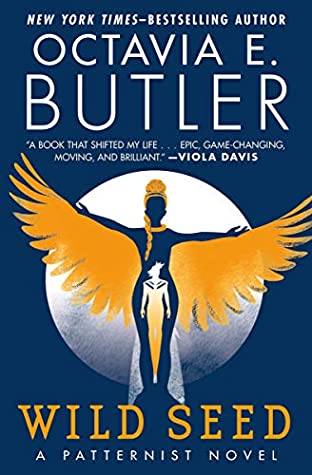
Summary:
Anyanwu is a shapeshifter who is immortal who has so far largely passed without notice. But when Doro, a being who maintains his immortality by stealing others’ bodies, discovers her, everything changes. He considers her to be wild seed for his project of gathering together all humans with special powers to breed them to try to create those who can match him. But is Anyanwu already a match for him? And can they ever produce children who are like them?
Review:
The simplest word to describe this book is unexpected. That’s something that’s difficult to achieve in fantasy about immortality, so I was pleasantly surprised.
This book immediately asks the reader to identify with and understand Anyanwu at least a little bit. Unlike in some other fantasies about immortality, she is already immortal when she meets Doro. So the challenge isn’t does she want to be immortal but rather what is it like to be truly seen by someone else? Doro is somehow more frightening than Anyanwu. The reader thus sides with Anyanwu, even though she is also a little bit scary. Anyanwu also says she goes with him to protect her children from him, an emotion it is easy to understand. Thus, the reader develops an ability to see Anyanwu’s viewpoint. When Anyanwu later does certain things that would have seemed shocking, this ability to see her perspective remains.
It is also interesting to see Doro and Anyanwu’s lives placed against a backdrop of slavery. Anyanwu is African. Doro can take the body of anyone he chooses, but he does state his original human body was in Africa. They are aware of slavery and even pull some seed away from being slaves to live in Doro’s villages instead. Doro breeds people regardless of their race. What he is interested in is their abilities. However, slowly the book comes to ask if this is in a way another form of slavery? Doro says the people view him as a god and that is their relationship, but Anyanwu feels differently. That sets up the reader to ask how free are these people in these villages really?
I was also pleasantly surprised by an appearance of queerness in the later half of the book. Anyanwu makes some interesting discoveries about her shapeshifting that leads to some pregnancies and relationships that are decidedly queer in nature. I was glad the book went there but surprised because so often books about shapeshifting and body inhabiting never do cross the line of gender.
Although this is the first book in a series, I felt it stood strongly on its own yet, simultaneously, propelled me to read more. The immortality angle is what makes it work this way. This is a solid chapter in the lives of Anyanwu and Doro. Yet clearly their story isn’t over, and there are new people who are going to encounter and challenge them. It was fantasy that felt possible and challenging simultaneously. Recommended to fantasy readers looking for a fresh take on immortality.
4 out of 5 stars
Length: 320 pages – average but on the longer side
Source: Library
Buy It (Amazon or Bookshop.org)
Get the Reading Group / Book Club Discussion Guide
A beautifully graphic designed 2 page PDF that contains: 1 icebreaker, 9 discussion questions arranged from least to most challenging, 1 wrap-up question, and 3 read-a-like book suggestions
View a list of all my Discussion Guides.
If you found this review helpful, please consider tipping me on ko-fi, checking out my digital items available in my ko-fi shop, buying one of my publications, or using one of my referral/coupon codes. Thank you for your support!
Book Review: Sorrowland by Rivers Solomon

Summary:
Vern desperately flees the strict, religious, Black Power compound she was raised on while she is heavily pregnant with twins. Giving birth shortly thereafter and raising her babies in the woods, she finds herself transforming inexplicably. But what is she transforming into? Why? And can she protect her children from both the compound and the world?
Review:
Another Rivers Solomon book was my favorite read of last year (An Unkindness of Ghosts, review), so when I saw their new book come available on NetGalley – featuring a religious, Black Power compound – I requested it immediately and was thrilled to receive a copy. Like all of Rivers Solomon’s work this book is a gorgeous, intertwining mixture of compelling and challenging.
I was startled by the focus on pregnancy and mothering at the beginning of the book. It hadn’t been the focus of the other Rivers Solomon books I’ve read, and I must admit as a person who has never been pregnant or a mother myself, I always struggle a bit more to connect to these characters. And, indeed, by the end of the book it was not Vern as mother I connected to but rather Vern as a person caught in a complex web of the world as we know it with her ability to right wrongs and change the future limited. That twist in the gut of being caught inside of something much bigger than yourself, that I was able to relate to.
Who cared who knew if the knowing didn’t prevent future occurrences?
location 5089
The fantastical elements are immediately engaging – beautiful and grotesque. I don’t want to give anything away, but suffice to say her transformation took my breath away in a manner that reminded me of my feelings watching Season 1 of Hannibal. I mean that as a complement. It’s a fantasy that both feels like a fantasy and also real and leaves one wondering if Vern is right in the head or not? Can the world really work like this? What is happening to her?
The social commentary in this book is astute and apt without being preachy. Characters say what they say because their very lives have lived it – these are their experiences and real feelings. What may to some readers seem the most out there about the book can easily be traced to real occurrences in US history. It’s not far-fetched but one hopes its realness will reach more people because of how it is couched in fantasy.
There is rich queer content in this book, both in the sense of gender and in the sense of sexual relationships. There is two sex scenes, one of which I would consider explicit with people of multiple genders participating. However, contrary to how some booksellers are listing it, I absolutely would not call it “er*tica.” This is a serious fantasy book about issues of justice that just happens to have queer characters have sex “on screen” twice. Queer sex is not automatically “er*tica.”
With regards to other representation, there are many Black and two Indigenous (Lakota) people. Two characters have albinism, and this book eloquently depicts the visual impairments that come with that.
Overall, this book delivers what I have come to expect from a Rivers Solomon book – an engaging fantastical imagining with queer content and different abilities represented that draws attention to social issues. Readers who are able to keep an open mind to the book potentially not going the places they were anticipating or hoping for but who are willing to let the book lead where it may will enjoy this one.
4 out of 5 stars
Length: 368 pages – average but on the longer side
Source: NetGalley
Buy It (Amazon or Bookshop.org)

Book Review: Corregidora by Gayl Jones
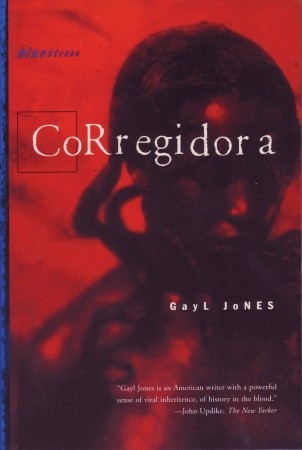
Summary:
First published in 1975, this explores the adult life of Ursa Corregidora, a Black woman blues singer haunted by trauma – both intergenerational and the violent loss of her fertility. Her great-grandmother and grandmother both were enslaved by Corregidora – a Portuguese enslaver in Brazil. He raped both of them, meaning he was the father to all the Corregidora women until Ursa herself. Her female ancestors constantly told her the importance of keeping the truth of their suffering alive through telling the story down through the family. So what will happen to the story now that Ursa, an only child, can no longer have children of her own?
Review:
This made it to my to be read pile before the current surge in interest in the history of the blues, partially coming from the newly released movie The US vs. Billie Holiday. This book demonstrates how clearly the blues and the trauma inflicted on Black folks in the US are intertwined, with the blues granting an outlet for speaking on at least some of the suffering but also a source of Black joy.
I have seen some reviews talk about how this book is about Ursa’s anger. I strongly disagree. This book is about Ursa’s intergenerational and current trauma, but she is absolutely not, as the GoodReads summary states, “consumed by her hatred of the nineteenth-century slavemaster [Corregidora].” Ursa suffers from trauma and struggles to deal with this trauma, but she is not consumed by hatred. I dislike how this summary seems to place the blame for her suffering upon Ursa. Ursa is doing the best she can with a whole pile of trauma. She’s not perfect, but, in my opinion, this isn’t some cautionary tale about being consumed by hatred. It’s an eloquent depiction of the intergenerational trauma of slavery and racism.
It is so immediately understandable why Ursa’s whole world is rocked when she loses her fertility due to abuse at the hands of her husband. (This happens very early in the book and is not a spoiler). Not only does she have a drive to have children that many women have, but she also has the lifelong expectation that she will fight injustice and white supremacy by passing the true story of what happened to the women in her family down along to the next generation. How can she manage her life when it becomes impossible for her to fulfill that expectation?
This book is not just about fertility/infertility and intergenerational trauma but also about the blues. Why Ursa is so drawn to the blues and what she is willing to give up and fight for in order to continue to sing them. The balance of moving among these themes is handled very well.
There are also some difficult moments where we see that Ursa is homophobic. She has a female friend who engages in relationships with other women and Ursa is, at the very least, uncomfortable with this. However, I do not think the book is necessarily in agreement with Ursa. Time is spent discussing why two Black women might be empowered by loving each other. However, time is also dedicated to discussing how white women have also raped enslaved (and servant) Black women, and that memory is part of what makes Ursa so uncomfortable. It is not an easy topic, and there is also the additional layer that Ursa finds this out right after she’s lost her fertility and others are questioning whether she counts as a woman anymore due to this. I think this section is handled honestly but readers who are more sensitive to negative reactions to queerness should be aware of its presence in this book.
This book is an engaging, powerful, and in many ways, unexpected, read. While I think everyone could get something out of this, I specifically want to mention that if you’ve read the white women’s feminist classics of the 1960s and 1970s, you definitely need to pick this one up and diversify your perspective.
4 out of 5 stars
Length: 192 pages – average but on the shorter side
Source: Library
Buy It (Amazon or Bookshop.org)
If you found this review helpful, please consider tipping me on ko-fi, checking out my digital items available in my ko-fi shop, buying one of my publications, or using one of my referral/coupon codes. Thank you for your support!
Book Review: The Conductors by Nicole Glover

Summary:
Hetty Rhodes was once enslaved, but she ran away with her sister, only her sister was caught while she escaped. She began returning south to try to free her sister, but with her repeated trips became a Conductor on the Underground Railroad, alongside a man named Benjy, using their magic to help others escape. Now the Civil War is over and she and Benjy, who is now her husband, have built a life for themselves in Philadelphia. He’s a blacksmith, she’s a seamstress, and they both solve crimes in their spare time that the white authorities can’t be bothered with. When one of their friends turns up dead in an alley, their investigation takes them throughout Black Philadelphia on a hunt for answers.
Review:
The premise of the worldbuilding for this book reminded me of Thieftaker (review), the first in the Thieftaker Chronicles, which I really enjoyed, only set in the 1800s rather than the 1700s and with a Black woman lead rather than a white man. I say this as I was excited and thought this was a good thing. I remember thinking at the time that I wished there were more alternate history fantasy books and I was excited when the next one I saw brought such diversity to the genre.
I liked the magic in this book. I thought it was a great analogy for colonizing culture versus Black and Indigenous culture. The colonizing culture (Sorcery) requires the use of tools (wands) but the wands make that magic very powerful. The Black and Indigenous cultures use Celestial magic, which doesn’t require tools (they draw sigils instead). It can become very powerful but takes more study and time to become so. Anyone with magic being able to pick up a wand and wreak some havoc with very little knowledge as an analogy for weapons like guns I thought was great.
The book also demonstrates the community the Black folks of Philadelphia built up, which included those who freed themselves by running away, those who were freed by the Civil War, and those who were born free. There is a male/male relationship included among Hetty’s friend group, as well as a woman who experienced infertility and adopted a baby.
What didn’t work for me was the order in which the plot was told. The book starts in post-Civil War Philadelphia with Hetty and Benjy (her husband) working together to solve cases, in much the same way they used to work together as Conductors on the Underground Railroad. How Hetty escaped, met Benjy, and how they worked together as Conductors was told through a series of broken up flashbacks throughout the book. For me, this didn’t work. I was much more heavily invested in the stories being told in the flashbacks than in the present mystery, largely because a lot of the present storytelling relied upon the relationship between Hetty and Benjy and, without the full flashbacks, I had no understanding of the relationship between Hetty and Benjy. I needed to know why they were, for example, married but just for propriety’s sake. I needed to know why they decided to work together as Conductors in the first place. What finally pushed them to get married? I was so confused and felt so much like I was dropped into the middle of a pre-existing world that I went and double-checked to make sure I hadn’t accidentally started with the second book in a series. Characters, even beyond Benjy and Hetty, kept talking about things that had recently happened in a way that felt like they had happened in a previous book. For example, the character who adopted a baby, the line about that felt like how the second book in a series will remind you of what happened in the first with that having been a key plot point in the first. I would say, in general, that for me, everything would have worked better if the first book in the series had been how Hetty and Benjy met and became Conductors together, maybe ending with them solving their first case as investigators after the War. Then this could have been the second book, perhaps with some additional flashbacks to inform us of some things from during the War.
I am sure that there are others that will read that paragraph and think “oh I like that vibe,” and that’s great. I hope this review helps this book find its audience. For me, though, I simply don’t like being dropped into the middle of the story.
3 out of 5 stars
Length: 384 pages – average but on the longer side
Source: NetGalley
Buy It (Amazon or Bookshop.org)
If you found this review helpful, please consider tipping me on ko-fi, checking out my digital items available in my ko-fi shop, buying one of my publications, or using one of my referral/coupon codes. Thank you for your support!
Book Review: Grown by Tiffany D. Jackson
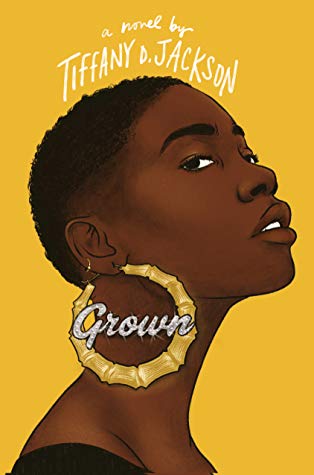
Summary:
17-year-old Enchanted Jones has been making it work at her new highschool in the suburbs where she’s the only Black girl. She has a good reputation on the swim team, and she takes care of her little siblings after school while her mom and dad work to afford their kids’ private schooling and their new house. But what Enchanted really wants to do is sing – an idea her parents aren’t too fond of. When she goes to a reality tv show audition, she meets R&B singer Korey Fields. He takes a shine to her, but that might not be the good thing she thinks it is.
Review:
I read this book in less than 24 hours because I simply could not stop thinking about Enchanted and needed to find out what happened in her world. This book both manages to be about important issues but also doesn’t feel like it’s an “issues” book. It’s Enchanted’s story, and that happens to involve today’s issues because today’s issues are real.
This book is about a lot of things, but many of the things it’s about come right back around to how society treats Black girls. How we treat them like they are grown up, when they are still children. This book beautifully depicts how truly adolescent Enchanted is – something that many of our adolescents are not allowed to be but Black girls especially. Enchanted is interested in boys and has feelings about them but she also loves Disney movie night with her little siblings. She has big dreams of stardom but she also just misses seeing her grandmother and swimming with her in the ocean. She has typical adolescent breakthrough moments of realizing what you saw and thought was beautiful as a child might actually be something else. This book asks us to believe girls, but to believe Black girls especially, because so many others will just look at them and say “oh they knew what they were doing, they were grown.”
The book is also about how wealthy abusers groom girls and take advantage of their wealth and power to separate girls from their families. The abuse depicted in this book is realistic and depicts emotional, sexual, and physical abuse and could be a trigger, so please do note that. That said, the author depicts just enough abuse for us to know what’s going on, but it never feels gratuitous or unnecessary.
While this is YA, it has important content for adults too, especially if you regularly come into contact with adolescents. Highly recommended.
5 out of 5 stars
Length: 384 pages – average but on the longer side
Source: Library
Buy It (Amazon or Bookshop.org)
If you found this review helpful, please consider tipping me on ko-fi, checking out my digital items available in my ko-fi shop, buying one of my publications, or using one of my referral/coupon codes. Thank you for your support!
 Support my work with a tip or browse my shop for curated book club guides, how to guides, cross-stitch patterns, and more!


This work by Amanda Nevius is licensed under a Creative Commons Attribution-Noncommercial-No Derivative Works 3.0 United States License.
 Opinions of a Wolf