
Archive
Book Review: Dead Reckoning by Charlaine Harris (Series, #11) (Audiobook narrated by Johanna Parker)
 Summary:
When Merlotte’s is firebombed, no one is sure if it’s because the shifters just came out and folks are angry that Sam is one or if it’s a more personal vendetta. As if that wasn’t bad enough, Eric’s vampire boss, Victor, has just opened a new human bar that’s stealing business from Merlotte’s. Sookie knows it’s a direct jab against her, as Eric’s wife. And Victor isn’t just stealing business. He’s punishing Eric via Pam, preventing Pam from turning her dying lover. Eric, Pam, and Sookie all know that Victor has got to go, and with the plotting going on, Sookie can’t be bothered to think too much about the firebombing.
Review:
This time it took me less than a year to return to Sookie, instead of the three year break I took last time. I’ve read so much of the 13 book series; I just have to know how it ends. The Sookie Stackhouse series is utterly ridiculous. But it’s a comfortable kind of ridiculous that’s just right to ease into while you’re cooking dinner. That’s why, when I listened to a sample and realized how perfect the audiobook narrator is for the books, I decided to listen to the end of the series. The warmth and ease of Sookie Stackhouse is perfect for combating cabin fever. This entry in the series has a bit more happen than in book 10, although the resolution to the big mystery feels repetitive.
Most of the ideas and plots in this book will ring familiar to any reader of the series. There might be hate against a newly out group (the shifters this time), some vampire higher ups are causing problems and need to be dealt with, and Sookie is just shocked that someone wants her dead. How she continues to be shocked by everyone hating her or wanting her out of the picture is beyond me, but Sookie isn’t exactly smart. Because many of the plots feel like previously visited territory, in spite of the fact that they’re well-written and active, they’re a bit boring. Something truly new really needs to happen to Sookie. The one plot point that is new, of course, is her interactions with the fae that were left behind when Niall closed off fairy. That plot was very interesting, and I’m glad it’s in the book, as it kept my interest up.
There really isn’t very much sex at this point. I honestly felt like that was a mercy since listening to someone read the awkward sex scene out loud was almost too cringe-inducing to bear. We all know Harris’s sex scenes are a bit….awkward. There’s not much new to say about that except that there’s really only one, and that feels like a good thing. Although Sookie does mention rather frequently Eric’s prowess in bed.
Sookie continues to be a self-righteous hypocrite, but someone close to her finally (finally!) calls her out on it. It happens toward the end of the book, after a lot of build-up of Sookie continuing to think she’s better than everyone else and has more morals than the rest of the supe world. The call-out is written with a perfect amount of ambiguity in the narration, leaving it up to the reader to decide if they agree with Sookie that she’s just holding onto her human morals or with the one who calls her out that she’s committing the acts and refusing to admit this is who she is. I’m not sure what camp Harris falls into, but I appreciated the finesse with which she leaves it open-ended for the reader to form their own opinion of Sookie.
The audiobook narrator, Johanna Parker, does a wonderful job. She truly makes Sookie and Bon Temps her own. There is a clear delineation in my head when listening to her that this is the book Bon Temps, not the True Blood one. She and Anna Paquin (who plays Sookie on tv) each bring their own interpretation, and they are both good and well-suited to the book and tv series, respectively.
Overall, this entry in the series is a bit repetitive. Two of the three main plots are similar versions of things we have seen before. However, Sookie finally gets called out for her hypocrisy and self-righteousness, and the third plot is new enough to keep interest up. Fans of the series will be a bit disappointed but will still find it a moderately interesting, quick read.
3.5 out of 5 stars
Source: Audible

Previous Books in Series:
Dead Until Dark
Living Dead in Dallas
Club Dead
Dead To The World
Dead as a Doornail
Definitely Dead
All Together Dead
From Dead to Worse
Dead And Gone
Dead in the Family
Book Review: The House of Azareal by Erik Dreistadt
 Summary:
Christopher is so grateful for his twins that seem a true miracle after he and his wife, Annamarie, had trouble conceiving. He can hardly believe it’s their 8th birthday already, and he won’t let anything spoil the celebration, not even an odd nightmare about being eaten by hellhounds he had the night before. But his children wander off into the woods after the party. When Christopher and Annamarie find them, they’ve stumbled upon an abandoned house. The children convince them to explore it. But the house quickly turns into a living nightmare. A nightmare designed and run by Azareal.
Review:
This is my second read of the twelve review copies I accepted for review here this year (see the complete list). I was looking for a shorter read after my previous two chunksters, and this short, fast-paced horror seemed like the perfect fit for my mood. The book puts a fresh twist on both haunted houses and trouble conceiving horror plots, although the writing style and dialogue struggle to support the excellent plot.
The story at first appears to be a straight-forward haunted/evil house plot. Right away, I liked that Azareal’s house isn’t the one the family lives in or one the family has just moved to. Instead, it is a house found in the woods, akin to Hansel and Gretel. That’s a trope I enjoy, and I liked seeing it used in the plot. Having the parents go into the house with the children was the first of several twists on tropes in the plot that made the book so engaging. From the point the family enters the house onward, the plot continues to twist and turn unexpectedly, yet believably. Gradually it becomes apparent that this is more than a haunted house book, it includes the occult, as well as a trouble conceiving plot. The fact that the results of using the occult to aid in conceiving doesn’t have consequences for eight years is a nice twist. Most books show consequences either during the pregnancy or immediately after the baby is born. The inclusion of new twists on both of these horror plots in one book makes the book fast-paced and engaging. It is a quick read that will propel you forward to see how it ends.
Unfortunately, the writing style doesn’t quite live up the high quality of the plot. Some of the dialogue feels forced and awkward. Similarly, while some scenes are set well, others are written in an awkward manner with focus on minute details that are irrelevant to the plot or the setting and not enough focus on other details that are. The writing style is good enough that it doesn’t ruin the enjoyment of the book, but it does knock it down a couple stars. The book is mostly well edited with the exception of one grammar mistake made quite a few times. Either using its for it’s or vice versa. Since it’s the same mistake made repeatedly, it’s easy enough to gloss over when reading it. However, I would advise for future books that the author keep an eye out for this particular issue during the editing process, especially since the rest of the grammar and spelling is so well-edited.
Overall, this is a fast-paced read that combines two horror plots into one book and puts unique twists on both. The writing style isn’t quite as good as the plot, but it’s still an enjoyable read. I’m looking forward to future works by the author. Recommended to horror fans looking for a quick, unique read.
3 out of 5 stars
Source: kindle copy from author in exchange for my honest review

Book Review: The Hornet’s Sting: The Amazing Untold Story Of Second World War Spy Thomas Sneum by Mark Ryan (Bottom of TBR Pile Challenge)
 Summary:
Thomas Sneum was a Danish Allied spy during World War II who was periodically suspected of being a double agent. Partially due to this suspicion and partially due to infighting between the two British spy agencies (SIS and SOE), he never got the attention or respect he deserved. Mark Ryan, the author, found out about him and set out to get to know him. Both personally and through research. Here he tells the true story of Tommy Sneum and sets the record straight once and for all.
Review:
I picked this book up during a kindle sale because I’m a big WWII buff and who doesn’t love real life spy stories? I thought it was a sure bet, but apparently even a true life spy story can be written in a dull manner.
It’s impossible to read the book without learning a lot. For instance, I had no idea that Britain had two different spy agencies that were battling each other for control of spying missions. This infighting between the SIS and the SOE led to lack of communication and lack of a solid spy front with one, unified plan. Similarly, I didn’t know it was common practice to take people who had escaped from behind Nazi lines, train them as spies, then re-drop them back in their home countries. I always thought the resistance movement just built up from the inside and then they contacted the Allies on the outside with information. How much more complex it was is really interesting. I also loved learning more about those from occupied countries who escaped and fought in other militaries against the Nazis. In spite of learning all of these new to me facts about WWII spying, the book manages to be dull. Ryan tends to wander off on side diatribes about the intricacies of red tape and paperwork instead of focusing in on the more action-oriented, interesting bits of the spying. He also spends a lot of time giving the full name of every single person even vaguely connected with Tommy and the spying, even if they really have no impact on the story. The book could really have used a bit more streamlining and focus to keep the energy up. Just because it’s nonfiction doesn’t mean it can, or should, meander.
Tommy Sneum is hard to root for. He’s not a likable guy. He abandons his wife and infant daughter to go be a spy. That could definitely be seen as valiant, however, he expresses consistent distate for his wife and a lack of concern or care for even knowing his daughter. He certainly comes across in the book as a guy just after adventure, not so much a man looking to protect his country or his family. Similarly, Tommy express arrogance when it comes to women, claiming that they essentially would go sleep with him at the drop of a hat or a snap of his fingers. He does not come across as seeing women as people but rather as recreational objects. One story that really demonstrates this is he tells the author that he had a threesome once, and he was upset that the women dared to pay attention to each other at all, rather than 100% to him. Sex is supposed to be about people giving to each other, not about one person being worshiped. His general attitude towards women gave me a squicky feeling throughout the book. Of course, most people are not all bad or good. Tommy is no exception. He expresses a real openness toward a male colleague who was known to be bi. He refuses to view all Germans as evil monsters and insists, to those high up in the British resistance no less, that most Germans are just caught up in Hitler’s war machine. Of course, these even-handed views are almost universally held of men.
Perhaps the most interesting part of the book is Ryan’s investigation into the accusations that Sneum was a double-agent. This part of the book isn’t really played up in the blurb, which I think is unfortunate. Ryan did a lot of investigative work and lays out all the details that he believes clears Sneum’s name. Seeing how Sneum and his methods were misunderstood by the British and also how having two different spy agencies working led to misunderstandings was truly fascinating, and I’m glad Ryan took the time to work at finding the truth.
Overall, this is a rather slow-paced work of historic nonfiction that focuses in on the red tape and organizational aspects of spying more than exciting adventures. It does good work in determining that Sneum was not a double agent in WWII. Sneum’s womanizing can be a bit tedious at times, although his even-handed perspective on the German people is good to see. Recommended to those interested in the organizational aspects of spying in WWII, including very minute details.
3 out of 5 stars
Source: Amazon
Buy It
Note: Apparently this book is no longer available on the kindle.

Book Review: The Reflections of Queen Snow White by David C. Meredith
 Summary:
Snow White lived decades of her happy-ever-after, but when Charming dies she is sent reeling into a depression. Not even their daughter, Raven’s, upcoming marriage can snap Snow White out of it. When wandering the halls of the castle, desperately seeking to be alone, she re-enters her old step-mother’s quarters. Now covered in dust, she discovers her stepmother’s magic mirror, which she never knew about before. The discovery will have far-reaching consequences.
Review:
This is my first read of the 12 indie books I accepted for review here in 2014 (see the whole list). I surprised myself a bit, reaching first for the fantasy, but I was in the perfect mood for a slightly pensive retelling of a fairy tale. The book takes an interesting angle for retelling the story, jumping ahead to Snow White’s elderly years, but it unfortunately doesn’t reimagine Snow White herself quite enough.
The narrative choice of having an elderly Snow White discover her stepmother’s magic mirror that then forces her into introspection on herself and her life is a great idea that works well. We already all know the end of the fairy tale, so flipping it on its head to start at the end addresses that fact head-on. Now the question isn’t, will this fairy tale end the way all the other retellings do. Instead, it looks on a psychological level at the impact of Snow White’s early years on her later ones. It also is an interesting way to address end of life issues. Snow White is elderly and stuck in a bit of a rut. She’s uncertain how to go on without her husband of so many years. These are relevant issues that don’t get addressed often enough in literature, and re-using the Snow White fairy tale to look at them works wonderfully. It thus is a familiar story and setting with a different focus, which is a great tact to take for a fairy tale retelling.
Snow White herself, however, hasn’t been tweaked enough to make for an interesting heroine. I admit, I was hoping for someone who either had found or would find her own strength. The Snow White we see in Disney and other retellings really is a bit of a shrinking violet. This Snow White stays that way. Over and over she is the helpless girl who must be rescued by others. She doesn’t flee the castle, someone else tells her, practically forces her to. She is then saved first by the dwarves and then by Charming. Later in her life, after leaving the official fairy tale, we find that she is a simpering clueless virgin on her wedding night who must be guided by Charming. Then even later she is heinously assaulted by some ladies of her court, and she again must be saved by someone else. Even in the end of her life, she doesn’t pick herself up and continue on. A magic mirror knocks some sense into her. Because fairy tales often remove so much agency from the “good” women in them (only evil women are allowed agency), I prefer to see retellings give the women more agency. Snow White could still have the character flaw of being a bit timid and eventually learn how to save herself. It’s not an all-or-nothing scenario. The way Snow White and her story is presented here reads a bit too traditionally medieval. I want a retelling to take me new places with the character, not extend the same ones.
This issue alone would have led me to give the book 4 stars, but, unfortunately, the book is riddled with spelling and grammar errors. I only marked the most egregious ones, and I still had 12 on my list. Issues such as saying someone laid down in the floor, instead of on the floor (loc 2302), putting the apostrophe in the wrong place (“princes’ tongue” instead of “prince’s tongue” (loc 1315) ), and just flat-out using the wrong word (“followed suite” instead of “followed suit” (loc 1084) ) sorely damaged my enjoyment of the novel. I don’t expect perfection from authors or editors, we are all human, but more than a few errors is something that truly negatively impacts the reading of the novel.
Overall, this retelling of Snow White takes the interesting angle of focusing on the end of her life. This allows the author to explore issues relevant to the elderly, such as losing long-term loved ones and coming to terms with the path your life has taken. Although this plot gives the fairy tale a new focus and extended plot, Snow White herself has not been updated at all. She is still the simpering violet who must be saved by all around her. Some readers may be bothered by the number of errors in the spelling and grammar in the book. Recommended to fans of traditional fairy tales with only a slight twist who won’t be bothered by a lack of editing for spelling and grammar.
3 out of 5 stars
Source: kindle copy from author in exchange for my honest review

Book Review: Ecstasy in Darkness by Gena Showalter (Series, #5) (Bottom of TBR Pile Challenge)
 Summary:
Ava Sans is hoping to move up to a full agent at New Chicago’s Alien Investigation and Removal (AIR) team. But before she can, she and her best friend, Noelle, are assigned to capture a powerful vampire who can manipulate time. McKell, recently cast out from the underground tunnels the monarchical vampires call their home, is having to adjust to living with daylight and is desperate to find out the secret these above ground vampires have for moving around in the daylight without burning. Used to seeing humans only as food slaves, he’s disturbed to find himself inexplicably attracted to Ava Sans, who just so happens to smell like butterscotch.
Review:
I rarely impulse buy books in drugstores and, after reading this book, I think that’s probably the wiser move. I bought this in a CVS due entirely to the cover and didn’t pick it up to read for three years. When I did, I saw it was the fifth book in the series. Fortunately, this isn’t the type of series that it’s necessary to read in order. Unfortunately, nothing about this book made me want to go read the rest of the series. It suffers from a meandering plot, ridiculous dialogue, two-dimensional characters, constant cock-teasing of the reader, and an entirely misleading cover (that I suspect was misleading on purpose).
This series focuses on a different romantic pairing in each entry. They all have ties to AIR in some way. The previous couples make cameos in other books, but the actual plot from the prior books doesn’t have much impact on this one. All that needs to be known is there was a war with the aliens, New Chicago is not on Earth, vampires are an alien species that are allergic to the sun and live underground on this planet, the vampires make humans their food slaves, and some of the vampires have started living above ground. Oh, and there’s this alien called the Schön Queen who looks beautiful but actually is a rotting, disease-ridden creature who gives those who bang her an illness that makes them her voodoo zombie slaves. Those who read a lot of pnr will understand that that’s a pretty simple plot summary for a series this far in.
The actual plot for this book basically is that Ava will help McKell lure vampires to interview to find out how they live in daylight and he will, in turn, come willingly to talk to the head of AIR. AIR wants to find out if McKell’s blood can be used to save victims of the Schön Queen’s disease. If the book stuck to this simple, straightforward plot it would work. But it meanders all over the place, tossing in red herrings, asides, diatribes, and scenes that seem to happen just for the fun of it. This book is over 500 pages long. That is not enough plot to support that many pages, unless the characters are stopping to bang a lot, which was honestly what I was expecting. That’s not what we get though.
The cover definitely implies that this is a BDSM book with a lot of sex. The only thing that ever happens with a whip is McKell comes over to Ava’s house with the whip intent on actually beating her up with it (in a to get revenge way not in a sexy BDSM way) but then he never uses it on her. She mentions it in a giggling aside toward the end of the book, and McKell states he would never ever whip her. He loves her too much now. I know the author generally doesn’t have any impact on the cover design at all, but somebody somewhere must have known they’d be pulling in people expecting BDSM only to have BDSM scorned within the book. Not cool. That’d be less irritating, though, if there was at least a lot of sex of some sort in the book. Instead, we repeatedly find Ava and McKell getting hot and steamy only to stop just short of having sex. They have sex twice in the book at the very end. You seriously have to read at least 400, maybe 450, pages to get one full sex scene. Which is incredibly frustrating because by far the best writing Showalter does is of the sex scenes. They’re tantalizing and realistic with some things we don’t always see in romance novels, like the guy going down on the girl, for instance. This book would have been at least three stars if Showalter’s steamy scenes had led to actual sex scenes throughout the novel. But instead, the reader just gets going with excitement only to have it yanked out from under them to go check in on that meandering plot.
The characters are so two-dimensional that it’s essentially impossible to truly care for them. McKell is a vampire with a temper. A bad boy, supposedly, that Ava inexplicably falls for. Most of his presence in the book consists of snapping at Ava and being shocked she doesn’t obey him and then being turned on by that. Ava, on the other hand, is traumatized by growing up on the bad side of the tracks and has a big inferiority complex. She also smells like butterscotch. And tastes like butterscotch. And her hair looks like butterscotch. She’s a piece of butterscotch candy who says boo hoo poor me and I want to prove to everyone that I’m not trash so oh hey let’s fall for this bad boy vampire who treats me badly that seems like a great choice. I admit by the end of the book McKell is treating her well but his transformation is out of the blue, not gradual. Plus, Ava falls for him when he’s a bad boy and never stands up for herself or says I deserve better. She ends up with an ok guy but only because he magically transformed, not out of any agency of her own. The supporting characters are even less well-developed. I can say maybe one or two things about them all, but nothing that makes them truly come to life in my mind.
Overall, this is an overly long pnr with a light, meandering plot and only two sex scenes in over 500 pages. While the sex scenes are well-written and tantalizing, the rest of the book is dull, with two-dimensional characters it is impossible to come to truly care for. The romance uses the bad boy/wounded woman trope and does nothing to make it deeper or richer. Those who think from the cover that this is a BDSM pnr should be aware that it is definitely not. I would perhaps pick it up in a library or at a friend’s house to skim through and read the sex scenes, but there is definitely better pnr out there to devote your time to.
2 out of 5 stars
Source: CVS

Previous Books in Series:
Awaken Me Darkly
Enslave Me Sweetly
Savor Me Slowly
Seduce the Darkness


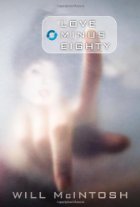
Book Review: Love Minus Eighty by Will McIntosh (Audiobook narrated by Kevin T. Collins, Eileen Stevens, and Ali Ahn)
 Summary:
In the future, you can live forever. But only if you can afford to pay to be medically resurrected and any injuries sustained fixed. The rest put everything they have into freezing insurance, getting cryogenically frozen in the hopes that one day, someday, they might get resurrected. At the very least, they wont’ die. But beautiful women who die too young (and too not filthy rich) get a different sort of a second chance. They get awoken and given the choice of going into the cryogenic dating facility. Men will come through and pay to wake them up and talk to them, and if they fall for them, they’ll pay to have them resurrected and their injuries healed.
In this world, three different, yet intertwined stories are told. There’s Rob. A once-musician who accidentally struck and killed a jogger in the middle of his break-up with his reality star-esque wealthy girlfriend. He proceeds to take out a loan to visit the jogger to apologize but slowly the guilt turns into something more. Then there’s Veronika, a dating coach with a bad case of unrequited love and a need to feel like she’s doing some good in the world. And finally, Mira. A lesbian who was placed into the heterosexual cryogenic dating pool back at the beginning before they bothered to wake the women and ask them if they wanted to be there.
Review:
I was immediately intrigued by this book’s premise and then realized I’d already read another scifi book by Will McIntosh and enjoyed it. That book, Soft Apocalypse

The future is a near dystopic mess of most of the wealth being in the hands of the few. While some people have foregone civilization to live off the land, the rest of the have-nots spend their time in body suits, called systems, that are basically like a full-bodied smartphone. They reminded me a bit of Google Glass. Their systems filter out all the unsightly aspects of where they live, including garbage, and they also block pop-up ads that otherwise accost you on the street. Everyone pours their little bit of money into their systems because without one you fall entirely off the social stratum. This is already creative enough to be intriguing, but then McIntosh tosses in this idea that cryogenics and resurrection has been figured out but only the wealthy can afford to be resurrected and everyone else pours all the rest of their money into freezing insurance. Then we get the cryogenic dating program aka bridesicles, and oh wow. Any scifi reader can see what an interesting setting this is.
On top of this setting, McIntosh weaves three different, yet ultimately intertwined narrators. It’s a narrative structure I enjoy but only when done well, and McIntosh mostly pulls it off. Some things sometimes felt a bit like too much of a coincidence, but for the most part the intertwining made sense. All three narrators have unique voices and perspectives. They are well-rounded with flaws, even Mira, who is frozen a lot of the time, but they also are still likable.
The plot is complex and truly had me on the edge of my seat for the last third of the book. I was rooting for the characters and did not know what would happen. An unpredictable, yet satisfying, ending plays in perfectly with the plot.
I am of two minds about the presence of Mira in the story. On the one hand, I appreciate that McIntosh took the time to think about how the heteronormativity of the bridesicle program could affect a lesbian. On the other hand, it frustrates me that she and her girlfriend have their agency removed and spend most of the story frozen and at the whim of the heterosexual people around them. Having lesbians rescued by the straight folks just kind of rubbed me the wrong way. I sort of wish there had been some modern day queer person who helped them out in some way. That was the other thing that bothered me. The only queer presence was from the past in the form of Mira and her frozen girlfriend. In such a sweeping narrative with so many characters that is also set in a city, it seems odd to me we never encountered another queer character. Particularly when one of the main characters is a dating coach.
The narration of the audiobook was wonderful. Having a different voice for each narrator really helped keep the stories straight, and each of the narrators did a wonderful job bringing their characters to life.
Overall, this book presents a richly imagined near-dystopian scifi future that gets the reader to think about if living afraid of death is truly living. The three-narrator structure lends a complexity to the plot that keeps it engaging and consistently moving forward. One of the plot choices might rub some readers the wrong way, but if the world building and narrative structure appeal, it shouldn’t be much of an issue. Recommended to scifi fans who enjoy a city setting and some romance.
4 out of 5 stars
Source: Audible
Series Review: The Georgina Kincaid Series by Richelle Mead
Introduction:
I post series reviews after completing reading an entire series of books. It gives me a chance to reflect on and analyze the series as a whole. These series reviews are designed to also be useful for people who: A) have read the series too and would like to read other thoughts on it or discuss it with others OR B) have not read the series yet but would like a full idea of what the series is like, including possible spoilers, prior to reading it themselves or buying it for another. Please be aware that series reviews necessarily contain some spoilers.
 Summary:
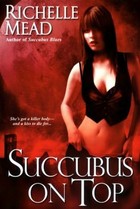
Georgina Kincaid loves her job managing a bookstore in Seattle. She’s not so sure about her job as Seattle’s only succubus, but she doesn’t have much choice about that one since she sold her soul to Hell back when she was mortal in ancient Greece. After hundreds of years of being a succubus, Georgina has started to feel guilty about stealing the life energy of good-souled men. So she’s switched to stealing the less high-quality life energy of bad-souled men. Her demon boss, Jerome, is none too happy about this. Things take an even more interesting turn when famous author, Seth Mortensen, moves to Seattle and chooses Georgina’s bookstore as his base of operations. Georgina quickly finds herself falling for him. Her first time falling for a man since WWII. Nobody seems to like the idea of Georgina dating Seth, except for Seth, but Georgina doesn’t have much time to wonder why as supernatural life carries on. Everything from an incubus plot to attempts at overthrowing her demonic boss (by another demon of course) to an escaped ancient supernatural power who feeds on dreams come Georgina’s way. Georgina starts to notice that Seattle seems to be facing more than the normal level of supernatural upheaval, and she starts to wonder why.
 Review:
A tightly told, sexy, humorous series featuring an overarching plot that ties into all of the smaller plots and lends the series as a whole a greater meaning makes this urban fantasy stand out above the rest.
The series ostensibly focuses on the bad guys of the supernatural world, not something that is seen very often in urban fantasy. Yes, Georgina is a succubus with a guilt complex, but she is still a succubus, and she still goes out and does her succubus thing. She is not out trying to save the world. She’s just trying to get by day by day in the role she has chosen for herself–fighting on the bad guy side of the battle. But Mead does not let the series fall easily into clear good versus evil. It soon becomes evident that good guys can be on the bad guy side and bad guys on the good guy side. In most cases, one decision or the fault of birth decides where they land. Just because someone is a vampire doesn’t mean he can’t desire to help out his friends. Just because someone is an angel doesn’t mean they can’t make mistakes. And the rules aren’t always fair and sometimes incomprehensible. This gray complexity lends a lot of interesting notes to the series that otherwise wouldn’t be there, not least of  which is the fact that the characters are able to be three-dimensional in this world Mead has created.
The characters, even the minor ones, are indeed three-dimensional. They sometimes make stupid choices, big mistakes, and are annoying. But they also make tough good choices, ones that aren’t easy but still happen. They fall in genuine love. They accidentally hurt each other but also sacrifice themselves for each other. They worry about having a bad hair day. They cry. They have great sex and bad sex. And they come to life in the reader’s mind.
The sex scenes, a key element of an urban fantasy series about a succubus, are never repetitive. They are tantalizing and sexy, except for a few which are aiming to show that sex can be bad. They range from the intense love making of a couple madly in love to a fun night out having sex in public at a public sex bar. And many positions and types of sex are covered as well. The sex scenes walk the line between barely mentioned and extremely explicit quite well. They are fully fleshed-out sex scenes without being extremely explicit.
 The overarching plot, though, is what really made me fall in love with the series. Georgina became a succubus in exchange for her husband and all those who knew her forgetting all about her. She cheated on her husband, and she felt so much guilt at both the act and the pain it caused that she felt this was the best solution. At first, she goes into being a succubus with enthusiasm but over time her feelings change. Her hurt starts to heal, and she begins to see the good side of both humanity and life. She is in the throes of this complex situation of wanting to be good but having already signed a contract for the bad side of the fight when Seth shows up and everything starts going haywire in the supernatural world in Seattle. Eventually, she finds out that Seth is the reincarnation of her original husband, Kiriakos. He lived his life thinking he must have a soul mate but never meeting her, so when he died he struck a bargain to get more chances at meeting her. He has a limited number of reincarnations (10, I believe), that will occur in the same vicinity as his soul mate. His soul mate is Georgina, and she has met him multiple times throughout her life as as a succubus. This reincarnation as Seth is his last chance. From here, the story takes a hard look at what makes people soul mates, that being soul mates doesn’t mean no mistakes will be made, that love
  and a relationship aren’t an easy cakewalk and sacrifices and compromises must be made. It delves into the idea of redemption, and that being a good person and having a good life aren’t just something innate in you. It’s a beautiful love story, spanning many centuries, that takes a hard look at what makes relationships work. It also ties in nicely with the questions established earlier about good versus evil and if being good or evil is a one-time choice or something that happens over time. I never would have guessed that I could end up feeling so positively about a love story that begins with betrayal but that’s where Mead uses the supernatural with great skill. The story works because the betrayal is treated so seriously. Georgina’s betrayal of her husband (and soul mate) leads them both to centuries of pain. It is not something that can be just brushed off. It’s a mistake she made, yes, but just because it was a mistake doesn’t mean she can just say sorry and make it all right. On that note, Kiriakos/Seth also made mistakes when they were first together that he also has to work through. They both learn through time that you can’t just sit back and let the marriage happen. You have to pay attention, invest, and work at growing together.
 The fun setting, tantalizing sex scenes, three-dimensional characters, and unexpected yet beautiful overarching plot about the nature of good and evil and love and redemption makes this series a stunner in urban fantasy. Highly recommended to urban fantasy and romance fans alike, although those who are irritated at the concept of soul mates might not enjoy it as much.
4.5 out of 5 stars
Source: PaperBackSwap, library, gift, Audible
Books in Series:
Succubus Blues
Succubus On Top
Succubus Dreams
Succubus Heat
Succubus Shadows
Succubus Revealed
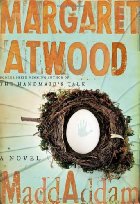
Series Review: The MaddAddam Trilogy by Margaret Atwood
Introduction:
I post series reviews after completing reading an entire series of books. It gives me a chance to reflect on and analyze the series as a whole. These series reviews are designed to also be useful for people who: A) have read the series too and would like to read other thoughts on it or discuss it with others OR B) have not read the series yet but would like a full idea of what the series is like, including possible spoilers, prior to reading it themselves or buying it for another. Please be aware that series reviews necessarily contain some spoilers.
 Summary:
In the not-too-distant future, the heavily populated world is run by corporations instead of governments. The corps keep their workers and people in Compounds where they’ll be safe from the rampant crime in the rest of the world. Supposedly. Those who can’t get jobs at a corp must live in the pleeblands, essentially ghettoes. The pleeblands are haunted by painballers–people who fought their way out of prison in a gladiator-style competition and who are usually now addicted to drugs.
The world isn’t entirely humans and corps, though. There are also a whole slew of new GMO plants and animals, such as rakunks and pigoons. Children can buy bracelets with live fish inside them as wearable pets.
Jimmy works in a corp with Crake. Crake is a genius who the corp allows to create basically whatever he wants. They share a love interest in Oryx, who works with them, caring for the creations Crake makes. Toby lives in the pleeblands, working in fast food restaurants. She is being pursued by a violent stalker, who she is sure will kill her one day. Then she discovers God’s Gardeners, a vegetarian cult that lives on the rooftops of the city gardening, learning all the species of the planet, and preparing for the impending End Times. And the End Times come in the form of a virus released by Crake to destroy humanity and make room for the new breed of humans he has created in his lab–Crakers. Crakers are herbivorous, polyamorous, and turn blue when they are in heat. The pandemic wipes out almost everyone, but not quite. Jimmy is left to care for the Crakers, and Toby survives, reminiscing about how her life has gone. And there are some that Crake gave an immunity drug to. They gather together and attempt to survive, guide the Crakers, and ponder on how things turned out this way.
 Review:
The future world Atwood creates in this series is inventive and engrossing. Unfortunately, many of the characters and some of the plot fail to fully engage the reader.
The future world, prior to the virus outbreak that destroys most human life, is incredibly imaginative and simultaneously realistic. It is by far the strength of the series. Atwood takes real modern day science and intelligently extrapolates how that combined with our evolving culture would affect life on Earth. The change from politicians and nations controlling the world to corporations doing so makes excellent sense. The types of animals those corps create are also logical both within that context and from a scientific perspective. For instance, the mo’hairs are sheep who have had their genetics modified so that their wool is instead human hair to makes wigs out of. How the world works makes sense and is slightly frightening at the same time. It’s a subtle dystopia.
The post-apocalyptic setting is slightly less creative. Only a few humans survive and quickly leave the cities to live in the countryside. Conveniently, at least half of the group of survivors are from the vegetarian cult, God’s Gardeners, who predicted the end times, and so are well prepared for living in the wild. This setting is much staler compared to the pre-apocalypse dystopia. It feels as if the characters are just sitting in a clearing in the woods chatting at each other. This would not be a problem if the characters were rich enough to sustain the plot when the creative world has disappeared. But most of them are not.
Atwood is known for writing richly imagined female characters in scifi settings. Unfortunately, this series is dominated by men, with the women mostly relegated to secondary roles, with the exception of Toby. Toby starts out strong, and the book focusing on her story (The Year of the Flood
 The plot is clearly meant to show us how the world could be destroyed and also how new life begins, complete with religious mythology. Some of the plot twists that go with this core of the plot work and others don’t. For the world destroying, the plot approaches it in two ways. There’s telling how the world ends from an outsider, underprivileged perspective of a woman who happens to survive. This aspect of the plot had enough twists and differences, such as Toby’s involvement in the God’s Gardeners cult, that it maintained interest. The plot also tells how the world ends from the perspective of a man caught in a hopeless hetero love triangle with a kind woman and an evil genius. This common trope takes no different plot twists or turns. It is entirely predictable and dull. A bit of a flop. The twists in the final third of the story, how the world begins and the last of the prior world fades out with a murmur, does nothing truly daring. Toby’s romance ends essentially as expected. Loose ends are tied up. And the Crakers take over with a new mythology given to them by a flawed human being. I’m sure this is meant to say something radical, and maybe someday to someone it will, but to the reader who has already read many thinly veiled take-downs of religion and where it comes from in scifi, it was rather ho-hum and long-winded. Particularly when compared to the much shorter and more richly written work by Atwood taking a similar anti-religion stance: The Handmaid’s Tale
Overall, this is a series with two-thirds of the plot set in a richly imagined and intelligently extrapolated subtle dystopia future. The basic plot of dystopia to apocalypse to post-apocalypse is told slightly non-linearally with some interesting poetic-style writing inserted in-between chapters. Most of the characters feel flat against the rich backdrop, although one female character at first stands out then slowly fades. Recommended to readers interested in a realistic near future dystopia who don’t mind a rather typical plot and two-dimensional characters will enjoy most of the series, although they may enjoy the first two books more than the third.
3.5 out of 5 stars
Source: PaperBackSwap, library, and Audible
Books in Series:
Oryx and Crake
The Year of the Flood
MaddAddam
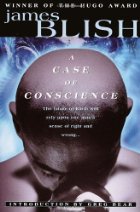
Book Review: A Case of Conscience by James Blish (Series, #4)
 Summary:
A new inhabited planet, Lithia, has been discovered, and an exploratory Earth crew of four is sent to determine how Earth will respond to the planet. Ruiz-Sanchez is a scientist and a member of this crew, but he’s also a Jesuit priest. Although he admires and respects the reptilian-humanoid inhabitants of Lithia, he soon decides that the socialist, perfectly co-existing society must be an illusion of Satan, so he advises against maintaining ties with the planet. The vote of the crew is a tie, however, so the UN must ultimately decide the fate. While they are awaiting the decision, Ruiz-Sanchez and the others must raise and guardian a Lithian child who is sent as a present to Earth. Soon, Ruiz-Sanchez starts having fears about just who the child might be.
Review:
This is the third book from the collection of 1950s American scifi classics from Netgalley, which I will review as a whole at a future date. I was surprised that a book that is fourth in its series was included in the collection. Upon investigation, I discovered that this series isn’t surrounding a certain set of events or characters but instead is multiple books around a similar theme. The theme for the series is each book deals with some aspect of the price of knowledge. So each book works as a standalone as well. There is also some disagreement as to precisely what book is what number in the series. I have chosen to use the number used by GoodReads. I had previously read a scifi book with a Jesuit priest scientist visiting a newly found planet (The Sparrow
Ruiz-Sanchez is a rather two-dimensional character who quickly turns into a bumbling priest trope. Very little attention is paid to his credentials as a scientist within the story, so instead of coming to know Ruiz-Sanchez the scientist, the man, and the priest, we only know him in his priest role. This prevents a connection or even a basic understanding of his rather bizarre concerns. Whereas in The Sparrow
The plot is fascinating, although it does jump around a lot. Essentially there’s the part on Lithia, which primarily consists of discourse between the scientists. Then there’s the development of the Lithian child into an adult who doesn’t fit anywhere, since he lacked the social training on Lithia and also is a reptilian humanoid on planet Earth. He then starts to incite rebellion among the youth. Meanwhile, Ruiz-Sanchez is told by the Pope that he committed an act of heresy and he must re-win favor by stopping the Anti-Christ aka the Lithian on Earth. All of the settings are fascinating, and the plot is certainly fast-paced. However, the plot is so far-fetched that it is difficult to properly suspend disbelief for it.
The settings are the strength of the book. Lithia is well-imagined, with uniqueness from Earth in everything from technology to how the Lithians handle child-rearing. The tech involves trees since they lack minerals, and the child-rearing is non-existent. The Lithians are simply birthed then allowed to develop on the planet, similar to turtles on Earth. Earth’s setting is interestingly imagined as well. The fear of nuclear weapons has driven humans to live underground for generations with only the elite living above ground, and the UN working hard to keep it that way. It’s a fun mix of alternate alien civilization and dystopia.
Essentially, the book has interesting world-building and what could be a promising plot that get derailed by two-dimensional characters and too many bizarre plot-twists and occurrences. It’s certainly an interesting read, particularly if you are interested in immersing yourself in this odd world Blish has created. However, readers should not expect to connect with the characters on an emotional level and should be prepared for a bizarre plot.
3 out of 5 stars
Source: Netgalley

Previous Books in Series:
Doctor Mirabilis
Black Easter
The Day After Judgement
The Devil’s Day


Book Review: MaddAddam by Margaret Atwood (Series, #3) (Audiobook narrated by Bernadette Dunne, Bob Walter, and Robbie Daymond)
Summary:
The world has been mostly wiped out by a virus released by Crake, who thinks he’s helping save the earth with a cleansing flood. The survivors who are left are some of the scientists who worked with him, some people who were following a crunchy granola earth-centric cult known as God’s Gardeners, and Painballers–dangerous drug addicts who survived a gladiator-style fighting ring. There’s also the Crakers. Genetically engineered by Crake and the scientists, they’re a new version of humans who are herbivorous and naturally poly. They also are only attracted to sex when the women are in heat and visibly blue, thus preventing sexual violence amongst themselves. The God’s Gardeners, scientists, and Crakers comes together to try to survive in this world and defend themselves from the painballers. Toby, a God’s Gardener, ends up leading and educating the Crakers. She also rediscovers Zeb, the God’s Gardener leader’s brother who she previously had a crush on. Zeb tells her the story of how his brother, Adam, came to be mad.
Review:
I was under the impression that this was supposed to be a set of two companion novels, not a trilogy. So when this book was released, I was surprised and excited. The prior two books left the reader hanging, not knowing what really happened after the flood, and I was eager to find out what did happen. I wish this book had lived up to the creativity and excitement of the second one, The Year of the Flood
At first it appears the sole narrator of the book will be Toby, the woman from The Year of the Flood
Toby’s character progression from a strong, creative, firecracker of a woman to someone who second-guesses herself, bemoans her inability to properly defend people, and moons after a man obsessively was rather jarring and disappointing. I’m all for Toby having a love life, and I think her having one as an older woman is something we don’t see enough in literature. But I don’t feel like her excessive pining and worrying over it was totally within character. Similarly, she seems to lose all ability to trust in herself and her capability in defending herself and others in bizarre situations. The one thing that did feel within her character was her taking the Crakers under her wing. These flaws in the characterization of Toby are kind of a big deal since she’s the only female narrator out of three narrators, and since she was such an amazing main character in The Year of the Flood. She deserves to have more of the story and more presence of personality than she gets.
That said, Zeb’s backstory is interesting and lends a lot of light to some of the mysteries from the previous two books. In some ways they were the best parts of the book, since we get to revisit the incredible pre-flood world Atwood created.
In comparison, the post-flood world is dull and lacks creativity. It’s essentially a bunch of survivors living in a jungle with some genetically engineered humans. The only extra or special thing added into this basic formula is the Crakers, and they are not that engaging or interesting. They’re mostly just a little creepy and off-putting.
The main conflict of the plot is rather predictable, although the ending is a bit of a surprise. The end of Toby’s story moved me the most, and that’s not a surprise since she is by far my favorite character in the series. The end of the book makes it clear that this is really more about the Crakers and the basis of their society, which I think explains my lukewarm feelings about the book.
The audiobook narrators all did a lovely job emoting the various characters they played. The choice of having a male narrator speak for Zeb’s story even though Zeb isn’t actually speaking was a bit odd, though.
Overall, those who enjoyed The Year of the Flood
3 out of 5 stars
Source: Audible

Previous Books in Series:
Oryx and Crake
The Year of the Flood
 Support my work with a tip or browse my shop for curated book club guides, how to guides, cross-stitch patterns, and more!


This work by Amanda Nevius is licensed under a Creative Commons Attribution-Noncommercial-No Derivative Works 3.0 United States License.
 Opinions of a Wolf