
Archive
Book Review: Sula by Toni Morrison

A lyrical and haunting novel about two Black women whose lifelong friendship is tested by betrayal, love, and the weight of their small-town community’s judgment.
Summary:
Sula and Nel are two young black girls: clever and poor. They grow up together sharing their secrets, dreams and happiness. Then Sula breaks free from their small-town community in the uplands of Ohio to roam the cities of America. When she returns ten years later much has changed. Including Nel, who now has a husband and three children. The friendship between the two women becomes strained and the whole town grows wary as Sula continues in her wayward, vagabond and uncompromising ways.
Review:
This was my second Toni Morrison novel—the first being The Bluest Eye, which I read back in college. Morrison’s prose is deeply lyrical, which makes her books swift reads on the surface, even when they delve into painful and challenging themes. Sula is no exception.
Each chapter is titled with the year it takes place in, but only covers a brief vignette from that year. Despite spanning several decades, this is a short novel, structurally and in page count. Though the title suggests a singular character focus, Sula is as much about a place—the Bottom, a Black neighborhood in a Southern state situated on the hillside, land the white residents had no interest in. The reason for its ironic name is revealed in the first chapter through a racist tale, setting the tone for the book’s critique of systemic racism.
Indeed, one of the novel’s most striking accomplishments is how clearly it shows that systemic racism ruins lives, whether characters comply with social expectations or resist them. For me, Nel represents compliance while Sula represents defiance—yet neither of them leads a life free from pain. Every person in their orbit suffers in some way, and that suffering is deeply entangled with the racist systems surrounding them.
The edition I read included an introduction in which Morrison writes: “Female freedom always means sexual freedom, even when—especially when—it is seen through the prism of economic freedom.” While I respect Morrison’s craft, I don’t personally agree with this framing. Throughout the book, the freest female characters are also the most sexually unrestrained, choosing partners without regard to consequences. For me, this reflects the central tensions I’ve often felt when reading Morrison’s work: I recognize the literary prowess but don’t agree with this belief. As someone who values intentionality in relationships and ethical sexuality, I believe there is freedom in discernment. My personal worldview differs from Morrison’s here, and I think that’s worth naming—especially since this quote helped me finally articulate why I sometimes feel at odds with what I’m “supposed” to take away from her narratives.
Of course, I also acknowledge that I am not Morrison’s intended audience. She has stated clearly that she writes for Black people—and I am a white woman. I honor that intention, while also appreciating the beauty, lyricism, and cultural specificity of this novel. Morrison evokes a place, a time, and a community with precision and poetry, showing rather than telling how racial injustice permeates generations.
For readers in recovery, or those who love someone with substance use disorder or alcohol use disorder, be advised that this book contains a disturbing scene involving the violent death of a character who struggles with addiction. A mother sets her son on fire, intentionally killing him because of his drug use. It’s a horrific and deeply stigmatizing portrayal. While I understand that literature doesn’t require characters to always make the “right” choices, scenes like this can be deeply harmful and may reinforce stigma around addiction. To anyone reading this who is struggling: You don’t deserve to die. You are not disposable. You can recover. We do recover. I acknowledge that the story is set in a time when resources for addiction recovery were nearly nonexistent, especially for a Black man. But violence is never the answer, and stories like this can perpetuate dangerous beliefs about addiction and worth.
With regards to diversity, the book explores colorism in the Black community, as well as racism faced by Black folks coming from immigrant white communities. It has multiple characters who fought in World War I who struggle with mental health afterwards. It also has a character who uses a wheelchair and is missing a limb. There is not any LGBTQIA+ representation that I noticed.
This is a novel that quietly devastates, not through high drama, but through its unflinching portrayal of how systemic racism, personal grief, and societal expectations shape lives over time. It’s beautifully written, deeply character-driven, and emotionally complex. Whether or not you’re part of Morrison’s intended audience, Sula is a compelling and powerful read. If you’re in recovery or close to someone who is, approach with care due to the painful and stigmatizing depiction of addiction. For those looking for fiction that treats mental health and recovery with care, check out my novel Waiting for Daybreak.
If you found this review helpful, please consider tipping me on ko-fi, checking out my digital items in my ko-fi shop, buying one of my publications, using one of my referral or coupon codes, signing up for my free microfiction monthly newsletter, or tuning into my podcast. Thank you for your support!
3 out of 5 stars
Length: 174 pages – average but on the shorter side
Source: Library
Buy It (Amazon or Bookshop.org)
Get the Book Club Discussion Guide
A beautifully graphic designed 2 page PDF that contains: 1 icebreaker, 9 discussion questions arranged from least to most challenging, 1 wrap-up question, and 3 read-a-like book suggestions
View a list of all my Book Club Guides.
Book Review: The Importance of Being Earnest by Oscar Wilde

This witty farce cleverly comments on romance and class while offering a glimpse into the sharp mind of a writer who was silenced by society for his homosexuality.
Summary:
Cecily Cardew and Gwendolen Fairfax are both in love with the same mythical suitor. Jack Worthing has wooed Gwendolen as Ernest while Algernon has also posed as Ernest to win the heart of Jack’s ward, Cecily. When all four arrive at Jack’s country home on the same weekend the “rivals” to fight for Ernest’s undivided attention and the “Ernests” to claim their beloveds pandemonium breaks loose. Only a senile nursemaid and an old, discarded hand-bag can save the day!
Review:
I wasn’t sure if a play from 1895 could still make me laugh out loud, but this had me literally laughing out loud throughout. Wilde’s sharp wit transcends time, offering humor that still feels fresh and fun.
The bulk of the humor revolves around romance and relationships, themes that are just as relatable today. One of the young women insists she can only marry a man named Ernest because, well, it’s just such a perfect name. Honestly, it feels like something an influencer might say now. Ridiculous? Yes. But her love interest plays along—an endearing and absurd romance that hits just right. The second couple’s drama, involving letters and the oddity of never having met in person, feels like it could be pulled straight from a modern reality TV show like 90 Day Fiancé. It’s both comical and oddly relatable, even today.
Then, there’s Wilde’s satirical take on class—an aspect of the play that’s still tragically relevant. The scene where the two young women exchange polite (but cutting) quips over tea is perhaps my favorite. The tension between societal expectations and personal desires couldn’t be more brilliantly portrayed.
The final twist? Whip-smart and unexpected, it’s a game-changing moment that had me thinking, “This could fit perfectly into a psychological thriller.” It’s brilliant… and hilarious.
I listened to this as an audiobook (with a live reading featuring James Marsters—swoon!), and I highly recommend experiencing plays this way. The clever dialogue really shines in an audio format, bringing Wilde’s wordplay and humor to life in a way you can’t always capture on the page.
As for diversity, it’s worth noting that Wilde’s characters are overwhelmingly upper-crust white English folk. However, it’s important to remember that Wilde wrote this play before being imprisoned for “gross indecency” (a term used at the time to criminalize homosexuality). The Importance of Being Earnest was his last play, and it showcases his sharpest writing before homophobia curtailed his career. Reading it today offers a poignant reminder of his legacy and the oppressive forces that silenced him.
Overall, this remains a clever, sharp, and incredibly funny play—one that continues to satirize the British class system with a witty edge. It’s a must-read for fans of intellectual humor, fans of Wilde, and anyone who appreciates supporting LGBTQIA+ writers who defied the odds in their time.
If you found this review helpful, please consider tipping me on ko-fi, checking out my digital items available in my ko-fi shop, buying one of my publications, using one of my referral/coupon codes, or signing up for my free microfiction monthly newsletter. Thank you for your support!
5 out of 5 stars
Length: 89 pages – novella/short nonfiction
Source: Audible
Buy It (Amazon or Bookshop.org)
Book Review: Jaws by Peter Benchley
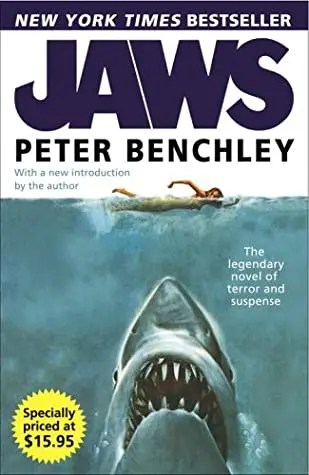
Get ready for shark week with this 1970s classic!
Summary:
A great white shark starts terrorizing a coastal town just as the money-making summer season begins. The classic, blockbuster thriller of man-eating terror that inspired the Steven Spielberg movie and made millions of beachgoers afraid to go into the water. Experience the thrill of helpless horror again—or for the first time!
Review:
As a New England girl born and raised, I can’t tell you how many times I’ve watched Jaws the movie. Everything about it is just so *chef’s kiss* perfectly small New England beach town. (The movie is set on Long Island, New York, but was filmed on Martha’s Vineyard, Massachusetts, and, let me tell you, everything about it reads New England to me.) Plus, my cat absolutely adores watching Jaws. She’s obsessed with that shark. With summer rolling around once again, I decided it was high time I read the book. The book is almost always better than the movie, right? Well, in this case, that almost really comes into play. (Spoilers ahead for both the movie and the book. If you haven’t seen this classic yet, please go watch it then come back to the book review.)
The book starts off strong with a close omniscient perspective of the shark getting ready to eat the drunk lady swimming in the ocean. The book could easily sway into anthropomorphizing territory, imagining the viciousness of the shark. But it consistently describes a creature whose instinct is to feed. What, exactly, made it come in to Amity and stick around is a mystery that is never solved. This first scene is one of the strongest in the book. But I have to admit I was hearing the absolutely classic movie soundtrack in my head while I was reading it, and we all know how essential that is at building suspense. So I’m not sure it’s safe to say I felt engaged purely because of the book.
But it didn’t take too long for the book to showcase itself as…worse than the movie. When we meet Sheriff Brody, he mentions a problem they had the previous summer where a Black gardener sexually assaulted six white women, none of whom would press charges. The only point of this from a narrative perspective is to demonstrate how the police department will keep things under wraps in order to protect the summer season. But it’s a hatefully racist way to establish this, narratively. Even if I charitably imagine that this is supposed to be pointing out the racial divide in Amity that is later even clearer in the book, there are better ways to do that than to play into this horribly racist myth of the serial Black assaulter of white women.
There are two other plot points in the book that weren’t in the movie at all. First, there’s that Brody’s wife cheats on him with Hooper because she feels some weird Feminine Mystique style ennui about her life as a housewife at a lower social class than she was before she got married. (We only see the sex in flashbacks she has about it and how strange and scary Hooper was). There is a large scene where she has lunch with Hooper first and talks about her sexual fantasies. Kind of slows down the pace of the suspense from the shark attacks.
The other additional plot point is that the mayor of the town is mixed up with the mafia because he had to take out a loan from a loan shark (har har) to pay his wife’s cancer treatment medical bills. (What on earth do other countries with nationalized health care do to justify characters taking out unwise loans? This is such a common plot device…but I digress.) The mafia wants the beaches to be kept open. This is a big motivator for why the mayor keeps insisting on it. But I don’t think this motivator is necessary. The economic pressure and need of a tourist town to keep their main tourist attraction open is more than enough motivation. Anyone who has any familiarity with a town that depends on seasonal tourism gets that. Spielberg was right to cut this from the movie. This also brings about a scene I found much more disturbing than any shark attack, which is that the mafia kills Brody’s son’s cat in front of his son, and then Brody takes the dead cat and throws it in the mayor’s face.
The final act where Quint, the old-time fisherman, takes Brody and Hooper out on his boat to hunt the shark is overall pretty good. There’s some nice tension between the three of them, and Quint really has to eat his words about the shark not being intelligent. It does not end with the 70s style bang of the movie. But I kind of liked the simplicity of the ending, leaving Brody to swim to shore and deal with the aftermath on his own without any reader audience.
I’ve seen some lists of the differences between the book and the movie with mistakes and inaccuracies on them, so I do want to clear up a couple of things. Brody is afraid of the water in the book. This is well-established; I’m not sure how people missed that. Mrs. Kintner does slap Brody in the book when she confronts him about the shark killing her son.
The version of the book I read also had an introduction by the author where we find out that he was, basically, a “summer person” himself – from a wealthy family and a legacy graduate of Harvard (his father also went to Harvard). His father was a novelist, and because of that connection, Benchley got an agent before he even had a book written. By Benchley’s own recollection, he sold the idea for Jaws and then they told him he needed to write the book, and the screenplay was sold before the book was even written. He took a first shot at the script, and Spielberg told him to throw out a lot of the stuff that I mentioned in my review as things I didn’t like. Moral of the story being privileged dude sold an admittedly solid idea based on the idea alone to someone else who directed it into it being a classic.
Overall, it was interesting to read the book behind the movie, but I also now have the perfect answer for the next time someone asks me, “When is the movie ever better than the book?”
If you found this review helpful, please consider tipping me on ko-fi, checking out my digital items available in my ko-fi shop, buying one of my publications, or using one of my referral/coupon codes. Thank you for your support!
3 out of 5 stars
Length: 320 pages – average but on the longer side
Source: Library
Buy It (Amazon or Bookshop.org)
Get the Book Club Discussion Guide
A beautifully graphic designed 2 page PDF that contains: 1 icebreaker, 9 discussion questions arranged from least to most challenging, 1 wrap-up question, and 3 read-a-like book suggestions
View a list of all my Book Club Guides.
Book Review: On a Grey Thread by Elsa Gidlow

Summary:
Published in 1923, this poetry collection was the first in North American history to openly express lesbian desire. Both personal and political, Gidlow’s poems express the poet’s complex feelings as a young woman whose political ideology and sexual identity ran counter to the traditional values of her time.
Review:
For Pride Month, I wanted to push myself a little by reading from a genre I read less often – poetry. I’ve also been striving to connect more with queer history, so I thought this groundbreaking collection was a great match.
The poems are collected into four sections – Youth, Grain and Grapes, Inner Chamber, and In Passing. If you are here for women loving women content…skip to the Inner Chamber section. Although, I am glad I read them all in order, because I do feel like they told a subtle overarching story.
The first poem in the collection beautifully explores the meaning of life and what makes us who we are via beads on a grey thread. Other poems consider the beauty of nature and sadness/loneliness (in a way that reminded me of 90s emo culture). In fact, I think what struck me the most when reading these was just how of the moment and today they felt, in spite of being written almost 100 years ago.
Since the entire collection is out of copyright, let me close my review by sharing my favorite in its entirety.
“Episode”
I have robbed the garrulous streets,
Thieved a fair girl from their blight,
I have stolen her for a sacrifice
That I shall make to this mysteried night.I have brought her, laughing,
To my quietly sinister garden.
For what will be done there
I ask no man’s pardon.I brush the rouge from her cheeks,
Clean the black kohl from the rims
Of her eyes; loose her hair;
Uncover the glimmering, shy limbs.I break wild roses, scatter them over her.
The thorns between us sing like love’s pain.
Her flesh, bitter and salt to my tongue,
I taste with endless kisses and taste again.At dawn I leave her
Asleep in my wakening garden
(For what was done there
I ask no man’s pardon.)
I hope this review entices you to read some (more) classic queer poetry.
If you found this review helpful, please consider tipping me on ko-fi, checking out my digital items available in my ko-fi shop, buying one of my publications, or using one of my referral/coupon codes. Thank you for your support!
4 out of 5 stars
Length: 73 pages – novella
Source: Archive.org
Buy It (Amazon or Bookshop.org)
Get the Reading Group / Book Club Discussion Guide
A beautifully graphic designed 2 page PDF that contains: 1 icebreaker, 9 discussion questions arranged from least to most challenging, 1 wrap-up question, and 3 read-a-like book suggestions
View a list of all my Discussion Guides.
Book Review: Rubyfruit Jungle by Rita Mae Brown

Summary:
This bawdy book originally published in 1973 tells the story of Molly Bolt, the adoptive daughter of a dirt-poor Southern couple who boldly forges her own path in America. With her startling beauty and crackling wit, Molly finds that women are drawn to her wherever she goes – and she refuses to apologize for loving them back.
Review:
I’ve been trying to read more queer classics and not solely limit myself to modern queer books. I stumbled upon this when looking for other books published around the same time as Tales of the City (review). While I absolutely appreciate how groundbreaking this was at the time, it didn’t work for me. I’ll have to give a couple of spoilers to be able to discuss why, so be forewarned!
Let’s start with what I did like. The prose calls out the racism of the north at a time when Jim Crow was still around in the south. Just because things may be better from a legal perspective doesn’t mean they actually are any less racist. This isn’t done in a preachy way. It comes about smoothly as Molly’s family moves from the hills of Pennsylvania to Florida. I really liked Molly’s dad, and the arc of her relationship with him. I loved how Molly’s first crush in middle school on another little girl named Leota is depicted. I appreciated how key moments in Molly’s life makes it clear she has to conform to succeed, and she refuses to do it. It hauntingly shows how minoritized people are kept down.
This is told in the first person, and Molly isn’t, to me, particularly likeable. I really wanted to like her. But I didn’t. She’s crass, abrasive, quite reactionary. She looks down on other people even while insisting she doesn’t. Ok, so for most of the book she’s a teenager or a young adult working her way through college. No one is perfect, and she has a lot stacked against her. But I would say she just becomes more full of herself as the novel progresses. I didn’t feel like she really learned anything. I suspect I’m supposed to think she did based on her final film school project, but it was hard for me to be moved by a film I didn’t see.
Something about Molly that particularly bothered me was an instance that really reminded me of some movies from the 70s I’ve seen, where a woman will say no to sex, but then the guy gets a little rough, gets her a little drunk, and later she basically says she’s grateful he took “advantage of her” because she really wanted it deep down (aka he raped her but she liked it). Well, Molly takes on the role of the aggressor in just such a situation in this book.I get it that this was a common trope at the time this book was written, and I’m imagining the goal was to show the same scene but with two women. But just because something was commonly shown in media at the time doesn’t make it right. I just can’t view Molly as a heroine when that’s how she engages with other women.
The other thing that’s problematic about Molly is that, since she’s adopted, she likes to say she doesn’t technically know her race. She bases this on having dark hair. At the end of the book she finds out she’s half…wait for it…French. She sees a photo of her father, and he’s French with dark hair. She never confronts herself about why she had this weird obsession with imagining herself as partially another minoritized race.
One more thing I feel I ought to mention is that Molly has a tendency to speak very negatively about butch presenting lesbians. It’s ok to not be into dating butches yourself. It’s even ok if you yourself find the butch/femme dynamic odd (although why you should care is beyond me). What bothers me, though, is how she describes butch women every single time she sees them. It’s downright insulting. You can be kind to other queer people you aren’t attracted to.
Again, I don’t expect characters to be perfect. Indeed, I think first person books with an imperfect main character are important for understanding other people’s perspective. But I do expect some growth and development over time. I felt throughout the book like Molly had no interest in self-improvement or reflection, and she never even has an epiphany that maybe she should.
Overall, why I understand why this book was groundbreaking, and it certainly had some memorable scenes, I felt the main character is unlikeable and doesn’t grow or change over time. I really liked her dad though. He was a morally flawed, complex character who I really felt could have held up his own fascinating book.
If you found this review helpful, please consider tipping me on ko-fi, checking out my digital items available in my ko-fi shop, buying one of my publications, or using one of my referral/coupon codes. Thank you for your support!
3 out of 5 stars
Length: 221 pages – average but on the shorter side
Source: Library
Buy It (Amazon or Bookshop.org)
Book Review: Coffee Will Make You Black by April Sinclair (Series, #1)

Summary:
Set on Chicago’s Southside in the mid-to-late 60s, following Jean “Stevie” Stevenson, a young Black woman growing up through the Civil Rights and Black Power movements. Stevie longs to fit in with the cool crowd. Fighting her mother every step of the way, she begins to experiment with talkin’ trash, “kicking butt,” and boys. With the assassination of Dr. King she gains a new political awareness, which makes her decide to wear her hair in a ‘fro instead of straightened, to refuse to use skin bleach, and to confront prejudice. She also finds herself questioning her sexuality. As readers follow Stevie’s at times harrowing, at times hilarious story, they will learn what it was like to be Black before Black was beautiful.
Review:
After reading Tales of the City by Armistead Maupin (review) and finding myself disappointed with how it handled race, I intentionally looked for older classics of LGBTQIA+ lit written by Black authors. (As a starting place. I intend to continue this searching with other BIPOC groups). In my search I found this book listed as an own voices depiction of a queer young Black woman in the South Side of Chicago. My library had a digital copy, so I was off.
First published in 1995, this is certainly an own voices book. The author grew up in Chicago in the same time period as Stevie, and that authenticity really shines through. The book is divided into three parts. Part 1 (spring 1965 to summer 1967), Part 2 (fall 1967 to fall 1968), and Part 3 (fall 1969 to spring 1970). Part 1 begins in Stevie’s last year of middle school. It establishes the systemic racism Stevie and her family live with that the Civil Rights movement that Stevie will later become involved in in high school. It also demonstrates Stevie’s difficult relationship with her mother. In Part 2, Stevie enters high school, Dr. King is assassinated, and Stevie starts to push back on racism and colorism. In Part 3, Stevie starts to question her sexuality and also the lack of interracial friendships and relationships she sees among her friends and family.
In some ways this was a tough book to read. It pulls no punches about what life was like for a young Black girl at this time. Although it always pains me to read about racism and colorism, there was an extra twinge in reading this because Stevie is just such an immediately likable little girl with a protective mother. The book opens with Stevie asking her mother what a virgin is (because a boy at school asked her if she was one), and her mother not wanting to tell her. This reminded me of all the conversations about Black girls being forced to grow up too fast and letting them stay the little girls they are. Although I advocate for frank talks about sexuality with questioning children, I also understood her mother’s impulse to keep Stevie little just a while longer.
Stevie’s sexuality is left open-ended in this book, in spite of my finding it on a list of lesbian fiction originally. Essentially the idea is posited that sometimes adolescents feel confused only to realize later they’re straight. I wondered if this is what happens with Stevie so peaked at the sequel. (spoiler warning!) Apparently in the sequel Stevie identifies as bisexual. This thrilled me, because there’s so little representation of bisexual folks in literature, but also because I felt a bit of a twinge of recognition when reading about Stevie’s confusion in the book. Part of why she’s so confused about if she’s straight or a lesbian is because the answer is neither. It was a great depiction.
I did feel the book ended kind of abruptly. It’s definitely a bit of a plot hanger that leaves you yearning for the sequel. Not in an uncomfortable way but more in a I want to see Stevie finish growing up way. Plus, it’s the start of the 1970s, and that’s such a fun time period to read about.
Overall, this own voices book gives a realistic yet fun depiction of growing up Black in the South Side of Chicago in the 1960s. If you’re coming for the queer content, hang in there, it shows up in Part 3. A great way to diversify your reading.
4 out of 5 stars
Length: 256 pages – average but on the shorter side
Source: Library
Buy It (Amazon or Bookshop.org)
Get the Reading Group / Book Club Discussion Guide
A beautifully graphic designed 2 page PDF that contains: 1 icebreaker, 9 discussion questions arranged from least to most challenging, 1 wrap-up question, and 3 read-a-like book suggestions
View a list of all my Discussion Guides.
If you found this review helpful, please consider tipping me on ko-fi, checking out my digital items available in my ko-fi shop, buying one of my publications, or using one of my referral/coupon codes. Thank you for your support!
Book Review: Tales of the City by Armistead Maupin (Series, #1)

Summary:
San Francisco, 1976. A naïve young secretary, fresh out of Cleveland, tumbles headlong into a brave new world of laundromat Lotharios, pot-growing landladies, cut throat debutantes, and Jockey Shorts dance contests. The saga that ensues is manic, romantic, tawdry, touching, and outrageous
Review:
This was first published as a novel in 1978, although it was published prior to that as a serialized story in a San Francisco newspaper. It is considered a classic of LGBTQIA+ literature. The first tv show miniseries based upon it that premiered in 1994 had a same-sex kiss made history and was also protested (source). The Netflix reboot/update in 2019 brought fresh attention to it, and I thought it was high-time I read the classic.
It’s clear that some restraints were placed upon Maupin, either by the newspaper or simply the culture of the time. Our window into the queer world in San Francisco is given to us by Mary Ann Singleton – a single cis straight woman who comes from Cleveland for a visit and decides to stay. She’s invited into Barbary Lane and declared one of us, although why exactly she’s considered part of the found family is not resolved in the first book.
The book is definitely a product of the 1970s. 1970s fashion and freewheeling culture are everywhere. Lack of acceptance of queer people is a real threat and concern, and the AIDS crisis had not yet hit. It’s an interesting snapshot of a very particular point in time.
While characters are quite loose about who they will sleep with, there’s also a lack of diversity in the cast of main characters that’s jarring. Especially for a story set in a city that’s so diverse. Particularly noticeable to me was how the Asian-American characters are all peripheral, even with this being San Francisco. I don’t think this lack of diversity is a product of its time – there were other very forward-thinking works of fiction at the same time as this. This lack of diversity is something to keep in mind when approaching the book.
There are also two plot twists that revolve around race, and I don’t think either is handled with particular grace. The race of someone’s lover is identified by pointing to a yellow flower. This is obviously offensive. While it seems to me that the character who does this is someone we’re supposed to think badly of, on the other hand, it seemed to me that this was supposed to be a funny moment. And it definitely was not. In the other case, a character reveals that they believe that the only way to become a successful model is to be Black. It is unclear what the other character they are speaking to thinks of that. I think this instance may be intentionally leaving it up to the reader to decide what they think, but it’s also a strange plot point in a book that’s mostly about hookups and very little about careers.
This reminded me very much of other books and tv shows that have dramatic, gasp-inducing storylines with large casts of characters whose lives intertwine and overlap in mysterious ways. Think Jane the Virgin or Desperate Housewives just with fewer identical twins and less murder (so far…..) and more queer characters. If you like that type of storytelling, then you’ll likely find this hilarious and engaging. If you don’t, then you probably won’t.
I personally found it to be a rapid read with an engaging storyline and funny chapter titles. I wished it had been more forward-thinking and intersectional, but I also respect that the mere depiction of queer people in a soap opera like story was quite groundbreaking. I appreciate it for what it is, and it was a fun, quick read.
4 out of 5 stars
Length: 386 pages – average but on the longer side
Source: Library
Buy It (Amazon or Bookshop.org)
Get the Reading Group / Book Club Discussion Guide
A beautifully graphic designed 2 page PDF that contains: 1 icebreaker, 9 discussion questions arranged from least to most challenging, 1 wrap-up question, and 3 read-a-like book suggestions
View a list of all my Discussion Guides.
If you found this review helpful, please consider tipping me on ko-fi, checking out my digital items available in my ko-fi shop, buying one of my publications, or using one of my referral/coupon codes. Thank you for your support!
Book Review: Bear by Marian Engel

Summary:
A librarian named Lou is called to a remote Canadian island to inventory the estate of a secretive Colonel whose most surprising secret is a bear who keeps her company–shocking company.
Review:
I don’t recall anymore how I heard about this book, but this is what I heard about it:
There’s this book that’s considered a Canadian classic where a librarian has sex with a bear.
Ok. I was left with questions. First, this sounds like erotica – how is it a classic? Second, as a trained librarian I immediately wondered if the librarian part was essential to the story. Third, does she really have sex with a bear? Then I became even more intrigued when I discovered I couldn’t get this book digitally but only in print AND it’s out of print in the US so it’s far cheaper to purchase it abroad and have it sent here. So, now that I got this book from the UK and read it (in one weekend), let me answer these questions for you.
First, I wouldn’t call this erotica. The point, in spite of the murmurings about it, is absolutely not about sex with a bear, whereas in erotica, the point is the sex. I in all honesty would say this is a book about burnout. Lou is an archivist who is in a rut. When the nameless Institute she works for sends her to this estate that has been left to them to inventory their materials, her time in nature and her experiences with the locals (yes, including Bear), reveals her massive burnout to her.
She wondered by what right she was there, and why she did what she did for a living. And who she was.
(pg 93)
Second, I would definitely say the librarian part is essential to the story. Librarianship is a feminized profession. This book was first published in 1976. It is an exploration of what it means to be a working woman and how the world views working women, even when our work is performed outside of the public’s eye (perhaps especially when our work is performed outside of the public’s eye). I also thought this book does an excellent job of showing how even though librarianship is a feminized profession, those in the positions of greatest power within libraries and archives are men. Lou’s boss is a man, and this is relevant to her negative work experience.
Third, does she actually have sex with a bear? Ok, slight spoiler warning here. There is no penetration. She tricks the bear to go down on her. That’s it. I didn’t find it particularly shocking, but I’m a millennial from the internet generation that grew up with the internet urban legend about the woman with the dog and the peanut butter so. I viewed the transgressive act with Bear as serving two purposes. First, Lou has a tendency toward self-sabotage, self-loathing, and self-punishment. I think transgressing in this way makes her see how she’s transgressing against herself and her own soul in other ways and makes her refind her own sense of self. Second, I think it’s important to note that at the beginning of the book an Indigenous woman named Lucy kind of hands off the caretaking of Bear to Lou. At the end of the book, she hands the caretaking back to Lucy. I view this as an acknowledgement that just because you can do something doesn’t mean you should. It doesn’t mean it’s your life calling. There are other interesting takes on this as a commentary on colonialism, which I also think are valid.
So do I see why this is a Canadian classic? Yes, absolutely. The whole story oozes Canada from the juxtaposition of the wilderness with the city to the entwining of European and local history to the acknowledgment of the realness and relevance of local Indigenous peoples. (These peoples are not of the past but are of the present, something I think Canadian literature often does a better job with than US literature).
I thought I was going to read this book and laugh at it, kind of like how folks on book-tok are laughing about the ice planet barbarians right now. Instead, I found a unique story about a woman’s time in the semi-wilderness and how it makes her confront her burnout and how her career is a poor fit for her. How her life setup is causing her to transgress and how that needs to change. A shocking way to get the point across? Perhaps. But an important point nonetheless.
4 out of 5 stars
Length: 167 pages – average but on the shorter side
Source: Purchased
Buy It (Amazon or Bookshop.org)
Get the Reading Group / Book Club Discussion Guide
A beautifully graphic designed 2 page PDF that contains: 1 icebreaker, 9 discussion questions arranged from least to most challenging, 1 wrap-up question, 3 read-a-like book suggestions
View a list of all my Discussion Guides.
If you found this review helpful, please consider tipping me on ko-fi, checking out my digital items available in my ko-fi shop, buying one of my publications, or using one of my referral/coupon codes. Thank you for your support!
Book Review: Watership Down by Douglas Adams
 Summary:
When a rabbit low on the totem pole has a bad premonition, he and some friends run from their warren just before man intrudes wreaking havoc on their once-home. What follows is an adventure of evading predators and foes and looking for a new home.
Review:
Let me preface my review by saying that I know a lot of people either: A) love this book or B) find this book to be very traumatic. My experience was neither of these. The fact that this was not my experience does not negate yours. But neither does your love or traumatizing by this book mean that I felt the same way about it.
One of the risks of reading a book that is widely-known and loved (or remembered as traumatic) is that you have a pre-existing notion of just what that experience might mean for you. I came at this book with some trepidation and excitement because I absolutely love bunnies and I also love semi-realistic depictions of wild animals. Those that are accurate about scientific information but also personify them somewhat. I wound up being greatly disappointed because it gave me neither a world of bunnies to get lost in nor an experience of great trauma and drama. What I wanted was a highly emotional experience, and instead I got a bit of boredom and my main emotion being disappointment.
Let me start with what I think was well done. Adams clearly paid a lot of attention to the real science of how wild bunnies live and function, and I appreciated that. I also like the allusions to mythology. But there’s lots of reviews that talk about why they love this book, so let’s get down to why I didn’t.
1) I found it to be way too wordy.
I want cuteness and bunnies and plot not overly long descriptions of fields. This is a really thick book (my copy was 479 pages) and just…not that much actually happens. I don’t like to feel like a book is wasting my time, and I felt that a lot with this one. You could argue that it just felt long because I didn’t emotionally connect to it, but I think part of my lack of emotional connection was because of the lengthy descriptive passages.
2) I was expecting a great mythos of a story, and what I got was WWII with bunnies.
I love WWII. Do not get me wrong. I did an entire course for my History BA in just WWII. But I don’t think bunnies particularly pair well with WWII. A large overarching mythos? Sure. Basically the Battle of the Bulge with rabbits? Not so much. I don’t want my bunnies acting like British colonels and their optimistic soldiers, and I certainly don’t want an evil bunny who is basically Hitler coming into the story. (I mean…who makes the enemy another bunny who is basically Hitler? ? What? Why??)
3)It just isn’t all that tragic (sorry guys).
*spoiler warning*
I thought that basically the bunnies fight to survive all book and then all die at the end. Of the core group of rabbits, only ONE dies. There are many epic battles but just no true peril except for the warren that the rabbits leave at the beginning of the book. They are, true, pretty brutally killed by the farmer, but the problem is we never had a chance to get to know them, and we hear the story of the killing from someone who saw it. We don’t see it first-hand. It’s all very distanced and just not that tragic. This would obviously bother me less if I wasn’t expecting a tragedy from everyone saying how sad Watership Down is. But honestly to this day I don’t get why everyone is so sad. The rabbits get a new warren. They successfully find female bunnies and make more bunnies. One main character dies. That is it. I just. What. Why does this traumatize you people?
*end spoilers*
So, if you are a person who doesn’t mind WWII told through rabbits, quite long passages of description, and will welcome a tale lacking in great tragedies, you might have a better experience with the book than I did. Lord knows many people the world-over have loved it. But for those who come to it expecting to find a great tragedy or a fast-moving tale or warm and cuddly rabbits be warned that it’s not what you’ve heard about it.
If you found this review helpful, please consider tipping me on ko-fi, checking out my digital items available in my ko-fi shop, buying one of my publications, or using one of my referral/coupon codes. Thank you for your support!
3 out of 5 stars
Length: 479 pages – chunkster
Source: PaperBackSwap
Counts For:
Bottom of TBR Pile Challenge
3 Speed Reads for Valentine’s Day (f/f, m/m/, and m/f)
 Happy Valentine’s Day my lovely readers!
I know, I know, it’s a made-up holiday. But I think there’s something lovely about celebrating romance in the middle of winter. Even if your version of celebrating it is delighting in the quirks of the genre and maybe not necessarily romance in real life.
(Personally I will be celebrating it in real life, but hey, I’m a newlywed. ;-) )
So maybe you’re finding yourself at home with no plans for Valentine’s Day. Sure, you could watch re-runs of The Bachelor, but why not spend the wintry day curled up with a quick romance read? Not sure what to read? Here are three speed read romances, vastly different from each other. What makes them a speed read? They are all less than 200 pages. And don’t worry. All three of them got 4 stars or more here on Opinions of a Wolf.
 Braided: A Lesbian Rapunzel
By: Elora Bishop
Mood: You believe in fairy tales and happy endings!
Pairing: f/f
Length: 61 pages
Blurb:
A lesbian retelling of Rapunzel. Gray, a witch’s daughter, visits Zelda every day. The witch switched Gray’s fate into Zelda, so now Zelda is the one entwined with the spirit of the tree that the people worship. She must live on the platform and every day lower her hair for people to tie ribbons and prayers into. Gray feels horrible guilt over their switched fates, but she’s also falling in love with Zelda.
Full Review
 Listening to Dust
By: Brandon Shire
Mood: You like a tragic romance that makes you cry. Keep the tissues handy for this one!
Pairing: m/m
Length: 142 pages
Blurb:
A chance meeting between orphaned British writer, Stephen, and American soldier, Dustin, leads to a passionate love affair in England. But when Dustin chooses to go back home to his small Southern town to care for his mentally challenged brother, Stephen is left behind, sending letters that are never answered. He finally decides to follow Dustin home and arrives only to discover that Dustin is no more.
Full Review
 Love Among the Chickens
By: P.G. Wodehouse
Mood: You enjoy slapstick and want to laugh. A lot!
Pairing: m/f
Length: 176 pages
Blurb:
Jeremy Garnet, a novelist, is living a relatively quiet bachelor life in London when his old school friend Stanley Ukridge shows up. Ukridge is starting a chicken farm with his wife, Millie, and wants “Garnie old boy” to come stay with them. He’ll get to write in the country in exchange for a few hours of work a day. In spite of the fact that Ukridge is planning to run the chicken farm without any prior knowledge or studying “the better for innovation, my boy,” Garnie takes him up on it. Of course, life with the eccentric Ukridge surrounded by chickens isn’t quite the quiet writing environment Garnie was planning on. Not to mention the Irish professor neighbor’s lovely daughter that Garnie can’t quite get out of his head.
Full Review
 Support my work with a tip or browse my shop for curated book club guides, how to guides, cross-stitch patterns, and more!


This work by Amanda Nevius is licensed under a Creative Commons Attribution-Noncommercial-No Derivative Works 3.0 United States License.
 Opinions of a Wolf