
Archive
Book Review: Sula by Toni Morrison

A lyrical and haunting novel about two Black women whose lifelong friendship is tested by betrayal, love, and the weight of their small-town community’s judgment.
Summary:
Sula and Nel are two young black girls: clever and poor. They grow up together sharing their secrets, dreams and happiness. Then Sula breaks free from their small-town community in the uplands of Ohio to roam the cities of America. When she returns ten years later much has changed. Including Nel, who now has a husband and three children. The friendship between the two women becomes strained and the whole town grows wary as Sula continues in her wayward, vagabond and uncompromising ways.
Review:
This was my second Toni Morrison novel—the first being The Bluest Eye, which I read back in college. Morrison’s prose is deeply lyrical, which makes her books swift reads on the surface, even when they delve into painful and challenging themes. Sula is no exception.
Each chapter is titled with the year it takes place in, but only covers a brief vignette from that year. Despite spanning several decades, this is a short novel, structurally and in page count. Though the title suggests a singular character focus, Sula is as much about a place—the Bottom, a Black neighborhood in a Southern state situated on the hillside, land the white residents had no interest in. The reason for its ironic name is revealed in the first chapter through a racist tale, setting the tone for the book’s critique of systemic racism.
Indeed, one of the novel’s most striking accomplishments is how clearly it shows that systemic racism ruins lives, whether characters comply with social expectations or resist them. For me, Nel represents compliance while Sula represents defiance—yet neither of them leads a life free from pain. Every person in their orbit suffers in some way, and that suffering is deeply entangled with the racist systems surrounding them.
The edition I read included an introduction in which Morrison writes: “Female freedom always means sexual freedom, even when—especially when—it is seen through the prism of economic freedom.” While I respect Morrison’s craft, I don’t personally agree with this framing. Throughout the book, the freest female characters are also the most sexually unrestrained, choosing partners without regard to consequences. For me, this reflects the central tensions I’ve often felt when reading Morrison’s work: I recognize the literary prowess but don’t agree with this belief. As someone who values intentionality in relationships and ethical sexuality, I believe there is freedom in discernment. My personal worldview differs from Morrison’s here, and I think that’s worth naming—especially since this quote helped me finally articulate why I sometimes feel at odds with what I’m “supposed” to take away from her narratives.
Of course, I also acknowledge that I am not Morrison’s intended audience. She has stated clearly that she writes for Black people—and I am a white woman. I honor that intention, while also appreciating the beauty, lyricism, and cultural specificity of this novel. Morrison evokes a place, a time, and a community with precision and poetry, showing rather than telling how racial injustice permeates generations.
For readers in recovery, or those who love someone with substance use disorder or alcohol use disorder, be advised that this book contains a disturbing scene involving the violent death of a character who struggles with addiction. A mother sets her son on fire, intentionally killing him because of his drug use. It’s a horrific and deeply stigmatizing portrayal. While I understand that literature doesn’t require characters to always make the “right” choices, scenes like this can be deeply harmful and may reinforce stigma around addiction. To anyone reading this who is struggling: You don’t deserve to die. You are not disposable. You can recover. We do recover. I acknowledge that the story is set in a time when resources for addiction recovery were nearly nonexistent, especially for a Black man. But violence is never the answer, and stories like this can perpetuate dangerous beliefs about addiction and worth.
With regards to diversity, the book explores colorism in the Black community, as well as racism faced by Black folks coming from immigrant white communities. It has multiple characters who fought in World War I who struggle with mental health afterwards. It also has a character who uses a wheelchair and is missing a limb. There is not any LGBTQIA+ representation that I noticed.
This is a novel that quietly devastates, not through high drama, but through its unflinching portrayal of how systemic racism, personal grief, and societal expectations shape lives over time. It’s beautifully written, deeply character-driven, and emotionally complex. Whether or not you’re part of Morrison’s intended audience, Sula is a compelling and powerful read. If you’re in recovery or close to someone who is, approach with care due to the painful and stigmatizing depiction of addiction. For those looking for fiction that treats mental health and recovery with care, check out my novel Waiting for Daybreak.
If you found this review helpful, please consider tipping me on ko-fi, checking out my digital items in my ko-fi shop, buying one of my publications, using one of my referral or coupon codes, signing up for my free microfiction monthly newsletter, or tuning into my podcast. Thank you for your support!
3 out of 5 stars
Length: 174 pages – average but on the shorter side
Source: Library
Buy It (Amazon or Bookshop.org)
Get the Book Club Discussion Guide
A beautifully graphic designed 2 page PDF that contains: 1 icebreaker, 9 discussion questions arranged from least to most challenging, 1 wrap-up question, and 3 read-a-like book suggestions
View a list of all my Book Club Guides.
5 Short LGBT Book Club Books

So, you want to bring an LGBTQIA+ book to your book club. But Pride month is already upon us, so it needs to be short! Or maybe reading an LGBTQIA+ book will be a bit of a stretch for your group so you want to entice them into it by promising a short read.
Never fear, your friendly queer and bisexual book blogger has your back with 5 books all under 300 pages. Plus, I have discussion guides available for each and every one of them.
Let’s take a look at them from shortest to longest.

On a Grey Thread by Elsa Gidlow
Coming in at just 73 pages, this is also in the public domain – meaning everyone in your book club can read it on Archive.org for free. (They can also get it on Amazon or Bookshop.org if they prefer.)
Published in 1923, this poetry collection was the first in North American history to openly express lesbian desire. Both personal and political, Gidlow’s poems express the poet’s complex feelings as a young woman whose political ideology and sexual identity ran counter to the traditional values of her time. Whether or not this will work for your book club depends on everyone’s feelings about poetry. But it’s a nice, quick read with historical value.
Get the Discussion Guide
A beautifully graphic designed 2 page PDF that contains: 1 icebreaker, 9 discussion questions arranged from least to most challenging, 1 wrap-up question, and 3 read-a-like book suggestions.
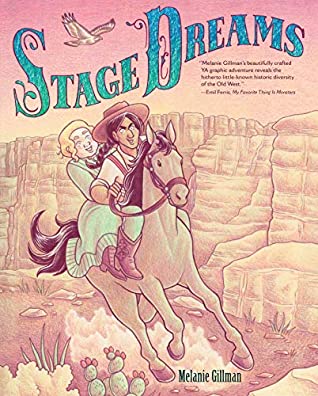
Stage Dreams by Melanie Gillman
While technically more pages than the poetry book with 104, this is a graphic novel, so it’s possible it’s actually an even quicker read. Get it on Amazon or Bookshop.org.
In this rollicking queer western adventure, acclaimed cartoonist Melanie Gillman (Stonewall Award Honor Book As the Crow Flies) puts readers in the saddle alongside Flor and Grace, a Latina outlaw and a trans runaway, as they team up to thwart a Confederate plot in the New Mexico Territory. When Flor—also known as the notorious Ghost Hawk—robs the stagecoach that Grace has used to escape her Georgia home, the first thing on her mind is ransom. But when the two get to talking about Flor’s plan to crash a Confederate gala and steal some crucial documents, Grace convinces Flor to let her join the heist.
Get the Discussion Guide
A beautifully graphic designed 2 page PDF that contains: 1 icebreaker, 9 discussion questions arranged from least to most challenging, 1 wrap-up question, and 3 read-a-like book suggestions.

Solo Dance by Lit Kotomi, translated by Arthur Reiji Morris
This 149 page read is more of a contemporary, literary selection, translated from its original Japanese. Get it on Amazon or Bookshop.org.
Cho Norie, twenty-seven and originally from Taiwan, is working an office job in Tokyo. While her colleagues worry about the economy, life-insurance policies, marriage, and children, she is forced to keep her unconventional life hidden—including her sexuality and the violent attack that prompted her move to Japan. There is also her unusual fascination with death: she knows from personal experience how devastating death can be, but for her it is also creative fuel. Solo Dance depicts the painful coming of age of a queer person in Taiwan and corporate Japan. This striking debut is an intimate and powerful account of a search for hope after trauma.
Get the Discussion Guide
A beautifully graphic designed 2 page PDF that contains: 1 icebreaker, 9 discussion questions arranged from least to most challenging, 1 wrap-up question, and 3 read-a-like book suggestions.

The Gilda Stories by Jewelle Gómez
If your book club likes the paranormal or urban fantasy genres, then this 252 page read should be right up their alley. Get it on Amazon or Bookshop.org.
A young Black girl escapes slavery in the 1850s United States. When she grows up, she is made into a vampire with her consent. We see her immortal life and her perspective of the US through an imagined 2050.
Get the Discussion Guide
A beautifully graphic designed 2 page PDF that contains: 1 icebreaker, 9 discussion questions arranged from least to most challenging, 1 wrap-up question, and 3 read-a-like book suggestions.

Coffee Will Make You Black by April Sinclair
At 256 pages, this will be a great fit for a book club that likes historic fiction set in the mid-20th century. Get it on Amazon or Bookshop.org.
Set on Chicago’s Southside in the mid-to-late 60s, following Jean “Stevie” Stevenson, a young Black woman growing up through the Civil Rights and Black Power movements. Stevie longs to fit in with the cool crowd. Fighting her mother every step of the way, she begins to experiment with talkin’ trash, “kicking butt,” and boys. With the assassination of Dr. King she gains a new political awareness, which makes her decide to wear her hair in a ‘fro instead of straightened, to refuse to use skin bleach, and to confront prejudice. She also finds herself questioning her sexuality. As readers follow Stevie’s at times harrowing, at times hilarious story, they will learn what it was like to be Black before Black was beautiful.
Get the Discussion Guide
A beautifully graphic designed 2 page PDF that contains: 1 icebreaker, 9 discussion questions arranged from least to most challenging, 1 wrap-up question, and 3 read-a-like book suggestions.
Bonus Suggestion:

Bloemetje: a speculative retelling of Hans Christian Andersen’s Thumbelina fairy tale by Amanda McNeil
Of course, I must also mention my own queer-inclusive retelling of Thumbelina, coming in at 121 pages. Available on Amazon.
A Dutch company known as The Bedrijf commences colonizing Venus via the construction of a dome filled with plants that convert its natural air into something breathable by humans. Since all workers are granted permission to bear a child, a woman and her spouse join the crew. But the woman soon discovers she is plagued with infertility. When her spouse illegally brings home a tulip from the garden, they discover a miniature baby inside who they name Bloemetje – little bloom. As the baby grows in mere days into a teenager, pushing her boundaries, she illuminates the true horrors of colonization and leads them all on a journey to decolonize.
If you’re interested in reading this for your book club, drop me a note at mcneil.author@gmail.com. I’d be happy to make a discussion guide and/or talk to your book club via Zoom or similar software.
Book Review: Stage Dreams by Melanie Gillman
Summary:
In this rollicking queer western adventure, acclaimed cartoonist Melanie Gillman (Stonewall Award Honor Book As the Crow Flies) puts readers in the saddle alongside Flor and Grace, a Latina outlaw and a trans runaway, as they team up to thwart a Confederate plot in the New Mexico Territory. When Flor—also known as the notorious Ghost Hawk—robs the stagecoach that Grace has used to escape her Georgia home, the first thing on her mind is ransom. But when the two get to talking about Flor’s plan to crash a Confederate gala and steal some crucial documents, Grace convinces Flor to let her join the heist.
Review:
This is a graphic novel for readers who love Westerns but are tired of them erasing BIPOC and queer people. In this read you get all the fun of a Western but it’s peopled with both BIPOC and queer people.
The book starts with a stagecoach robbery by Flor (a Latina woman) and her pet hawk. She kidnaps a white damsel (Grace) who turns out to be a young trans woman on the run both to avoid her family’s wish for her to serve in the Confederate army and to seek out performing on the stage. Grace convinces Flor to let her help in a plot to spy on some Confederate documents.
Since this is a short book, there aren’t a ton of characters. It’s mostly the other folks on the stagecoach with Grace (all deliciously hateable), the tailor who helps them get ready for the Confederate gala, and the Confederate gala attendees. This doesn’t leave a ton of room for additional BIPOC in the story, but the tailor is Luis who is Black and completely supportive of Grace.
The book does an artful job of establishing that Grace is trans without ever using the word or deadnaming her. I had been concerned that Grace’s visible depiction might fall into the cringer category of visibly “man in a dress” like in the old movies when male characters dress as women to escape something. This absolutely does not happen with Grace. She simply looks like a larger woman. (Larger than Flor, close in size to the men in the stagecoach). There are also multiple times when the existence of other trans people are established. Luis says Grace isn’t the only larger woman he’s designed for. Flor discusses other women like Grace performing on stage out west.
I enjoyed Flor but wanted a little more backstory on her. What made her start robbing stagecoaches? How did she get the pet hawk? How does she know Luis? I get it she’s a more close-lipped character, but Luis could have dropped a few tidbits about the two of them, and I get the vibe from Grace that she might be the type to be able to lure information out of people with her charm.
The spying plot worked and fit into the small amount of space allotted. I liked that it gave Grace and Flor a reason to team up and showed them as active rather than passive. I did wish for a little more detail in these scenes, though. Specifically, when someone recognizes Grace, what is their relationship to her?
I love the art and thought it worked great for a Western story. Only when I looked it up later did I discover Gillman does everything by hand with colored pencils. Truly amazing and translated into a book that was beautiful to read.
Overall, this was a fun, beautifully drawn, sapphic read with a lot of diversity that establishes trans people as existing in history. It just left me wishing for more – more background and for Flor and Grace’s adventures to continue.
If you found this review helpful, please consider tipping me on ko-fi, checking out my digital items available in my ko-fi shop, buying one of my publications, or using one of my referral/coupon codes. Thank you for your support!
4 out of 5 stars
Length: 104 pages – novella
Source: Library
Buy It (Amazon or Bookshop.org)
Get the Reading Group / Book Club Discussion Guide
A beautifully graphic designed 2 page PDF that contains: 1 icebreaker, 9 discussion questions arranged from least to most challenging, 1 wrap-up question, and 3 read-a-like book suggestions
View a list of all my Discussion Guides.
Book Review: On a Grey Thread by Elsa Gidlow
Summary:
Published in 1923, this poetry collection was the first in North American history to openly express lesbian desire. Both personal and political, Gidlow’s poems express the poet’s complex feelings as a young woman whose political ideology and sexual identity ran counter to the traditional values of her time.
Review:
For Pride Month, I wanted to push myself a little by reading from a genre I read less often – poetry. I’ve also been striving to connect more with queer history, so I thought this groundbreaking collection was a great match.
The poems are collected into four sections – Youth, Grain and Grapes, Inner Chamber, and In Passing. If you are here for women loving women content…skip to the Inner Chamber section. Although, I am glad I read them all in order, because I do feel like they told a subtle overarching story.
The first poem in the collection beautifully explores the meaning of life and what makes us who we are via beads on a grey thread. Other poems consider the beauty of nature and sadness/loneliness (in a way that reminded me of 90s emo culture). In fact, I think what struck me the most when reading these was just how of the moment and today they felt, in spite of being written almost 100 years ago.
Since the entire collection is out of copyright, let me close my review by sharing my favorite in its entirety.
“Episode”
I have robbed the garrulous streets,
Thieved a fair girl from their blight,
I have stolen her for a sacrifice
That I shall make to this mysteried night.I have brought her, laughing,
To my quietly sinister garden.
For what will be done there
I ask no man’s pardon.I brush the rouge from her cheeks,
Clean the black kohl from the rims
Of her eyes; loose her hair;
Uncover the glimmering, shy limbs.I break wild roses, scatter them over her.
The thorns between us sing like love’s pain.
Her flesh, bitter and salt to my tongue,
I taste with endless kisses and taste again.At dawn I leave her
Asleep in my wakening garden
(For what was done there
I ask no man’s pardon.)
I hope this review entices you to read some (more) classic queer poetry.
If you found this review helpful, please consider tipping me on ko-fi, checking out my digital items available in my ko-fi shop, buying one of my publications, or using one of my referral/coupon codes. Thank you for your support!
4 out of 5 stars
Length: 73 pages – novella
Source: Archive.org
Buy It (Amazon or Bookshop.org)
Get the Reading Group / Book Club Discussion Guide
A beautifully graphic designed 2 page PDF that contains: 1 icebreaker, 9 discussion questions arranged from least to most challenging, 1 wrap-up question, and 3 read-a-like book suggestions
View a list of all my Discussion Guides.
Book Review: Burn Down, Rise Up by Vincent Tirado

Summary:
For over a year, the Bronx has been plagued by sudden disappearances that no one can explain. Sixteen-year-old Raquel does her best to ignore it. After all, the police only look for the white kids. But when her crush Charlize’s cousin goes missing, Raquel starts to pay attention—especially when her own mom comes down with a mysterious illness that seems linked to the disappearances. Raquel and Charlize team up to investigate, but they soon discover that everything is tied to a viral worldwide game called the Echo Game. If you play it wrong, it can trap you in an echo – a parallel universe based on one of the worst times your particular region has seen.
Review:
I love a horror based around a bunch of people doing something that tempts the supernatural into coming to get them, and then being surprised when it does. (And when I say “love” I mean I will literally throw you out of my house if you say Candyman at a mirror twice). When I saw there was a sapphic version of this trope coming out, you bet I smashed the request button on NetGalley so hard.
The first hurdle any horror like this has to get over is giving us a horrifying scene right off-the-bat that’s scary even though we don’t really know what’s going on. This book does a great job at that. Charlize’s cousin, Cisco, has been missing. He comes back from being missing “wrong” and accidentally gives “something” that’s clearly supernatural to Raquel’s mom, who’s a nurse. This beautifully sets up both Charlize and Raquel to be heavily invested in what exactly is going on in their neighborhood. They used to be close friends but now they’ve drifted to acquaintances, and Raquel has the hots for Charlize. It’s just the right set-up.
The next hurdle the book has to get over is why are the Black kids sneaking out at night to play this viral game tempting the supernatural at 3am? The book takes this head-on with the characters acknowledging doing such a thing doesn’t go with their culture. Charlize and Raquel are motivated to save their family members, but what about Cisco? We learn he befriended a bunch of white theater kids who asked him to come along and do it as part of some theater kids bonding activity. I have to say, as a once upon a time theater kid myself, this sort of thing rang as very true.
So is the horror scary? Yes, largely because it’s starting to reach out into the Bronx even among those who aren’t playing the Echo Game. But I will say, I didn’t think it was terrifyingly scary. If this was a movie, I could sleep after it. Unlike The Ring, which made me terrified of being in the same room with my own television for two weeks. So I’d say it’s moderate on the scary scale. It’s definitely kind of gory, and the peril is real.
The relationships are interesting, realistic, and Raquel has just the right amount of them. She has her best friend, his brother, Charlize, Cisco, her father, and her mother. The fact that she was living with her mother and has to move in with her bachelor pad father while her mother is ill was one of my favorite parts of the book. Her dad clearly loves her and they were absolutely part of each other’s lives before, but there’s a difference between the dad who loyally pays child support who you see a few times a month and the dad you live with. I appreciated how that difference was drawn out, acknowledging the awkwardness without blaming either of them. I also liked how her dad both brought out the Latinx aspect of the story, as well as giving her a direct connection to when the Bronx burned in the 1970s. (This time period, of course, is when the echo draws from).
The Charlize/Raquel situation was cute. I liked how Raquel’s best friend, Aaron, also likes Charlize, and he just wants Raquel to be honest with him about liking her as well. I was a little bit confused about why Raquel has some internalized homophobia making it hard for her to accept that she likes Charlize. It was unclear to me if this was coming from her family (who seemed very accepting) or if it was just worrying how her peers would react or what exactly. I think a richer development of that would have helped make the scenes where Raquel works on accepting herself more powerful.
Overall, this is a fun take on the viral game tempting the supernatural trope. The setting of the Bronx and the main character’s Afro-Latinx culture are both well developed. It’s a medium scary read that will certainly appeal to YA readers.
If you found this review helpful, please consider tipping me on ko-fi, checking out my digital items available in my ko-fi shop, buying one of my publications, or using one of my referral/coupon codes. Thank you for your support!
4 out of 5 stars
Length: 352 pages – average but on the longer side
Source: NetGalley
Buy It (Amazon or Bookshop.org)
Get the Reading Group / Book Club Discussion Guide
A beautifully graphic designed 2 page PDF that contains: 1 icebreaker, 9 discussion questions arranged from least to most challenging, 1 wrap-up question, and 3 read-a-like book suggestions
View a list of all my Discussion Guides.
Book Review: Getting Clean with Stevie Green by Swan Huntley

Summary:
At thirty-seven, Stevie Green has had it with binge drinking and sleeping with strange men. She’s confused about her sexuality and her purpose in life. When her mother asks her to return to her hometown of La Jolla to help her move into a new house, she’s desperate enough to say yes. The move goes so well that Stevie decides to start her own decluttering business. She stops drinking. She hires her formerly estranged sister, Bonnie, to be her business partner. She rekindles a romance with her high school sweetheart, Brad. Things are better than ever—except for the complicated past that Stevie can’t seem to outrun.
Who was responsible for the high school scandal that caused her life to take a nosedive twenty years earlier? Why is she so secretive about the circumstances of her father’s death? Why are her feelings for her ex-best friend, Chris, so mystifying? If she’s done drinking, then why can’t she seem to declutter the mini wine bottles from her car?
Review:
I smashed the request button on NetGalley when I read this description. A mixture of quit lit (literature about addiction and recovery) and decluttering? Sign me up! And it did not disappoint. In fact, it surprised me with delightful queer content I wasn’t expecting.
It’s important to know that Stevie’s ex-best friend Chris is a woman. Chris also came out in high school as a lesbian around the time of the scandal that so traumatized Stevie. Stevie has also slept with women, although only the men are mentioned in the description. The only hang-ups about Stevie’s sexuality seen in her circle of family, friends, and even lovers, come from Stevie herself. This is a great example of how addiction can freeze someone’s self-awareness and self-acceptance. Stevie began drinking in high school, and it’s a trueism in recovery circles that you freeze at the age of development you were at when you began drinking until you stop. Then you can begin maturing again. So is it a bit frustrating that Stevie is 37 and kind of acting like a teenager? Yes. But is it realistic? Also yes.
When we meet Stevie she is newly sober and running her decluttering business. I loved the depiction of how Type A Stevie is about her days and routines. This is so accurate to early recovery. One of my favorite parts is how she starts every day by standing in a Wonder Woman pose and saying affirmations to herself repeatedly.
How had I become a woman who chanted affirmations to herself while doing this ridiculous pose? Because it was supposed to make me feel better. I would have done anything to feel better.
location 806
Early recovery really is this incredible moment of being willing to do anything to feel better, and this is wonderfully depicted here.
The scenes with Stevie decluttering with her clients also shine. I’m a fan of decluttering YouTube videos and tv shows, and these gave me the same thrill as watching those. I loved seeing the variety of types of clutter the clients had, their personalities, and how Stevie interacted with them. She also quickly ends up working with her sister, Bonnie, who is also going through it after her boyfriend of 15 years left her for a younger woman. Bonnie and Stevie have great sisterly chemistry, and her addition to the business helps keep the pace moving forward.
Ultimately, it’s only when Stevie fully faces both her past and her father’s death that she can really begin to heal and move on. I thought this requirement hit her in the right way and with the right force. The pacing of this book really was quite good. And while there’s always the concern when reading queer lit that there will be a tragic ending, don’t worry, readers, there’s a happy ever after for Stevie. This is truly a lighthearted queer romance that also tackles the serious topic of recovery. It was like eating a salted caramel ice cream – sweet with just the right amount of savory.
4 out of 5 stars
Length: 304 pages – average but on the longer side
Source: NetGalley
Buy It (Amazon or Bookshop.org)
Get the Reading Group / Book Club Discussion Guide
A beautifully graphic designed 2 page PDF that contains: 1 icebreaker, 9 discussion questions arranged from least to most challenging, 1 wrap-up question, and 3 read-a-like book suggestions
View a list of all my Discussion Guides.
If you found this review helpful, please consider tipping me on ko-fi, checking out my digital items available in my ko-fi shop, buying one of my publications, or using one of my referral/coupon codes. Thank you for your support!
Book Review: One Last Stop by Casey McQuiston (Plus Reading Group / Book Club Discussion Guide)

Summary:
Twenty-four-year-old August has struggled to find her place in life. She’s now transferred to her third college, this time in Brooklyn, and she hopes it’ll stick. She finds a room in an apartment that comes with a delightful mix of found friends all also a part of the queer community, and they set her up with a job at the local diner. August thinks maybe it’s finally time to fit in and start to feel like she’s living a normal life, but then she meets a stunningly cute Chinese-American girl on the Q train. And meets here again. And again. Slowly she discovers that this girl might not be quite what she seems to be – in fact she’s a punk rock lesbian from the 1970s displaced out of time. Can August solve the case of how she got displaced and not lose her heart in the process?
Review:
I heard this described somewhere as a queer romance similar to the movie Kate & Leopold. That’s one of my favorite romantic comedies, so I was sold. I can definitely understand the comparison. They’re both set in New York and feature a love interest displaced out of their own time. While I love Kate & Leopold though, I have to admit I didn’t quite love this book.
Let’s start with what I liked. The main character, August, is bisexual and says it (more than once) with confidence. There is no biphobia expressed in this book by any of the characters she cares about. I also really appreciated seeing a bisexual main character who is a virgin and yet still declares this. An important moment of representation that one does not need to sleep with people to know one’s sexuality
August’s roommates and new friends are eclectic and fun while still feeling real. There is representation of gay and trans* folks especially. One of the roommates is Black (with Chinese adoptive parents), one is Greek-American, and one is Jewish. There’s a lot of diversity here. Part of what made them all feel real is that all of them had their own different families and issues. It wasn’t one queer story but many. I also really liked how real the local drag club felt, and I appreciated the representation of someone in recovery (the chef at the pancake restaurant).
I thought there was a lot of sizzle between August and the girl on the train – Biyu. Now at first she goes by Jane but over the course of the book she comes to ask to go by her birth name, Biyu, rather than her Americanized nickname. I want to be respectful of that. I also enjoyed the mystery of how she came to be on the train, and how August goes about solving it.
I felt pretty neutrally about the sex scenes. They were steamy without being explicit, but they weren’t anything particularly memorable for me. Some readers, I know, were turned off by the fact some of the sex happens on the train. That didn’t bother me because it makes sense for the characters. But be forewarned!
Now what I liked less. I don’t think the book handled racism and homophobia as directly or clearly as it should have. Biyu is from the 1970s and is a Chinese-American who is visibly lesbian. She literally had run-ins with the cops over wearing men’s clothes in her time period. But being jetted forward 40 years doesn’t solve the problems of homophobia and racism. I think the book acknowledges this by having Biyu have a run-in with someone who says something both racist and homophobic to her (the words are not said in the book and the incident appears off-screen). Yet August responds by saying, “most people aren’t like that anymore” (I can’t give an exact page number as this was a review copy but it occurs in Chapter 12). This does lead into a large fight between Biyu and August, which I think implies that August was wrong in what she said. However, I think August needed a bigger I was wrong moment, where she acknowledges that she did a very poor job of both being there for Biyu in that moment and of describing the complexity of how racism and homophobia are simultaneously different and yet not in modern times. I think readers also would have benefited from a nuanced discussion of how, for example, same-sex marriage is now legal and yet hate crimes against Asian-Americans and Pacific Islanders have increased dramatically in the last year, especially against Chinese-Americans (source). I think this book wanted to say something big and interesting about sexuality and queerness especially in the 1970s versus now, but in my opinion it falls short of accomplishing this.
Additionally, I know I was supposed to find the ending satisfying but it left me dissatisfied. I think for similar reasons – it’s a complex situation and the book doesn’t dig deep enough or hard enough into these complexities. Things are kept at the surface level. While it is a book in the spirit of a romcom, romcoms can say big and difficult things while not losing the romcom feel. Confessions of a Shopaholic springs to mind – it deals with the very serious issue of shopping addiction while still feeling like a very fun romcom.
Overall, this book is fun and lighthearted. It features a realistic bisexual lead and steamy, yet not explicit, f/f scenes. The queer found family is delightful. But it could have stood to have dug a bit deeper into the serious issues it brought up. They are important conversations to have that wouldn’t have messed up the lightheartedness of the romcom vibe.
4 out of 5 stars
Length: 422 pages – average but on the longer side
Source: NetGalley
Buy It (Amazon or Bookshop.org)
Get the Reading Group / Book Club Discussion Guide
A beautifully graphic designed 2 page PDF that contains: 1 icebreaker, 9 discussion questions arranged from least to most challenging, 1 wrap-up question, 3 read-a-like book suggestions
View a list of all my Discussion Guides.
If you found this review helpful, please consider tipping me on ko-fi, checking out my digital items available in my ko-fi shop, buying one of my publications, or using one of my referral/coupon codes. Thank you for your support!
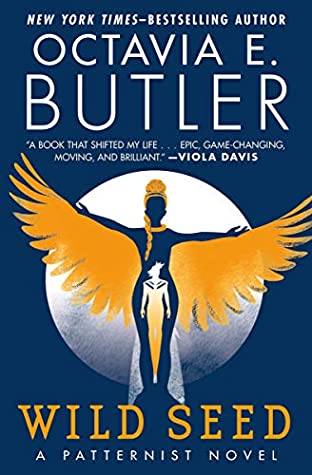
Book Review: Wild Seed by Octavia Butler (Series, #1)
Summary:
Anyanwu is a shapeshifter who is immortal who has so far largely passed without notice. But when Doro, a being who maintains his immortality by stealing others’ bodies, discovers her, everything changes. He considers her to be wild seed for his project of gathering together all humans with special powers to breed them to try to create those who can match him. But is Anyanwu already a match for him? And can they ever produce children who are like them?
Review:
The simplest word to describe this book is unexpected. That’s something that’s difficult to achieve in fantasy about immortality, so I was pleasantly surprised.
This book immediately asks the reader to identify with and understand Anyanwu at least a little bit. Unlike in some other fantasies about immortality, she is already immortal when she meets Doro. So the challenge isn’t does she want to be immortal but rather what is it like to be truly seen by someone else? Doro is somehow more frightening than Anyanwu. The reader thus sides with Anyanwu, even though she is also a little bit scary. Anyanwu also says she goes with him to protect her children from him, an emotion it is easy to understand. Thus, the reader develops an ability to see Anyanwu’s viewpoint. When Anyanwu later does certain things that would have seemed shocking, this ability to see her perspective remains.
It is also interesting to see Doro and Anyanwu’s lives placed against a backdrop of slavery. Anyanwu is African. Doro can take the body of anyone he chooses, but he does state his original human body was in Africa. They are aware of slavery and even pull some seed away from being slaves to live in Doro’s villages instead. Doro breeds people regardless of their race. What he is interested in is their abilities. However, slowly the book comes to ask if this is in a way another form of slavery? Doro says the people view him as a god and that is their relationship, but Anyanwu feels differently. That sets up the reader to ask how free are these people in these villages really?
I was also pleasantly surprised by an appearance of queerness in the later half of the book. Anyanwu makes some interesting discoveries about her shapeshifting that leads to some pregnancies and relationships that are decidedly queer in nature. I was glad the book went there but surprised because so often books about shapeshifting and body inhabiting never do cross the line of gender.
Although this is the first book in a series, I felt it stood strongly on its own yet, simultaneously, propelled me to read more. The immortality angle is what makes it work this way. This is a solid chapter in the lives of Anyanwu and Doro. Yet clearly their story isn’t over, and there are new people who are going to encounter and challenge them. It was fantasy that felt possible and challenging simultaneously. Recommended to fantasy readers looking for a fresh take on immortality.
4 out of 5 stars
Length: 320 pages – average but on the longer side
Source: Library
Buy It (Amazon or Bookshop.org)
Get the Reading Group / Book Club Discussion Guide
A beautifully graphic designed 2 page PDF that contains: 1 icebreaker, 9 discussion questions arranged from least to most challenging, 1 wrap-up question, and 3 read-a-like book suggestions
View a list of all my Discussion Guides.
If you found this review helpful, please consider tipping me on ko-fi, checking out my digital items available in my ko-fi shop, buying one of my publications, or using one of my referral/coupon codes. Thank you for your support!
 Support my work with a tip or browse my shop for curated book club guides, how to guides, cross-stitch patterns, and more!


This work by Amanda Nevius is licensed under a Creative Commons Attribution-Noncommercial-No Derivative Works 3.0 United States License.
 Opinions of a Wolf