
Archive
Book Review: Wanderlust by Elle Everhart

In this romcom that tackles hard topics, Dylan wins a trip around the world, the only catch is she has to go with a man she ghosted months ago.
Summary:
Feeling stuck at work and tired of London’s dreary weather, magazine writer Dylan Coughlan impulsively rings a radio station one day only to win a once-in-a-lifetime trip around the world. The catch? Her travel partner must be a contact randomly selected on her phone. And of course this stressful game of contact roulette lands on a number listed only as Jack the Posho, an uptight, unbearably posh guy she met on a night out and accidentally ghosted.
The two couldn’t be more different, and as the trip kicks off, Jack seems like he’d sooner fling himself into the sun than have a conversation with Dylan. But more is hinging on this trip than the chance to see the world. For the past two years, Dylan’s been relegated to writing quizzes (and only quizzes) at her lifestyle magazine after an article about her past abortion went viral—and not in the good way. If she’s able to make a series about their trip successful, her overbearing boss will give her a chance at a permanent column. Dylan’s willing to do anything to make the series a hit, even if it means embellishing her and Jack’s relationship to satisfy readers. But as the column’s popularity grows, so does the bond between Dylan and Jack, and Dylan is forced to consider if the one thing she thought she always wanted is worth the price she’ll have to pay to get there.
Review:
I picked this up off the library’s new book shelf because the romcom set-up sounded great. I was pleasantly surprised in chapter one to find that Dylan identifies as both queer and bisexual. Yay for more representation! But I actually ended up not liking Dylan particularly much by the end of the book.
Let’s start with the good. I found the romance sweet. It’s a classic grumpy/sunshine and organized/disorganized (Oscar and Felix for us olds out there). I liked how Dylan teased Jack for being posh and how he clearly didn’t mind the teasing. I was intrigued by why Jack was willing to drop everything to go on a trip around the world with someone who ghosted him who he also seemed to not like very much. And I was rooting for Dylan to find success blogging about her trip. The first destination was Australia, and it was definitely written the best. I could really visualize Australia, and I felt like we saw the characters spend an appropriate amount of time there.
In contrast, for a book about a trip around the world, a lot of the locations really breezed by. For example, India was less than a chapter. In South Africa we saw them at a dock. In New York we hear Jack excited about the Empire State Building but then don’t see the characters go there. It was a little bizarre for a book ostensibly about a trip around the world with a magazine writer. It was a let-down after the Australia chapters, especially.
The book deals with a couple of tough topics that might be a turn-off to some readers. Dylan wrote about her own abortion around the time Ireland was looking at its abortion policies. Her piece went viral, and she ended up being cyberbullied and doxxed. These topics aren’t mentioned in passing. They come up repeatedly in the book. Kind of heavy for a romcom. While the blurb I gave you talks about it, the blurb on the back of the print book I got from the library doesn’t mention it at all. It’s clear from looking at reviews that readers would have preferred knowing in advance, and I am glad the blurb was updated accordingly.
To me, Dylan started out likeable enough but became less likeable as the book progressed. The first glimmer I got of this was early on in Australia when Jack is nervous doing an activity, and she’s irritated at him because him looking and seeming anxious (while still doing the activity!) is impinging on her own enjoyment of the activity. This would be like saying your flight is ruined because a person in the seat next to you seems a little nervous during the flight but doesn’t talk about it and causes no issues. She has basically no empathy for Jack and is clearly self-centered. Which was jarring. As the book continues, it becomes increasingly clear that she acts without thinking. Ok sometimes people do that. But when it’s a recurring character trait that impacts other people (and hers does), that’s an issue. Especially for a character who’s almost 30. I also found how she spoke to her mother to be really terrible. She wasn’t trying to have a conversation with her mother (even though her mother was clearly trying to do so). She was giving her a speech without any interest in reconciliation. I don’t personally think her mother messed up enough to warrant that. And I didn’t like seeing it played up as some big empowering scene for Dylan. I thought it was quite sad, actually.
For readers wondering about the spice, this was an odd mix. The vast majority of the book is low spice/slow burn. Then there is one very spicy scene that takes up two chapters. (This scene also managed to make me like Dylan even less, and the score was already pretty low at that point). I found it jarring to go from all of the heat being from like a hand on the low of your back to a detailed spicy scene. I would have preferred a fade out and maybe some post-activities snuggling and pillow talk. It just fits the vibe of the rest of the book better.
Overall, the idea for the set-up for this romcom is stellar. Jack is a great leading man. But he’s set up with a leading lady who’s not particularly likeable, and the romcom is dragged down by some heavy topics.
If you found this review helpful, please consider tipping me on ko-fi, checking out my digital items available in my ko-fi shop, buying one of my publications, using one of my referral/coupon codes, or signing up for my free microfiction monthly newsletter. Thank you for your support!
3 out of 5 stars
Length: 368 pages – average but on the longer side
Source: Library
Buy It (Amazon or Bookshop.org)
Book Review: The Stolen Sisters by Louise Jensen

Summary:
Leah’s perfect marriage isn’t what it seems but the biggest lie of all is that she’s learned to live with what happened all those years ago. Marie drinks a bit too much to help her forget. And Carly has never forgiven herself for not keeping them safe.
Twenty years ago The Sinclair Sisters were taken. But what came after their return was far worse. Can a family ever recover, especially when not everyone is telling the truth…?
Review:
I really enjoyed this twist on the abducted children thriller trope. Instead of being told linearly from the moment of abduction forward, we meet the children as adults. We know they survived, but we also see what emotional and mental health impact being abducted had on them. Chapters alternate among characters and also among timelines . We see both the past and the present, and how they converge together at the 20th anniversary of their abduction.
In a way it may seem this twist removes all suspense – we know the sisters survived the abduction and were returned. But in fact it was still quite a suspenseful read. There’s still a lot of mystery. For example, we at first don’t know who did the abduction or why. We don’t know exactly what happened to the sisters when they were abducted and why that might have led to their current behaviors. And we also don’t know if Leah especially is correct to be anxious about something nefarious happening on the 20th anniversary or if it’s her PTSD and OCD tricking her.
I like how this book goes about exploring that what makes something traumatic isn’t necessarily the exact degree of physical trauma experienced but rather each individual’s own perception of the situation. Trauma is very personal, and what traumatizes some and not others is also personal. We see this very clearly in the sisters who had varying degrees of physical harm during the abduction, and yet their long-term trauma responses differed but not in direct proportion to the traumas they experienced. This is a very trauma-informed read.
The book also explores family and sisters. What makes us call someone a sister, and what makes us call someone family? Who gets to truly be our family and who doesn’t. What impact do those relationships have on us.
In general Leah’s OCD is well represented, although her magical number is a little low at 3. I understand why Leah’s number is 3 but a higher number is more common and obviously a higher magical number is more invasive in day to day life. Leah, for example, feels a compulsion to clean the floor 3 times. Cleaning the floor 10 times for a magical number of 10 is obviously more invasive in daily life. I also personally feel that she puts too much blame on herself for her OCD, and those around her let her. I’m fine with this happening but I’d like for it to be corrected by the end of the book. Instead she continues to blame herself for causing those around her to suffer from her OCD rather than understanding it’s not her fault.
Marie’s addiction is not explored as thoroughly as I would have liked but that’s my own personal preference. What is there is well-done. Carly’s feelings as the oldest who took on a lot of responsibility even at the age of 13 I found well-done.
Overall this is a creative exploration of the abducted children thriller trope that turns it on its head, following them as adults with flashbacks to childhood that still maintains suspense throughout. Recommended to those seeking a thriller more focused on the psychological than physical risks.
4 out of 5 stars
Length: 400 pages – average but on the longer side
Source: NetGalley
Buy It (Amazon or Bookshop.org)
If you found this review helpful, please consider tipping me on ko-fi, checking out my digital items available in my ko-fi shop, buying one of my publications, or using one of my referral/coupon codes. Thank you for your support!
Book Review: The House in the Cerulean Sea by T.J. Klune

Summary:
Linus leads a solitary life with his cat and his records and an ethical commitment to his job as a Case Worker for the Department in Charge of the Magical Youth in the UK. When his long-time commitment to investigating cases precisely according to the book by Extremely Upper Management with a highly classified case, he finds himself Marsyas Island Orphanage. Here six dangerous children reside: a gnome, a sprite, a wyvern, an unidentifiable green blob, a were-Pomeranian, and the Antichrist. Linus must put aside his own fears and decide if they’re likely to bring about the end-times, all while keeping a particularly special eye on their mysterious caretaker, Arthur Parnassus.
Review:
When I picked this up, I expected to read a cheery tongue-in-cheek book about the end times. What I got instead was a cheery book, yes, but one about taking the risks that allow you to actually live your life in a fulfilling way. It inspired me and made me teary-eyed.
Klune simultaneously depicts the soul-crushing horror of working for a bureaucratic organization and makes it funny. This is evident just by the name Extremely Upper Management. It is just so relatable to see Linus working for a government organization that clearly has some nefarious tendencies and, at the very least, creates a terrible work environment, yet that Linus has convinced himself is him doing an ethical job. He clasps to the idea that he is making a good impact on the world, and therefore allows his life to be the horrible and depressing way it is. It takes going to Marsyas Island to snap him out of it.
Just as Linus’s depressing London life is drawn (the depiction of his commute alone is just so on point to a city commute), Maryas Island is depicted to beautifully that even now, weeks after finishing the book, I can send my mind back there for a mini-break. It’s not that it’s perfect, there are, of course, infuriating aspects to small town life (like the ferry) but! Linus can see the sun again. And he can see what can happen when people are encouraged that there is good in them they just need to draw out. My favorite of the children is the gnome, a little girl with a beard who loves her garden and threatens to kill with her shovel anyone who seems like a danger to it. But instead of focusing on the negative (the shovel threatening) Arthur focuses on encouraging her to show people her garden and guide them through what there is to appreciate about it and how to appreciate it respectfully.
I was surprised but thrilled by the blooming attraction between Linus and another adult male at the island (I somehow didn’t know that Klune is a Lambda Literary Award winning author). When I realized that a potential change for Linus might include finding love after 40 as well, I was thrilled. I would be hesitant to call this a romance, because I felt like it was really a book about living your life in a way that is authentic to who you really are and makes you happy, Loving someone who loves you back is part of that for Linus. But it’s not the focus. His life calling is the focus.
I want to encourage readers who might be distressed by Linus’s initial disappointment in his own body size and commitment to dieting that this is not a story where pounds magically fall away on an island and only then can our character find love. No, this set-up is part of making room for Linus to learn to love his body and care about other markers of health (like having a healthy glow).
This is a delightful fantasy about breaking out of your routine to find the life you really want to live. About helping children and adults find the good in themselves and draw it out. About a gay man learning to love his body and finding love in his 40s. It was so beautifully written it left me speechless, and I pre-ordered Klune’s next book. Recommended to those wanting to find inspiration to living a life that brings joy.
5 out of 5 stars
Length: 394 pages – average but on the longer side
Source: Library
Buy It (Amazon or Bookshop.org)
If you found this review helpful, please consider tipping me on ko-fi, checking out my digital items available in my ko-fi shop, buying one of my publications, or using one of my referral/coupon codes. Thank you for your support!
Book Review: Homesick: Why I Live in a Shed by Catrina Davies
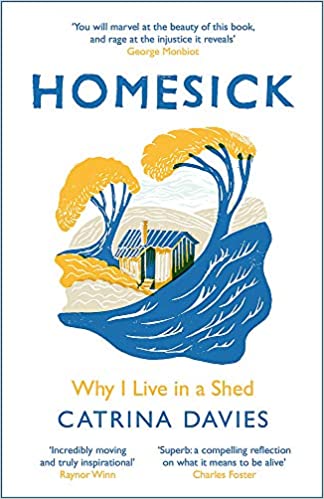
Summary:
Catrina was 31 and very tired of never quite being sure if she could even make the rent on her box-room in a home she shared with four adult roommates (plus one child). With the cost of housing in the UK, she knew the odds were stacked against her to both be able to afford better housing and to have time for her artistic pursuits. So she decided to opt out by taking up residence in her father’s abandoned shed in Cornwall. She doesn’t have a toilet but she does have time to surf, write, and make music. This memoir both chronicles her decision and beginnings in the shed, as well as gives deep consideration to the housing crisis, consumerism, and finding the time to truly live.
Review:
I was immediately intrigued by the name of this book. It’s not why I live in a tiny house. It very explicitly calls it a shed. When I saw this was set in the UK, I was even more intrigued. As an American, my pre-existing understanding was that the UK has a robust system for caring for the poor, thinking specifically of the dole and council housing. It seemed to me that this must have been a choice to live in a shed, and I wanted to know more about this counter-cultural choice. This is indeed a beautiful counter-cultural memoir that surprised me by illuminating how much I didn’t know about the realities of the UK’s housing situation currently.
Catrina artfully weaves in both facts about housing in the UK and her own thoughts on modern culture within the story of her moving to and setting up the shed. (I would call it her first year in the shed, but the author’s note is that she actually condensed several years into one to make it more of a story). For example, while she asks her father for permission to live in his old small business’s shed, we find out that the shed is not zoned for housing, so, while she has the owner’s permission, what she is doing is still technically illegal. I also learned a lot about lords and how much of her area of Cornwall is actually owned by a lord with a castle on an island who will randomly make decisions like to charge for parking when previously people just parked for free to enjoy the ocean. Obviously a lord has no need for this money. I am still jarred by the idea of an actual lord running most of the show in a town. This is just one of the many examples of the inequities that remain in the UK that I had not previously known about.
When not discussing housing, Catrina explores gardening, surfing, making music, and writing. She discusses how living in the shed rent-free enables her to take low-paying jobs that leave her with enough time and energy to enjoy these pursuits. Living in the shed puts her closer to nature, and she becomes a bit obsessed with Walden (as a New Englander, I really wanted to enlighten her about how Walden Pond isn’t all it’s cracked up to be and how many moneyed connections, including in his own family, Thoreau actually had, partially thanks to having graduated from Harvard). While this may seem like a digression, it actually leads me quite smoothly into my main critique of the book, which is that I do wish the author demonstrated a bit more insight into her own privilege. She only can live in the shed because her father bought and paid for it. There is intergenerational assistance and provision here, even if she doesn’t recognize it as such. I’m not saying that it’s the same thing as having a trust fund handed to you, but it’s also not the same thing as her friends who squat in sheds of their own making on public land. Similarly, she, for example, showers at the homes of the people who she gardens for (often with their permission, but not always). She couldn’t take these moments of comfort she loves so much if those people hadn’t bought into the housing game. She may feel she’s opted out of society, but has she really?
Those who enjoy memoir as a way to gain insight into a different type of life than their own will not be disappointed by this book. This book made me think about what I am doing in my life because I want to versus what I am doing just because my culture pointed me here, and I appreciate that. I also enjoyed getting to vicariously surf in Cornwall.
4 out of 5 stars
Length: 256 pages – average but on the shorter side
Source: Purchased
Buy It (Amazon, this book is not available on Bookshop.org)
Get the Reading Group / Book Club Discussion Guide
A beautifully graphic designed 2 page PDF that contains: 1 icebreaker, 9 discussion questions arranged from least to most challenging, 1 wrap-up question, 3 read-a-like book suggestions
View a list of all my Discussion Guides.
If you found this review helpful, please consider tipping me on ko-fi, checking out my digital items available in my ko-fi shop, buying one of my publications, or using one of my referral/coupon codes. Thank you for your support!
Announcement: New Line in Shop: Miffy / Nijntje!
 Hello my lovely readers!
I am incredibly excited to announce the new line in my shop: Miffy / Nijntje!
Miffy is a beloved character from a series of children’s books by Dick Bruna. Her name is Nijntje in Dutch. I discovered Miffy on Netflix one night, and immediately fell in love. She’s such an adorable little bunny, and her stories are wonderful! Their availability in dual-language apps are also helping me on my side-quest to learn Dutch. When I discovered a shocking lack of Miffy cross stitch patterns, I made my own so we could hang a version of her in our living room. I decided to make BOTH the patterns and the completed products available for all Miffy fans to enjoy. The picture on this post is just of my personal favorite design, Miffy’s Garden / De Tuin Van Nijntje. Please click through to my shop to see all five designs!
PS I am now shipping completed items to The Netherlands and the UK in addition to the US! Patterns are available worldwide.
ETA 3/5/15: I have now closed my Etsy shop, but I’ve made my patterns available on my Cross-Stitch page.
Book Review: Addicted by S. A. Archer and S. Ravynheart (Series, #2)
 Summary:
If a human is touched once by a Sidhe, they become addicted….heroin addict level addicted. Since London’s Sidhe died, she now has to periodically put her private investigator for paranormal clientele job aside in order to seek out more Sidhe for a fix. This time, a bunch of young vampires say they know where she can have a changeling teleport her to an enslaved Sidhe….for a price.
Review:
Series of fast-paced novellas are becoming more popular in urban fantasy and paranormal romance. I know I enjoy them as a kind of single-serving of ice cream. Fun and delicious and able to get through in those 40 minutes your bread is in the oven or something. I read the first book in the Touched series, and since I enjoyed it, Archer, one of the authors, was kind enough to send along the next entry in exchange for my honest review. It was still fun, but not quite as well-written as the first.
The world of the paranormal in the UK and Ireland that Archer has created continues to be creative and engaging. While some of her paranormal creatures are typical (such as the vampires) others are more unique, like the changelings and fairies. For instance, having a changeling run the whole come party and suck the blood or touch a Sidhe thing was pretty unique! In other series, that would definitely be the sort of thing run by vampires.
Unfortunately, I didn’t find the characterizations as good this time around. London comes off as a bit flat, as do the vampires around her. Most distressing to me, though, as an American reader is her American character she put in. London meets a guy when doing a job for the changelings. She can tell he is American because, I kid you not, he is wearing a flannel shirt and a cowboy hat. Erm, ok. More annoying though is the fact that this American dude twice says, “shite.” Americans don’t say “shite,” except perhaps for some 20-something hipsters who are trying to be ironic. This 40-something mercenary is definitely not a hipster. He would say “shit.” If you are going to have a character from a country besides your own, you really need to fact-check how they speak, and especially how they swear. He’s not a major character, and I probably would have noticed it less if this was a book and not a novella. He was a lot more noticeable since he was present for most of the novella.
Overall, then, the world is interesting but the characters could use a bit of work. If you’re just looking for some light, quick urban fantasy to brighten up your day, though, it might be worth your 99 cents. Personally, though, I won’t be continuing on with the series.
3.5 out of 5 stars
Source: Kindle copy from author in exchange for my honest review

 (
(Book Review: Wolf Hunt: The Burning Ages by Sebastian P. Breit (series, #1)
 Summary:
It’s the future, and the world is in another semi-cold war between NATO and BRIC (Brazil, Russia, India, China). A NATO group of British, American, and German naval ships is being sent to Brazil on a mission, but part-way there they are all zapped back in time to 1940. With the chance to change history for the better, what will they decide to do?
Review:
I first want to point out that Breit is German and wrote this in English himself; it is not a translation. I have to say that I wonder why he made that choice as the plot certainly seems to have more of a European than an American appeal, but I am impressed at his effort to write in his second language.
The summary of the book makes the plot sound fast-paced, but in fact it is actually distressingly slow-moving. It takes about 1/3 of the book for the all-important time-traveling event to happen. I spent the whole first part of the book just waiting and wondering when it was going to happen, because once the basic politics of the world and character traits were set up, it’s just a waiting game. The naval mumbo-jumbo filling up the rest of the space just wasn’t necessary. This issue carries on throughout the book with half of the sailors spending a solid amount of their time stranded on an island, for instance. Since this is marketed as a fast-paced historical thriller, perhaps somewhat like the style of The Da Vinci Code it quite simply needs to move along faster. Intense naval specifics and codes are not necessary. Fast-moving plot is.
Breit also needs to invest in a British and American editor each, as the British and American characters say and do things that are just flat-out wrong in British and American English respectively. One that really slapped me across the face is that one of the characters is from Boston, but everyone refers to him as a “Bostoner.” People from Boston are called “Bostonians.” I have never once in my life heard anyone say “Bostoner,” and I live in Boston. Another example is at one point one of the Americans reads another American’s birthdate from off an id and says it the European way “11 September 2001,” instead of the American way “September 11th, 2001.” This is one of those instances where the author needs to have his facts straight in order for the story to be believable. Nothing makes me not believe a character is American quite like having him get a bunch of American English wrong.
Additionally, as a woman and an author, the way the female characters are handled is distressing to me. Just one example is that a bunch of the stranded female sailors are attacked on the island by some of the locals in an attempt at rape. These women who had the exact same training as their male counter-parts are apparently completely incapable of saving themselves, but instead have to be rescued by their male comrades. But it gets worse. Later when the captain of the ship is relating the event to another man, he asks if the women were alright. The captain responds by saying that the doctor said they were fine. The doctor. Apparently nobody bothered to ask these women if they were raped (HINT: I’m pretty sure women can tell if they’ve been raped or not). Plus no one seems to care that these women are clearly not going to be emotionally ok after almost getting raped, and not once do any of the female characters who were attacked say anything about it with their own voices. This is just completely inexcusable. It’s a removal of women’s voices from ourselves, and it’s insulting to a female reader.
There’s the issue of European bias expressed through the American characters. For instance, one American character expresses shame at how Americans only speak one language. First of all, the rate of bilingualism in the US is actually rising, so following the arc of the future, there should be more bilingual Americans, not less. Second, I’ve never once heard an American express woe in an all-encompassing way like that by saying something like “It’s so sad Americans aren’t bilingual.” People say, “I wish I was fluent in another language,” or “I wish I was fluent in Japanese,” but they just don’t put it that way. That whole paragraph sounded like a European using an American character as a puppet to say what Europeans think of Americans. Yeesh.
I also have problems with the German characters though. A bunch of them express the desire to stop the Holocaust not to save lives but to save the German people from harboring the shame and guilt for generations to come. Um, what? That’s your concern oh time-traveling Germans? Having been to Germany myself on a student exchange and visited Dachau, etc… I can say that I have a hard time imagining any of the kids my age at the time (15ish in the early 2000’s) focusing in on that as opposed to stopping a bad thing from happening because it’s evil and wrong. I can only imagine that generations even further along would be even more focused in on stopping a genocide as opposed to saving some broad idea of German honor. It’d be like having a time-traveling modern American decide to stop the Trail of Tears to save us from shame as opposed to doing it to save innocent Cherokees. The whole thought just makes my brain hurt.
To sum up, Breit shows ability as a writer that needs to be worked on and honed. I’d recommend either getting a good editor who can handle both British and American English or switching to writing in German. He also needs to work on tightening up his plot. Normally I’d say, nice first effort keep trying, but due to the opinions and biases and presentation of women present in this first attempt, I’m afraid I can’t say that. It’s readable, but why would you want to read it anyway?
2 out of 5 stars
Source: Ebook from author in exchange for my honest review

Movie Review: Shaun of the Dead (2004)
 Summary:
Shaun is a 20-something loser with a dead-end job and a girlfriend who he only ever takes out to the local pub. She dumps him on the eve of a zombie outbreak. Shaun drags his job-less roommate through the streets, battling zombies in an attempt to save his mother and restore his relationship with Liz.
Review:
I couldn’t watch this movie and not compare it to Zombieland, which I watched last summer. I honestly think that anyone wanting to compare US culture to UK culture should just watch these two films. Shaun of the Dead takes an everyman who wants desperately to save people, but his only weapon is a cricket bat (btw, those things look like such a pussy weapon). Shaun stumbles about the city with his line of relatives, friends, and frenemies, and they all make witty asides to each other while maintaining some sense of propriety when battling the zombies. It’s wonderfully funny to watch, but not a point of view I, as an American, would imagine at all for a zombie apocalypse. My pov lines up much more with Zombieland where the characters swipe trucks and double-tap the zombies with guns. However, that’s what made Shaun of the Dead such a delightful watch, because it was a character study on top of the fun zombie scenes. There were some jokes that fell flat for me, and I wasn’t too keen on the ending, but I know some people will enjoy the ending for precisely the reasons I disliked it. However, Shaun of the Dead was still a delightful watch, and I recommend it to anyone who enjoys humorous apocalypse or zombie tales.
4 out of 5 stars
Source: Netflix

 Support my work with a tip or browse my shop for curated book club guides, how to guides, cross-stitch patterns, and more!


This work by Amanda Nevius is licensed under a Creative Commons Attribution-Noncommercial-No Derivative Works 3.0 United States License.
 Opinions of a Wolf