
Archive
Rereading the Chronicles of Narnia as a Progressive, Queer Christian Adult – Books 1 & 2

What does The Chronicles of Narnia look like through the eyes of a queer, progressive Christian rereading the series as an adult?
Summary:
The Lion, the Witch, and the Wardrobe – Four children sent to the countryside to escape the bombing of London of WWII open a door in their host’s home and enter Narnia. In the land beyond the wardrobe, the children meet the White Witch, discover the Magic, and meet Aslan, the Great Lion, for themselves. In the blink of an eye, their lives are changed forever.
Prince Caspian – Narnia . . . where animals talk . . . where trees walk . . . where a battle is about to begin.
A prince denied his rightful throne gathers an army in a desperate attempt to rid his land of a false king. But in the end, it is a battle of honor between two men alone that will decide the fate of an entire world.
Review:
This post kicks off a new kind of review for me—a reread series. I was raised in a fundamentalist Christian household, but through a long and winding journey, I’ve found my spiritual home in progressive Christianity, which affirms queer folks like me and focuses on social justice. Over the years, people from all backgrounds have asked me what I think of Narnia. I’ve been surprised by how widely beloved it is—even among children who weren’t raised in Christian environments.
My strongest early memory of Narnia comes from Jesus Camp, where it was one of the few books counselors were allowed to read to us. I remember sitting around the fire, half-listening to something about a silver chair. At the time, I didn’t connect with the stories. I often reject things that feel forced on me, and Narnia was everywhere. Maybe I also felt misled—there’s a hint of World War II at the beginning, which is one of my special interests, but the story quickly shifts to an icy kingdom ruled by a talking lion. Later, I heard critiques of how C.S. Lewis portrayed female characters and wondered if I had sensed that as a child, too.
This year, I decided to revisit the series through audiobooks. I’m reading in publication order, rather than chronological. I want to experience the books as readers did when they first came out—and hear Lewis’s voice as it developed over time.
Before I go further, I want to be clear: I don’t dislike all of Lewis’s work. I loved The Screwtape Letters—I’m a sucker for a good epistolary story—and I found Mere Christianity thoughtful and compelling during my faith journey. So this isn’t a hit piece. It’s an honest reflection on how these stories read to me now, as an adult queer woman of faith.
So what stood out to me in The Lion, the Witch, and the Wardrobe?
I can absolutely see the appeal. The idea of a secret world just through the wardrobe—a place full of talking animals that needs a savior—is enchanting. The allegory of Aslan’s sacrifice on the stone table, often critiqued by secular readers as too jarring and confusing, struck me as a strong, nuanced theological metaphor. It makes sense within Christian theology, and Lewis presents it with clarity.
But I now also understand why I didn’t enjoy these books as a child: the representation of gender roles. The female characters feel flat and constrained. Susan comes off as petty and unlikable. Lucy, while kind, is so passive that her forgiveness becomes a personality trait. The girls aren’t allowed to fight because “that’s not what girls do,” as the narrator—not a character—tells us. That omniscient narration gives the sexism an unchallenged authority. The White Witch is the only powerful female character, and of course, she’s the villain. Her assertiveness and autonomy are equated with evil.
As a progressive Christian who attends a church led by a woman pastor, I find this particularly disheartening. From the very beginning, Jesus uplifted women—Mary Magdalene, Martha, the Samaritan woman. Early church leaders like Lydia and Phoebe helped shape the faith. But those stories often get overshadowed by patriarchal interpretations. I see that dynamic echoed in Narnia.
Another theme that troubled me is the normalization of violence—especially how it’s gendered. Peter is praised for killing a wolf. Boys are encouraged to wield swords and lead armies. Meanwhile, Jesus rebuked Peter for cutting off a soldier’s ear and modeled nonviolence, even in moments of great personal risk. Paul and Silas stayed in a prison after an earthquake freed them, sparing the jailer’s life. Their faith led them to protect others, not conquer them.
In Prince Caspian, the battles escalate. The girls observe from a distance. And we learn that the children’s prior reign left Narnia in ruins, with many of the original inhabitants dead or scattered. The colonial undertones are hard to ignore. The children are outsiders who arrive, rule, and leave—upending the local ecosystem and political structure in the process. Even as a fantasy, it raises hard questions about heroism and power.
As a child, I didn’t like being told what girls couldn’t do. As an adult, I feel equally uneasy watching kind-hearted Peter be shaped into a glorified conqueror. The lens Lewis offers here reflects more about the cultural assumptions of his time—especially about gender and empire—than it does the radical love and subversive power of the Gospel.
That said, I’m curious to keep going. I remember The Silver Chair more vividly than the others, and I’m interested to see how it holds up. I’m not reading these books expecting them to reflect my beliefs. But I am reading them with both a theological imagination and a desire to understand the appeal of these stories. Perhaps we can craft new, long-lasting fables for our youth full of the values of equality and social justice.
If you found this review helpful, please consider tipping me on ko-fi, checking out my digital items in my ko-fi shop, buying one of my publications, using one of my referral or coupon codes, signing up for my free microfiction monthly newsletter, or tuning into my podcast. Thank you for your support!
3 out of 5 stars (The Lion)
3 out of 5 stars (Caspian)
Length: The Lion: 180 pages – average but on the shorter side; Caspian: 240 pages – average but on the shorter side
Source: Library
Buy It (The Lion: Amazon or Bookshop.org; Caspian: Amazon or Bookshop.org)
Book Review: She Who Knows by Nnedi Okorafor
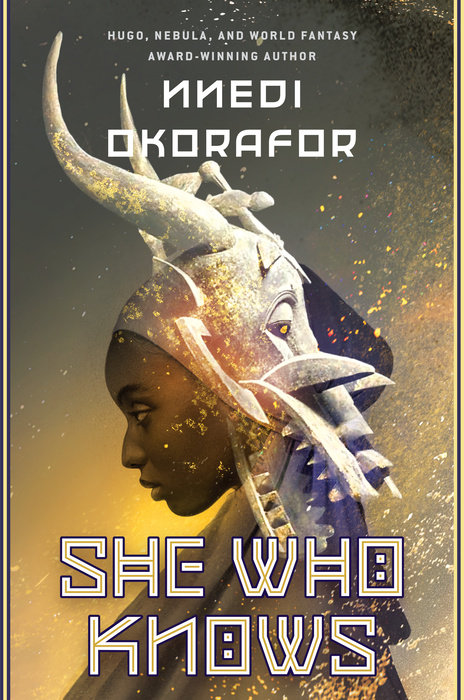
Blending science fiction and fantasy in a near future West African setting, this engaging prequel offers a compelling plot blended with a unique coming-of-age story in a quick read.
Summary:
Najeeba knows.
She has had The Call. But how can a 13-year-old girl have the Call? Only men and boys experience the annual call to the Salt Roads. What’s just happened to Najeeba has never happened in the history of her village. But it’s not a terrible thing, just strange. So when she leaves with her father and brothers to mine salt at the Dead Lake, there’s neither fanfare nor protest. For Najeeba, it’s a dream come true: travel by camel, open skies, and a chance to see a spectacular place she’s only heard about. However, there must have been something to the rule, because Najeeba’s presence on the road changes everything and her family will never be the same.
Review:
This short, powerful book packs quite a punch with its quickly established setting, a main character you can easily root for, and action scenes that will leave you breathless.
This is a perfect example of science fantasy (also called space fantasy), blending elements of both science fiction and fantasy seamlessly. The science fiction aspect is revealed through its post-apocalyptic future—something happened to reset the world. Paper books are rare and kept in a community building, and the salt fields that Najeeba’s people harvest from were created by a drying up of the water. The fantasy elements feel just as integrated, from the “Call” that Najeeba’s people receive when it’s time to go to the salt, to the supernatural powers some individuals can access. (For another science fantasy read, check out my retelling of Thumbelina set on Venus.)
Though part of a prequel series to Nnedi Okorafor’s Who Fears Death, you don’t need to have read that to enjoy this one. I hadn’t read it either, and I never felt lost or like I was missing crucial context. The initial conflict—Najeeba’s desire to do something that’s typically only for boys—is easy to grasp, and the world-building is subtle and effective. By the time the more unique and fantastical elements come into play, I was fully immersed in the world.
Set in a future version of West Africa, this features Black protagonists, with other characters who are Arab. While some of the abilities that develop in the story could be read as an allegory for developing a disability, none are explicitly represented.
The plot kept me hooked, and while I was satisfied with the ending, I found myself eager to explore more of this world. I’m excited to pick up the next book in the series when it’s available.
Overall, this is a quick, engaging read that brings science fantasy to a West African future setting. It’s a refreshing take on the near-future genre, offering a new perspective that I look forward to exploring further.
If you found this review helpful, please consider tipping me on ko-fi, checking out my digital items available in my ko-fi shop, buying one of my publications, using one of my referral/coupon codes, or signing up for my free microfiction monthly newsletter. Thank you for your support!
4 out of 5 stars
Length: 161 pages – average but on the shorter side
Source: Library
Buy It (Amazon or Bookshop.org)
Book Review: Wildwood Chronicles Trilogy by Colin Meloy

When crows steal Prue’s little brother, she and her friend Curtis find that the Impassable Wilderness bordering Portland, Oregon, isn’t quite so Impassable after all.
Summary:
Prue and her friend Curtis uncover a secret world in the midst of violent upheaval—a world full of warring creatures, peaceable mystics, and powerful figures with the darkest intentions. And what begins as a rescue mission becomes something much greater as the two friends find themselves entwined in a struggle for the very freedom of this wilderness. A wilderness the locals call Wildwood.
Review:
A middle grade fantasy trilogy by the lead singer of my favorite band, The Decemberists. Gorgeously illustrated by his wife, Carson Ellis. If you’ve ever read The Chronicles of Narnia, this is like that except replace the Christianity with environmentalism and new age spirituality.
My favorite part of this trilogy was the various talking birds. All the animals in the Impassable Wilderness can talk, but Meloy’s love of birds really comes through. (As a fan of his songs, this didn’t surprise me at all.) The dapper outfits all the animals wear are also just too cute. It’s a trilogy with maps, and I do always love a good map to go with a story. I appreciate very much that the hero of the story is a girl with Curtis playing the sidekick.
There are really two enemies in the plot. A civil war style conflict inside the Impassable Wilderness, and the looming threat of capitalism from outside the Impassable Wilderness. I liked the idea of the latter more than the former, but the execution felt a bit too silly to me. For example, the big bad capitalists are all named the Titans of Industry (capitalized like that). One of them uses child labor in the form of orphans collected directly from Portland. It felt quite Victorian for something where the rest of the world outside of the Impassable Wilderness is quite modern.
The books are incredibly long, hitting chunkster length even for adult books. Each is over 500 pages (the last clocking in at 580.) I certainly read some long books when I was a kid, so I don’t begrudge them that per se. I do think it’s a tough sell when even the first book is super long. Regardless, I don’t think that the length is justified by the plot. While the first book is just about paced right, the latter two are not. There’s a lot of pages spent on not a lot going on. The middle book especially suffers horribly from middle book syndrome.
I liked the world, the Impassable Wilderness residents, and the illustrations. I felt the plot lacked depth, and the pacing was too slow for my taste, especially for such long books. I also found the ending to be a let-down.
Overall, this could be a good match for a reader who has a hankering for a through a secret door fantasy. Especially for the reader who loves talking animals and doesn’t mind a slower pace.
If you found this review helpful, please consider tipping me on ko-fi, checking out my digital items available in my ko-fi shop, buying one of my publications, using one of my referral/coupon codes, or signing up for my free microfiction monthly newsletter. Thank you for your support!
3 out of 5 stars
Books in Series:
Wildwood, 4 stars, length 541 pages – chunkster
Under Wildwood, 3 stars, length 559 pages – chunkster
Wildwood Imperium, 3 stars, length 580 pages – chunkster
Source: Gift
Buy It (Amazon or Bookshop.org)
Book Review: Rouge by Mona Awad

When Belle’s semi-estranged mother dies falling off a cliff in California, she comes from Montreal for the funeral and soon finds herself sucked into the same “spa” her mother was frequenting before her death.
Summary:
For as long as she can remember, Belle has been insidiously obsessed with her skin and skincare videos. When her estranged mother Noelle mysteriously dies, Belle finds herself back in Southern California, dealing with her mother’s considerable debts and grappling with lingering questions about her death. The stakes escalate when a strange woman in red appears at the funeral, offering a tantalizing clue about her mother’s demise, followed by a cryptic video about a transformative spa experience. With the help of a pair of red shoes, Belle is lured into the barbed embrace of La Maison de Méduse, the same lavish, culty spa to which her mother was devoted. There, Belle discovers the frightening secret behind her (and her mother’s) obsession with the mirror—and the great shimmering depths (and demons) that lurk on the other side of the glass.
Review:
Imagine a woman gets pulled into the world of Eyes Wide Shut, only there’s a lot less clarity about what exactly is going on.
The first 10% of the book and the last 25% had me very interested. The middle felt a little repetitive and slow. On the plus side, this book put me to sleep so easily. I can’t remember the last time I fell asleep so quickly when reading. Maybe not a huge positive to say about a horror book, but something about the language and the setting lulled me right to sleep. I only started to be able to make progress when I began to skim. I think the lengthy descriptions of the skin care routine just wasn’t particularly interesting to me as someone who simply doesn’t do skincare.
The main character is half Egyptian, half white. Her Egyptian father died so she lives with her white mother. A lot of the book is about the conflicts that arise for her as a woman of color with a white mother. I liked how the book illuminated the mistakes Belle’s mother made as a white woman raising an Egyptian daughter while also showing how she still loved her daughter and was trying. It’s a delicate balance to strike, and it was well done. She is also bisexual. This is established by her dating two siblings, which wasn’t my favorite way of revealing that. It’s a little too close to the bisexual as cheater trope.
What exactly was going on at the spa and how it ties back to Belle’s childhood remains a little confusing to me, even after reading the ending. I think I understand it. But I suppose what confuses me the most (minor spoiler) is how this society could target people from the other side of the continent many years in advance, and what made them target those specific people. That was a bit fuzzy to me. (Read more about what others thought about the confusing bits here. Be warned – there’s a lot of spoilers in that link!) I also agree with others who say the romance subplot wasn’t needed. I would have been quite happy with full focus on Belle and her mother.
I really enjoyed the way the sentences were put together, even if I thought the story overall could have been tightened. The story itself is interesting, although definitely drawing inspiration from others that I felt were creepier and with a more straight-forward big bad.
Recommended to those willing to dive into scenes of a character’s skin-care routine and atmospherically vague reveals that let you choose what you think happened. I am certain these readers are out there, and I hope they find this book. It feels almost like a love letter to that audience.
If you found this review helpful, please consider tipping me on ko-fi, checking out my digital items available in my ko-fi shop, buying one of my publications, using one of my referral/coupon codes, or signing up for my free microfiction monthly newsletter. Thank you for your support!
3 out of 5 stars
Length: 384 pages – average but on the longer side
Source: Library
Buy It (Amazon or Bookshop.org)
Book Review: The Witch’s Lens by Luanne G. Smith
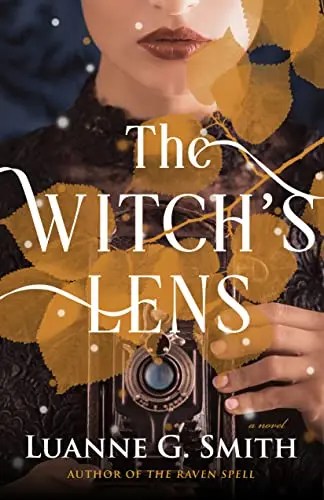
A witch finds herself recruited to WWI’s eastern front to fight a scourge of zombies.
Summary:
With her husband off fighting at World War I’s eastern front, Petra Kurková embraces her fleeting freedom, roaming the city at night with her camera. A born witch, she’s discovered that she can capture the souls of the dead on film. Her supernatural skills don’t go unnoticed by the enigmatic Josef Svoboda. He’s recruiting a team of sorcerers to infiltrate the front lines, where the bloodshed of combat has resurrected foul creatures. Petra’s unique abilities will be needed against the most dangerous enemies of all—those ever present, undead, and unseen.
Deep in the cursed Carpathian Mountains, the ragtag team meets with an emissary of an ancient organization founded to maintain balance between worlds. Photographing the escalating horrors is beyond anything Petra imagined. So are the secrets among her fellow witches. But Petra can’t turn back. Not before she discovers her husband’s fate and the myriad ways her magic is manifesting. To defeat an occult foe, Petra must release the power she’s been concealing for so long, or risk damning a war-torn world to ashes.
Review:
I came into this book expecting a lot of WWI with a dash of witches but it ended up being the other way around.
If it wasn’t for the book’s blurb mentioning WWI and one passing mention of the Archduke’s assassination, it would be possible to read this book and think the entire war was a fantasy. This becomes increasingly so as the book progresses. Perhaps I missed something but at first it sounds like the humans are fighting and unaware of any supernatural folks participating in the war pushing it one way or the other. Then later it seems like everyone knows about witches. So which is it?
The book starts slowly, showing Petra living on her own, lonely and bored, going out at night to take photos since she’s discovered the dead show up in them. I was intrigued by this and wondering why Petra can only see the dead in her photos, but the why is never revealed. The camera is useful to the plot but not in the way you would imagine from what we know it can do.
The zombies in the book are the fast type. (See more zombie recommendations from me.) They can move at superhuman speeds. An interesting unique take is that zombies can continue to exist among the living until they’re called upon by another power to act like a zombie. They’re basically Trojan horses among the soldiers.
There is some light romance in the book. Personally, it didn’t work for me because we see Petra starting to long for a man who isn’t her husband. That’s just not a plot point I personally enjoy. The romance is hinted at in the book. There is not even a kiss. I suspect it will get stronger in the sequel. Those who want to read for the romance should know this is a very slow burn.
If we ignore the confusing aspects of whether or not everyone in the world knows about the witches, the plot does escalate in a way that mostly make sense and things come to a head with quite a bit of action. But there is an element of “the chosen one,” which I find dull. Especially in a book about WWI. I wanted to see everyone coming together with unique strengths. Not one overpowered person.
Overall, this book wasn’t a match for me. I wanted a lot more WWI than was in it. Recommended to those interested in a witch’s war with a dash of light, slow-burn romance.
If you found this review helpful, please consider tipping me on ko-fi, checking out my digital items available in my ko-fi shop, buying one of my publications, using one of my referral/coupon codes, or signing up for my free microfiction monthly newsletter. Thank you for your support!
3 out of 5 stars
Length: 255 pages – average but on the shorter side
Source: Library
Buy It (Amazon or Bookshop.org)
Book Review: The Ballad of Black Tom by Victor LaValle

Tommy is a hustler just taking care of himself and his dad in 1920s Harlem when an old white man invites him to play at his private shindig in his home.
Summary:
Charles Thomas Tester hustles to put food on the table, keep the roof over his father’s head, from Harlem to Flushing Meadows to Red Hook. He knows what magic a suit can cast, the invisibility a guitar case can provide, and the curse written on his skin that attracts the eye of wealthy white folks and their cops. But when he delivers an occult tome to a reclusive sorceress in the heart of Queens, Tom opens a door to a deeper realm of magic, and earns the attention of things best left sleeping.
A storm that might swallow the world is building in Brooklyn. Will Black Tom live to see it break?
Review:
The Lovecraft universe is a fascinating example of an author creating a world that then becomes the playground for a lot of other people’s imaginations. Legally! Beyond a story being technically set in a Lovecraft universe with Lovecraft characters, though, there’s an entire genre of speculative horror that sprung out of it called cosmic horror. Think Eldritch Gods. Secret societies. Tentacles.
I love cosmic horror. (I even have published a cosmic horror short story.) The thing is, though, most cosmic horror fans have a complex relationship with the genre because of Lovecraft’s blatant racism and xenophobia. So a lot of modern authors, fans of the universe itself but not the person, are writing their own cosmic horror stories that turn Lovecraft’s racism and xenophobia on its head. Enter The Ballad of Black Tom.
The author of this novella is a Black man who decided to take one of Lovecraft’s most xenophobic short stories (“The Horror at Red Hook“) and reapproach it from the perspective of a minor secondary character – Black Tom. Tommy lives in 1920s Harlem with a dad who’s a talented musician while he himself is not. He is, however, able to convince white folks outside of Harlem that he’s a talented musician and so he goes there to hustle them. He also has a variety of other side hustles including procuring magical items for people.
The first thing that struck me about this book was how it put a minoritized Lovecraft character front and center. I also noticed how Tommy doesn’t go by the name “Black Tom.” That comes later and, even when it does, Tommy is claiming the name from a place of power.
Part of the terror that Lovecraft’s characters often feel is that of potentially losing their place of privilege. Tommy is living in a blatantly racist society where he can’t even take a train too far out of his neighborhood without someone questioning or harassing him. Instead, what he has to lose is his community in Harlem. Something it takes him a while to figure out. Some of what tears that away from him is the cosmic horror. But some of that is the day-to-day horror of being Black man in 1920s Harlem. (Warning for police brutality in this book).
This novella hits all the notes a reader might want in a cosmic horror – existential dread, elder gods, a little blood, cult rituals. But it does it without the cringe-inducing racist asides. I found it easier to empathize with Tommy than I had with a main character in a cosmic horror in a while. Of course he wants the elder gods to come tear things up. Of course he does. What I wasn’t expecting was the note of…what have I done?…at the end or that I would agree with that too.
I will say, I didn’t enjoy was when the perspective shifted to that of the police officer. I would have preferred remaining in Tommy’s perspective throughout. There was also a hint that a song Tommy’s dad taught him would come back up in a meaningful way, and it didn’t. Perhaps I missed it.
Overall, this is a wonderful entry into the Lovecraft universe that gives voice to a character Lovecraft had maligned, written from an own voices perspective.
If you found this review helpful, please consider tipping me on ko-fi, checking out my digital items available in my ko-fi shop, buying one of my publications, using one of my referral/coupon codes, or signing up for my free microfiction monthly newsletter. Thank you for your support!
4 out of 5 stars
Length: 149 pages – novella
Source: Library
Buy It (Amazon or Bookshop.org)
Get the Book Club Discussion Guide
A beautifully graphic designed 2 page PDF that contains: 1 icebreaker, 9 discussion questions arranged from least to most challenging, 1 wrap-up question, and 3 read-a-like book suggestions
View a list of all my Book Club Guides.
Book Review: Death Valley by Melissa Broder

A woman dealing (or not dealing) with her husband’s and father’s medical conditions arrives in the desert to research her newest novel and has a fantastical experience.
Summary:
A woman arrives alone at a Best Western seeking respite from an emptiness that plagues her. She has fled to the California high desert to escape a cloud of sorrow—for both her father in the ICU and a husband whose illness is worsening. What the motel provides, however, is not peace but a path, thanks to a receptionist who recommends a nearby hike.
Out on the sun-scorched trail, the woman encounters a towering cactus whose size and shape mean it should not exist in California. Yet the cactus is there, with a gash through its side that beckons like a familiar door. So she enters it. What awaits her inside this mystical succulent sets her on a journey at once desolate and rich, hilarious and poignant.
Review:
I didn’t expect this to be a book that kept me up late at night because I needed to know how the plot resolved. I have not personally tended to experience much forward momentum in magical realism. But this was such a perfect mix of adventure plot and emotional magical realism that I simply couldn’t stop reading.
I love a cactus. This is a fact I don’t usually admit to because they’re so popular in design nowadays, and I’d rather support an underdog.
location 206
The main character was easy to bond with initially, which is critical to a plot that relies on the reader believing her experiences in the desert – even when they become fantastical. She’s a bisexual woman in long-term recovery from drugs and alcohol. She’s trying to finish her novel. Her husband has had a mysterious chronic illness for several years, and her father has been in the hospital for a long time after a car accident. The hospital keeps telling them that he’s dying, and then he wakes up and improves (only to have something else go wrong.) It’s a lot for anyone to handle. She has a dry wit that we hear inside her head but that rarely makes it outside. We can see how she’s barely keeping it together, and yet she continues to try because of how much she loves her loved ones.
Since my husband got sick, my words don’t mean what they are supposed to mean.
location 289
It’s interesting what a beautiful depiction of a marriage this book is when so little in it features the spouses together. Yet through the main character we see how her marriage and loving her husband, as she would say, isn’t just a feeling. It’s a choice. Perhaps some people would find it gauche to have a whole book focusing in on the impact of a chronic illness on the spouse who doesn’t have it. But that’s the rub of a marriage. What happens to one person is happening to both.
The setting of the book is also gorgeous. I’m not sure I’d have appreciate it as much as I did if I had never been to the desert. The beauty and danger and overwhelmingness of the desert is all encapsulated so beautifully from the coolness of her room in the Best Western to the magical cactus and everything in between. (Plus there’s both desert bunnies and multiple types of cactus from saguaro to teddy-bear cholla.)
If I was reading a review of this book, my main question would be – ok, ok, but how about the magical realism? Does it work? Yes, it works really well. By the time I finished the book, I couldn’t imagine the main character’s arc happening any other way. It makes sense in the context of that trip and that world, and that’s all that really matters. I wasn’t questioning it. I was on board from the first magical moment partway into the book.
Overall, this is an engaging story of one woman’s trip into the desert intertwined with her inner journey of continuing to choose to love her husband every day. It’s beautiful representation of the complexities of in sickness and in health. Recommended to readers interested in that journey with an open mind to magical realism.
If you found this review helpful, please consider tipping me on ko-fi, checking out my digital items available in my ko-fi shop, buying one of my publications, using one of my referral/coupon codes, or signing up for my free microfiction monthly newsletter. Thank you for your support!
5 out of 5 stars
Length: 240 pages – average but on the shorter side
Source: NetGalley
Buy It (Amazon or Bookshop.org)
Book Review: In the Lives of Puppets by T.J. Klune
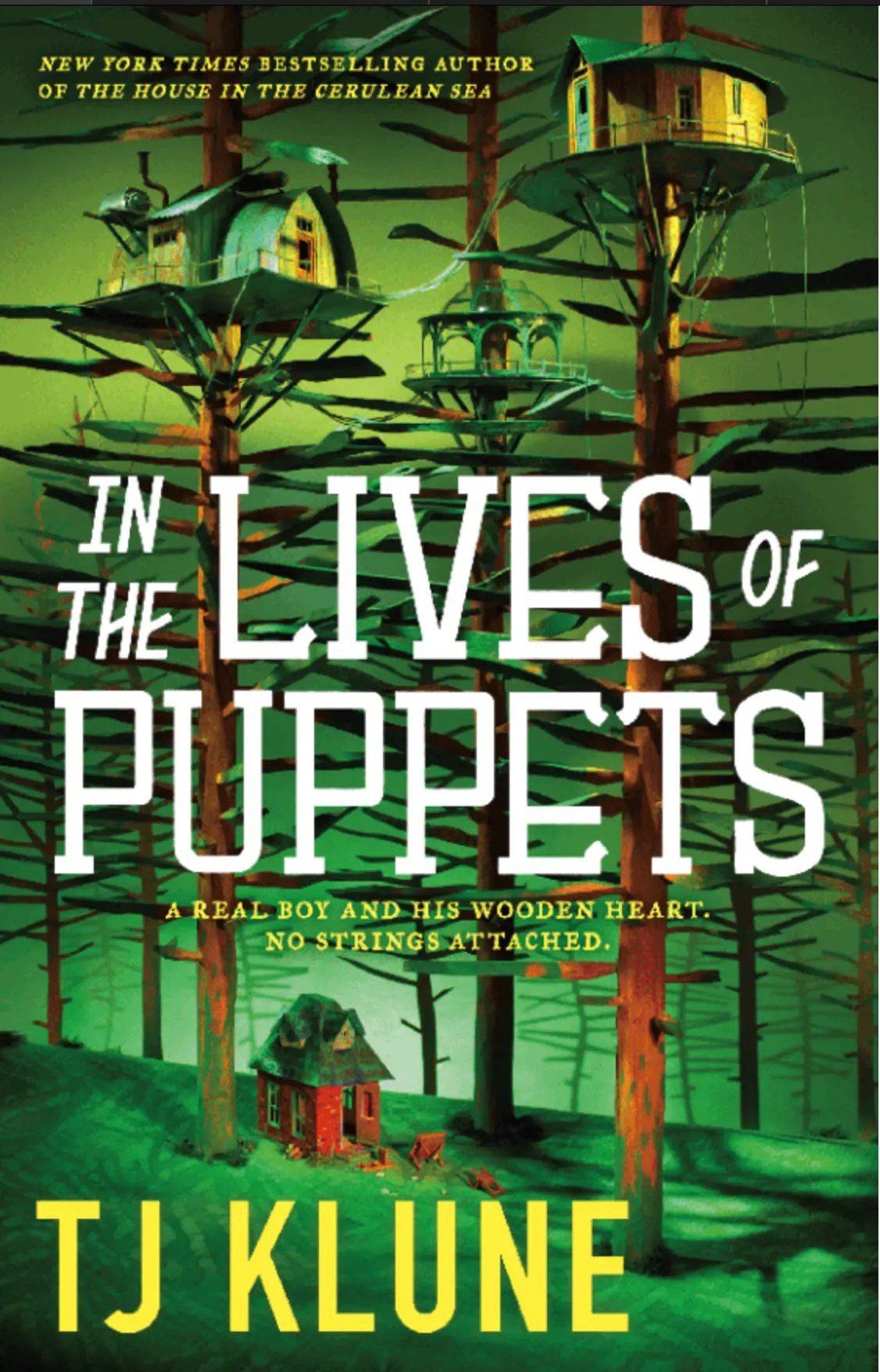
A science fantasy reimagining of Pinocchio where Pinocchio is a “real boy” surrounded by robots (puppets) with a m/m (or, rather, male, male robot) romance added in.
Summary:
In a strange little home built into the branches of a grove of trees, live three robots–fatherly inventor android Giovanni Lawson, a pleasantly sadistic nurse machine, and a small vacuum desperate for love and attention. Victor Lawson, a human, lives there too. They’re a family, hidden and safe.
The day Vic salvages and repairs an unfamiliar android labelled “HAP,” he learns of a shared dark past between Hap and Gio-a past spent hunting humans.
When Hap unwittingly alerts robots from Gio’s former life to their whereabouts, the family is no longer hidden and safe. Gio is captured and taken back to his old laboratory in the City of Electric Dreams. So together, the rest of Vic’s assembled family must journey across an unforgiving and otherworldly country to rescue Gio from decommission, or worse, reprogramming.
Along the way to save Gio, amid conflicted feelings of betrayal and affection for Hap, Vic must decide for himself: Can he accept love with strings attached?
Review:
This is a loving and detailed send-up to Pinocchio. I hadn’t seen the movie in years, and it still stirred up memories for me. When I went to look up the original book version’s plot to compare to this retelling, I found even more details I hadn’t realized or remembered. It’s obvious the author loves Pinocchio, and if you do too, I’m expecting you’ll likely love this retelling. For me, the problem is, I was so excited about a new T.J. Klune book that I sort of…forgot I don’t like Pinocchio. (“Don’t like” is a gentle remembrance. In fact, the movie absolutely terrified me as a child.) Even so, I found myself able to appreciate this loving rendition of the story.
I absolutely adored the character of Rambo – the tiny robot vacuum who’s clearly supposed to be a later generation of roombas. As always, I liked the narrative style the author uses – it reads as sing-songy in my head and feels like someone telling me a fairy tale, which is perfect for this book. I liked the wide variety of robots inhabiting the world, and I really enjoyed the robot substitute for the traveling circus character. I also appreciated that this isn’t an exact retelling of Pinocchio. The story is sometimes restrained, with simple allusions to the original. For example, Victor is never turned into a donkey, but he does stay the night in a hotel like room that is decorated with donkeys at about the right point in the story.
I appreciated the flipping of Pinocchio (Victor in this telling) as being human with his father being a “puppet” (a robot). But I felt like the ending really lets that inversion down, not taking it to its full and complete conclusion. I think there’s supposed to be humor in this book, but it wasn’t funny to me. You will know within the first few chapters if it’s tickling your funny bone or not.
I also found myself unable to root for anyone in this book, save for the small, innocent Rambo. Everyone else has something so wrong with them that it soured me to like them. The one I can talk about without spoilers, as the episode happens in the first chapter, is Nurse Ratched. She is a robot companion of Victor’s who was designed to nurse humans. She’s described as sociopathic, in a way that I think is supposed to read as comedic. As in, she acts like she enjoys inflicting pain but doesn’t really. Yet in the first chapter she chases down a squirrel (off-screen) and kills it by rolling over it again and again. I almost stopped reading the book, I was so horrified. But it was an advanced copy, so I decided to give it another chance. She never does anything like this ever again, but it is actually not uncommon for characters in this book to have something they have done in the past that is truly horrific that is brushed off as their programming. I’m all for plots where characters have to overcome their own tendency toward being bad, and redemption and forgiveness are both very important. But I need for that not to be the plot for almost every single character. It, at the very least, is distressing to read about.
The romance did not move me, which was surprising given what strong feelings I had for the couple in The House in the Cerulean Sea! I also have complicated feelings about how the book depicts what freedom means, how robots pursue freedom, the offerings of the “freedom fighter” character, etc… This, in fact, is a reflection of how I feel the overarching messages tended to get muddled. The only message that I felt was clear and consistent was “be brave!” but no clear reason as to why was ever given. To borrow from an American fairy tale – the overarching story needed a heart. I think, perhaps, the romance was supposed to be the heart, but it didn’t work as one for me.
This is also an incredibly sad book. It’s not uplifting in the slightest. There’s nothing wrong with sad books, but it is a departure from the author’s other books, and so I think the warning is warranted.
Overall, this is an imaginative and loving retelling of Pinocchio that should appeal to fans of that fairy tale. Readers should be aware that the darkness of the original story remains in this retelling.
If you found this review helpful, please consider tipping me on ko-fi, checking out my digital items available in my ko-fi shop, buying one of my publications, or using one of my referral/coupon codes. Thank you for your support!
3 out of 5 stars
Length: 432 pages – average but on the longer side
Source: NetGalley
Buy It (Amazon or Bookshop.org)
Publication Announcement: Space Fantasy: “Legends as Told by the Laborers of the Forest Solar System Logging Corp. – An Oral History Project”

I am thrilled to announce the publication of my space fantasy short story in Crow & Cross Keys literary journal.
This literary journal is 100% free, so please give it a click and a perusal!
Here’s a blurb about my piece.
Oral history interview with an anonymous retired logger (Interviewee #15) for the Forest Solar System Logging Corp. Interview conducted by Tess Dalgleish on stardate 99938 on Planet Minnesota. Topic of the interview is the legend of Paul Bunyan. This version includes Babe the Big Blue Ox.
Please be sure to check out my Publications Page for my other work.
Publication Announcement: Novelette – Bloemetje: a speculative retelling of Hans Christian Andersen’s Thumbelina fairy tale

I am thrilled to announce the publication of my new novelette Bloemetje: a speculative retelling of Hans Christian Andersen’s Thumbelina fairy tale!!!
One miniature girl leads her human and fairy people to decolonize Venus in this speculative, queer-inclusive reimagining of Thumbelina.
A Dutch company known as The Bedrijf commences colonizing Venus via the construction of a dome filled with plants that convert its natural air into something breathable by humans. Since all workers are granted permission to bear a child, a woman and her spouse join the crew. But the woman soon discovers she is plagued with infertility. When her spouse illegally brings home a tulip from the garden, they discover a miniature baby inside who they name Bloemetje – little bloom. As the baby grows in mere days into a teenager, pushing her boundaries, she illuminates the true horrors of colonization and leads them all on a journey to decolonize.
This retelling takes the original Thumbelina’s focus on marriage and flips it on its head, granting the miniature girl a strong voice of her own and questioning her removal from the fairy world. Exploring themes of childlessness, adoption, being childfree by choice, colonization, decolonization, negative impacts of capitalism, and what LGBTQIA+ inclusive societies can look like, this novelette comes in 17 bite-sized episodes perfect for reading in the small snippets of time available to modern individuals and families.
Early readers called this “transporting” and “intriguing.” The “journey is beautiful,” and the ending is “deeply satisfying.” “A great escape read that also made me think, and it’s both quick and engrossing.”
*A portion of proceeds will be donated to the Massachusetts Center for Native American Awareness, a Native American-led 501(c)(3) nonprofit.
The ebook is available for pre-order now and will be delivered on May 18th. If you want to sneak in a little earlier, you can order the paperback or hardcover versions and get them delivered at your usual Amazon shipping speed.
If you would like to read a sneak peek of the first episode (chapter), sign up for my newsletter. I will be sending that sneak peek out on Monday, May 15th.
Pre-orders really matter for books, so please do consider pre-ordering if you know you want to purchase a copy. I also sincerely appreciate you passing the link on to anyone you know who might be interested in the book. Word of mouth is vital for indie authors.
Thank you for your support!
 Support my work with a tip or browse my shop for curated book club guides, how to guides, cross-stitch patterns, and more!


This work by Amanda Nevius is licensed under a Creative Commons Attribution-Noncommercial-No Derivative Works 3.0 United States License.
 Opinions of a Wolf