
Archive
Book Review: She and Her Cat by Makoto Shinkai and Naruki Nagakawa
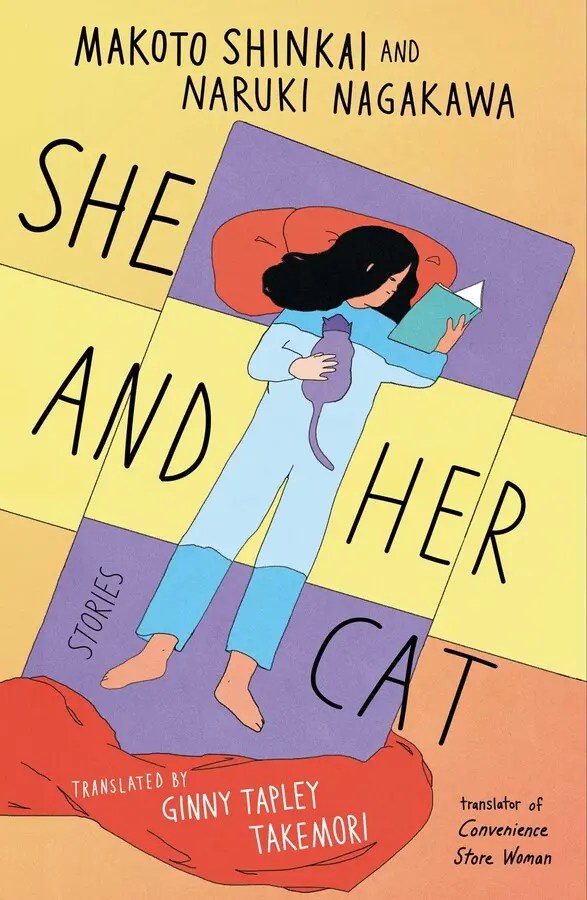
Interconnected short stories explore the relationships between women and their cats in a Japanese city.
Summary:
Lying alone on the edge of the sidewalk in an abandoned cardboard box, a nameless narrator contemplates the indifferent world around him. With his mother long gone, his only company is the sound of the nearby train. Just as he fears that the end is near, a young woman peers down at him, this fateful encounter changing their lives forever.
So begins the first story in She and Her Cat, a collection of four interrelated, stream-of-conscious short stories in which four women and their feline companions explore the frailty of life, the pain of isolation, and the limits of communication.
With clever narration alternating between the cats and their owners, She and Her Cat offers a unique and sly commentary on human foibles and our desire for connection.
Review:
When I saw this collection of interconnected short stories about women and their cats, I couldn’t hit the request button fast enough. One of my favorite short story collections is James Herriott’s Cat Stories. I’m always on the lookout for something similar. This delivered in more ways than I was anticipating. I didn’t realize the stories would be interconnected, and that really adds something to the collection as a whole. Makoto Shinkai is a well-known animator and filmmaker. His most recent anime is Suzume no Tojimari but this book was actually originally an anime short in 1999 as well.
The stories alternate between a human and a cat perspective. Whether it’s a human or a cat is indicated by the section break. If it’s a human, it’s a usual decorative scene break. If it’s a cat, it’s the silhouette of a cat. The first story opens from the perspective of a cat who is the runt of a litter in a cardboard box listening to the sound of a train. The cat is clearly about to die but then a woman’s face appears and takes him in. He becomes an indoor/outdoor cat. I won’t spoil the trajectory of the whole story, but where the interconnectedness comes in is that this cat (Chobi) meets a young cat while outside who shows him a woman who feeds her fish when she shows up in her yard. The next story is then this cat’s perspective. And so all of the stories have these connections between the cats, but also slowly the humans come to be connected, largely thanks to their cats.
The stories offer subtle but insightful commentary both into universal aspects of human nature and into more specific aspects of Japanese culture that impacts these women’s lives. I’m not an expert by any means on Japan, but I do know, for example, that there’s a problem with toxic work cultures where people stay at the office overnight and don’t come home. This is one of the issues addressed in the stories. The animals also offer commentary on human nature and bigger life questions (like what happens after we die). it reminded me a little of animal fables in that it was the animals offering these lessons to each other, wanting to help humans, and yet the humans couldn’t understand them.
Where the stories really shine, though, is in showing the relationship between, as the book says, she and her cat. The unconditional love of the cats for their owners is heart-wrenching and left me near tears. This line in particular shone to me. It’s from the perspective of a cat with an owner who is struggling with loneliness.
I couldn’t do anything about her problems. I just lived my days at her side.
loc 443
There were two things that held me back from five stars. First, sometimes I did get confused about who was speaking. This is because in some stories it’s not just the owner who is a human perspective. So it’s not a straightforward swap back and forth between the cat and her owner – sometimes there were other humans in there too. Second, one male cat calls his owner his girlfriend and that gave me the heebie-jeebies. Perhaps that was a translation issue, though.
Overall, this is a delightful collection of short stories that is sure to please any cat lover. With full page illustrations throughout, it would make a great gift.
If you found this review helpful, please consider tipping me on ko-fi, checking out my digital items available in my ko-fi shop, buying one of my publications, or using one of my referral/coupon codes. Thank you for your support!
4 out of 5 stars
Length: 144 pages – novella
Source: NetGalley
Buy It (Amazon or Bookshop.org)
Book Review: Buffalo Is the New Buffalo by Chelsea Vowel

Summary:
Inspired by classic and contemporary speculative fiction, this collection of eight short stories explores science fiction tropes through a Metis lens: Nanites babble to babies in Cree, virtual reality teaches transformation, foxes take human form and wreak havoc on hearts, buffalo roam free, and beings grapple with the thorny problem of healing from colonialism.
Review:
This collection contains nine short stories by Indigenous (Métis) author Chelsea Vowel. The Métis are a recognized Indigenous people with a unique culture descended from the pairings of Indigenous with European fur traders (usually, but not always, First Nations women with French men). Most of the stories are set in the same region of Canada, and all of the stories are speculative, containing some fantastical element, whether they are set in the past, present, or future.
The author is queer, and queerness is clearly present in five of the nine stories. These include: a historical woman figure who identifies as a woman, is interested in women, and dresses in male clothing; a woman character who becomes interested in a fox presenting as a woman; a woman character who is in lockdown without her girlfriend who ended up trapped in another town after she went to visit her family; a queer poly family raising a child together in a collective; and a nonbinary femme-presenting character who uses Métis gender-neutral pronouns.
My favorite story of the collection is “Maggie-Sue.” This is the story where an Indigenous woman becomes interested in a beautiful Cree woman she sees but realizes is actually a fox disguised as a woman (this is revealed very early on, so not a spoiler). I loved everything about the fox woman, the mystical adventure the main character goes on, and the ending was a delight to imagine. I also really appreciated the play on words in the title (which I won’t reveal, because it’s more fun for you to realize it when you’re reading it yourself). I thought this story also offered solid critique on the difficulties of being a survivor of ongoing colonization on your ancestral lands, without that criticism ever feeling like telling instead of showing or like academic language sneaking in where a character wouldn’t use it.
The latter is my main complaint for the story I liked least – “Unsettled.” There is a scene where five characters, none of whom are established as academics, sit around having a highly academic conversation for many pages. The story felt more like an academic thought experiment than a story with unique characters and perspectives. I also struggled a little bit with the first story in the book, “Buffalo Bird.” its pacing was slow, which is a challenge for me. I think I would have liked it more further into the collection. I personally need to kind of “know” a writer to trust that a story will ultimately go into an interesting place if it has a slow start.
Something else interesting about this collection is that it has footnotes throughout, where the author explains things or gives historical context. I enjoyed these and felt they added to the stories. They’re not used all the time, sometimes you as the reader do need to figure things out from context for yourself if you’re not Métis (which I, to be clear, am not). But I thought the footnotes struck a nice balance.
The other thing is after each story there’s a short reflection from the author about the story. On the one hand, I liked these because I learned more from them. As an author myself, also, it was interesting to hear from the author on what her goals were and compare them to my actual experience as the reader. On the other hand, I could see some readers not enjoying this aspect of the book, wanting to be left with their own experience with the story and leave it at that. But you can always skip over these essays if you prefer not to have the inside story.
Related to the essays, I do also want to note one additional thing. I do think that an author’s beliefs and politics tend to make it into their writing, whether they intend that or not. I’m not saying every character reflects the author’s worldview, absolutely not, but the more you read an individual author’s work, the more you come to see how they likely see the world. This is even more clear in this collection where each story is paired with a nonfiction reflective essay by the author. The author is an academic Indigenous queer woman, and definitely leans very left. I’m not saying this is a good or a bad thing. But I do think it shows through more clearly in some stories than others, and is very present in the essays. Only you, the potential reader, can know if this would be a plus, negative, or neutral for you.
Overall, this is an interesting collection of speculative short stories from a queer Indigenous woman author. I’m glad I took the time to read them and see a different way of storytelling and views on the world within the speculative framework I personally enjoy.
Please note, I calculate a rating for a short story collection by individually rating each story then reporting out the average. This came out to 3.7, so I rounded up to 4.
If you found this review helpful, please consider tipping me on ko-fi, checking out my digital items available in my ko-fi shop, buying one of my publications, or using one of my referral/coupon codes. Thank you for your support!
4 out of 5 stars
Length: 272 pages – average but on the shorter side
Source: Library
Buy It (Amazon or Bookshop.org)
Book Review: Nightmare at 20,000 Feet – Horror Stories by Richard Matheson

Summary:
Remember that monster on the wing of the airplane? William Shatner saw it on The Twilight Zone and Bart Simpson saw it too. “Nightmare at 20,000 Feet” is just one of many classic horror stories by Richard Matheson that have insinuated themselves into our collective imagination.
Here are more than twenty of Matheson’s most memorable tales of fear and paranoia. Personally selected by Richard Matheson, the bestselling author of I Am Legend and What Dreams May Come, these and many other stories, more than demonstrate why he is rightfully regarded as one of the finest and most influential horror writers of our generation.
Review:
I picked this up because I remembered enjoying I Am Legend (although my review is only 3 stars, when I looked it up just now…) I also had familiarity with The Twilight Zone episode based on the first story in the collection. I individually rated each of the twenty stories then calculated the average to give the collection a rating.
I rated two stories 5 stars. “Mad House” (made me make shocked and thrilled faces) and “First Anniversary” (I called it timeless in my notes). The former is a very meta commentary on being a writer. The latter reminded me of Buffy in that who you’ve fallen in love with changes, only in this case it was the woman changing instead of the man.
There were quite a few stories that I found moderately engaging and enjoyed their historic vibe. Like “Disappearing Act,” whose whole idea is it’s someone’s personal notebook left in a cafe. Or “Crickets” whose idea is what if crickets’ chirps are really a form of Morse code?
But there are also two stories where, just, the entire structure idea is racist. One “The Children of Noah” involves the idea that a town’s inhabitants are all the descendants of a sea captain and his Pacific Islander bride. The racist part is that they’re dangerous BECAUSE of being part Pacific Islander. The story “Prey” is about a “Zuni” doll that’s inhabited by the spirit of a great warrior. The whole idea made me cringe. One story, “The Distributor” confused me so much that I’m still not sure what the overall point was. A character who I think is a bad guy uses the the n word and another racial slur, but it’s a little unclear to me if he was meant to be a bad guy.
There are also definitely outdated gender ideas here. The least offensive is that it’s oh so scary for teenage girls to wage war as witches in “Witch War.” The worst is “The Likeness of Julie.” Most of the story is from the perspective of a college undergrad male rapist. That’s bad enough. If you want to know how it manages to get worse, check out the spoiler paragraph below in brackets.
[The twist ending is that the college woman he rapes, Julie, in fact got inside his mind supernaturally and made him rape her. It’s the worst victim blaming I’ve seen in forever, and I honestly wanted to scrub my own brain out with soap. I’m suspicious that Matheson knew on some level how awful this story was, because the collection notes that he published it under the pseudonym of Logan Swanson in Alone by Night, which appears to have been some sort of anthology.]
So, there we have it. Some stories manage to be timeless. But definitely not all. Come into this collection prepared for a mixed bag.
If you found this review helpful, please consider tipping me on ko-fi, checking out my digital items available in my ko-fi shop, buying one of my publications, or using one of my referral/coupon codes. Thank you for your support!
4 out of 5 stars
Length: 336 pages – average but on the longer side
Source: Purchased
Buy It (Amazon or Bookshop.org)
Book Review: The Rest of the Robots by Isaac Asimov

Summary:
A collection of 8 of Isaac Asimov’s classic robot short stories, divided into three sections: The Coming of the Robots, The Laws of Robotics, and Susan Calvin.
Review:
I often struggle to read short stories. For me, they often are just a bit too short for me to get fully invested into the world they’re set in, so they oddly drag in spite of being short. But this collection really worked for me, and I think that’s because the world was already fully established in my mind. It was just then a matter of what would happen with this particular iteration of a robot and the humans around it.
The world that pre-existed in my mind already was Asimov’s Three Laws of Robotics (this explains them, if you’re not already familiar with them). Well, that combined with a world that had managed to make robots and engages in space exploration.
The book starts with an early generation robot who goes missing in a rural area and ends up at the behest of a rural man. This one made me laugh out loud, and not in a way that I think takes advantage of anyone. The second short story in this section looks at what happens when robots are sent in advance to a hostile alien planet. What I enjoyed about both of these is how the robots are so pure and so honest and how that throws everyone around them.
I thought the second section was the least engaging, but keep in mind I loved the collection so that’s barely a criticism. There’s a short story that’s very Cold War inspired about spies and robots. Then there’s also one that’s a human telling a tall tale about a robot breaking one of the laws. It’s left up to the reader to decide if it’s true.
The third section all feature the robopsychologist Susan Calvin. To me, it’s clear Susan is somewhere on the Autism spectrum, and I loved her. It did bother me a bit how everyone else in the stories describes Susan as cold and seems to question her femininity because they perceive her as lacking warmth and mothering qualities. But I also think this is a bit of a commentary – is Susan really like this or do others just perceive of her that way? I also really like how well she relates to the robots. She’s not a main character in each of the stories, but she does play a pivotal role in all of them. My favorite was “Galley Slave,” which is about a robot being brought into academia to do some ho-hum labor. Asimov was a professor of biochemistry, and the realness of the problems with academia are clear in the hilarious scifi and robot flavored commentary on that institution.
Overall, I really enjoyed these short stories. They’re a great example of how strong clear, rapid worldbuilding combined with characters formed quickly in broad strokes can make short stories work very well.
5 out of 5 stars
Length: 224 pages – average but on the shorter side
Source: Gift
Buy It (Amazon, not available on Bookshop.org)
If you found this review helpful, please consider tipping me on ko-fi, checking out my digital items available in my ko-fi shop, buying one of my publications, or using one of my referral/coupon codes. Thank you for your support!
Book Review: Dinosaur Tales by Ray Bradbury
 Summary:
Dinosaur Tales is a Magnificent Collection of Famous Tales by RAY BRADBURY, One of America’s Best-Loved and Best-Selling Authors. In This Elegantly Designed and Illustrated Book, Bradbury Presents All of His Dinosaur Stories in One Volume! “I have an idea that Bradbury’s work would have given Edgar Allan Poe a peculiar satisfaction to have written them himself.” -Somerset Maugham
Review:
Ray Bradbury clearly loves dinosaurs. This collection of short stories just about dinosaurs was obviously a labor of love. The introduction to the book where Bradbury discusses at length his deep love of dinosaurs and complete disbelief that anyone could possibly not love them is one of the best parts of the book and totally sets the tone. Heck, I love dinosaurs myself but even I found his tone infectious and sent my own love soaring higher than I thought possible.
The collection consists of 5 short stories and a poem. The short stories range from a little boy who wants to be a dinosaur when he grows up to a time-traveling business that obviously goes awry to a lonely sea monster who mistakes a lighthouse for a friend. They alternate between hilarity and bitter-sweet, all touched with pure Americana. In news that surprises no one, the poem was my least favorite but I didn’t hate it (and that’s strong praise for a poem). All of the stories (and poem) are lovingly illustrated by a team of illustrators, with each one receiving its own unique style. It’s definitely a book that I think is well worth owning in print, and it’s taken up residence on my shelf as a reminder that I don’t always dislike short stories. They’ve just gotta be the right ones.
Recommended to dinosaur fans, and to quote Bradbury, who doesn’t love dinosaurs?
If you found this review helpful, please consider tipping me on ko-fi, checking out my digital items available in my ko-fi shop, buying one of my publications, or using one of my referral/coupon codes. Thank you for your support!
4 out of 5 stars
Length: 146 pages – novella
Source: Gift
Book Review: Bits of Bliss – Volume 1 by Andrea Trask (Series, #1)
 Summary:
A collection of nine erotica short stories, mostly featuring elements of fantasy. Covering everything from fairy tale retellings to vampires to a bit of scifi.
Review:
This erotica short story collection was quite hit or miss for me. The stories that excelled were creative and unique, but the stories that did not featured some problematic elements that prevented me from enjoying the erotica.
When I read a short story collection, I always individually rate the stories. My rating of the collection as a whole is just the average of those ratings. The highest rating any story in this collection received from me was four stars. There were three stories I gave four stars, and two of them were the first two stories in the collection, so it definitely started out strong for me. One is a F/F story featuring a woman who is also a flower (or a flower who is also a woman). It is poetic and heart-quickening. The second story features a sentient house that has missed its owner and demands attention. This made me laugh, and I enjoyed the oddity. It read like a lighter-hearted, erotica version of dark fantasies where there is an evil house–this one is just horny. The third four star read was enjoyable for a different reason. It’s a scifi erotica where two lovers are in a spaceship that is running out of air. They decide to make love, even though they will die quicker. It was so heart-breaking and beautiful that I wished it was a whole book.
Four of the stories received three stars. In each case I felt the story either didn’t take an idea far enough or the story wasn’t long enough to tell the story. Take it farther, and these all could be just as good as the first three I discussed.
Unfortunately, there were two stories that were big clunkers for me, with each receiving only one star, and they both had almost the same problem. “Hunting Hound” has a woman mating with a werewolf. She meets him when she is out riding, and they start making out against a tree, with her a willing participant. Then this happens.
“Stop” she said, and his face darted in toward her own with a low growl. “Too late to stop.” (loc 1650)
He proceeds to penetrate her. There is nothing sexy about a woman asking a man to stop and him claiming it’s too late and proceeding to rape her. It is never too late to stop, and it’s never too late for a partner to change their mind. It really bothers me that this type of scene is still being presented as sexy. I know everyone gets off to their own thing, but this is such a clear scene of consent being removed and then ignored that I just cannot say to each their own in this case. I also want to mention that the book blurb claims that this story features “consensual sexual violence” but it definitely did not read that way to me.
“Summer Nights,” which also received one star, has a similar problem. This story features a woman who keeps seeing the same mysterious man at parties. She goes out to the woods behind the house at one of these parties, and he follows her. She finds out he’s a vampire. She stands in the woods talking to him, holding a wineglass, when this happens:
“he struck like a train, his swinging backhand sending the wineglass flying toward the treeline, and I faintly registered the tinkling shatter of it, perhaps hitting a rock, or a fallen log.” (loc 5654)
She finds the fact that he just hit a glass out of her hand to be massively sexy and proceeds to bang him. This is, again, something I feel like I shouldn’t need to say, but there is nothing sexy about a partner violently hitting something out of your hand. Nothing. Sexy. This is not a sign that oh man she should totally bang this vampire. It is a sign she should run because she is alone in the woods with a violent motherfucker. This could have so easily been foreplay if, instead of hitting a glass out of her hand, he said something like, “I want you now,” and he gently took the glass from her hand and tossed it away. Or if she said, “I want you so much,” and tossed the glass over her shoulder. It would be so easy to have the same erotica about a powerful vampire alone in the woods with a woman without it turning into problematic territory.
I truly wish these last two stories were not in the collection. The rest of the collection is creative, features some fun queer content (the F/F story and a gender-swapping story), and in the case of the best three stories, has some unique ideas. Where the collection flounders is, interestingly enough, with the two most mainstream stories that take the agency out of the hands of the women in them and instead retreats to the tired idea of violent men being sexy.
Overall, if a reader is looking for some quick fantasy erotica, most of the stories in this book will satisfy this need, although I would recommend skipping over “Hunting Hound” and “Summer Nights.” The reader who enjoys the other stories for their uniqueness will most likely be disappointed by the “sexy violence” in these two.
If you found this review helpful, please consider tipping me on ko-fi, checking out my digital items available in my ko-fi shop, buying one of my publications, or using one of my referral/coupon codes. Thank you for your support!
3 out of 5 stars
Length: 53 pages – novella
Source: Kindle copy from author in exchange for my honest review

Book Review: A Banquet for Hungry Ghosts by Ying Chang Compestine (Bottom of TBR Pile Challenge)
 Summary:
According to Chinese tradition, those who die hungry or wrongfully come back to haunt the living. Compestine presents here eight different ghost stories, each correlated along with a course in a banquet and richly steeped in Chinese culture and history.
Review:
I picked this up because I had previously read Compestine’s book Revolution Is Not a Dinner Party
The eight short stories are organized into appetizers, main courses, and desserts. The titles are for the food being served that course, such as “Tea Eggs” or “Long-life Noodles.” The food mentioned in the title also appears somewhere in the story as a key part of the plot. It’s a gorgeous way to organize the short stories and makes them also feel like diverse parts of a whole.
The short stories are mostly set in 20th century China, but a couple feature 20th century characters investigating something from the more distant past or being haunted by more ancient ghosts. One story is set in New York City and features a Chinese-American family.
The stories, universally, quickly establish the setting and characters. They all subtly teach some aspect of Chinese culture or history. For instance, one story looks at medicine under Communism in China, while another features preying mantis fights. At the end of each story, a brief blurb gives further details about two to three aspects of Chinese culture or history featured in the story. Most surprising, and incredibly welcome, at the end of each short story, Compestine gives a recipe for the featured food! It reminded me of how cozy mysteries often feature patterns or recipes at the end of the book, only this time the recipes are found in a shorty story horror collection. Brilliant!
What about the horror aspect of the short stories? I found them simultaneously plausible and sufficiently scary. I was a bit on the edge of my seat without being scared out of my wits, which is exactly what I was looking for.
Overall, I immensely enjoyed each of these short stories, from the touch of horror to the settings to the amount I learned about Chinese culture and history to the wonderful recipes. Highly recommended to anyone with even a moderate interest in China, Chinese culture, or Chinese food. Even if horror isn’t usually your genre, give these ghosts a chance. You’ll be glad you did.
If you found this review helpful, please consider tipping me on ko-fi, checking out my digital items available in my ko-fi shop, buying one of my publications, or using one of my referral/coupon codes. Thank you for your support!
5 out of 5 stars
Length: 192 pages – average but on the shorter side
Source: Better World Books

Counts For:

Book Review: I, Robot by Isaac Asimov (Series, #0.1) (Bottom of TBR Pile Challenge)
 Summary:
This collection of short stories tells the history of the invention and gradual improvement of robots. The robots in this future must follow the 3 Laws of Robotics:
- A robot may not injure a human being or, through inaction, allow a human being to come to harm.
- A robot must obey the orders given to it by human beings, except where such orders would conflict with the First Law.
- A robot must protect its own existence as long as such protection does not conflict with the First or Second Law.
But following these laws doesn’t always have quite the outcome the inventors and managers of robots intended.
Review:
I wasn’t aware I, Robot

One thing I like about the world Asimov sets up is that unlike many scifi books featuring AI, the people in Asimov’s world are highly, intensely cautious of robots. They’re very concerned about robots taking jobs, killing humans, and even robbing humans of their autonomy. It sets up a conflict from the beginning and frankly presents the humans as just a bit more intelligent than in some AI scifi universes.
I was under the impression from pop culture that in I, Robot they think they’re protected by the Laws of Robotics but something happens so that the robots aren’t programmed with them any longer. That’s not what happens at all. What happens is much more complex. How the robots interpret the Laws and how the Laws work end up being much more complex and less straight-forward than the humans originally imagined, so much so that they have to have a robopsychologist to help them interpret what’s going on with the robots. This is really quite brilliant and is one of my favorite aspects of the book.
Unfortunately, the book can read a bit sexist sometimes, in spite of having a female protagonist through quite a bit of the book. (The robopsychologist is a woman). The book was first published in 1950, though, so when you think about the time period, the sexism is pretty minor, especially compared to having a female worldwide expert on robopsychology. The main time sexism comes up is when the leader of Europe is a woman and says some self-deprecating things about difficulty leading because she’s a woman. Yes, there is older scifi that avoids sexism pretty much entirely, but I am able to give this instance a bit of a pass considering the other strong portrayal of a woman in a leadership role. But be aware that at least one cringe-inducing sexist conversation does occur.
Overall, this piece of classic scifi stands the test of time extraordinarily well. Its film adaptations do not do it proper service at all. Come to this book expecting a collection of short stories exploring robopsychology, not an action flick about killer robots. Recommended to scifi fans.
4 out of 5 stars
Source: Harvard Books
Book Review: Mulliner Nights by P.G. Wodehouse (Series, #3) (Bottom of the TBR Pile Challenge)
 Summary:
Mr. Mulliner has a wide variety of eclectic relatives, and he’s more than happy to tell snippets of their life stories over a pint at the local pub. From a freewheeling artist brought into line by a judgmental cat to a timid fellow who accidentally subscribes to a correspondence course on how to get a backbone to a private detective with such a disturbing smile that criminals readily confess their hijinks keep the patrons of Angler’s Rest in stitches.
Review:
This made it onto my tbr pile thanks to a visit to Harvard Books’ used books and remainders cellar. This was in the remainders pile, and three things drew me to it. 1) It was under $5, 2) The cover has a cat drunk on whiskey on it, 3) I had just read Love Among the Chickens
Don’t worry about this being the third in a series. The only connection among the short stories is the main characters are all a Mulliner (or married to one). It was completely unnecessary to have read the first two books in the series to get into this collection, although I intend now to read all of the Mulliner books. I really appreciated how Wodehouse sets up a structure to hold his short story collection together in one unit. Although they are all self-contained tales, their being together in one collection actually makes sense. They have more in common than just the author. They are literally a family of stories. This helped it hold my interest in a way that many short story collections can’t.
This collection consists of 9 short stories, most of which have some sort of love element. One person wants to be with (or marry) another and must overcome some sort of obstacle (usually caused by British upper-class culture) in order to be with them. Hilarity ensues. My favorite of these was “The Story of Webster,” the cover’s drunk cat. In this a freewheeling artist has his religious uncle drop his cat off with him while he goes on assignment to Africa. The judgmental, sullen cat soon starts to reign in the young artist, much to his and his girlfriend’s chagrin. Everything about this, from the early 20th century fashion and dialogue to the witty commentary on cats and culture works perfectly, particularly for this cat-lover. The story that I thought worked least-well, and unfortunately wraps up the book, is “Gala Night.” A pastor Mulliner accidentally helps a young couple who enjoys dancing to acquire the young woman’s parents’ approval of their union. I didn’t like the religious Mulliner. He just wasn’t funny to me. Similarly the catalyst of a mysterious mood enhancing drink just lacked the creativity found in the other stories. Fortunately, most of the stories fell much closer to the hilarity of the whiskey drinking cat. However, a couple did fall a bit flat for me, which is why while I greatly enjoyed the book, I wouldn’t say I was totally in love with it.
Overall, this is a wonderfully witty collection of short stories held together by an elderly Mulliner who enjoys telling (possibly tall) tales about his family over a pint in the local pub. If you enjoy a dry wit and slapstick humor to top off a cute love story, this collection is for you.
4 out of 5 stars
Source: Harvard Books

Previous Books in Series:
Meet Mr. Mulliner
Mr. Mulliner Speaking



 Support my work with a tip or browse my shop for curated book club guides, how to guides, cross-stitch patterns, and more!


This work by Amanda Nevius is licensed under a Creative Commons Attribution-Noncommercial-No Derivative Works 3.0 United States License.
 Opinions of a Wolf