
Archive
Book Review: The Shining by Stephen King (Series, #1) (Audiobook narrated by Campbell Scott)
 Summary:
Jack Torrance, a writer and schoolteacher, almost let his temper and alcoholism destroy himself and his family. But he’s joined AA and is determined to get his life, family, and career back on track. When he hears through a friend about a hotel in rural Colorado need of a winter caretaker, it seems like the perfect solution. Spend time in seclusion working on his new play and provide for his family simultaneously. But what Jack doesn’t know is that The Overlook Hotel has a sinister past, and his son, Danny, has a shine. Psychic abilities that make him very attractive to the sinister forces of the hotel.
Review:
The new release of Doctor Sleep

The characterization is the strongest here that I’ve seen in the King books I’ve read so far. All the characters are three-dimensional, but the Torrance family in particular are well-explored. Jack and Wendy (his wife) read so much like real people, because while both make some horrible mistakes, neither are truly bad. Neither had a good childhood or much help to overcome it, and both want so badly to have a good family and a good life but no clear idea on how to do so. Danny, a five-year-old, is handled well as well. He speaks appropriately for his age, not too advanced or childish. The use of a third person narrator helps the reader get to know Danny and his psychic abilities at a deeper level than his five-year-old vocabulary would otherwise allow for. This level of character development is true to a certain extent for the rest of the characters as well and is handled with true finesse.
The plot starts out strong and frightening on a true-to-life visceral level. The Torrance home life is not good, and that’s putting it lightly. Wendy feels she has nowhere to be but with her husband, due to her only relative being her abusive mother. Jack is terrified of turning into his father, who abused his wife and children, and yet he has broken Danny’s arm while drunk. And in the midst of this is Danny, a child with special needs. This was where I was the most engrossed in the story. Before the hotel is even a real factor.
The Overlook is the supernatural element of the story that is supposed to kick it up a notch into horror territory. It is never made entirely clear exactly what is up with the hotel but we do know: 1) there is a sinister force at work here 2) that sinister force is out to have people kill others or commit suicide and join their haunting party 3) for some reason, people with a shine are more attractive to this sinister force as someone to have on board 4) the sinister force extorts whatever weaknesses are present in the people in the hotel to get what it wants. So the sinister force very much wants Danny to be dead, as well as his father and mother, although they are sort of more like side dishes to the whole thing. The sinister force figures out the family dynamics and extorts them by kicking Jack’s anger and Wendy’s mistrust up a notch. It also gets Danny to wander off where he’s not supposed to go. But things don’t really get going until the sinister force possesses Jack. I get why this might freak some people out. The sinister force gets the people to do something they normally would never do. However, personally I found the parts where Jack’s own real shortcomings cause him to do something sinister, like breaking Danny’s arm, to be so much more frightening. Jack’s regret over his actions and fear of himself are much more frightening because what if you did something like that? Whereas a sinister force is easier to distance oneself from mentally. It’s gory and thrilling but it’s not terror-inducing evil. Perhaps if the things Jack does at the hotel were just things inside himself that the hotel allows to come out, it would still be truly terrorizing. But it is clearly established in the book that the sinister things Jack does in the hotel are due to his being possessed by the hotel. They are not him. This removes a certain amount of the terror from the book.
The audiobook narrator, Campbell Scott, did a good job bringing a unique voice to each character. His pacing and reading of the book was spot-on. However, the production quality of the reading didn’t match his acting. The entire recording was too quiet. I had to crank my headphones up all the way, and I still had trouble hearing the book when walking around the city, which is not normally a problem for me. In contrast, whenever Jack yells, it blew out my eardrums. Some better sound balance was definitely needed.
Overall, this is a thrilling read that begins with a terrifying focus on overcoming flaws and bad dynamics from the family you were raised in then switches to a less frightening focus on a sinister force within a hotel. It thus ends up being a thrilling read but not a terror-inducing one. Those seeking a thrilling tale with well-rounded main characters being threatened by the supernatural in the form of ghosts and/or possession will certainly enjoy it. Those who are less frightened by the supernatural might enjoy it less. I recommend picking up the print or ebook over the audiobook, due to sound quality.
4 out of 5 stars
Source: Audible
Book Review: Deeper than the Dead by Tami Hoag (Series, #1) (Bottom of TBR Pile Challenge)
 Summary:
When four children stumble upon the displayed body of a dead woman, they and their teacher are pulled into the investigation. But when this murder is connected to others, that makes it a potential serial killer, and that means the FBI wants to get involved. Quietly. Of course, it’s only 1985, the edge of modern forensics, so they must pursue their murderer with a combination of science and old-fashioned detective work.
Review:
I wish I could remember how this thriller made it into my TBR Pile. It’s a unique entry into the serial killer/forensics sector of the genre due to the time period Hoag chose to set it in. She states in her author’s introduction that she wanted to set her thriller in the 80s due to a personal nostalgia for the time but only after starting her research did she realize what an important time period it was for forensics. I think it’s yet another example of an author following her interests and getting a unique work out of it.
The plot alternates perspectives between the four children, their teacher, the older FBI agent on the case, and the killer (without revealing who the killer is), all in the third person. The changing perspectives help keep the plot complex and moving, as well as give us multiple plausible theories on who the killer is. That said. I was still able to predict the killer, and I honestly felt the killer to be a bit stereotypical.
The serial killings themselves are all of young women who either are currently at or have recently left the local halfway house. The murder/torture methods are sufficiently grotesque without going over the top. Fans of the genre will be satisfied.
The characters are a bit two-dimensional, particularly the older FBI agent, the young cop on the force, and all of the murder suspects. I also, frankly, didn’t appreciate the fact that an expert in the field calls one of the mothers a crazy borderline. She was presented as entirely the flat, evil representation of people with BPD that we problematically see in the media. This is why writing two-dimensional characters can be problematic. We only see the woman being overly dramatic and demanding. We never see her softer or redeeming qualities. I’d have less of a problem with this presentation of this woman with BPD in the book if it was a first person narration or a third person narration that maintained one perspective. Then it could be argued that this is that one character’s perception of the woman. But given that multiple perspectives are offered, presenting so many people in a two-dimensional way is rather inexcusable, and it’s irresponsible to write mental illness in this way. I’m not saying every character with a mental illness needs to be written in a positive light, but they should be written as three-dimensional human beings, not monsters (with, perhaps, the exception of sociopathy).
This is a book, then, with an interesting idea and fairly good plot but shaky characterization. Some people don’t mind that in their thrillers. I admit I speed-read, eager to find out who the killer was. But I also was bothered by the flatness of the characters. If you think this won’t bother you, then you will probably enjoy this book. Those with a mental illness should be warned that the representation of mental illness in the book could be upsetting or triggering.
3 out of 5 stars
Source: PaperBackSwap

Book Review: The Isle of Blood by Rick Yancey (Audiobook narrated by Steven Boyer) (Series, #3)
 Summary:
Will Henry states that this is a story that Dr. Warthrop did not want told…and proceeds to tell it anyway. When a British man shows up with a package being delivered under duress, Dr. Warthrop is ecstatic to realize it is the nest of the Magnificum–the holy grail of monstrumology. Dr. Warthrop decides to leave Will Henry in New York while he pursues this beast. But when his monstrumologist companion returns claiming that Warthrop is dead, Will Henry and two fellow monstrumologists travel to Europe to track him–or his body–down.
Review:
Not as engaging or thought-provoking as the first two books in the series, I can only hope that this third entry is suffering from the common penultimate book malady where the book which must set everything up for the finale of the series can sometimes drag.
There are two problems in this entry that make it fail to be as engaging or thrilling as the first two books. First, Will Henry is left behind in New York for a significant portion of the novel. We are thus left with a whiny teenager bemoaning Warthrop’s choice to be responsible for once and keep him out of danger. We also are left with very little action for far too large a portion of the book. The second issue is perhaps a bit of a spoiler but suffice to say that the monster is disappointing and its disappointment is easily predicted. If we had a lot of action with a disappointing monster, that’s still engaging. If we had less excitement with a surprising, phenomenal monster, that’s still thrilling. The combination of the two, though, prevents this thriller from being as thrilling and engaging as it should be.
Of course there are other elements that still worked, which is why I kept reading it. Yancey’s writing is, as ever, beautiful to read (or listen to) and contains much depth.
“So many times we express our fear as anger…, and now I think I wasn’t angry at all, but afraid. Terribly, terribly afraid.”
The settings are unique, and the characters are strong and leap off of the pages. Will Henry becomes more fully fleshed-out in this entry as we start to see his descent into a love affair with monstrumology. We also get to see Warthrop at what he himself perceives of as his lowest point. It’s a dark bit of characterization but it works very well for the story Yancey is telling.
Overall, I was a bit disappointed, purely because the first two entries in the series were so phenomenal. The third book is still a very good book. Fans might be a bit disappointed, depending on how attached they are to the unique thriller aspect of the series, but the characters and writing still make this well worth the time. Fans will remain in eager anticipation of the final entry in the series.
4 out of 5 stars
Source: Audible

Previous Books in Series
The Monstrumologist
The Curse of the Wendigo
Series Review: The John Cleaver Series by Dan Wells
Introduction:
I post series reviews after completing reading an entire series of books. It gives me a chance to reflect on and analyze the series as a whole. These series reviews are designed to also be useful for people who: A) have read the series too and would like to read other thoughts on it or discuss it with others OR B) have not read the series yet but would like a full idea of what the series is like, including possible spoilers, prior to reading it themselves or buying it for another. Please be aware that series reviews necessarily contain some spoilers.
 Summary:
Fifteen-year-old John Wayne Cleaver is not a serial killer. At least not yet. John’s therapist believes he has Antisocial Personality Disorder, commonly known as sociopathy, although he can’t legally deliver the official diagnosis until he’s 18 years old. But both his therapist and himself hope John can learn to control his illness in the meantime. An illness John refers to as Mr. Monster. This becomes more difficult as a serial killer shows up in his town. John starts to wonder if he can harness Mr. Monster to find and kill the killer. A killer he soon learns is supernatural and ultimately faces. The demons continue coming to his town, and John feels his grasp on control and an ability to function in average society slipping. Are there really more and more demons coming to his town? Or is it just his sociopathy getting the better of him?
Review:
This trilogy starts with an incredible bang, but makes a slow trajectory downward to end on a whimper.
The first book is incredible. It bashes ableism on its head by featuring a main character who is a teenager struggling with a mental illness, and not an easy one to identify with either. People with APD lack empathy, which can make it difficult to empathize with them in return. Wells carefully crafts a realistic yet sympathetic teenager with APD. His struggles to defeat his mental illness and be a functioning member of society are great to see in a novel period, let alone in a YA one. On top of this, we have a single mother running a business with the help of her just graduated high school daughter and part-time help of her teenage son. It’s the perfect mix of non-traditional and yet not off the wall family to have as a backdrop for John. We have all this, then, with a thriller plot that starts with the hint of a serial killer then deliciously builds to the revelation that the killer is a demon. This fantasy element fits perfectly in with what is hot in YA right now, giving an interesting, unique main character an appealing wrapping.
 I was stoked after reading this and had high hopes for the trilogy. The middle book maintains some of the elements that made the first book amazing but missed on others. On the plus side, John is still who he was in the first book, although with more confidence. He tries to date, and his family has their own struggles. Although the thriller pacing is less deftly done, it still works in the context of this book, particularly since the middle book of a trilogy is traditionally setting things up for the last hurrah of the final book. Plus this book manages to accomplish two things. It has John learning more about himself and his mental illness and it shows him learning more about demons. It ends on a powerful note with him inviting one of the demon’s friends to Clayton County to face off with him. He’s tired of waiting for things to come to him and is ready to go on the offensive. Thus, although this book wasn’t as strong as the first, I had high hopes that it was setting us up for a powerful final book in the trilogy.
Things really fall apart in the final book, which is what makes the trilogy taken as a whole disappointing. Everything is building toward the final book. Toward what John ultimately learns and what he ultimately becomes. Unfortunately the answers to both of those questions are a major let-down after the unique and albeism-smashing features of the first two books. In the climactic scene, John’s mother sacrifices herself to save her son. When he loses her, he realizes that he is feeling feelings. He’s feeling the pain of losing her. When he realizes this, the lightbulb goes off in his head that he stopped feeling feelings when his father abandoned them. It was just him trying to deal with his broken family. I shit you not. And then he decides he has been healed by his mother’s death. His mother’s sacrifice opens him up to letting himself feel things again. What. The Fuck.
 First of all, going numb after being badly emotionally hurt is a real thing. But it’s not a real thing that would be mistaken by a therapist as Antisocial Personality Disorder. And being numb doesn’t mean a person starts daydreaming about killing everyone around him and the girls he has crushes on in particular. Numb is not the same as lacking empathy, and it honestly doesn’t even take a therapist to see that. Numb looks and feels different from sociopathy. They are not the same thing and simply could not be mistaken for each other. If we decide that perhaps Wells didn’t mean to imply that John was simply numb and didn’t have sociopathy, then we can only read this as saying that John’s father abandoning the family *caused* his son’s sociopathy and that his mother’s sacrifice cured it. I’m sorry, but your dad running off does not give people Antisocial Personality Disorder, and it certainly isn’t cured in the span of 10 minutes by someone sacrificing their life for yours. (By the way, does anyone see the heavy-handed religious symbolism in that? Because it is definitely there). The cause, as with many mental illnesses, is officially unknown but is believed to be a combination of genetics and severe environmental factors such as child abuse (source). Since John is not abused, then we can only assume that in his case his APD is genetic. It is utterly ridiculous to present the matter as his APD being caused by something as simple as a parent leaving. Similarly, there is no cure for APD. People do not get magically better overnight. It can be managed so a person may have a healthy, normal life, but it does not just disappear. The symptoms do sometimes become less severe on their own in a person’s 40s (according to the DSM-IV-TR), but John is not 40, and he doesn’t suddenly get better thanks to aging. The whole climax of the series turns the series from being about a person with a mental illness learning to function and do positive things into a story about how a father abandoning his family destroyed them and almost ruined his son for life. The former is unique and powerful. The latter is heavy-handed and preachy. Plus that whole dynamic belittles mental illness and makes it out to be just overcoming a bad part of your life, rather than the very real illness that people deal with every day.
So what we have here is a trilogy that starts as one thing and ends as another. It starts as a thriller with a unique main character demonstrating dealing with mental illness in an engaging, realistic manner. It ends with a thriller that quickly goes from spine-tingling to heavy-handed and preachy. It is unfortunate that this preachiness also gets the facts about a mental illness wrong and presents these false ideas to a YA audience in such an attractive, fantastical thriller wrapping. Ultimately the writing is good but the last book in the trilogy takes a nose-dive when it comes to facts and the realities of having and living with a mental illness. Thankfully, one can read the first or first two books in the trilogy without reading it all. There are not major cliffhangers that compel the reader to continue on, and the first two books stand on their own well enough. I’m disappointed that the series as a whole is not something I can recommend whole-heartedly. I’m disappointed that after starting out so strong, Wells went so far astray. That doesn’t change the quality of the first two books, though, so I still recommend them. But only if you’re capable of leaving a series partly unread.
3 out of 5 stars
Source: PaperBackSwap, Audible
Books in Series:
I Am Not A Serial Killer
Mr. Monster 
I Don’t Want to Kill You
Book Review: I Don’t Want to Kill You by Dan Wells (Audiobook narrated by Kirby Heyborne) (Series, #3)
Summary:
Teenaged John Cleaver had his sociopathy under control but when his town was plagued with two different demons, he had to let it loose a bit to fight them. He invited the demon Nobody to come face off with him, but he and those around him are left wondering if Nobody is real or if John’s sociopathy has just gone out of control. Meanwhile the teenage girls of the town are committing suicide left and right, and John can’t help but wonder why he’s ever tried to save anybody.
Review:
This is one of only a few YA series that I’ve enjoyed reading. The paranormal/youth aspect are almost like a Dexter lite, which is enjoyable. I must say, though, that I was disappointed by the ultimate ending to the series. However, since I write up series review posts every time I finish a series, I’ll leave my analysis of the series as a whole to that post, which will be coming up next. For right now, let’s look at the final book on its own merit.
The plot this time around was disappointingly full of obvious red herrings. I knew within the first chapter where Nobody was hiding, and it was kind of ridiculous that talented, intelligent John was missing it. Similarly, I found the serial killer who John identified as who he could end up being if he made the wrong choices to be a bit heavy-handed. John was already well aware of the risks of his sociopathy from the very first book. It felt a bit unnecessary to make this such a strong plot point. It came across as preachy, which is something that this series had avoided so far. Similarly, John goes to see a priest at one point in his investigations, and his conversations with him felt a bit too heavy-handed, almost like the (known religious) Wells was preaching at the readers through the priest. Authors are allowed their opinions and perspectives, but preachiness is never good writing. Perspective and opinion should be shown eloquently through the plot and characters.
Speaking of characterization, John was still strongly written, but his mother and sister were another story. They felt less like they were doing what was logical and more like they were doing what needed to be done to move the plot forward. On the other hand, I really enjoyed John’s new girlfriend. She was well-rounded and realistic. Plus she was fit while being curvy, which I think is a great thing to see in a book.
In spite of the slightly obvious plot, I still was engaged to get to the end. Even though I knew whether or not there was a demon and who the killer was, I still deeply wanted to see how John would handle it. The audiobook narrator, Kirby Heyborne, helped with this momentum. His narration was just the right amount of tension while still remaining in a teenager’s voice. Be warned, though, that there is some yelling in the book, so the volume does spike considerably at a few points in the narration. You may want to keep the volume a bit lower than usual to accommodate this.
Unfortunately, where the plot ultimately ended up was deeply disappointing to me. It was not at all a satisfying ending, and from a mental illness advocacy perspective, I actually found it distressing. Whereas John’s sociopathy previously was handled with a lot of scientific understanding, I found the ending of this book to be completely out of touch with real sociopathy. While it wasn’t offensive per se, it drastically oversimplifies sociopathy, both its treatment and its causes, which is just as bad as demonizing it. I will address this issue more fully in the series review, but suffice to say that I found the ending to this book’s individual mystery and the series as a whole to be disappointing, particularly given the potential of the book.
Overall, then, this is an average book that wraps up an above average series. If you are someone who is fine with stopping things partway through, I’d recommend just stopping with the previous book in the series, Mr. Monster. But if you are interested in the overall perspective, this book is still an engaging read that doesn’t drag. It just might disappoint you.
3.5 out of 5 stars
Source: Audible
Previous Books in Series
I Am Not A Serial Killer
Mr. Monster
Counts For:

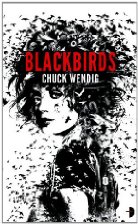
Book Review: Blackbirds by Chuck Wendig (Series, #1)
 Summary:
Miriam Black is an early 20-something drifter with bleach blonde hair and a surprising ability to hold her own in a fight. She also knows when and precisely how you’re going to die. Only if you touch her skin-on-skin though. And it’s because of this skill that Miriam became a drifter. You try dealing with seeing that every time you touch someone. But when a kind trucker gives her a lift and in her vision of his death she hears him speak her name, her entire crazy life takes an even crazier turn.
Review:
This is one of those books that is very difficult to categorize. I want to call it urban fantasy, but it doesn’t have much supernatural about it, except for the ability to see deaths. The world isn’t swimming in vampires or werewolves of goblins. I also want to call it a thriller what with the whole try to stop the trucker from dying bit but it’s so much more than chills and whodunit (or in this case, who will do it). Its dark, gritty style reminds me of Palahniuk, so I suppose what might come the closest would be a Palahniuk-esque urban fantasy lite thriller. What I think sums it up best, though, is a quote from Miriam herself:
It starts with my mother….Boys get fucked up by their fathers, right? That’s why so many tales are really Daddy Issue stories at their core, because men run the world, and men get to tell their stories first. If women told most of the stories, though, then all the best stories would be about Mommy Problems. (location 1656)
So, yes, it is all of those things, but it’s also a Mommy Problems story, and that is just a really nice change of pace. Mommy Problems wrapped in violence and questioning of fate.
The tone of the entire book is spot on for the type of story it’s telling. Dark and raw with a definite dead-pan, tongue-in-cheek style sense of humor. For instance, each chapter has an actual title, and these give you a hint of what is to come within that chapter, yet you will still somehow manage to be surprised. The story is broken up by an interview with Miriam at some other point in time, and how this comes into play with the rest of the storyline is incredibly well-handled. It’s some of the best story structuring I’ve seen in a while, and it’s also a breath of fresh air.
Miriam is also delightful because she is unapologetically ribald and violent. This is so rare to find in heroines.
We’re not talking zombie sex; he didn’t come lurching out of the grave dirt to fill my living body with his undead baby batter. (location 2195)
As a female reader who loves this style, it was just delightful to read something featuring a character of this style who is also a woman. It’s hard to find them, and I like that Wendig went there.
While I enjoyed the plot structure, tone, and characters, the extreme focus on fate was a bit iffy to me. There were passages discussing fate that just fell flat for me. I’m also not sure of how I feel about the resolution. However, I’m also well aware that this is the beginning of a series, so perhaps it’s just that the overarching world rules are still a bit too unclear for me to really appreciate precisely what it is that Miriam is dealing with. This is definitely the first book in the series in that while some plot lines are resolved, the main one is not. If I’d had the second book to jump right into I would have. I certainly hope that the series ultimately addresses the fate question in a satisfactory way, but at this point it is still unclear if it will.
Overall, this is a dark, gritty tale that literally takes urban fantasy on a hitchhiking trip down the American highway. Readers who enjoy a ribald sense of humor and violence will quickly latch on to this new series. Particularly recommended to readers looking for strong, realistic female leads.
4 out of 5 stars
Source: Netgalley

Book Review: The Preying Mantis by Andreas Louw
 Summary:
FBI agent Betty Roy has been pursuing one serial killer for years. He murders one young female teacher who plays a musical instrument per season. Suddenly, though, he contacts Betty herself and starts ratcheting up the rate of the killings. He seems to have some sort of personal interest in her.
Review:
I picked this up during the Smashwords Summer/Winter sale for two reasons. The plot sounded intriguing, and honestly the cover amused me. What I found inside was a plot that was mostly strong (although it fell apart at the end) that was unfortunately supported by some truly bad writing.
Let’s start with the good. The plot is genuinely creepy. Although the Preying Mantis (as he calls himself) is fairly typical for a serial killer thriller, he’s got enough unique qualities that the reader is left intrigued and guessing. The murder scenes are brutal and frightening. I was engaged enough that I kept reading in spite of the bad writing quality, purely because I wanted to know what happened at the end.
Unfortunately, the plot at the end takes a bit of a nonsensical nose-dive. I have an incredibly difficult time believing that the FBI would let an agent recently removed from a serial killer case who they know is currently being pursued by him run off into the middle of the woods without backup. Or some sort of catch the criminal plan she is in on. Similarly, I have major issues believing this same FBI agent would be stupid enough to go to the woods at this point in time, let alone go there without her big guard dog that she instead leaves at a friend’s house. It’s a lot of characters acting stupid just to get them to where the author needs them to be. Thankfully, that only shows up at the end.
As for the writing itself, there are three separate issues at hand.
First up, we have an omniscient third person narrator telling a story that takes place almost entirely in New York City with American characters, and yet the narrator repeatedly speaks British English. This is bizarre, confusing, and jolts the reader out of the story. I actually had to check a couple of times and make sure the story was indeed happening in NYC. Here are a few examples:
She had met the old man before and knew his heart was a bit dodgy. (location 1095)
He thought it best not to point out at this stage that if he had been shagging Wells’ wife, he might not have been gay. (location 2306)
Betty came out of the shower, refreshed, and took out a pack of crisps and a soft drink. (location 3553)
In case it’s unclear, Americans don’t say dodgy, shagging, or crisps. We say sketchy, banging, and chips. I suppose it’s possible that Louw could want the narrator of this event taking place in America to be British, but if so, it should be for a reason. For instance, it would make sense if the story was being told by a British person researching the killer at a later date. That is not the case, though. As previously pointed out, this is an omniscient third person narrator telling a story set in America. They should speak American English. The British English also drifts into the American characters’ dialogue, but there are far larger problems with the dialogue, so I won’t bother citing those. Suffice to say though that if it’s a problem for the narrator to speak British English it’s an even larger one for the American characters to do so.
Speaking of dialogue (see what I did there), let’s get to that. The main problem with the dialogue is that it doesn’t sound realistic. At all. Also every single character sounds exactly the same. The Latino-American cop sounds exactly like the white American FBI Agent who sounds exactly like the serial killer who sounds exactly like the head of the FBI’s investigation. And none of them sound realistic. Rather than try to explain it, let me show you.
I shall go mad if I don’t have anything to do for the next two weeks. (location 310)
Would you like to order out? I am quite hungry and can do with some sustenance. (location 1213)
After about fifteen minutes he emerged form his office and said, “Let us go.” (location 2868)
How come you being here all by yourself in the middle of nowhere, dear? (location 3617)
The only way dialogue like this would work would be if, say, one character was OCD about never saying a contraction or had Asperger’s Syndrome or something. But none of the characters are like that and also they all speak exactly the same way. It’s a real problem for dialogue to sound so incredibly unrealistic. It drags the reader out of the story, plus it’s bad characterization. Each character should have an individual sound.
Finally, there are the general grammar/spelling issues. The most annoying being the author’s tendency to switch back and forth between present and past tense, frequently within the same sentence. For example:
She had been hunting him for the last two years and it reached the point where he has invaded every aspect of her life. (location 123)
Lemke had played this kind of game before and he is definitely not going to let someone like Newmark get under his skin. (location 669)
Shudders up and down my spine, y’all. And not the kind you’re supposed to get from reading about a serial killer.
Overall, the book has a relatively unique plot that is overshadowed by a first draft quality level of writing. I encourage Louw to get either a co-author or an editor for future endeavors, as well as a wider variety of beta readers. Sound editing and checks by beta readers could have cleared up many of these issues.
2 out of 5 stars
Source: Smashwords
Book Review: The Chicken Thief by Fiona Leonard
 Summary:
Alois used to work for the Ministry, but he felt stifled and quit. Now he steals chickens. One night the white owner of one of the large, walled-in houses he steals from stops him. He wants him to get a letter for him. A letter from Gabriel, a revolutionary leader who has been long-thought to be dead. Alois accepts for the money, but soon finds his whole world changing around him.
Review:
This book was a gift from a one-time friend who also enjoys African lit. She enjoyed it and thought I would, but remember that problem I mentioned in my last review where I don’t seem to like books other people recommend to me? Yeah. Still a problem. I do enjoy African lit, and I thought when I saw the cover and heard the title that this book would be more of a social justicey kind of plot. But it’s actually quite a bit of a political thriller, and I personally don’t like those. Putting that element aside, though, I am still able to review the quality of the book.
The plot takes the less common method of looking at political upheavals and developments through the eyes of an average person dragged into the situation. There are a few chapters that show us the president’s perspective, but primarily things are seen through Alois’s eyes. I think this is what made it readable to me, because honestly who cares about politicians? It’s the everyman that is interesting. The plot is also interesting in that it looks at both a past revolution and a present-day coup. That makes it more unique in the world of political thrillers.
The writing can only be described as flowery. For example:
In truth he saw her everywhere, but you couldn’t say to a woman, not one who was meant to be just your friend, “Here, I have brought you this tree because its branches moved as you do” or “see here this bucket, when the water falls from it I hear your voice. (page 104)
Pretty much the entire book has that kind of meandering, highly descriptive cadence. I know that works for lots of readers. It’s just not personally something I enjoy, and I did find it odd in a political thriller.
One thing that bothered me is that it’s never entirely clear what country in Africa this is. I think it might be a fictional country in the southern region of Africa. The author herself lived in Ghana for a time so perhaps the idea was inspired by Ghanaian culture, but not based on anything factual in Ghana. In a book like this, a political thriller, I prefer real countries. Or at least a clearly defined country. That might bother other readers less though.
Overall then, there are some aspects of this political thriller that make it unique in the genre. It examines both a past revolution and a current coup through the eyes of a non-political youth who was not alive for the previous revolution. The writing is surprisingly flowery for the genre, so fans should be aware of that difference going in. Recommended to fans of political thrillers looking for something different.
3 out of 5 stars
Source: Gift

Counts For:
Specific country? Uncertain. Southern region of Africa. Australian author who has lived in Ghana.

Book Review: The Book of Lost Fragrances by M. J. Rose (Series, #4)
 Summary:
Jac ran away from her family’s traditional perfumerie in Paris to pursue a career in mythology in her mother’s homeland of the USA. This move was spurred on by her mother’s suicide, and Jac’s own subsequent loss of touch with reality. Years of therapy later, all is well, but when Jac’s brother and current manager of the perfumerie goes missing, Jac must face up to her demons at home, as well as scenes in her own mind. Are they delusions or past life memories?
Review:
I requested this on NetGalley without realizing it was part of a series, but it is evident each entry in the series is about different people whose lives intertwine in a minor way. Thus, I was able to read this book without feeling that sense of disorientation that happens when you jump into the middle of a series. I’m glad too, because I found the story an intriguingly different plot-line for a thriller.
Essentially, there are some pottery pieces that Robbie discovers in his home that may or may not have once held a scent that allows whoever smells it to remember their past lives. A past life therapist wants these pottery pieces, Robbie wants to give them to the Dalia Lama, and the Chinese government wants to keep them out of the Dalai Lama’s hand in their on-going quest against Tibet. It’s a good big world plot, but the overall focus is mostly on Jac, which is how I tend to prefer thrillers. And Jac is a great character. She is strong, intelligent, a caring sister. She had a rough childhood, but still has her head on straight. Her struggle with whether or not she had past lives ends up not being as important as the reader might at first think, which I also appreciated. Jac’s character development is about accepting herself for who she is and not making selfish choices. It is not at all the romance I thought at first it was going to be, and that is a good thing.
Rose evokes the settings of Paris and NYC with equal aptitude. I must say I found myself craving an afternoon at the museum and some creperies when I was done with the book. The perfumerie business and house are equally beautiful and easy to picture, but also the tunnels underneath Paris are evoked well. Setting and characterization are strong points of Rose’s.
I did periodically feel the book moved too slow in the beginning. Also, I was disappointed that people who were evil now were evil in past lives and the good were always good. Similarly, only one person had a past life as a different gender. I get it that Rose’s point is that one needs to know one’s past lives in order to fix your mistakes that you make over and over, but I think it’s a bit short-sighted to think that if reincarnation did exist it would be that simplistic. Also, personally, I just don’t believe in soul mates, so having that as a strong theme in the book was rather eye-roll inducing.
Overall, this is a fun worldwide thriller with educated people at the center of it that includes thought-provoking themes like self-improvement and self-acceptance. Fans of the modern, globe-spanning thriller will enjoy it, as well as anyone who has a love of Paris.
4 out of 5 stars
Source: NetGalley

Previous Books In Series:
The Reincarnationist
The Memorist
The Hypnotist


Book Review: Death Island by Joan Conning Afman
 Summary:
In future America the prisons are so overcrowded that the government needed to come up with a new idea. So they started sending the worst criminals to a remote island to live out their lives (or deaths). Naturally, this Lord of the Flies style punishment is also a nationally televised weekly reality tv show. When Danny is wrongfully accused of serial killing five women with an axe, including his own wife, this reality tv show becomes his stark….reality.
Review:
At this point, the idea of a reality televised punishment type thing run by the government is relatively passe. A trope of the dystopian scifi genre, even. However, Afman does bring a unique twist to this basic idea that keeps the book fresh and engaging.
For instance, the inhabitants of the island are not forced to pit themselves against each other. They sort of naturally divided up into the Village, the Tribe, and the loners. The Village consists of those men who feel badly about their crimes and are trying to live out their lives with some semblance of normalcy. A lot of them have formed couples and shacked up. The Tribe are basically the psychopathic killers who periodically get drunk on their homemade rum and randomly attack others on the island. The loners are relatively self-explanatory. Having this type of conflict naturally happen instead of forcing it upon the participants is a nice throwback to The Lord of the Flies.
On the other hand, the fact that Danny proclaims his innocence and is innocent makes the plot far less appealing to me. There’s no real moral ambiguity at the center that would drive the reader to question her own belief system or the concept of justice in general. It’s odd to me that Afman chose Danny as the main character when there is a minor character on the island who admittedly committed a crime but perhaps for the right reasons. This is where the meat of a real story would lie. Choosing Danny instead makes it sort of like those tv shows people put on for background noise but don’t pay any real attention to.
Of course, Danny is not the entire plot. We also have the minister’s wife, Charlie, who firmly believes in Danny’s innocence and works toward freeing him. She provides the connection to the real axe murderer and a really odd romance layer to the book. Seeing the program how those in America do is interesting, but wouldn’t it be more interesting to travel around to various viewing parties in the US? Perhaps to those who are blood-thirsty to the casual viewers to family members of those sent to the island, even. Instead, every time Charlie’s plot interrupts Danny’s it’s distracting.
All of those things said, it’s not that the book is badly written. It’s not. It’s just not amazing or even very good. It’s just good. It entertains for a couple of hours and then is easily tossed aside. Perhaps for some people that’s enough. Personally I was hoping for more.
Overall, I recommend this book to those who are a fan of the concept looking for a light, quick read.
3 out of 5 stars
Source: LibraryThing’s EarlyReviewers

 Support my work with a tip or browse my shop for curated book club guides, how to guides, cross-stitch patterns, and more!


This work by Amanda Nevius is licensed under a Creative Commons Attribution-Noncommercial-No Derivative Works 3.0 United States License.
 Opinions of a Wolf