
Archive
Book Review: Superior Women by Alice Adams (Bottom of TBR Pile Challenge)
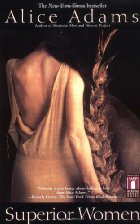 Summary:
When Californian Megan Greene runs has a steamy affair in the summer of 1943 with a Harvard student visiting the west coast for the summer, she decides to follow him back to the east coast and attend Radcliffe. There she meets four other women, three of whom it might be more accurate to call frenemies than friends. Their lives and destinies repeatedly intertwine throughout the tumultuous changes of mid-20th century America.
Review:
I kept my eye out for this book when it was named as a read-a-like to my 2011 5 star read The Group
The book covers 1940s to 1980s America, yet as the decades move on, less and less is said. The 1940s are expressed clearly with exquisite detail, and I was excited to see what would happen with the 1950s and the 1960s. But the 1950s slowed down, the 1960s were barely touched upon, the 1970s were jumped over almost entirely, and the 1980s were the final chapter of the book. The pacing was all off. I wanted to know these women in as much detail in the latter decades as in the first. Instead of feeling like I knew them more and more intimately, they increasingly became strangers to me.
One thing that I think really works against the book is it is neither an ensemble nor a one character piece. Most of the book is told about Megan, but not all of it. We get snippets of the other characters, meaning perspectives that Megan is not privy to, but not enough to ever truly know them. Since most of the book is about Megan, these bits away from her feel sort of like the story is robbing us of more time with the main character we are interested in. Similarly, reading the blurb and the title, I thought this was going to be an ensemble book, which is not what we get either. I wanted to know much more about two of the characters in particular, Peg, who comes out as a lesbian at some point in the 1960s, and Cathy, who has an affair with a priest. These two stories are wonderfully intriguing, particularly Peg’s since her love of her life is met on a mission to register black voters in the American south, and her love interest is a Latina woman. There is so much meat to that storyline, and yet it is barely touched upon while we instead listen to Megan hem and haw about her job, and Lavinia try to figure out how best to cheat on her husband. The balance of telling this ensemble piece was just entirely off.
Similarly, while big issues and events of mid-20th century America were briefly touched upon, the book never really presented a truly personal look at any of them. For instance, Megan has a friend who is bashed in a drive-by gay bashing but we never get to see Megan emotionally deal with this stark reality. She hears about it, calls him, and moves on. Similarly, as previously mentioned, Peg comes out as a lesbian, and we see a snippet of her depression caused by living the lie of being straight, but we never get to understand the emotions or impetus behind her bravely coming out and living in a visible, inter-racial lesbian relationship in the south. It is disappointing because we get a taste of really encountering these historical issues, but we never actually get to.
In spite of all these problems, I still enjoyed reading the book well enough. The plot, while frustrating, does progress forward in an interesting fashion. The characters, although frequently two-dimensional, are bright and vivid. I came away with the perspective I always have with historical fiction about women’s history. That I am grateful I was born in a different time, because we women have much more opportunities available to us now. So I appreciated my visit to that time period but it was a bit disappointing.
Overall, if you are a huge fan of historical fiction about women’s issues, this is an interesting book to add to your repertoire. It is a good comparison to others that did it differently or better, and it is still fun to visit those time periods. If this type of literature is not generally your cup of tea, though, I would suggest you instead read stronger competitors in that genre, such as The Group
3.5 out of 5 stars

Book Review: Galapagos by Kurt Vonnegut
 Summary:
In the future when humans have evolved to have much smaller brains and the ability to swim like penguins, a long-lasting ghost from the prior stage of human evolution tells us the tale of how it all went down. How overpopulation of the old-fashioned, big-brained humans, a very bad economy, and a series of unfortunate (fortunate?) events led to an odd group of humans being marooned in the Galapagos, surviving the worldwide fallout, and evolving into the smaller-brained, fish-eating, natural swimmers we have today.
Review:
I picked this up during a kindle sale for incredibly cheap purely for the author. I’d read three other Vonnegut works previously: Cat’s Cradle


There is an incredibly unique writing style to this particular scifi book. So much so that my boyfriend and I wound up researching to find out if, perhaps, Vonnegut wrote this toward the end of his life when he was perchance senile. (It was not, although it was published in the 80s, unlike my three prior Vonnegut reads, which were published in the 60s). Then we wondered if maybe Vonnegut had Asperger’s, although we didn’t bother checking up on that. Why these wonderings? Well, Galapagos
Beyond the whole odd scenario, there’s the fact that if a character will be dead by the end of the chapter, an asterisk appears next to their name. And the names appear a lot. Vonnegut is incredibly fond of naming everyone and everything by their full name every time they appear. He also loves lists. (This is the part that had us wondering about Asperger’s). At first this is grating on the nerves, but with time it comes to feel like the vibe of the world you’re visiting when you open the book.
Similar to the lists and constant naming, there are philosophical asides. Some of these are worked smoothly into the story thanks to a handheld computer device (similar to a smartphone) that pulls up relevant quotes to read to the survivors. Other times, though, they are truly random asides that go so far off the path of the story you’re left wandering around in a cave in the woods instead of on the nice paved road. But then everything comes right back around to the story, and you can’t really be upset about spending some time listening to an old ghost ramble. For example:
What made marriage so difficult back then was yet again that instigator of so many other sorts of heartbreak: the oversize brain. That cumbersome computer could hold so many contradictory opinions on so many different subjects all at once, and switch from one opinion or subject to another one so quickly, that a discussion between a husband and wife under stress could end up like a fight between blindfolded people wearing roller skates. (page 67)
Off-topic? Yes. Quirky? Absolutely. Interesting and fun nonetheless? Totally.
The plot, in spite of being deeply meandering, does develop and actually tell a story. We learn how overpopulation caused disaster and then how a few humans managed to survive on the Galapagos Islands and evolve into the futuristic penguin-like folk. Along the way we have some fun side-trips like an Argentinian military man appearing on a talk show and trying to explain that Argentina really does have submarines, it’s just that once they go underwater they never show up again.
Although I did ultimately appreciate the absurdity and the quirkiness, I must admit that I think it was perhaps a bit overdone. At the very beginning of the book when the list-making and other elements like that were much more prevalent, I was more annoyed and might have stopped reading the book if it wasn’t for the fact that my boyfriend and I wanted to finish the first book we started reading together. It took until about 60% of the way in for the list-making to ease off a bit and the style of the book to really start to work for me. I could easily see a reader being totally lost by some of the more annoying elements of the book, and I wonder what the effect would be if the order was reversed. If the quirks built throughout the book instead of starting that way. Or even if they were just dialed back a bit. I think just that tiny bit of editing would have made me love the book.
Overall, this is a fun piece of absurdist scifi that examines evolution from an over-the-top hypothetical situation. Potential readers should be aware that this book is even more absurdist than Slaughterhouse-Five
4 out of 5 stars
Source: Amazon
Book Review: Dead in the Family by Charlaine Harris (Series, #10) (Bottom of TBR Pile Challenge)
 Summary:
With the Fae war at an end, Sookie tries to return to some semblance of normal, working on both physical and emotional rehab. Although she has feelings for Eric, she is uncomfortable with his insistence that she is his wife, even if she technically is by vampire law. Plus, his maker and his new vampire-brother show up, putting a strain on the relationship. Meanwhile, the ramifications of the shifters coming out are beginning to be felt, and Sookie’s fae cousin, Claude, moves in with her, missing the presence of other fairies.
Review:
I just need to take a moment to point out two things. 1) The last time I read/reviewed a Sookie Stackhouse book was in October of 2010. This is why I started the Bottom of TBR Pile Challenge for myself. Books (even series books!) were getting lost in the pile! 2) Every time I look at that cover I think for a brief moment that Eric is bald. Something is just off in that painting. Now, on to the book.
Even though I read it almost three years ago (seriously, holy shit), I still clearly remember really enjoying the ninth book of the series. It was action-packed with lots of development of both plot and character. It reinvigorated the series for me so much so that even this much later, I was excited to pick up the next book. I should have known it would fizzle some after the action of the last book. It’s not easy to keep that much tension and action going, and it’s not like there weren’t any lulls earlier in the series. What I can mostly say about this book is that nothing much happens. Seriously. It’s longer than some of the books but less happens. I suppose technically things do happen. Eric’s maker shows up with a new vampire-brother for Eric, the hemophiliac Romanov brother, who is just not quite right in the head. This leads to some interesting development of Eric’s background, but not a ton. And it just isn’t all that intriguing. Similarly, even though logically it should be very interesting that Claude shows up at Sookie’s and the weres sniff out two fairies around, but it just isn’t. They sound interesting on the surface, but when you’re reading the book it mostly feels like you’re hanging out at Sookie’s house eating a cookie and wondering if the calories are worth it to listen to her yammer on.
I think the crux of the problem might be that neither Sookie nor Harris is comfortable with Sookie being with Eric, in spite of the reader liking Sookie being with Eric. If it’s not within the character for her to be with Eric, then a break-up needs to happen, regardless of what the readers like seeing. It’s important to keep characters acting within character. Interestingly, Sookie has started to notice that she is aging and thinking about what it will be like to slowly grow old and die. She seems to be seriously considering her vampire options. But we all know Sookie doesn’t want to be a vampire. Sookie wants children. If she gives that up to be a vampire, it will make the series take an incredibly dark turn. The next book will be an important one. It’s basically a shit or get off the pot moment for character development, and in spite of the ho hum nature of this entry in the series, I am interested to see if things pick up in the next book in this regard. They tend not to slump for long in Sookie Stackhouse-land.
There’s not too terribly much else to say about the book. Weaknesses that are there earlier in the series are still there. Sookie isn’t very smart and is kind of annoying. The sex scenes continue to be cringe-inducing. But the world is complex and fun to visit, even when not much is happening there. Sookie does need to start taking some agency soon though, or being stuck with her first person narration may become a bit too much to handle. Readers of the series will be disappointed by this dull entry, although it won’t come as a surprise since lulls happen earlier in the series. Enough happens to keep some interest up to keep going with it though.
3 out of 5 stars
Source: PaperBackSwap

Previous Books in Series:
Dead Until Dark
Living Dead in Dallas
Club Dead
Dead To The World
Dead as a Doornail
Definitely Dead
All Together Dead
From Dead to Worse
Dead And Gone
Book Review: Mulliner Nights by P.G. Wodehouse (Series, #3) (Bottom of the TBR Pile Challenge)
 Summary:
Mr. Mulliner has a wide variety of eclectic relatives, and he’s more than happy to tell snippets of their life stories over a pint at the local pub. From a freewheeling artist brought into line by a judgmental cat to a timid fellow who accidentally subscribes to a correspondence course on how to get a backbone to a private detective with such a disturbing smile that criminals readily confess their hijinks keep the patrons of Angler’s Rest in stitches.
Review:
This made it onto my tbr pile thanks to a visit to Harvard Books’ used books and remainders cellar. This was in the remainders pile, and three things drew me to it. 1) It was under $5, 2) The cover has a cat drunk on whiskey on it, 3) I had just read Love Among the Chickens
Don’t worry about this being the third in a series. The only connection among the short stories is the main characters are all a Mulliner (or married to one). It was completely unnecessary to have read the first two books in the series to get into this collection, although I intend now to read all of the Mulliner books. I really appreciated how Wodehouse sets up a structure to hold his short story collection together in one unit. Although they are all self-contained tales, their being together in one collection actually makes sense. They have more in common than just the author. They are literally a family of stories. This helped it hold my interest in a way that many short story collections can’t.
This collection consists of 9 short stories, most of which have some sort of love element. One person wants to be with (or marry) another and must overcome some sort of obstacle (usually caused by British upper-class culture) in order to be with them. Hilarity ensues. My favorite of these was “The Story of Webster,” the cover’s drunk cat. In this a freewheeling artist has his religious uncle drop his cat off with him while he goes on assignment to Africa. The judgmental, sullen cat soon starts to reign in the young artist, much to his and his girlfriend’s chagrin. Everything about this, from the early 20th century fashion and dialogue to the witty commentary on cats and culture works perfectly, particularly for this cat-lover. The story that I thought worked least-well, and unfortunately wraps up the book, is “Gala Night.” A pastor Mulliner accidentally helps a young couple who enjoys dancing to acquire the young woman’s parents’ approval of their union. I didn’t like the religious Mulliner. He just wasn’t funny to me. Similarly the catalyst of a mysterious mood enhancing drink just lacked the creativity found in the other stories. Fortunately, most of the stories fell much closer to the hilarity of the whiskey drinking cat. However, a couple did fall a bit flat for me, which is why while I greatly enjoyed the book, I wouldn’t say I was totally in love with it.
Overall, this is a wonderfully witty collection of short stories held together by an elderly Mulliner who enjoys telling (possibly tall) tales about his family over a pint in the local pub. If you enjoy a dry wit and slapstick humor to top off a cute love story, this collection is for you.
4 out of 5 stars
Source: Harvard Books

Previous Books in Series:
Meet Mr. Mulliner
Mr. Mulliner Speaking


Book Review: Oddkins: A Fable for All Ages by Dean Koontz
 Summary:
Isaac Bodkins is a magical toymaker. He makes toys that actually come alive and seek out children who need them the most, such as children who have lost a parent or who are facing abuse. When he dies before he has a chance to tell his chosen heir about her purpose, evil has a chance to take over again. His toys, the Oddkins, must set out to tell her before evil manages to land its own new evil toymaker that would create living toys to torture children. Evil sends out his evil toys in an attempt to stop the Oddkins on their dangerous cross-town mission.
Review:
The person who loaned me this book told me it was marketed as a fable for all ages but really might be a bit too scary for the youngest among us. Person also knew that I love me some fables, not to mention talking animals or toys, so I was excited to get into this book. Alas, it wasn’t ultimately my style, but it is a well-written book I could see working for a lot of people.
The plot is a quest where each member of the questing group gets at least one chance to shine. Although I was fairly certain that good would ultimately triumph over evil, I still was left worried for the main characters periodically, and I also was unable to predict the details of the triumph. Since the toymaker lived in the countryside outside of the city, the quest consists of time in both the country and the city. This kept situations varied and engaging.
Since this is a fable and most of the characters are in fact magical toys, they are not what one would describe as three-dimensional. However, their two dimensions work for the story. For instance, the teddy bear leader of the good toys is brave and strong and true but he also has to work at being brave. He is not just naturally brave. Similarly, although the two potential inheritors of toymaking are good and evil, they both get background information given to them. The evil one was in prison and only takes pleasure from causing others pain. The good one ran a toy store and was recently widowed and looking for something more in her life.
So why didn’t I love it? Well, some things said were just too clearly religious for me. There’s a lot of talk of afterlife, and the evil toys are driven by who is clearly Satan. There are also times where the good toys stop and make statements to each other that are clearly the author preaching to the reader through them. For instance
God’s world is full of magic, isn’t it? Not just the secret kind of magic of which we’re a part, but the simple magic of everyday life-magic. (location 1358)
Given that this happens rather frequently and given that the evil is clearly represented to be Satan, I just found the whole book to be a bit too heavy-handed in the religion department for me. A reader who does follow Christianity might not be bothered, but even then, the preachiness within a book isn’t for everyone.
Overall this is a well-written fable that is engaging and unique. It is a bit heavy-handed in its presentation of various religious beliefs for this reader, but other readers who enjoy that in their literature will probably enjoy this book.
3 out of 5 stars
Source: Borrowed

Book Review: Where the Blind Horse Sings: Love and Healing at an Animal Sanctuary by Kathy Stevens (Bottom of TBR Pile Challenge)
 Summary:
When Kathy Stevens decided to change careers mid-life, she wanted to do something that would help animals and let her teach. She landed on the idea of founding an animal sanctuary. But this book is very minimally about Kathy. It is mostly about the animals that came to find a safe haven at the sanctuary she founded. Animals like Rambo the sheep who guards other animals. Paulie a former cockfighting rooster who loves car rides. And of course a blind horse once terrified to move who now goes for trail rides.
Review:
This book wasn’t what I was expecting, which was an account of setting up and running an animal sanctuary. Instead it is a collection of short stories about individual animals who live at Catskill Animal Sanctuary, in the vein of James Herriot, although not quite to that classic’s level.
The stories are roughly grouped based on the situations that led the animals to the sanctuary, their personality, and of course some ultimate peaceful deaths at the sanctuary. I was a bit frustrated that instead of telling one animal’s story end to end, they were split up among sections. I can understand not wanting to end every chapter with an animal’s death, but I also think seeing one animal’s life in a complete story would be more touching. On the other hand, I also appreciated how clearly the different animals’ personalities were drawn without ever venturing into the land of hypothesizing. One doesn’t have to impose their own beliefs on an animal to clearly see the difference between a hurt, abused animal and a happy one. Stevens presents the difference quite clearly without venturing into speculation, which I think will give the book the broadest audience.
In spite of the dark past lives of these once abused animals, the book is a light read, both in spirit and in content. You won’t learn the nitty gritty of founding and running an animal sanctuary, which I think is too bad. It’d be nice if there was even an epilogue about more of the day to day realities of rescuing animals. On the other hand, the light, easy read gives the book a broader audience. It also features a suggested further reading list at the end, as well as links to the sanctuary’s website and invitations to visit, so those who want more can seek it out.
Overall, this is a well-written, feel-good collection of stories of the animals of Catskill Animal Sanctuary. It doesn’t provide much insider information on the running of animal rescue charities, but it does provide insight into the personalities of farm animals. Recommended to animal lovers who enjoy short stories.
4 out of 5 stars
Source: Amazon

Book Review: vN by Madeline Ashby (series, #1)
 Summary:
Amy is 5 year old robot. An exact replica–iteration–of her mother, who is in a relationship with a human male. Her parents are restricting her food to raise her slowly at a human child’s pace instead of at a robot’s. But when her grandmother shows up to her kindergarten graduation and threatens her mother, things go haywire. It quickly becomes apparent that the failsafe that makes robots love humans innately and makes them incapable of withstanding seeing violence against humans has failed to activate in Amy. She finds herself full-grown and on the run from humans and her robot aunts alike as she struggles to figure out who she is and what her existence means to humanity.
Review:
Artificial Intelligence/Robot books tend to take a bit more to draw me in than say a zombie book. It’s really hard to do AI in a way that is simultaneously scientifically/culturally believable and unique. Frankly, I need a bit more believability in an AI book than in a zombie one, since AI is real science. Plus, the book should examine their cultural place in the world, and that needs to be believable. I am pleased to say that this book gets it mostly right. It’s enjoyable, scientifically minded, culturally thought-provoking, and examines a real life issue in the context of genre, which long-time readers of this blog know is something I highly enjoy.
The first thing that made me know this is a smart book is the source of the robots (called Von Neumanns after their creator). A fundamentalist group in the American South decided that the humans left behind after Jesus’ Second Coming should have someone to help them through the Tribulation, so they invented humanoid robots to be ready to help. Clearly, the Second Coming didn’t happen, and the fundamentalists ended up selling Von Neumanns, and the Von Neumanns wind up a part of the cultural backdrop, not to mention the porn industry. As a character says to Amy:
There are only two industries in this world that ever make any kind of progress: porn, and the military. And when they hop in bed together with crazy fundamentalists, we get things like you. (location 1944)
This is the most unique and engaging origin story for robots that I’ve seen, plus it makes sense and provides cultural commentary. The Von Neumanns originated as a religious experiment, were swiped by the military and the porn industry, and became a part of everyday life. It’s just an awesome origin story for the world that Amy is in.
The characters, including the robots, are three-dimensional. Everyone has complex motivations and the main characters definitely grow and progress with time. No one is presented as pure evil or good.
The plot is similarly complex. There’s a lot going on in Amy’s world, and none of it is predictable. What is the failsafe precisely and is it a good or a bad thing? Is it a natural progression that it doesn’t work in Amy? What about how Amy’s mother and grandmother reacted to the human world around them? Did they see accurate shortcomings or were they just malfunctioning? And what about how the various humans use the Von Neumann’s? For instance, pedophiles acquire Von Neumanns and keep them young by starving them. Is this a good, harmless thing since it protects human children or have robots evolved to be far more than just a machine? The world is complex and full of tough questions, and thus is challenging and unpredictable, making for an engaging read.
What I most enjoyed though was how the whole book presents the question of nature versus nurture in a genre setting. Are we our parents with no hope of improvement or escape? Or do we have more say in the matter than just our genetics or “programming”? Amy has a psychopathic grandmother and a mother who has made questionable choices. Does this mean that Amy is evil or malfunctioning or even capable of being something different from the rest of her family? All of these questions lead to some interesting stand-offs, one of which includes my favorite quote of the book:
An iteration isn’t a copy, Mother. It’s just the latest version. I’m your upgrade. That’s why I did what I did. Because I’m just better than you. (location 2581)
All that said, there were two things that kept this back from five stars for me. First, some of the writing style choices Ashby uses drew me out of the story a bit. They are periodically highly artistic in a way that didn’t jibe with the story for me. I get why she made those choices, but as a reader they aren’t ones that generally work for me. Second, one thing that really drew me out of the story is the fact that the robot’s boobs don’t move. This is mentioned at one point as being a way to tell if a woman is robot or not. This drew me out of the world very hard while I laughed uproariously. I’m sorry, but machines designed by men would simply not have hard plastic boobs. Their boobs would bounce, dammit. This would at least be in the top 10 list of robot requirements. It simply wasn’t a realistic design choice, and it pulled me out of the story to such an extent that it lost the believability for a bit for me.
Overall, this is a creatively written and complex scifi artificial intelligence story that examines not just what makes us human but also individuality and uniqueness separate from parents and family. Some of the more artistic writing choices and high levels of violence might not appeal to all audiences, but if you’re an AI or scifi lover with an interest in nature versus nurture and stories featuring strong female leads, you should definitely give this a go.
4 out of 5 stars
Source: NetGalley

Book Review: The Wanting Seed by Anthony Burgess (Bottom of TBR Pile Challenge)
 Summary:
In the near future world with no war and totalitarian governments there’s an ever-looming threat of starvation thanks to overpopulation and diseases attacking the crops. The governments have responded with worldwide one child policies and psa campaigns to encourage homosexual relationships. Englishman, Tristram Foxe, lives in a skyscraper with his wife, Beatrice-Joanna and works as a social studies teacher. But his advancement suffers both from his status as a person with siblings and as a married man with a child. When he discovers that his wife is cheating on him with his passing as gay brother who works for the Infertility Bureau, his world falls apart just as the world around him tilts from totalitarian regime to cannibalism and pagan fertility rituals.
Review:
When I picked up this book, the summaries I’d seen were nowhere near as clear or straightforward as the one I just wrote for you. I’m not sure I would have ever picked it up if I’d had an inkling of an idea as to what I was getting myself into. All I saw was a dystopian overpopulated future by the same author as A Clockwork Orange
The first half of the book reads like a treatise by a Quiverfull (Evangelical Christians who believe in having as many children as possible, more info) with some terror of a hyper-liberal future where people are denied their right to choose to have children (funny how they fear that but don’t get that pro-choice is all about protecting a woman’s right to choose what to do with her own reproductive organs but that’s another rant for another day), and people are forced into being gay/lesbian. I know this sounds like it could be an interesting flip-flop of current times, but it didn’t read that way for me. It read as a lot of homophobia and yelling about how population control goes against god’s plan and going against god’s plan sends the plagues. Seriously. That’s how it reads. But, I traveled on because this is Anthony Burgess, and characters don’t have to be likeable. They could be used to show the opposite point. But that’s not really what happens. What happens is that this set-up gets ditched for a mad-cap dash through sociology.
The last half of the book is kind of an interesting sociological exploration of how the world moves through the liberal/conservative/military cycle. It is mad-cap and bizarre, and as a person with a BA in History, I really enjoyed seeing a country move through those cycles at rapid-fire in a slapstick humor style. This part of the book felt like an entirely different book in fact. But I also think only a certain type of person would enjoy it. (Like, oh, Political Science and History majors).
As for character development, there is none. Everyone ends up pretty much where they started after having lived through the cycles of political change. It really reminds me a lot of playing Civ or SimCity where you move artificial people around to illustrate greater points. I enjoyed this alright, but I would have preferred stronger characterizations or at least some growth.
So, is the book a phobic conservative dream of what a liberal society would look like? I don’t think so. I think Burgess actually presented each part of the political cycle as awful, including the fall into tribal-feeling paganism. It sort of felt like the book was saying that someone somewhere will always be unhappy no matter what the political/sociological situation is. Depressing, huh? And yes I know it’s dystopian and lot of people think dystopias are innately depressing, but personally I think they can frequently offer a lot of insight and hope for the future. This just felt a bit defeatist. With some Quiverfull and homophobic characters to boot.
Overall I’m left feeling decidedly no reaction either way to this book, which is not what I was expecting from Burgess. I was neither offended nor enlightened and mildly entertained but I could have had the same entertainment from playing Civ on my computer. I think this book best appeals to readers who also enjoy studying political science or the history of societies, but even they should proceed with the caution that this is decidedly a mad-cap, non character-driven look at those topics.
3 out of 5 stars
Source: PaperBackSwap

Book Review: Dagon by Fred Chappell (Bottom of TBR Pile Challenge)
 Summary:
Peter doesn’t know much about his father’s side of the family as his mother left him when he was little. Now, a married pastor, he returns to his father’s parents’ house, a recent inheritance. Slowly he discovers the cultist history of his family and begins his descent into madness.
Review:
There aren’t that many books in the Lovecraft mythos, so when I spot one, I almost always add it to my wishlist and pick it up if I spot it. (I’m a big fan of the mythos, and my current work in progress is set in it). I spotted this one during one of Better World Books’ periodic sales and got it for just a couple of dollars. The problem with the world of Lovecraftian horror is this. The mythos is great, but a lot of the books/movies set in it are a swing and a miss. Which is sad for me as a reader, because I know that this is an author with the same funky interest as me, so I want it to work. I want it to work very much. It just doesn’t always. This, unfortunately, falls solidly in the swing and a miss category for me.
The germ of the story is a great idea. An ostensibly mainstream “good” man following his roots and falling into a dark god worshiping cult. Brilliant. The execution is weak, however. The cover of my copy of the book claims that it is a “novel of blinding terror.” This is just not the case. In some ways I feel that Chappell just tried too hard. The entire first chapter is meant to set the scene with extremely heavy-handed gothic language, but it is just painful to read. The first chapter describes one room of the house. Excessive energy is spent trying to make even the throw pillows seem malicious. It is too over-the-top and becomes laughable. Thankfully, the next chapter abandons the excessive language, but it is still never scary. It is titillating at a couple of points. Engaging as well. But never terrifying.
Part of the problem is that the book fails to build suspense from beginning to end. It builds up in part one to a singular event, but then immediately crashes back down to a period in part two in which Peter lies around in a depressed funk. While this might be realistic, it does nothing to build the suspense. The suspense thus must start all over again. This may be acceptable in a long work (and even then I’m dubious), but in such a short book it’s just jarring and ruins the suspense.
I also found the ultimate payoff to be a bit disappointing. While we find out one or two things about Peter’s family, we don’t get enough details to truly experience shock or horror. Similarly, the ultimate final descent of Peter was a bit disappointing. He doesn’t engage in any agency or become a committed cultist. A lot of cult things are done to him, but he doesn’t really have the descent into madness promised. He is tortured and made into a slave and has the mental and emotional breakdown such experiences could make someone experience, but he himself doesn’t turn into a raving Dagonite, for instance.
That said, there are some things that worked in the book. As stated previously, the germ of the idea is great. Peter’s nemesis/mentor, the tenant farmer family’s daughter, is delightfully powerful and sinister. A couple of scenes were a great mix of titillation and horror, and the final climax was definitely a surprise.
Overall, then, it’s a book that tries to be a terrifying, gothic horror, but instead is a titillating grotesque bit of southern literature. Fans of the Lovecraftian mythos will appreciate it for this, although the Lovecraftian elements themselves are sparse and a bit disappointing. Recommended for big fans of grotesque, fantastical horror who don’t mind it leaning a bit more toward the grotesque than the scary side of horror.
3 out of 5 stars
Source: Better World Books

Book Review: Braided by Elora Bishop (Series)
 Summary:
A lesbian retelling of Rapunzel. Gray, a witch’s daughter, visits Zelda every day. The witch switched Gray’s fate into Zelda, so now Zelda is the one entwined with the spirit of the tree that the people worship. She must live on the platform and every day lower her hair for people to tie ribbons and prayers into. Gray feels horrible guilt over their switched fates, but she’s also falling in love with Zelda.
Review:
I’m a sucker for fairy tale retellings, although I can be fairly picky about whether or not I like them. But Rapunzel is a tale that is not redone often enough, in my opinion, and the fact that it was a lesbian version made me jump at this novella.
It’s nice that the retelling doesn’t just change the genders of the main romantic pairing and leave it at that. In the original version, a married couple steal from a witch’s garden and in payment they must give her their unborn child who she then locks up into a tower. She would let her long hair down for her witch/mother to use as a ladder to get into the tower. A prince years later hears her singing in the tower and helps her escape. In this retelling, the people worship a tree. When the tree starts to die they tie its spirit into a person. That person lives on a platform in the tree and the people pray to him/her. When the person dies, the fate to be tied to the tree randomly chooses a baby by putting a tree pattern on their chest. This fate is supposed to be Gray’s, but her mother somehow acquires another baby, Zelda, and with magic cuts the fate out and ties it to her instead. Gray knows this and at first visits Zelda out of guilt but eventually falls in love with her. This version, surprisingly, is actually a lot more fantastical and magical. There is even a quest within an alternate dimension/dream world. I enjoyed the increase in the otherworldly feel, and I liked that it lent the twist of a parent trying to protect her child rather than a mother smothering her child.
The writing has an earthy, magical quality to it. It’s definitely language that is looking to be pretty, and it mostly succeeds. The romance between Zelda and Gray is sweet and very YA. Their passion revolves entirely around kissing and holding. I like that it gives a soul and connection to the romance without ignoring the physical aspect. It’s the perfect balance for this type of story.
While I enjoyed reading the story, I must admit it wasn’t my ideal retelling of Rapunzel. I didn’t like the religious aspect that was drawn into it, and I did feel that Zelda falling for Gray was a bit fast, particularly given the fate switching aspect of the story. I was also disappointed to see that in spite of all the other changes in the story, the Rapunzel character is still blonde. I’m not sure why no one ever seems to change this when retelling Rapunzel.
Overall, this is a fun retelling of Rapunzel, particularly if you’re looking for a non-heteronormative slant or enjoy a more magical feel. Note that this is part of a series entitled Sappho’s Fables
4 out of 5 stars
Source: Amazon

 Support my work with a tip or browse my shop for curated book club guides, how to guides, cross-stitch patterns, and more!


This work by Amanda Nevius is licensed under a Creative Commons Attribution-Noncommercial-No Derivative Works 3.0 United States License.
 Opinions of a Wolf