
Archive
Book Review: The House Across the Lake by Riley Sager

Summary:
Casey Fletcher, a recently widowed actress trying to escape a streak of bad press, has retreated to the peace and quiet of her family’s lake house in Vermont. Armed with a pair of binoculars and several bottles of liquor, she passes the time watching Tom and Katherine Royce, the glamorous couple who live in the house across the lake. They make for good viewing—a tech innovator, Tom is rich; and a former model, Katherine is gorgeous.
One day on the lake, Casey saves Katherine from drowning, and the two strike up a budding friendship. But the more they get to know each other—and the longer Casey watches—it becomes clear that Katherine and Tom’s marriage is not as perfect and placid as it appears. When Katherine suddenly vanishes, Casey becomes consumed with finding out what happened to her. In the process, she uncovers eerie, darker truths that turn a tale of voyeurism and suspicion into a story of guilt, obsession and how looks can be very deceiving.
Review:
I have read every single Riley Sager book almost as soon as I could get my hands on them. I find them all enjoyable, although I enjoy some more than others. I particularly appreciate their twists on common horror movie tropes. So I was excited to have a new one available for my summer thriller season.
Unlike the other books, I’m not sure what horror movie trope this is playing with. (Is it playing with one at all?) Nothing stuck out to me, but it’s also not like I’ve watched every single horror movie on the planet. At the beginning of the book, that dialed down my enjoyment a bit, because in general I find Sager’s fictional commentary on these tropes to be snappy and witty. I missed it. What made up for it a bit to me was the setting at a lake in Vermont. I grew up in Vermont, and I really enjoyed the whole a bunch of too wealthy for their own good New Yorkers come to their vacation homes and cause trouble plot while the local Eli sighs heavily and tries to make sure no one drowns in the lake. Again.
That said, the beginning dragged a little bit for me. Setting up Casey’s backstory felt like it could’ve been a bit tighter, partially because it’s not the first alcoholic lonely woman main character in a thriller I’ve read, so I didn’t need it super spelled out. Maybe someone else would. I’m glad I persevered though because WOW did I not see those twists coming. That’s right. I said twists.
I found the ending satisfying. I appreciated how alcoholism was handled, although I will say, I didn’t find its handling particularly mind-blowing or moving. I’d say it was accurate but not earth-moving to me.
I would definitely recommend reading this because I found the twists unique and genuinely surprising and yet I was kicking myself for not figuring it out sooner. I feel like there were enough clues there that I could have figured it out. I just didn’t. And if you know what horror trope this is playing with, let me know in the comments!
If you found this review helpful, please consider checking out my digital items available in my ko-fi shop, buying one of my publications, using one of my referral/coupon codes, or tipping me on ko-fi. Thank you for your support!
4 out of 5 stars
Length: 368 pages – average but on the longer side
Source: library
Buy It (Amazon or Bookshop.org)
Book Review: Hitler’s Forgotten Children by Ingrid von Oelhafen and Tim Tate

Summary:
Created by Heinrich Himmler, the Lebensborn program abducted as many as half a million children from across Europe. Through a process called Germanization, they were to become the next generation of the Aryan master race in the second phase of the Final Solution.
Ingrid is shocked to discover in high school that her parents are actually her foster parents and struggles, like many in post-war Germany, to get official documentation of who she is. When the Red Cross contacts her, she slowly starts to realize her connection to the Lebensborn program. Though the Nazis destroyed many Lebensborn records, Ingrid unearths rare documents, including Nuremberg trial testimony about her own abduction.
Review:
There can sometimes be this misconception that society immediately dealt with all of the fall-out of WWII. Germany does do an admirable job of directly confronting genocide and fascism. But, as this book demonstrates, not everything was in fact dealt with right away. There were intentions to, but other things like the Cold War got in the way. One of the things that got swept under the rug until the early 2000s (!!) was the Lebensborn program.
Ingrid speaks eloquently about the rumors in the 90s especially about an SS “breeding program.” I actually remember hearing these rumors. Ingrid does a good job of describing how she felt realizing she might have a connection to Lebensborn in the face of these rumors. In fact, there was no “breeding program” aspect to Lebensborn. At least, not in the way the rumor mill said it. Women were not kept in breeding houses with SS members sent to them. But women were encouraged to sleep with SS members, regardless of their own coupled or marital state, to make more Aryan babies for Hitler. Where Lebensborn came in was that if a pregnant woman and the father of the baby fit the Aryan bill sufficiently, she could come to Lebensborn to be cared for until her baby was born. Then she might keep the baby or she might give it to “suitable” foster parents, usually high-ranking officials.
But the actual war crime part of Lebensborn was the other aspect. The SS abducted children from largely Eastern European occupied territories, sending them to Lebensborn to be Germanized and given to foster parents. They literally would put out a call ordering all families to report with their children to a center, check them for “racially desirable” qualities, and then take the children that “had potential” for Germanization, returning the rest. They also used this as a punishment against resistance fighters, only they would abduct all of their children, sending the “undesirable” ones to work camps and the rest to Lebensborn. It’s this latter aspect of Lebensborn that Ingrid discovers her connection to.
The book begins with a scene of a child abduction and then switches to Ingrid’s memories of her early life immediately post-war and her discovery that she was a foster child. Then many decades are skipped because in reality Ingrid discovered nothing new about her childhood until she was an older woman starting to think about retirement. The earliest part of the book is quite engaging because her foster mother escapes from East to West Germany right before the Iron Curtain closes. The rest is engaging because, of course, we are alongside with Ingrid as she discovers the truth of her early life.
Ingrid’s early investigations in the early 2000s are hampered by intentional resistance and red tape. Even though on paper it should have been easy for her to get assistance going through the voluminous archives (the Nazis kept meticulous records of everything), she actually met foot dragging and even downright lies from those who should have been helping her. Essentially, some people didn’t want the truth of Lebensborn to get out. But Ingrid finds help along the way from those who want to see the truth come out and justice, what little is available at this point in time, done.
Ingrid is quite honest about her difficult feelings during all of this. She ultimately decides she’s not defined by her origins. While I absolutely agree that “the choices we make throughout our life” (page 267) are essential in defining us, I also think where we come from does as well. The two go hand-in-hand. It saddens me that she seems to need to distance herself from that, although I understand why it helps her to do so.
Overall, this is an engaging book that is a quick read. The pairing of the historical facts with the memoirs of an innocent person who discovers her connection to this program works well for the delivery of these facts. It helps the reader remember that these were real events impacting real people who were just starting to discover the truth of their early childhood in the early 2000s.
If you found this review helpful, please consider checking out my digital items available in my ko-fi shop, buying one of my publications, using one of my referral/coupon codes, or tipping me on ko-fi. Thank you for your support!
4 out of 5 stars
Length: 276 pages – average but on the shorter side
Source: purchased
Buy It (Amazon or Bookshop.org)
Book Review: On a Grey Thread by Elsa Gidlow

Summary:
Published in 1923, this poetry collection was the first in North American history to openly express lesbian desire. Both personal and political, Gidlow’s poems express the poet’s complex feelings as a young woman whose political ideology and sexual identity ran counter to the traditional values of her time.
Review:
For Pride Month, I wanted to push myself a little by reading from a genre I read less often – poetry. I’ve also been striving to connect more with queer history, so I thought this groundbreaking collection was a great match.
The poems are collected into four sections – Youth, Grain and Grapes, Inner Chamber, and In Passing. If you are here for women loving women content…skip to the Inner Chamber section. Although, I am glad I read them all in order, because I do feel like they told a subtle overarching story.
The first poem in the collection beautifully explores the meaning of life and what makes us who we are via beads on a grey thread. Other poems consider the beauty of nature and sadness/loneliness (in a way that reminded me of 90s emo culture). In fact, I think what struck me the most when reading these was just how of the moment and today they felt, in spite of being written almost 100 years ago.
Since the entire collection is out of copyright, let me close my review by sharing my favorite in its entirety.
“Episode”
I have robbed the garrulous streets,
Thieved a fair girl from their blight,
I have stolen her for a sacrifice
That I shall make to this mysteried night.I have brought her, laughing,
To my quietly sinister garden.
For what will be done there
I ask no man’s pardon.I brush the rouge from her cheeks,
Clean the black kohl from the rims
Of her eyes; loose her hair;
Uncover the glimmering, shy limbs.I break wild roses, scatter them over her.
The thorns between us sing like love’s pain.
Her flesh, bitter and salt to my tongue,
I taste with endless kisses and taste again.At dawn I leave her
Asleep in my wakening garden
(For what was done there
I ask no man’s pardon.)
I hope this review entices you to read some (more) classic queer poetry.
If you found this review helpful, please consider tipping me on ko-fi, checking out my digital items available in my ko-fi shop, buying one of my publications, or using one of my referral/coupon codes. Thank you for your support!
4 out of 5 stars
Length: 73 pages – novella
Source: Archive.org
Buy It (Amazon or Bookshop.org)
Get the Reading Group / Book Club Discussion Guide
A beautifully graphic designed 2 page PDF that contains: 1 icebreaker, 9 discussion questions arranged from least to most challenging, 1 wrap-up question, and 3 read-a-like book suggestions
View a list of all my Discussion Guides.
Book Review: Solo Dance by Li Kotomi, translated by Arthur Reiji Morris

Summary:
Cho Norie, twenty-seven and originally from Taiwan, is working an office job in Tokyo. While her colleagues worry about the economy, life-insurance policies, marriage, and children, she is forced to keep her unconventional life hidden—including her sexuality and the violent attack that prompted her move to Japan. There is also her unusual fascination with death: she knows from personal experience how devastating death can be, but for her it is also creative fuel. Solo Dance depicts the painful coming of age of a queer person in Taiwan and corporate Japan. This striking debut is an intimate and powerful account of a search for hope after trauma.
Review:
This is a gut-wrenchingly beautiful read that I couldn’t put down.
The story starts with Cho in Japan. We learn what led to her emigration from Taiwan through a combination of flashbacks and her rereading her own college journal entries. Cho is a writer who has been obsessed with death from a young age. But she also went through a devastating trauma. The PTSD from that event destroyed her budding relationship with another young woman and haunts her to this day.
I think it’s important for anyone considering this book to know coming into it what the devastating trauma was. It’s central to the book and can be quite triggering for some. Cho was raped by a stranger who specifically targeted her due to her same-sex relationship. Although Cho does encounter kind and understanding people who validate how wounded she is from this experience, there are others who expect her to just get over it. Worse, some people blame her for it. She feels shame for what has happened to her. While this is realistic, it is painful to read about.
So this book is about many complex things. It’s about how Cho was obsessed with death from a young age. Why is that? Is it ok to feel that kind of emo way? It’s also about the systemic exclusion of queer and trans people. Cho also travels the world and sees how queerness and Pride and love exist in many countries. While she wants a sense of belonging, just what is the right way to belong is a question left for the reader. Ultimately, though, this is a book about trauma and healing from trauma. How trauma isolates a person, even when other people try, imperfectly, to reach out.
It’s easy as a queer westerner to get caught up in what queerness means in the west. It’s important to dive into what queerness means and looks like in other cultures in order to better grasp how we might create a community that’s more inclusive of all types of origins and experiences.
Although this novella is challenging, it’s also beautiful. If you feel ready to engage with the realistic trauma depicted in it, I encourage you to pick up a copy.
If you found this review helpful, please consider tipping me on ko-fi, checking out my digital items available in my ko-fi shop, buying one of my publications, or using one of my referral/coupon codes. Thank you for your support!
4 out of 5 stars
Length: 149 pages – novella
Source: NetGalley
Buy It (Amazon. This book is not available yet on Bookshop.org)
Get the Reading Group / Book Club Discussion Guide
A beautifully graphic designed 2 page PDF that contains: 1 icebreaker, 9 discussion questions arranged from least to most challenging, 1 wrap-up question, and 3 read-a-like book suggestions
View a list of all my Discussion Guides.
Book Review: Burn Down, Rise Up by Vincent Tirado

Summary:
For over a year, the Bronx has been plagued by sudden disappearances that no one can explain. Sixteen-year-old Raquel does her best to ignore it. After all, the police only look for the white kids. But when her crush Charlize’s cousin goes missing, Raquel starts to pay attention—especially when her own mom comes down with a mysterious illness that seems linked to the disappearances. Raquel and Charlize team up to investigate, but they soon discover that everything is tied to a viral worldwide game called the Echo Game. If you play it wrong, it can trap you in an echo – a parallel universe based on one of the worst times your particular region has seen.
Review:
I love a horror based around a bunch of people doing something that tempts the supernatural into coming to get them, and then being surprised when it does. (And when I say “love” I mean I will literally throw you out of my house if you say Candyman at a mirror twice). When I saw there was a sapphic version of this trope coming out, you bet I smashed the request button on NetGalley so hard.
The first hurdle any horror like this has to get over is giving us a horrifying scene right off-the-bat that’s scary even though we don’t really know what’s going on. This book does a great job at that. Charlize’s cousin, Cisco, has been missing. He comes back from being missing “wrong” and accidentally gives “something” that’s clearly supernatural to Raquel’s mom, who’s a nurse. This beautifully sets up both Charlize and Raquel to be heavily invested in what exactly is going on in their neighborhood. They used to be close friends but now they’ve drifted to acquaintances, and Raquel has the hots for Charlize. It’s just the right set-up.
The next hurdle the book has to get over is why are the Black kids sneaking out at night to play this viral game tempting the supernatural at 3am? The book takes this head-on with the characters acknowledging doing such a thing doesn’t go with their culture. Charlize and Raquel are motivated to save their family members, but what about Cisco? We learn he befriended a bunch of white theater kids who asked him to come along and do it as part of some theater kids bonding activity. I have to say, as a once upon a time theater kid myself, this sort of thing rang as very true.
So is the horror scary? Yes, largely because it’s starting to reach out into the Bronx even among those who aren’t playing the Echo Game. But I will say, I didn’t think it was terrifyingly scary. If this was a movie, I could sleep after it. Unlike The Ring, which made me terrified of being in the same room with my own television for two weeks. So I’d say it’s moderate on the scary scale. It’s definitely kind of gory, and the peril is real.
The relationships are interesting, realistic, and Raquel has just the right amount of them. She has her best friend, his brother, Charlize, Cisco, her father, and her mother. The fact that she was living with her mother and has to move in with her bachelor pad father while her mother is ill was one of my favorite parts of the book. Her dad clearly loves her and they were absolutely part of each other’s lives before, but there’s a difference between the dad who loyally pays child support who you see a few times a month and the dad you live with. I appreciated how that difference was drawn out, acknowledging the awkwardness without blaming either of them. I also liked how her dad both brought out the Latinx aspect of the story, as well as giving her a direct connection to when the Bronx burned in the 1970s. (This time period, of course, is when the echo draws from).
The Charlize/Raquel situation was cute. I liked how Raquel’s best friend, Aaron, also likes Charlize, and he just wants Raquel to be honest with him about liking her as well. I was a little bit confused about why Raquel has some internalized homophobia making it hard for her to accept that she likes Charlize. It was unclear to me if this was coming from her family (who seemed very accepting) or if it was just worrying how her peers would react or what exactly. I think a richer development of that would have helped make the scenes where Raquel works on accepting herself more powerful.
Overall, this is a fun take on the viral game tempting the supernatural trope. The setting of the Bronx and the main character’s Afro-Latinx culture are both well developed. It’s a medium scary read that will certainly appeal to YA readers.
If you found this review helpful, please consider tipping me on ko-fi, checking out my digital items available in my ko-fi shop, buying one of my publications, or using one of my referral/coupon codes. Thank you for your support!
4 out of 5 stars
Length: 352 pages – average but on the longer side
Source: NetGalley
Buy It (Amazon or Bookshop.org)
Get the Reading Group / Book Club Discussion Guide
A beautifully graphic designed 2 page PDF that contains: 1 icebreaker, 9 discussion questions arranged from least to most challenging, 1 wrap-up question, and 3 read-a-like book suggestions
View a list of all my Discussion Guides.
Book Review: Rubyfruit Jungle by Rita Mae Brown

Summary:
This bawdy book originally published in 1973 tells the story of Molly Bolt, the adoptive daughter of a dirt-poor Southern couple who boldly forges her own path in America. With her startling beauty and crackling wit, Molly finds that women are drawn to her wherever she goes – and she refuses to apologize for loving them back.
Review:
I’ve been trying to read more queer classics and not solely limit myself to modern queer books. I stumbled upon this when looking for other books published around the same time as Tales of the City (review). While I absolutely appreciate how groundbreaking this was at the time, it didn’t work for me. I’ll have to give a couple of spoilers to be able to discuss why, so be forewarned!
Let’s start with what I did like. The prose calls out the racism of the north at a time when Jim Crow was still around in the south. Just because things may be better from a legal perspective doesn’t mean they actually are any less racist. This isn’t done in a preachy way. It comes about smoothly as Molly’s family moves from the hills of Pennsylvania to Florida. I really liked Molly’s dad, and the arc of her relationship with him. I loved how Molly’s first crush in middle school on another little girl named Leota is depicted. I appreciated how key moments in Molly’s life makes it clear she has to conform to succeed, and she refuses to do it. It hauntingly shows how minoritized people are kept down.
This is told in the first person, and Molly isn’t, to me, particularly likeable. I really wanted to like her. But I didn’t. She’s crass, abrasive, quite reactionary. She looks down on other people even while insisting she doesn’t. Ok, so for most of the book she’s a teenager or a young adult working her way through college. No one is perfect, and she has a lot stacked against her. But I would say she just becomes more full of herself as the novel progresses. I didn’t feel like she really learned anything. I suspect I’m supposed to think she did based on her final film school project, but it was hard for me to be moved by a film I didn’t see.
Something about Molly that particularly bothered me was an instance that really reminded me of some movies from the 70s I’ve seen, where a woman will say no to sex, but then the guy gets a little rough, gets her a little drunk, and later she basically says she’s grateful he took “advantage of her” because she really wanted it deep down (aka he raped her but she liked it). Well, Molly takes on the role of the aggressor in just such a situation in this book.I get it that this was a common trope at the time this book was written, and I’m imagining the goal was to show the same scene but with two women. But just because something was commonly shown in media at the time doesn’t make it right. I just can’t view Molly as a heroine when that’s how she engages with other women.
The other thing that’s problematic about Molly is that, since she’s adopted, she likes to say she doesn’t technically know her race. She bases this on having dark hair. At the end of the book she finds out she’s half…wait for it…French. She sees a photo of her father, and he’s French with dark hair. She never confronts herself about why she had this weird obsession with imagining herself as partially another minoritized race.
One more thing I feel I ought to mention is that Molly has a tendency to speak very negatively about butch presenting lesbians. It’s ok to not be into dating butches yourself. It’s even ok if you yourself find the butch/femme dynamic odd (although why you should care is beyond me). What bothers me, though, is how she describes butch women every single time she sees them. It’s downright insulting. You can be kind to other queer people you aren’t attracted to.
Again, I don’t expect characters to be perfect. Indeed, I think first person books with an imperfect main character are important for understanding other people’s perspective. But I do expect some growth and development over time. I felt throughout the book like Molly had no interest in self-improvement or reflection, and she never even has an epiphany that maybe she should.
Overall, why I understand why this book was groundbreaking, and it certainly had some memorable scenes, I felt the main character is unlikeable and doesn’t grow or change over time. I really liked her dad though. He was a morally flawed, complex character who I really felt could have held up his own fascinating book.
If you found this review helpful, please consider tipping me on ko-fi, checking out my digital items available in my ko-fi shop, buying one of my publications, or using one of my referral/coupon codes. Thank you for your support!
3 out of 5 stars
Length: 221 pages – average but on the shorter side
Source: Library
Buy It (Amazon or Bookshop.org)
Book Review: I’ll Be You by Janelle Brown

Summary:
Two identical twin sisters and former child actors have grown apart—until one disappears, and the other is forced to confront the secrets they’ve kept from each other.
Review:
I previously read Janelle Brown’s Pretty Things and really enjoyed its delightful thriller take on Instagram influencers. I was excited to see another of her books on NetGalley and even more excited to see it using a child star identical twins plot. I smashed that request button, let me tell you, and this did not disappoint. In fact, between the two sisters, it covered two of my other favorite plots – a person with addiction in recovery and a person falling for a cult.
Imagine if the Olsen twins were identical (they’re not) and had a falling out right after they stopped acting. That’s the basic set-up of this book. Sam continues to try to act and also continues to fall into a hole of addiction. Elli pursues a regular life, going to college, setting up a florist business, and marrying. We find this all out in flashbacks, as the book starts with a bang with Sam, who we quickly find out is just past a year in recovery, getting a phone call from her parents to come help take care of her niece. Elli brought her newly adopted toddler daughter to them to go on a quick spa retreat in Ojai, but is gone longer than expected. Sam is shocked by all of this because she and Elli haven’t spoken in over a year for ominous reasons we don’t know yet.
I loved this book. I was immediately enamored with Sam. What a tough situation to get plopped in your lap just over a year into recovery. She suspects something is amiss with Ellie, but Ellie has always been the stable one and Sam the untrustworthy addict, so her parents don’t take her concerns seriously. But we, the readers, quickly see that Sam is likely right. There’s something fishy going on. Why would Ellie and her husband suddenly separate right when they adopt after years of infertility? How likely is it that a woman who struggled with infertility for years would suddenly disappear to a retreat for more than a week, barely speaking to those caring for her long hoped-for daughter? Why won’t Sam and Elli’s mom and dad admit something is off? There’s a lot of delicious suspense immediately.
Most of the beginning of the book is from Sam’s perspective, but partway through we swap to Elli’s. I wasn’t sure how I’d feel about this, because I was so invested in Sam, but it worked. Eventually, we swap back to Sam’s toward the end. Sam’s characterization is just so strong and relatable to me, whereas Elli’s is a more difficult character for me to relate to. But the reason it worked is Sam needs to come to understand Elli and so, getting inside Elli’s head and perspective helped me see that, so that I started to root for Sam’s attempts to rebond with Elli in a way I hadn’t before.
The only reason this is getting four stars and not five from me is because of one scene where a secondary lesbian character is biphobic. It was hurtful to me to read that scene, and I just didn’t think it was necessary to the plot of the book. I’m ok with characters being imperfect when it serves needs of character and plot development, but the exact same plot device could have worked without the biphobia. (Essentially, this character exacts revenge on her ex-wife. While the revenge is spurred on by multiple things the ex-wife did, the tipping point is that she got together with a man after the divorce, and the character is extra upset because it’s a man and she’d “hid” being bisexual from her. Ick. We could have just….had something else be the tipping point. There are plenty of options. An example of biphobia I would have been ok with seeing would have been if Sam and Elli’s big fight was about one of them being bisexual and the other not being able to handle it. That’s important character development. This wasn’t.)
Overall, this was a fun, different read with a main character I really enjoyed and a different take on some common thriller plot devices. I recommend it, and I think I myself might go back and read more of Janelle Brown’s back catalog.
If you found this review helpful, please consider tipping me on ko-fi, checking out my digital items available in my ko-fi shop, buying one of my publications, or using one of my referral/coupon codes. Thank you for your support!
4 out of 5 stars
Length: 368 pages – average but on the longer side
Source: NetGalley
Buy It (Amazon or Bookshop.org)
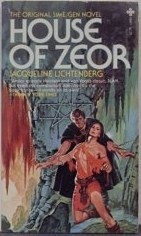
Book Review: House of Zeor by Jacqueline Lichtenberg (Series, #1)
Summary:
In the distant future, humanity has split into two mutant forms: the life-energy producing Gen, and the vampiric, tentacled Sime. Most Simes treat Gens like animals to be consumed for food. Hugh Valleroy from the Gen Territories must infiltrate the Sime lands in order to locate his beloved Aisha. This means joining House Zeor, a Sime Householding led by Klyd, that believes in the necessary unification of the two peoples, and who have the ability to let the Sime feed without killing the Gen donors.
Review:
I do my best to read widely in scifi, which includes older scifi. I especially try to find older scifi by women authors. This book was first published in 1974, and, in addition to being older scifi by a woman, I heard it involved tentacles. I was intrigued, so I hunted down a copy. There are very few reviews online from modern reads. There are some nostalgic reviews about reading it many years ago. So, even though I didn’t like it, I thought it might be helpful to others to contribute a modern, non-nostalgic take.
The basic concept was interesting. There are predators who absolutely need something from the prey to function. It is made abundantly clear that eventually without consuming some Gen life force the Sime die. But the prey are sentient. What to do? Something else that was interesting was that the mutation doesn’t occur until puberty and, bizarrely, children in both Sime and Gen territory mutate into both forms. This means Gen parents turn on their Sime child (for fear of being eaten) and Sime parents….eat their Gen children. What a world! I wish this had been explored more deeply than it was.
A lot of the world building is touched on briefly but then not really explained or not explored deeply enough. Hugh has a “starred cross” he wears that his mother, who escaped Gen territory, gave him, telling him belief in it would protect him. But does it? It’s unclear. What is he believing in exactly? It’s never explored. Similarly, the “selyn” is mentioned a lot but never really defined. The Gens all speak English but the Simes speak “Simelan.” Is this true of the whole world? Just this area? What is Simelan anyway?
Let’s talk about the three things that made me bump this down from three stars to two. First, one of the heroes of the book, Klyd, displays clear homophobia. He and Hugh are an auction of Gens looking for Aisha. It’s established that most Simes view Klyd as a “pervert” because he doesn’t kill Gens but rather has a symbiotic companion relationship with them. Another Sime goes to bid and Klyd says that Sime is the true pervert because he sleeps with men as if they are women. He and all the other Simes show disgust at it, and our other hero doesn’t argue back against it. The existence of queer people is never touched upon again in the book, so this viewpoint remains unchallenged. I found this particularly upsetting as the companionship relationship has some really clear homoerotic undertones. In order to do a selyn exchange, the two people must hold each other’s forearms and then touch at a fifth touching point, the preferred one is lip to lip contact aka to kiss. It’s also common for companions to share a bed. But somehow this relationship isn’t a perversion but being queer is?
The second thing is how race and ethnicity are handled. At a couple of points, it’s established that at some point the races all mixed up together and we have many blended people now. That’s fine. But the main characters are all white coded. I mean, really white coded. In a way that wouldn’t make any sense if this was truly a future of completely mixed races. And when talking about it, Hugh, who is born in this “mixed race” world uses current terms to talk about what races he thinks various people are mixed with. Um, ok. If it’s all of them, why even wonder this? I also want to mention for my Asian diaspora readers that at one point a slur is used to describe someone of Asian descent.
The third thing is how the women in the book are handled. This frustrates me as this was written by a woman. You’ve already noticed the two main characters are men out to save a woman. There are really only three other female characters in the book. One is raped (off-screen). (Slight spoiler coming here). One dies in childbirth. I’d say Hugh’s mother is the only woman character who is well-rounded and interesting.
Overall, the initial world imagined is interesting, but how it is handled is not. Additionally, those looking for a thoughtful handling of the existence of queer people, race, and women won’t be getting it in this book.
2 out of 5 stars
Length: 224 pages – average but on the shorter side
Source: PaperBackSwap
Buy It (Amazon or Bookshop.org)
If you found this review helpful, please consider tipping me on ko-fi, checking out my digital items available in my ko-fi shop, buying one of my publications, or using one of my referral/coupon codes. Thank you for your support!
Book Review: Coffee Will Make You Black by April Sinclair (Series, #1)

Summary:
Set on Chicago’s Southside in the mid-to-late 60s, following Jean “Stevie” Stevenson, a young Black woman growing up through the Civil Rights and Black Power movements. Stevie longs to fit in with the cool crowd. Fighting her mother every step of the way, she begins to experiment with talkin’ trash, “kicking butt,” and boys. With the assassination of Dr. King she gains a new political awareness, which makes her decide to wear her hair in a ‘fro instead of straightened, to refuse to use skin bleach, and to confront prejudice. She also finds herself questioning her sexuality. As readers follow Stevie’s at times harrowing, at times hilarious story, they will learn what it was like to be Black before Black was beautiful.
Review:
After reading Tales of the City by Armistead Maupin (review) and finding myself disappointed with how it handled race, I intentionally looked for older classics of LGBTQIA+ lit written by Black authors. (As a starting place. I intend to continue this searching with other BIPOC groups). In my search I found this book listed as an own voices depiction of a queer young Black woman in the South Side of Chicago. My library had a digital copy, so I was off.
First published in 1995, this is certainly an own voices book. The author grew up in Chicago in the same time period as Stevie, and that authenticity really shines through. The book is divided into three parts. Part 1 (spring 1965 to summer 1967), Part 2 (fall 1967 to fall 1968), and Part 3 (fall 1969 to spring 1970). Part 1 begins in Stevie’s last year of middle school. It establishes the systemic racism Stevie and her family live with that the Civil Rights movement that Stevie will later become involved in in high school. It also demonstrates Stevie’s difficult relationship with her mother. In Part 2, Stevie enters high school, Dr. King is assassinated, and Stevie starts to push back on racism and colorism. In Part 3, Stevie starts to question her sexuality and also the lack of interracial friendships and relationships she sees among her friends and family.
In some ways this was a tough book to read. It pulls no punches about what life was like for a young Black girl at this time. Although it always pains me to read about racism and colorism, there was an extra twinge in reading this because Stevie is just such an immediately likable little girl with a protective mother. The book opens with Stevie asking her mother what a virgin is (because a boy at school asked her if she was one), and her mother not wanting to tell her. This reminded me of all the conversations about Black girls being forced to grow up too fast and letting them stay the little girls they are. Although I advocate for frank talks about sexuality with questioning children, I also understood her mother’s impulse to keep Stevie little just a while longer.
Stevie’s sexuality is left open-ended in this book, in spite of my finding it on a list of lesbian fiction originally. Essentially the idea is posited that sometimes adolescents feel confused only to realize later they’re straight. I wondered if this is what happens with Stevie so peaked at the sequel. (spoiler warning!) Apparently in the sequel Stevie identifies as bisexual. This thrilled me, because there’s so little representation of bisexual folks in literature, but also because I felt a bit of a twinge of recognition when reading about Stevie’s confusion in the book. Part of why she’s so confused about if she’s straight or a lesbian is because the answer is neither. It was a great depiction.
I did feel the book ended kind of abruptly. It’s definitely a bit of a plot hanger that leaves you yearning for the sequel. Not in an uncomfortable way but more in a I want to see Stevie finish growing up way. Plus, it’s the start of the 1970s, and that’s such a fun time period to read about.
Overall, this own voices book gives a realistic yet fun depiction of growing up Black in the South Side of Chicago in the 1960s. If you’re coming for the queer content, hang in there, it shows up in Part 3. A great way to diversify your reading.
4 out of 5 stars
Length: 256 pages – average but on the shorter side
Source: Library
Buy It (Amazon or Bookshop.org)
Get the Reading Group / Book Club Discussion Guide
A beautifully graphic designed 2 page PDF that contains: 1 icebreaker, 9 discussion questions arranged from least to most challenging, 1 wrap-up question, and 3 read-a-like book suggestions
View a list of all my Discussion Guides.
If you found this review helpful, please consider tipping me on ko-fi, checking out my digital items available in my ko-fi shop, buying one of my publications, or using one of my referral/coupon codes. Thank you for your support!
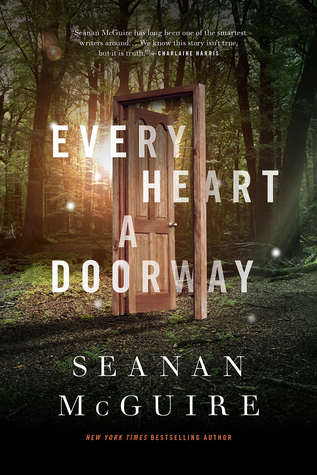
Book Review: Every Heart a Doorway by Seanan McGuire (Series, #1)
Summary:
Children have always disappeared under the right conditions; slipping through the shadows under a bed or at the back of a wardrobe, tumbling down rabbit holes and into old wells, and emerging somewhere… else. But magical lands have little need for used-up miracle children.
Nancy tumbled once, but now she’s back. The things she’s experienced… they change a person. The children under Miss West’s care at her Home for Wayward Children understand all too well. And each of them is seeking a way back to their own fantasy world.
But Nancy’s arrival marks a change at the Home. There’s a darkness just around each corner, and when tragedy strikes, it’s up to Nancy and her new-found schoolmates to get to the heart of things. No matter the cost.
Review:
This is the first book in the series but they all also can be read as stand-a-lone stories if you want. One of my siblings-in-law gave me the second book as a gift, and I decided I wanted to read the first book first to ensure I got the greatest enjoyment out of it possible. I felt confident with this decision, because I’ve really enjoyed everything else by Seanan McGuire I’ve read. As expected, this was a fun read.
The worldbuilding is gorgeous and creative. Not just the idea of the doors but also the map of how the other worlds are organized. Stephen King’s other worlds are organized around a tower. These are organized around a compass, similar to those political leaning compass tests, only this is organized on points such as Logic vs Nonsense and Wickedness vs Virtue. The worlds are varied, and so are the children who get drawn in then come back. Although come back is the wrong term for these children. They all want to “go home” to their other worlds. The children who don’t want to go back attend a different boarding school. (Now that’s also a series I’d read, just saying).
I found the plot to be less engaging than the world building. The mystery at the school was both bloodier than I would have preferred and also far too expected and easy to figure out. I viewed the plot as an excuse to continue sojourning in the world.
There is diversity present in the book. Although the main character and owner of the school are both white, Nancy’s roommate is Japanese-American. One of her new friends is Latino. I do wish the races and ethnicities of more of the secondary characters were more clearly stated. There is a trans girl character, who is a strong secondary character with a lot of realistic struggles. Nancy, the main character, is asexual (but romantic), and the word is used. Although I am myself queer and bisexual, I fully admit my understanding of the ace members of our community is less than it might be. I was uncertain about the representation in the book, so I found an ace person’s review. They loved the representation and felt Nancy to be very representative of them.
Some folks complain the book is too short, but largely because they wanted to linger longer. I thought it was just about the right length. I like reading a shorter read sometimes, and this means it’ll be much faster and easier to visit the worlds of the other characters featured in the other entries in the series more in-depth.
Recommended for readers looking for a quick read with a creative and engaging fantasy world. Especially recommended for those looking for asexual and trans representation in their fantasy.
4 out of 5 stars
Length: 176 pages – average but on the shorter side
Source: Library
Buy It (Amazon or Bookshop.org)
If you found this review helpful, please consider tipping me on ko-fi, checking out my digital items available in my ko-fi shop, buying one of my publications, or using one of my referral/coupon codes. Thank you for your support!
 Support my work with a tip or browse my shop for curated book club guides, how to guides, cross-stitch patterns, and more!


This work by Amanda Nevius is licensed under a Creative Commons Attribution-Noncommercial-No Derivative Works 3.0 United States License.
 Opinions of a Wolf