
Archive
Book Review: Bear by Marian Engel

Summary:
A librarian named Lou is called to a remote Canadian island to inventory the estate of a secretive Colonel whose most surprising secret is a bear who keeps her company–shocking company.
Review:
I don’t recall anymore how I heard about this book, but this is what I heard about it:
There’s this book that’s considered a Canadian classic where a librarian has sex with a bear.
Ok. I was left with questions. First, this sounds like erotica – how is it a classic? Second, as a trained librarian I immediately wondered if the librarian part was essential to the story. Third, does she really have sex with a bear? Then I became even more intrigued when I discovered I couldn’t get this book digitally but only in print AND it’s out of print in the US so it’s far cheaper to purchase it abroad and have it sent here. So, now that I got this book from the UK and read it (in one weekend), let me answer these questions for you.
First, I wouldn’t call this erotica. The point, in spite of the murmurings about it, is absolutely not about sex with a bear, whereas in erotica, the point is the sex. I in all honesty would say this is a book about burnout. Lou is an archivist who is in a rut. When the nameless Institute she works for sends her to this estate that has been left to them to inventory their materials, her time in nature and her experiences with the locals (yes, including Bear), reveals her massive burnout to her.
She wondered by what right she was there, and why she did what she did for a living. And who she was.
(pg 93)
Second, I would definitely say the librarian part is essential to the story. Librarianship is a feminized profession. This book was first published in 1976. It is an exploration of what it means to be a working woman and how the world views working women, even when our work is performed outside of the public’s eye (perhaps especially when our work is performed outside of the public’s eye). I also thought this book does an excellent job of showing how even though librarianship is a feminized profession, those in the positions of greatest power within libraries and archives are men. Lou’s boss is a man, and this is relevant to her negative work experience.
Third, does she actually have sex with a bear? Ok, slight spoiler warning here. There is no penetration. She tricks the bear to go down on her. That’s it. I didn’t find it particularly shocking, but I’m a millennial from the internet generation that grew up with the internet urban legend about the woman with the dog and the peanut butter so. I viewed the transgressive act with Bear as serving two purposes. First, Lou has a tendency toward self-sabotage, self-loathing, and self-punishment. I think transgressing in this way makes her see how she’s transgressing against herself and her own soul in other ways and makes her refind her own sense of self. Second, I think it’s important to note that at the beginning of the book an Indigenous woman named Lucy kind of hands off the caretaking of Bear to Lou. At the end of the book, she hands the caretaking back to Lucy. I view this as an acknowledgement that just because you can do something doesn’t mean you should. It doesn’t mean it’s your life calling. There are other interesting takes on this as a commentary on colonialism, which I also think are valid.
So do I see why this is a Canadian classic? Yes, absolutely. The whole story oozes Canada from the juxtaposition of the wilderness with the city to the entwining of European and local history to the acknowledgment of the realness and relevance of local Indigenous peoples. (These peoples are not of the past but are of the present, something I think Canadian literature often does a better job with than US literature).
I thought I was going to read this book and laugh at it, kind of like how folks on book-tok are laughing about the ice planet barbarians right now. Instead, I found a unique story about a woman’s time in the semi-wilderness and how it makes her confront her burnout and how her career is a poor fit for her. How her life setup is causing her to transgress and how that needs to change. A shocking way to get the point across? Perhaps. But an important point nonetheless.
4 out of 5 stars
Length: 167 pages – average but on the shorter side
Source: Purchased
Buy It (Amazon or Bookshop.org)
Get the Reading Group / Book Club Discussion Guide
A beautifully graphic designed 2 page PDF that contains: 1 icebreaker, 9 discussion questions arranged from least to most challenging, 1 wrap-up question, 3 read-a-like book suggestions
View a list of all my Discussion Guides.
If you found this review helpful, please consider tipping me on ko-fi, checking out my digital items available in my ko-fi shop, buying one of my publications, or using one of my referral/coupon codes. Thank you for your support!
Book Review: Under the Whispering Door by T.J. Klune

Summary:
When a reaper comes to collect Wallace Price from his own funeral, Wallace suspects he really might be dead. Instead of leading him directly to the afterlife, the reaper takes him to a small village. On the outskirts, off the path through the woods, tucked between mountains, is a particular tea shop, run by a man named Hugo. Hugo is the tea shop’s owner to locals and the ferryman to souls who need to cross over.
But Wallace isn’t ready to abandon the life he barely lived. With Hugo’s help he finally starts to learn about all the things he missed in life.
Review:
I preordered this because of how much I loved another Klune book that I read earlier this year – The House in the Cerulean Sea (review). I just did not want to have to wait through the line at the library for a copy of this one. So maybe my expectations were a bit high for this after that. Maybe I would have liked this better if I hadn’t loved that one so much. But I do feel decidedly ho-hum about it.
Here’s what I did enjoy about it. The main character is a bisexual man. We don’t see that often in literature. And the representation of male bisexuality is well done. The setting and feel of the book is just plain cozy. I loved the tea shop, and how it’s described. I would want to go there for tea for sure. It was soothing to visit, in spite of being populated by ghosts and having a general ambiance of being in touch with the dead. The cover really beautifully represents the tea shop. It was a setting I wanted to soak into.
So what turned me off? I feel a bit awkward talking about this as the author states in the afterword that writing this book was part of his own grief process after losing someone. But I am also a person who has gone through grief for someone close to me, and I just have to say that this vision of the afterlife just didn’t work for me. I found it quite sad, actually. I got the vibe I was supposed to feel at least a little hopeful from it but I didn’t. I don’t like that there’s jobs and management. I didn’t like that the supernatural creature in management asserts there’s no god. (Kind of confusing for a setting that’s entirely about a mystical afterlife?)
My other issue with the book was with the main character Wallace’s character development. He was a jerk in his life and learns to do better in his afterlife. I didn’t find the transformation realistic or believable. It’s like one minute he’s the guy heartlessly firing someone in the first chapter and the next he’s this selfless ghost. What happened that made him change? It just didn’t track for me. And that made it quite difficult for me to care about his storyline. I read about it because I wanted to hang out in the tea shop but not because I cared about Wallace.
So if you’re ok with the depiction of an afterlife that’s managed like a department store and an extremely rapid turnaround of character, you’ll probably really like this book. The cozy setting, and the bisexual male representation are big pluses also.
3 out of 5 stars
Length: 373 pages – average but on the longer side
Source: Purchased
Buy It (Amazon or Bookshop.org)
If you found this review helpful, please consider tipping me on ko-fi, checking out my digital items available in my ko-fi shop, buying one of my publications, or using one of my referral/coupon codes. Thank you for your support!
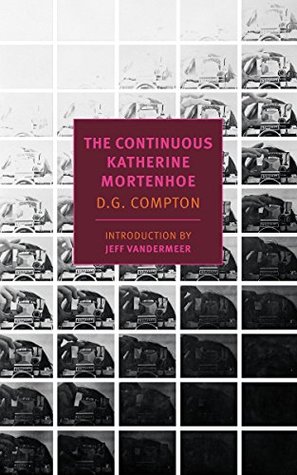
Book Review: The Continuous Katherine Mortenhoe by D.G. Compton
Summary:
Katherine Mortenhoe’s world looks very similar to our own, except that in this near future medical science has found the cure for death—or eliminated nearly every cause for it other than old age. So when Katherine is diagnosed with a terminal brain disease caused by an inability to process an ever-increasing volume of sensory input, she immediately becomes a celebrity to the “pain-starved public.” But Katherine will not agree to be the star of the reality TV show Human Destiny, her last days will not be recorded by any cameras. She doesn’t realize that from the moment of her diagnosis, she’s been watched, not only by television producers but by a new kind of reporter, one with no visible camera, who is always recording behind his never-blinking eye.
Review:
This book was first published in 1973 under the title The Unsleeping Eye. It was then published in the UK in 1974 under this title. It was made as a film in 1980 under the title Death Watch with the books published after that under that title. Then in 2016 it was republished as The Continuous Katherine Mortenhoe along with a new introduction by Jeff Vandermeer. All of which is to say, although you may see it listed as published in 2016, this is actually a 1970s vision of the future. This makes its take on reality tv all the more impressive to me.
The story is told in two perspectives from Katherine’s and from the reporter’s. They both live in the near future UK. Katherine is in her 40s on her second husband, childfree (there is no discussion of fertility issues or a desire for children), and works for Computabook’s romance department. Computabook appears to be essentially an AI largely writing Harlequin style romance novels. The consensus seems to be that she could write a great novel and is wasting her time at Computabook. She goes to the doctor quite a bit, which is presented as odd for a time when most illnesses are cured. The gentle opinion seems to be that she has a mental problem skewing toward perhaps hypochondria. But then she gets a terminal diagnosis. The reality tv show Human Destiny is so sure that they will get her to sign on to live out her last days filmed that they secretly film her receiving the diagnosis news, figuring they will get her permission via contract later.
The reporter has just consented to have tv cameras implanted in his eyes, allowing them to film without the presence of any cameras, only him. He cannot be in full darkness for a period of time after the surgery and takes pills to stay awake. He has an ex-wife and son. The ex-wife very much dislikes his work for the producer who does Human Destiny. She does not like this producer.
There are a lot of ex-spouses in this society because they do 5 year handfastings, essentially, and at that point they decide whether or not to recommit for another 5 years. It’s supposed to not be a big deal if folks don’t recommit, but it’s clear from both the reporter’s relationships and Katherine’s that it actually is to the folks involved. While not a focus of the book, I found this interesting.
The book then ultimately explores the ethics of why Katherine might or might not sign on for the show, whether or not the reality tv show is in and of itself ethical, and what the limits of cameras in a person’s eyes are to truly telling the truth. I would also say it explores the impact of your job on your life and your sense of fulfillment. Another theme is how different people’s lives look depending on how much they have “bought in” to the way of life depicted to them as the main choice by the government. There’s also a question of what’s a good death and who gets to choose what that means.
I most enjoyed the exploration of the alternative societies outside of the mainstream. I also found the depiction of near future reality tv very well-imagined. I am happy to report that there is no rape or sexual violence in this 1970s scifi book. There is an instance where it seems a possibility, but it does not ultimately happen. There is medical trauma and some minor violence seen in robberies.
This book ultimately left me pondering if it was trying to say something larger about the male gaze or if that was coincidental. Regardless, it left me thinking about women and our lives and how others view them. A valuable issue to ponder. Plus it was fun to explore this imagined future society.
4 out of 5 stars
Length: 264 pages – average but on the shorter side
Source: Purchased
Buy It (Amazon or Bookshop.org)
If you found this review helpful, please consider tipping me on ko-fi, checking out my digital items available in my ko-fi shop, buying one of my publications, or using one of my referral/coupon codes. Thank you for your support!
Book Review: Laziness Does Not Exist by Devon Price, PhD

Summary:
Explores the psychological underpinnings of the “laziness lie,” including its origins from the Puritans and how it has continued to proliferate as digital work tools have blurred the boundaries between work and life. Using in-depth research, Price explains that people today do far more work than nearly any other humans in history yet most of us often still feel we are not doing enough. Filled with practical and accessible advice for overcoming society’s pressure to do more, and featuring interviews with researchers, consultants, and experiences from real people drowning in too much work.
Review:
I was raised with a strict, Protestant work ethic. I mean, I grew up in New England. The epicenter of Puritanism. “Lazy” was one of the worst insults to hurl at someone else or to internally scream at myself to keep myself pulling all-nighters etc… So why did I pick up a book with such a title? I follow Devon on Instagram, and I found myself helped and relating so much to what they said about dealing with burnout in academic labor that I decided to see past the title and try out the book.
Devon starts the book by sharing their own burnout/overwork story. The thing that makes this so compelling is we know that Devon still accomplished things – just look at this book! – in spit of embracing what some might call “laziness.” So how did Devon go from burnt out and overworked to fighting back and successful? Devon intertwines their story with psycho-social explorations and stories from others encountering burnout and overwork.
A few things really stuck out to me when reading this book. The first is that there’s no science behind the length of the average workday or workweek as it stands in the US (8 hours a day, 40 hours a week). What science there is indicates it’s “still probably too long and demanding for most people” (loc 15%). A statistic to back this up that really blew my mind:
Researchers consistently find that in office jobs, people are capable of being productive for only about three hours per day, on average.
loc 24%
The point being that if you’re finding it hard to concentrate or get things done it’s not that you’re lazy, it’s that you’re being asked to think and work for longer periods of time than people are actually capable of naturally. Devon then goes into how more breaks and less time working actually leads to better quality of labor and greater satisfaction in workers. They also talk about the dangers of work performed by overtired people, and these aren’t just the obvious like falling asleep at the wheel. People also, for example, get more negative and judgmental when overtired.
Devon then goes into the perils of information overload. How access to so much information so easily can and does overwhelm us. How this has changed dramatically in the last decades.
The volume of unique information the average person encounters in a day is approximately five times what the average person encountered in 1986.
loc 39%
They also speak about how it’s not always possible to just “disconnect,” giving the example of how we might need to check the news to see if there’s currently a lockdown in place.
This all leads nicely into a part of the book that talks about the importance of downtime – not just from physical labor but from brain work and accessing information. This essentially boils down to a need for quiet contemplation that is often demonized as laziness. But this is essential for us to be able to engage with our world in a meaningful way.
In the interest of not going into information overload here, I will say the final thing that stuck out to me in this book. Devon calls on us to be kinder to both ourselves and others. To not jump to the accusation of lazy but rather to ask are we in service to the system asking too much of ourselves? Of others? How can we be kinder and ask less? Keeping in mind that with less the quality often improves as well. So instead of, for example, berating yourself for feeling tired mid-afternoon and struggling to finish your to do list, look at what you have done. How many hours have you worked? Is your to do list reasonable? Can you reduce it at all? Do you still have time for downtime? Maybe your body just needs rest. Maybe your mind does too. We’re all only human, and we’re asking an inhuman amount from people.
Recommended if you’re interested in a deeper dive into these concepts with more real world examples.
4 out of 5 stars
Length: 256 pages – average but on the shorter side
Source: Library
Buy It (Amazon or Bookshop.org)
If you found this review helpful, please consider tipping me on ko-fi, checking out my digital items available in my ko-fi shop, buying one of my publications, or using one of my referral/coupon codes. Thank you for your support!
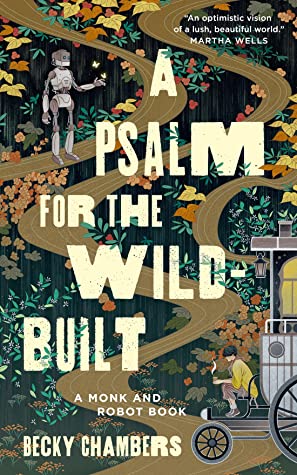
Book Review: A Psalm for the Wild-Built by Becky Chambers (Series, #1)
Summary:
Dex is a tea monk on a planet that lives an eco-friendly lifestyle on a minimal share of the planet with a large portion left wild. The robots found sentience years ago and left for the wild themselves. When Dex diverges suddenly from their usual traveling path, a robot makes contact for the first time in generations.
Review:
This book just oozes coziness and relaxation. Things happen but reading it feels sort of like visiting a 1990s era fantasy/scifi tv show where nothing truly dangerous happens and everything gets wrapped up nicely within 60 minutes. If that tv show was progressive enough to have a non-binary main character that is.
Sibling Dex’s planet is a lot like Earth but definitely is not Earth. The most notable clear indicator that this is not Earth is the universal religion, which Dex is a monk in service of. That said, this religion seems like kind of a mash-up of Buddhism and Hinduism to me. It’s got a lot of Buddhist traditions but tied to a set of 6 gods/goddesses. Dex is in particular service to Allalae, who is tied to bears somehow. I enjoyed the tie to bears. It means there are cute carvings and things of bears everywhere.
The book follows Dex’s journey from an urban monk to a traveling tea monk who roams around the countryside on a bicycle/tiny house extravaganza. Tea monks basically show up, listen to people’s feelings, and then make the perfect cup of tea for whatever their current needs are. They eventually feel what struck me as a bit of a quarter-life (or mid-life?) crisis and veers off-course to visit an old monastery. It’s at this point that Mosscap the wild-build robot reaches out to make contact.
When the robots gained sentience, it was agreed that humans would not contact robots but robots could contact humans. Mosscap is on a mission to see how humans are doing, and of course Dex and Mosscap pair up and help each other on their quests. This is when the fun conversations take place between Dex, who is clearly a bit overly tied to his emotions, and Mosscap, an externally observant logical being. I enjoyed these conversations, even though I found them to be rather expected.
Here’s the thing. I would have loved this book if it had gone on longer. I felt like we were just really starting to get into the meat of things when the book ended. I get it this is the start to a series. But it’s quite short (almost novella length), and I was enjoying the world. I also, from a story structure perspective, feel that essentially things just got set up. I supposed one could chose to write a trilogy that splits the basic story structure out across three books but that will inevitably feel to some people like a bit of a let-down because we expect a complete story. I wish someone had said, “Hey! Just finish telling Dex and Mosscap’s story! No need to stop yet.” I’d probably be less annoyed by this if the next book was out already.
I didn’t find anything in this to be incredibly deep, although I suspect I may have if I had read it before I had studied a lot of philosophical and religious literature. I did however find it to be cozy and relaxing, and I loved the juxtaposition of a cottage core tiny house monk with a 1950s style robot with sentience. Yes. I was also pleased to see Dex as non-binary, and how smoothly their culture just clearly had it set up to say Sibling Dex instead of Brother or Sister. The representation worked and never felt forced.
Recommended to anyone looking for a short, cozy, scifi read and/or to those looking for non-binary representation in scifi.
4 out of 5 stars
Length: 160 pages – average but on the shorter side
Source: Library
Buy It (Amazon or Bookshop.org)
If you found this review helpful, please consider tipping me on ko-fi, checking out my digital items available in my ko-fi shop, buying one of my publications, or using one of my referral/coupon codes. Thank you for your support!
Book Review: The Rest of the Robots by Isaac Asimov

Summary:
A collection of 8 of Isaac Asimov’s classic robot short stories, divided into three sections: The Coming of the Robots, The Laws of Robotics, and Susan Calvin.
Review:
I often struggle to read short stories. For me, they often are just a bit too short for me to get fully invested into the world they’re set in, so they oddly drag in spite of being short. But this collection really worked for me, and I think that’s because the world was already fully established in my mind. It was just then a matter of what would happen with this particular iteration of a robot and the humans around it.
The world that pre-existed in my mind already was Asimov’s Three Laws of Robotics (this explains them, if you’re not already familiar with them). Well, that combined with a world that had managed to make robots and engages in space exploration.
The book starts with an early generation robot who goes missing in a rural area and ends up at the behest of a rural man. This one made me laugh out loud, and not in a way that I think takes advantage of anyone. The second short story in this section looks at what happens when robots are sent in advance to a hostile alien planet. What I enjoyed about both of these is how the robots are so pure and so honest and how that throws everyone around them.
I thought the second section was the least engaging, but keep in mind I loved the collection so that’s barely a criticism. There’s a short story that’s very Cold War inspired about spies and robots. Then there’s also one that’s a human telling a tall tale about a robot breaking one of the laws. It’s left up to the reader to decide if it’s true.
The third section all feature the robopsychologist Susan Calvin. To me, it’s clear Susan is somewhere on the Autism spectrum, and I loved her. It did bother me a bit how everyone else in the stories describes Susan as cold and seems to question her femininity because they perceive her as lacking warmth and mothering qualities. But I also think this is a bit of a commentary – is Susan really like this or do others just perceive of her that way? I also really like how well she relates to the robots. She’s not a main character in each of the stories, but she does play a pivotal role in all of them. My favorite was “Galley Slave,” which is about a robot being brought into academia to do some ho-hum labor. Asimov was a professor of biochemistry, and the realness of the problems with academia are clear in the hilarious scifi and robot flavored commentary on that institution.
Overall, I really enjoyed these short stories. They’re a great example of how strong clear, rapid worldbuilding combined with characters formed quickly in broad strokes can make short stories work very well.
5 out of 5 stars
Length: 224 pages – average but on the shorter side
Source: Gift
Buy It (Amazon, not available on Bookshop.org)
If you found this review helpful, please consider tipping me on ko-fi, checking out my digital items available in my ko-fi shop, buying one of my publications, or using one of my referral/coupon codes. Thank you for your support!
Book Review: You’re As Good As Dead by E.A. Aymar (Series, #2)
Summary:
Three years have passed since Tom Starks, a Baltimore community college professor and single father, tried to avenge his wife’s death by hiring a hit man. Tom is now hopeful that he has left the world of violence and murder behind. But he is drawn back into Baltimore’s criminal underground after he witnesses the assassination of an influential crime boss. To make matters worse, it appears the FBI has discovered Tom’s involvement, and they force him to work with them as an informer. Now Tom must navigate a deadly path between warring crime families and ruthless federal agents, even as he desperately tries to keep his involvement a secret from those closest to him.
Review:
Tom Starks is definitely an example of what happens when you make one grave error in a moment of passion. This man just can’t seem to learn from his mistakes. The book opens with him dropping off money to the crime boss to keep quiet, and he witnesses the crime boss being taken out. The FBI then approaches him to infiltrate the battle between two different crime families. It’s help them or go to prison. Tom chooses helping of course.
The most interesting part of the story to me was when one crime family sends twin Black woman assassins to live with Tom. It’s a bit unclear even to Tom if they’re there to keep him quiet or keep him safe. I liked the characterization of the sisters. Yes, they’re involved in crime, but we find out the crime family’s boss essentially found them as teenagers and saved them from the streets. So they feel obligated to the crime family. They can be violent but also kind. I was particularly fond of how the sisters interact with the family’s pet bunny.
Tom clearly thinks of himself as the good guy but to the reader he’s really not one. He did, after all, hire a hit man. It seems easy to push his boundaries and to get him to do ever increasingly ethically wrong things. He also, in his spare time, sleeps with his dead wife’s sister – who is still married. He tries to protect his adopted daughter by pushing her away out of the house and never telling her anything about what’s really going on or doing a particularly great job of listening to her. This book is a story of a man’s continual descent.
It’s been a long time since I accepted this review copy, and I feel my reading tastes changed in the meantime. I used to be more interested in violent books than I am now. Now I need the violence to be making a statement about something, and I don’t think this one is making a statement. Plus, there is definitely a lot of violence – beatings, murders, and tortures. (No sexual assault though).
This is a book about violence and an ethically questionable man falling further and further into a descent of the loss of light. There is no hope at the end of the book. There seems to be no way out. Does this count as a cautionary tale about the ever-reaching effects of choosing retaliation over transformative justice? I think maybe. For someone like myself who already believes in choosing transformative justice over retaliation, it wasn’t illuminating, though, simply a tale with an expected sad trajectory.
3 out of 5 stars
Length: 290 pages – average but on the shorter side
Source: Kindle copy from author in exchange for my honest review
Buy It (Amazon, not available on Bookshop.org)
Previous Book in Series:
I‘ll Sleep When You’re Dead, review
If you found this review helpful, please consider tipping me on ko-fi, checking out my digital items available in my ko-fi shop, buying one of my publications, or using one of my referral/coupon codes. Thank you for your support!
Book Review: Made in China: A Memoir of Love and Labor by Anna Qu

Summary:
When Anna Qu was in high school, she had her guidance counselor call child protective services because her mother was making her work without pay in the family sweatshop. Her memoir uses this moment as the way into telling her life story. Of what happens when a family member is seemingly randomly selected as the one to ostracize.
Review:
I was immediately intrigued by this book because I thought – wow, what kind of mother brings her child to the US only to turn around and force her to work in a sweatshop? I could wrap my head around a mother owning and running a sweatshop. I could even imagine having your child work in a sweatshop in a different cultural context (due to need, due to cultural expectations, etc…). But the usual immigration story is a desire for your child to have a better life than your own. How does that compute if your own life is owning the sweatshop? I had to find out.
Anna’s mother immigrated to the US from China, leaving her in the care of her grandparents. She felt loved, but that changed when she joined her mother, new stepfather, and two new half-siblings in the US. An early warning sign of what is to come is seen at her arrival party thrown to celebrate her family’s ability to bring her over from China. How that party went awry and how the relationship with her mother started to fall apart is one of the most painful and eloquent scenes in the book.
Of course because this is a memoir we never get to know Anna’s mother’s motivations. But we do see some of her perspective revealed through the case worker, case documents, and what Anna’s grandmother had to say about it. A strength of this book is how the author is able to explore her mother’s own trauma without excusing her actions.
I was a ghost haunting a family that wanted nothing to do with me, and the loneliness left a tightness in my chest.
location 392
But Anna’s family wasn’t the only one to other her. Society did as well. Classmates perceived her as different and distanced themselves from her. When she went away to college, she did so without any familial support and found nothing at college was set up for people like her. She struggled to find places to stay on winter breaks, had to advocate to be declared independent from her family so she could get financial aid, and more. Thus we see the pain of noninclusive societies. How societal inclusion is even more important for people being denied by their own families.
The author also examines the two-pronged issue of sweatshop labor and workaholism. She views this as having started out as a necessity to make it in the US that then became a way of being. Although the author acknowledges the exploitation of her own experience, she takes the time to point out how much worse it is for other people. For example, undocumented workers with no legal recourse.
Thus, the book explores what makes family, society, and workplaces abuse some and not others. It provides no easy answers but is a memorable call for greater inclusivity and empathy. Recommended for readers of memoirs with an interest in intergenerational trauma and/or immigration and labor issues.
4 out of 5 stars
Length: 224 pages – average but on the shorter side
Source: Netgalley
Buy It (Amazon or Bookshop.org)
If you found this review helpful, please consider tipping me on ko-fi, checking out my digital items available in my ko-fi shop, buying one of my publications, or using one of my referral/coupon codes. Thank you for your support!
Book Review: Safe In My Arms by Sara Shepard

Summary:
Three women whose children attend an elite preschool in coastal California find their lives intertwined when they all receive threatening notes in their children’s backpacks.
Review:
Sara Shepard is most famous for writing Pretty Little Liars, the series the hit tv show is based upon. In Pretty Little Liars the threat is text messages. Here it’s old school notes. Only this time, it’s the moms twisted into secrets and lies.
The three moms are at the center of the book, and I only actually liked one. Andrea is a trans woman who moved to California to be able to transition and live openly, away from her elite and judgmental family. Now, I will note I am a cis woman, and I would like to hear what a trans woman thinks of the representation, but I thought Andrea was written very well. I appreciated the realism of having to deal with some transphobia in her family but also being warmly welcomed by the other two women – both as a friend and as a woman. The author’s note at the end makes it clear she sought out a sensitivity reader for Andrea, and I could tell. If only the same efforts had been made for the other two women….
Lauren is struggling with postpartum rage (a symptom tied to postpartum depression). I just felt she was quite two-dimensional, and I just couldn’t bring myself to care about her.
Ronnie is a topless maid, formerly a stripper, who moved here from Pennsylvania with her daughter. It at first appears she did so to get away from an abusive man. I can’t talk about Ronnie without revealing a slight spoiler (it’s revealed about 1/3 of the way into the book), so be warned.
Ronnie’s “daughter” is actually her niece. Her sister was in a relationship with an abusive man and was addicted to something. It’s vaguely explained as drugs. Ronnie, after a violent fight with her sister’s significant other that ends with her discovering her sister wounded on the floor, takes the baby and runs with her. She never follows up to see if her sister is ok. No, no, she just steals her daughter, changes her daughter’s name, and decides her daughter is better off with her anyway. I just simply could not empathize with the child abductor here. Ronnie had other options to help her niece. She had never even tried anything else (beyond living with her sister to “protect” her). I’m ok with a book featuring a less than ideal character. I’m not ok with the whole tone of the book being that I should empathize with her or that what she did was a mistake.
Because that’s the thing. The book kind of wraps up with the message that all moms make mistakes and it’s ok to not be perfect. I mean, sure, within reason. But there’s it’s ok to not be perfect and then there’s you’re only in the mom club because you stole someone else’s child.
Also as someone who cares about addiction and recovery, I found the depiction of Ronnie’s sister Vanessa to be heartless. She isn’t given the same chance and possibility to recover and change and learn from her mistakes as the other mom’s. In fact, the whole “moms don’t have to be perfect” scene features the moms describing all the reasons their children make them drink alcohol. The hypocrisy of this scene sickened me.
Contemporary books are approaching the pandemic in a variety of ways. This one chose to set the story “post-pandemic.” I’m fine with that optimistic choice, and I understand why it was made. But the strange thing is it mostly seems to acknowledge the impacts of the pandemic as purely economic – there’s a lot of talk about economic challenges from when we all stayed home but almost zero mention of anything else. I think there was one mention of face masks? This is set in California. There was way more impact than just economic. It rubbed me the wrong way how it made it out to be all about economic issues, and also how things just immediately snapped back to normal. If one wants a normal contemporary book, fine, just don’t acknowledge the pandemic at all then. Include an author’s note that this is for escapism and move on. Don’t acknowledge it as an economic downturn like 2008 and nothing much else…..
Beyond this, the actual main issue going on at the school was interesting and twisty. I had my suspicions early on, but I still enjoyed the twists. What really saved the book for me, though, was Andrea. We need more positive trans rep in psychological thrillers, and Andrea was very well-done.
3 out of 5 stars
Length: 304 pages – average but on the longer side
Source: NetGalley
Buy It (Amazon or Bookshop.org)
If you found this review helpful, please consider tipping me on ko-fi, checking out my digital items available in my ko-fi shop, buying one of my publications, or using one of my referral/coupon codes. Thank you for your support!
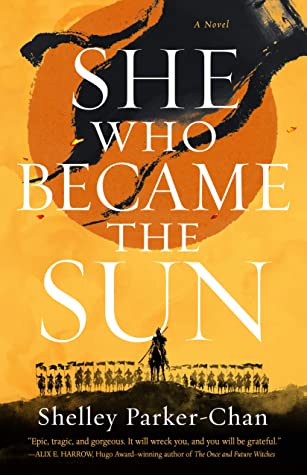
Book Review: She Who Became the Sun by Shelley Parker-Chan
Summary:
In China in 1345, a little peasant girl barely surviving a famine hears her brother will have a great fate but she is fated to nothingness. When their father dies and her brother chooses to die with him, she lays claim to his fate, going to a monastery and pretending to be a boy for survival. When she grows up, she finds herself pursuing her brother’s great fate and clashing repeatedly with Ouyang – a man who survived an order to kill his entire male line by being forcibly turned into a eunuch. As the Mongols and the Nanren clash for dominance in China, Ouyang and the person known as Zhu Chongba find their fates clashing.
Review:
This is being marketed as the queer Mulan, and I just have to say that Mulan was already queer. Li Shang Mulan regardless of what gender she is presenting as. But there’s plenty of room for more than one queer ancient China war drama. :-)
I loved the beginning of this book. The famine and Zhu’s entire time in the monastery just spoke to me. I was engrossed. But then when Zhu leaves the monastery the tone and setting of the book changed, and it worked less for me. To me the beginning of the book is about choosing your own destiny, and the clash of desire and faith. The end of the book is about being the best warlord with your brains instead of brawn, which just was less compelling to me personally. Actually, I think this quote from the book sums up how Zhu is at the end of the book, even though this is actually Zhu describing someone else:
[T]he ferocious, irreligious joy of a man who has willingly cast aside any chance of nirvana for the sake of his attachment to life.
(location 843)
The fantasy elements of this book include that Zhu and some others can see ghosts – hungry ghosts specifically, which is a Buddhist concept. Leaders also have a mandate from heaven, which presents itself as a visible fire they can summon into their hands. Different leaders have fire of different colors. It’s interesting to note that many sides seem to have a real mandate of heaven. Why is an interesting question that I hope the sequel will explore.
The queer elements in the book include both gender and sexuality. Zhu seems to experience some gender dysphoria – this is not presented simply as a cis woman passing as a man. It’s more complex than that. However, I do wish this was explored more deeply. For example, the omniscient narrator refers to Zhu as “she” regardless of how Zhu seems to feel about their gender at any point. Ouyang is a eunuch, and eunuchs fall under the queer umbrella. Ouyang has romantic feelings for another man. It was unclear to me if these feelings were ever consummated. Zhu falls for a woman, and they have sexual relations onscreen. For me, Ouyang’s relationship was a classic queer tragedy. Zhu’s is more complex, and I’m interested to see where it goes in the sequel.
There is a character who loses a limb in this book. The moment of the limb loss is presented as a turning point for this character. It lets them become who they need to be. I felt negatively about this. It read to me as a bit like disability inspiration p*rn. I understand that, for this character, their relationship with their body is complex. But I wish another way had been found to help the character come into their own rather than this.
Overall, I really enjoyed that this fantasy was set in a culture steeped in Buddhism as a nice change of pace for fantasy. Queer characters are central, rather than as tragic sidekicks. The qualms I had did not keep me from enjoying the book as a whole, and I am interested in its sequel. Recommended to fantasy lovers looking for a change or to those who don’t usually read fantasy but might enjoy it for the representation.
4 out of 5 stars
Length: 416 pages – average but on the longer side
Source: NetGalley
Buy It (Amazon or Bookshop.org)
If you found this review helpful, please consider tipping me on ko-fi, checking out my digital items available in my ko-fi shop, buying one of my publications, or using one of my referral/coupon codes. Thank you for your support!
 Support my work with a tip or browse my shop for curated book club guides, how to guides, cross-stitch patterns, and more!


This work by Amanda Nevius is licensed under a Creative Commons Attribution-Noncommercial-No Derivative Works 3.0 United States License.
 Opinions of a Wolf