
Archive
Stories That Heal: 5 Books for Mental Health Awareness Month
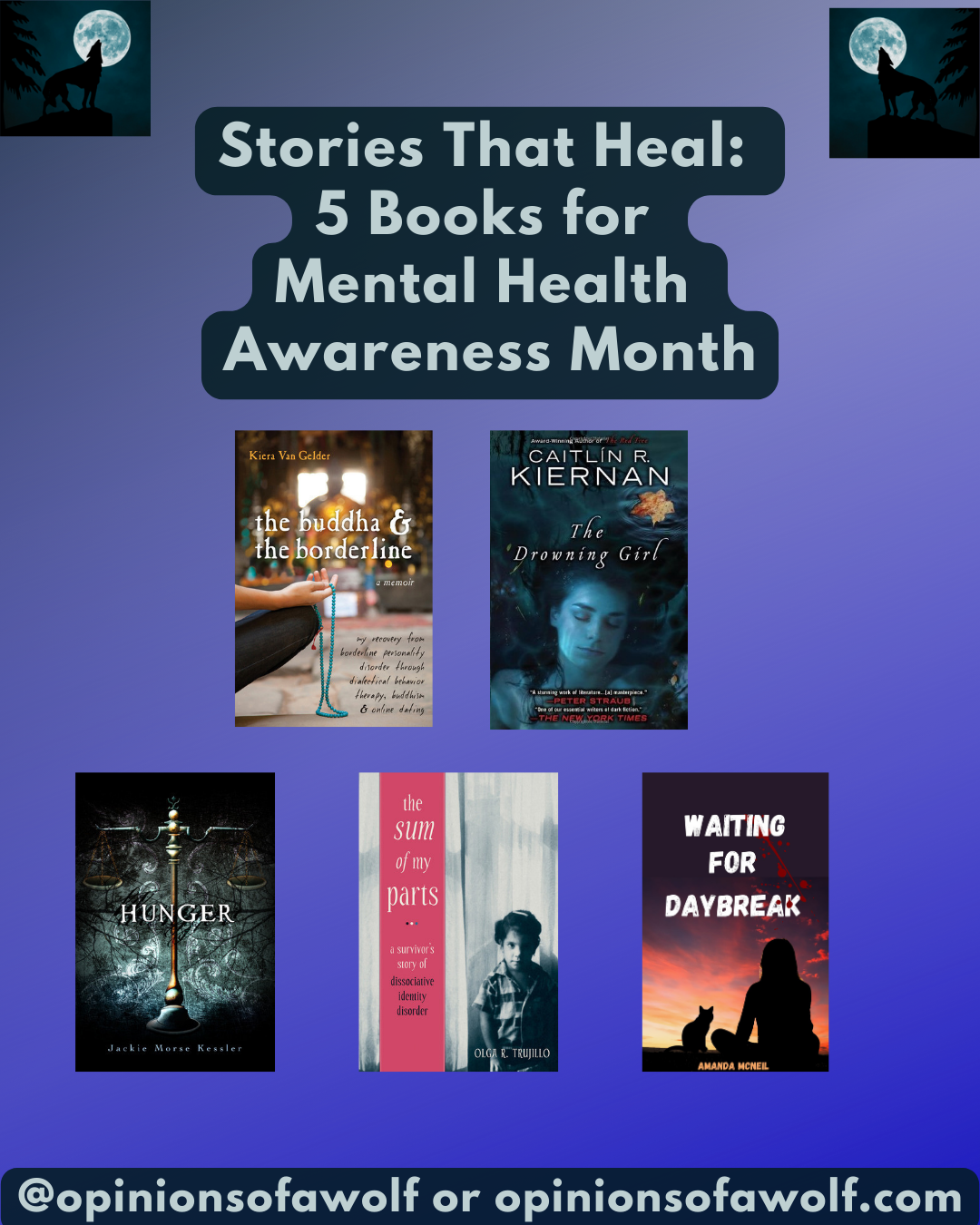
May is Mental Health Awareness Month—an annual observance founded by Mental Health America in 1949 to highlight the importance of mental wellbeing, educate the public, reduce stigma, and promote support for those affected by mental health conditions.
As someone who believes in the power of books to change lives, I thought this was the perfect time to share a mental health–focused reading list. Whether you frequently read books centered on mental health or are exploring this space for the first time, I hope you’ll find something here that resonates. This list includes a mix of fiction and nonfiction across genres—something for every reader.
The Buddha and the Borderline: My Recovery from Borderline Personality Disorder through Dialectical Behavior Therapy, Buddhism, and Online Dating by Kiera Van Gelder
(Amazon, Bookshop.org)
memoir
In this candid memoir set largely in Boston, Kiera Van Gelder traces her journey through Borderline Personality Disorder—from self-harm and addiction to healing through Dialectical Behavior Therapy and Buddhism. It’s an honest, hopeful account of finding stability and meaning after years of chaos.
(Read full review)
The Drowning Girl by Caitlin R. Kiernan
(Amazon, Bookshop.org)
literary fantasy, LGBTQIA+
In this haunting literary mystery, India Morgan Phelps—Imp to her friends—tries to untangle what really happened the summer she met Eva Canning. Was Eva a mermaid? A werewolf? Or is Imp’s memory altered by her schizophrenia? Told in lyrical, first-person prose, The Drowning Girl explores mental illness, identity, and unreliable memory, with nuanced queer representation and a mystery that unfolds entirely from within.
(Read full review)
Hunger by Jackie Morse Kessler
(Amazon, not available on Bookshop.org)
fantasy, YA
In this early 2010s YA standout, Hunger blends biting fantasy with raw realism to explore anorexia through a supernatural lens. When teen Lisabeth Lewis is visited by Death and becomes Famine—one of the Four Horsemen of the Apocalypse—she’s forced to confront the eating disorder that controls her life. With Buffy the Vampire Slayer-style humor and emotional honesty, this novel offers a powerful, metaphor-rich take on the inner voice of anorexia and the path to healing.
(Read full review)
The Sum of My Parts: A Survivor’s Story of Dissociative Identity Disorder by Olga Trujillo, JD
(Amazon, Bookshop.org)
memoir
In this powerful memoir, Olga Trujillo—once a successful attorney in D.C.—recounts their journey through the diagnosis, treatment, and recovery process of Dissociative Identity Disorder. As long-repressed memories of childhood abuse begin to surface, Olga works to integrate their parts and reclaim their life. With compassion, clarity, and survivor-centered care, this memoir offers both insight and hope to anyone seeking to understand trauma, dissociation, or the long path to healing.
(Read full review)
(Note: At the time I wrote my original review, Trujillo had not yet come out as nonbinary, so older references use previous pronouns.)
Waiting for Daybreak by Amanda McNeil
(Amazon, Bookshop.org)
zombie horror
In my own novel, Waiting for Daybreak, a young woman with Borderline Personality Disorder unexpectedly finds sobriety from alcoholism and strength when a zombie outbreak turns Boston upside down. Frieda has spent years battling emotional chaos and isolation—but when a mysterious virus brings society to a halt, she discovers survival suits her better than daily life ever did. As she sets out to save her sick cat, her solitary routine shatters, and she’s forced to reengage with a world that no longer plays by the rules. A character-driven post-apocalypse, Waiting for Daybreak explores mental illness, addiction recovery, and the fragile resilience that can grow in even the bleakest moments.
(See what readers are saying)
I hope you’ve found something here that speaks to you. If you have a favorite book that explores mental health—fiction or nonfiction—I’d love to hear about it in the comments!
Book Review: She Who Knows by Nnedi Okorafor
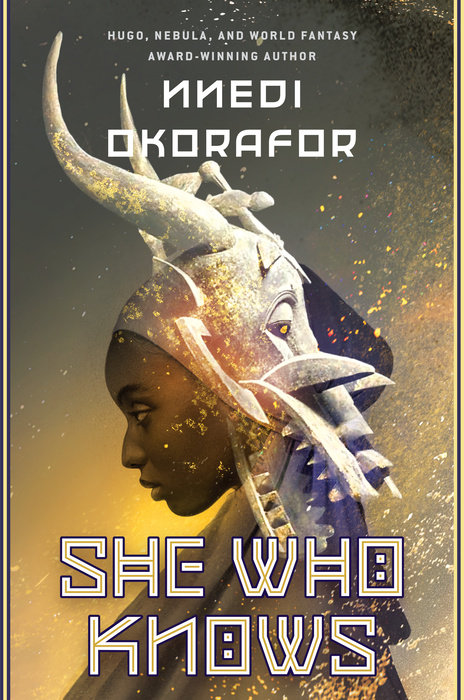
Blending science fiction and fantasy in a near future West African setting, this engaging prequel offers a compelling plot blended with a unique coming-of-age story in a quick read.
Summary:
Najeeba knows.
She has had The Call. But how can a 13-year-old girl have the Call? Only men and boys experience the annual call to the Salt Roads. What’s just happened to Najeeba has never happened in the history of her village. But it’s not a terrible thing, just strange. So when she leaves with her father and brothers to mine salt at the Dead Lake, there’s neither fanfare nor protest. For Najeeba, it’s a dream come true: travel by camel, open skies, and a chance to see a spectacular place she’s only heard about. However, there must have been something to the rule, because Najeeba’s presence on the road changes everything and her family will never be the same.
Review:
This short, powerful book packs quite a punch with its quickly established setting, a main character you can easily root for, and action scenes that will leave you breathless.
This is a perfect example of science fantasy (also called space fantasy), blending elements of both science fiction and fantasy seamlessly. The science fiction aspect is revealed through its post-apocalyptic future—something happened to reset the world. Paper books are rare and kept in a community building, and the salt fields that Najeeba’s people harvest from were created by a drying up of the water. The fantasy elements feel just as integrated, from the “Call” that Najeeba’s people receive when it’s time to go to the salt, to the supernatural powers some individuals can access. (For another science fantasy read, check out my retelling of Thumbelina set on Venus.)
Though part of a prequel series to Nnedi Okorafor’s Who Fears Death, you don’t need to have read that to enjoy this one. I hadn’t read it either, and I never felt lost or like I was missing crucial context. The initial conflict—Najeeba’s desire to do something that’s typically only for boys—is easy to grasp, and the world-building is subtle and effective. By the time the more unique and fantastical elements come into play, I was fully immersed in the world.
Set in a future version of West Africa, this features Black protagonists, with other characters who are Arab. While some of the abilities that develop in the story could be read as an allegory for developing a disability, none are explicitly represented.
The plot kept me hooked, and while I was satisfied with the ending, I found myself eager to explore more of this world. I’m excited to pick up the next book in the series when it’s available.
Overall, this is a quick, engaging read that brings science fantasy to a West African future setting. It’s a refreshing take on the near-future genre, offering a new perspective that I look forward to exploring further.
If you found this review helpful, please consider tipping me on ko-fi, checking out my digital items available in my ko-fi shop, buying one of my publications, using one of my referral/coupon codes, or signing up for my free microfiction monthly newsletter. Thank you for your support!
4 out of 5 stars
Length: 161 pages – average but on the shorter side
Source: Library
Buy It (Amazon or Bookshop.org)
Book Review: Wildwood Chronicles Trilogy by Colin Meloy

When crows steal Prue’s little brother, she and her friend Curtis find that the Impassable Wilderness bordering Portland, Oregon, isn’t quite so Impassable after all.
Summary:
Prue and her friend Curtis uncover a secret world in the midst of violent upheaval—a world full of warring creatures, peaceable mystics, and powerful figures with the darkest intentions. And what begins as a rescue mission becomes something much greater as the two friends find themselves entwined in a struggle for the very freedom of this wilderness. A wilderness the locals call Wildwood.
Review:
A middle grade fantasy trilogy by the lead singer of my favorite band, The Decemberists. Gorgeously illustrated by his wife, Carson Ellis. If you’ve ever read The Chronicles of Narnia, this is like that except replace the Christianity with environmentalism and new age spirituality.
My favorite part of this trilogy was the various talking birds. All the animals in the Impassable Wilderness can talk, but Meloy’s love of birds really comes through. (As a fan of his songs, this didn’t surprise me at all.) The dapper outfits all the animals wear are also just too cute. It’s a trilogy with maps, and I do always love a good map to go with a story. I appreciate very much that the hero of the story is a girl with Curtis playing the sidekick.
There are really two enemies in the plot. A civil war style conflict inside the Impassable Wilderness, and the looming threat of capitalism from outside the Impassable Wilderness. I liked the idea of the latter more than the former, but the execution felt a bit too silly to me. For example, the big bad capitalists are all named the Titans of Industry (capitalized like that). One of them uses child labor in the form of orphans collected directly from Portland. It felt quite Victorian for something where the rest of the world outside of the Impassable Wilderness is quite modern.
The books are incredibly long, hitting chunkster length even for adult books. Each is over 500 pages (the last clocking in at 580.) I certainly read some long books when I was a kid, so I don’t begrudge them that per se. I do think it’s a tough sell when even the first book is super long. Regardless, I don’t think that the length is justified by the plot. While the first book is just about paced right, the latter two are not. There’s a lot of pages spent on not a lot going on. The middle book especially suffers horribly from middle book syndrome.
I liked the world, the Impassable Wilderness residents, and the illustrations. I felt the plot lacked depth, and the pacing was too slow for my taste, especially for such long books. I also found the ending to be a let-down.
Overall, this could be a good match for a reader who has a hankering for a through a secret door fantasy. Especially for the reader who loves talking animals and doesn’t mind a slower pace.
If you found this review helpful, please consider tipping me on ko-fi, checking out my digital items available in my ko-fi shop, buying one of my publications, using one of my referral/coupon codes, or signing up for my free microfiction monthly newsletter. Thank you for your support!
3 out of 5 stars
Books in Series:
Wildwood, 4 stars, length 541 pages – chunkster
Under Wildwood, 3 stars, length 559 pages – chunkster
Wildwood Imperium, 3 stars, length 580 pages – chunkster
Source: Gift
Buy It (Amazon or Bookshop.org)
Book Review: Rouge by Mona Awad

When Belle’s semi-estranged mother dies falling off a cliff in California, she comes from Montreal for the funeral and soon finds herself sucked into the same “spa” her mother was frequenting before her death.
Summary:
For as long as she can remember, Belle has been insidiously obsessed with her skin and skincare videos. When her estranged mother Noelle mysteriously dies, Belle finds herself back in Southern California, dealing with her mother’s considerable debts and grappling with lingering questions about her death. The stakes escalate when a strange woman in red appears at the funeral, offering a tantalizing clue about her mother’s demise, followed by a cryptic video about a transformative spa experience. With the help of a pair of red shoes, Belle is lured into the barbed embrace of La Maison de Méduse, the same lavish, culty spa to which her mother was devoted. There, Belle discovers the frightening secret behind her (and her mother’s) obsession with the mirror—and the great shimmering depths (and demons) that lurk on the other side of the glass.
Review:
Imagine a woman gets pulled into the world of Eyes Wide Shut, only there’s a lot less clarity about what exactly is going on.
The first 10% of the book and the last 25% had me very interested. The middle felt a little repetitive and slow. On the plus side, this book put me to sleep so easily. I can’t remember the last time I fell asleep so quickly when reading. Maybe not a huge positive to say about a horror book, but something about the language and the setting lulled me right to sleep. I only started to be able to make progress when I began to skim. I think the lengthy descriptions of the skin care routine just wasn’t particularly interesting to me as someone who simply doesn’t do skincare.
The main character is half Egyptian, half white. Her Egyptian father died so she lives with her white mother. A lot of the book is about the conflicts that arise for her as a woman of color with a white mother. I liked how the book illuminated the mistakes Belle’s mother made as a white woman raising an Egyptian daughter while also showing how she still loved her daughter and was trying. It’s a delicate balance to strike, and it was well done. She is also bisexual. This is established by her dating two siblings, which wasn’t my favorite way of revealing that. It’s a little too close to the bisexual as cheater trope.
What exactly was going on at the spa and how it ties back to Belle’s childhood remains a little confusing to me, even after reading the ending. I think I understand it. But I suppose what confuses me the most (minor spoiler) is how this society could target people from the other side of the continent many years in advance, and what made them target those specific people. That was a bit fuzzy to me. (Read more about what others thought about the confusing bits here. Be warned – there’s a lot of spoilers in that link!) I also agree with others who say the romance subplot wasn’t needed. I would have been quite happy with full focus on Belle and her mother.
I really enjoyed the way the sentences were put together, even if I thought the story overall could have been tightened. The story itself is interesting, although definitely drawing inspiration from others that I felt were creepier and with a more straight-forward big bad.
Recommended to those willing to dive into scenes of a character’s skin-care routine and atmospherically vague reveals that let you choose what you think happened. I am certain these readers are out there, and I hope they find this book. It feels almost like a love letter to that audience.
If you found this review helpful, please consider tipping me on ko-fi, checking out my digital items available in my ko-fi shop, buying one of my publications, using one of my referral/coupon codes, or signing up for my free microfiction monthly newsletter. Thank you for your support!
3 out of 5 stars
Length: 384 pages – average but on the longer side
Source: Library
Buy It (Amazon or Bookshop.org)
Book Review: The Witch’s Lens by Luanne G. Smith
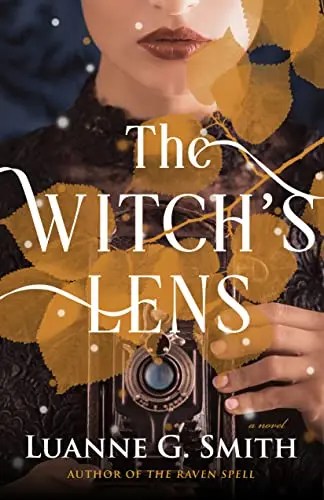
A witch finds herself recruited to WWI’s eastern front to fight a scourge of zombies.
Summary:
With her husband off fighting at World War I’s eastern front, Petra Kurková embraces her fleeting freedom, roaming the city at night with her camera. A born witch, she’s discovered that she can capture the souls of the dead on film. Her supernatural skills don’t go unnoticed by the enigmatic Josef Svoboda. He’s recruiting a team of sorcerers to infiltrate the front lines, where the bloodshed of combat has resurrected foul creatures. Petra’s unique abilities will be needed against the most dangerous enemies of all—those ever present, undead, and unseen.
Deep in the cursed Carpathian Mountains, the ragtag team meets with an emissary of an ancient organization founded to maintain balance between worlds. Photographing the escalating horrors is beyond anything Petra imagined. So are the secrets among her fellow witches. But Petra can’t turn back. Not before she discovers her husband’s fate and the myriad ways her magic is manifesting. To defeat an occult foe, Petra must release the power she’s been concealing for so long, or risk damning a war-torn world to ashes.
Review:
I came into this book expecting a lot of WWI with a dash of witches but it ended up being the other way around.
If it wasn’t for the book’s blurb mentioning WWI and one passing mention of the Archduke’s assassination, it would be possible to read this book and think the entire war was a fantasy. This becomes increasingly so as the book progresses. Perhaps I missed something but at first it sounds like the humans are fighting and unaware of any supernatural folks participating in the war pushing it one way or the other. Then later it seems like everyone knows about witches. So which is it?
The book starts slowly, showing Petra living on her own, lonely and bored, going out at night to take photos since she’s discovered the dead show up in them. I was intrigued by this and wondering why Petra can only see the dead in her photos, but the why is never revealed. The camera is useful to the plot but not in the way you would imagine from what we know it can do.
The zombies in the book are the fast type. (See more zombie recommendations from me.) They can move at superhuman speeds. An interesting unique take is that zombies can continue to exist among the living until they’re called upon by another power to act like a zombie. They’re basically Trojan horses among the soldiers.
There is some light romance in the book. Personally, it didn’t work for me because we see Petra starting to long for a man who isn’t her husband. That’s just not a plot point I personally enjoy. The romance is hinted at in the book. There is not even a kiss. I suspect it will get stronger in the sequel. Those who want to read for the romance should know this is a very slow burn.
If we ignore the confusing aspects of whether or not everyone in the world knows about the witches, the plot does escalate in a way that mostly make sense and things come to a head with quite a bit of action. But there is an element of “the chosen one,” which I find dull. Especially in a book about WWI. I wanted to see everyone coming together with unique strengths. Not one overpowered person.
Overall, this book wasn’t a match for me. I wanted a lot more WWI than was in it. Recommended to those interested in a witch’s war with a dash of light, slow-burn romance.
If you found this review helpful, please consider tipping me on ko-fi, checking out my digital items available in my ko-fi shop, buying one of my publications, using one of my referral/coupon codes, or signing up for my free microfiction monthly newsletter. Thank you for your support!
3 out of 5 stars
Length: 255 pages – average but on the shorter side
Source: Library
Buy It (Amazon or Bookshop.org)
Book Review: In the Lives of Puppets by T.J. Klune
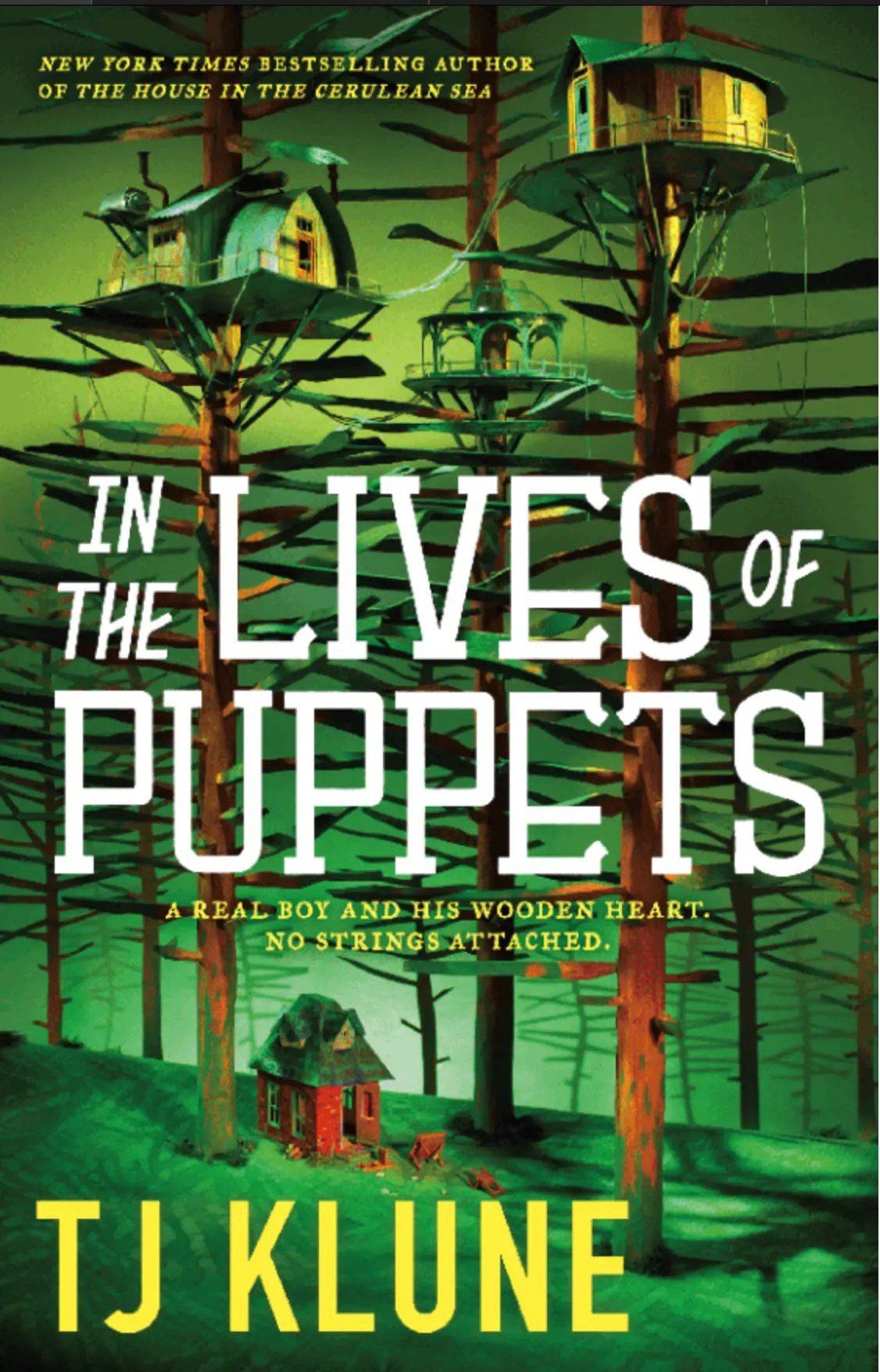
A science fantasy reimagining of Pinocchio where Pinocchio is a “real boy” surrounded by robots (puppets) with a m/m (or, rather, male, male robot) romance added in.
Summary:
In a strange little home built into the branches of a grove of trees, live three robots–fatherly inventor android Giovanni Lawson, a pleasantly sadistic nurse machine, and a small vacuum desperate for love and attention. Victor Lawson, a human, lives there too. They’re a family, hidden and safe.
The day Vic salvages and repairs an unfamiliar android labelled “HAP,” he learns of a shared dark past between Hap and Gio-a past spent hunting humans.
When Hap unwittingly alerts robots from Gio’s former life to their whereabouts, the family is no longer hidden and safe. Gio is captured and taken back to his old laboratory in the City of Electric Dreams. So together, the rest of Vic’s assembled family must journey across an unforgiving and otherworldly country to rescue Gio from decommission, or worse, reprogramming.
Along the way to save Gio, amid conflicted feelings of betrayal and affection for Hap, Vic must decide for himself: Can he accept love with strings attached?
Review:
This is a loving and detailed send-up to Pinocchio. I hadn’t seen the movie in years, and it still stirred up memories for me. When I went to look up the original book version’s plot to compare to this retelling, I found even more details I hadn’t realized or remembered. It’s obvious the author loves Pinocchio, and if you do too, I’m expecting you’ll likely love this retelling. For me, the problem is, I was so excited about a new T.J. Klune book that I sort of…forgot I don’t like Pinocchio. (“Don’t like” is a gentle remembrance. In fact, the movie absolutely terrified me as a child.) Even so, I found myself able to appreciate this loving rendition of the story.
I absolutely adored the character of Rambo – the tiny robot vacuum who’s clearly supposed to be a later generation of roombas. As always, I liked the narrative style the author uses – it reads as sing-songy in my head and feels like someone telling me a fairy tale, which is perfect for this book. I liked the wide variety of robots inhabiting the world, and I really enjoyed the robot substitute for the traveling circus character. I also appreciated that this isn’t an exact retelling of Pinocchio. The story is sometimes restrained, with simple allusions to the original. For example, Victor is never turned into a donkey, but he does stay the night in a hotel like room that is decorated with donkeys at about the right point in the story.
I appreciated the flipping of Pinocchio (Victor in this telling) as being human with his father being a “puppet” (a robot). But I felt like the ending really lets that inversion down, not taking it to its full and complete conclusion. I think there’s supposed to be humor in this book, but it wasn’t funny to me. You will know within the first few chapters if it’s tickling your funny bone or not.
I also found myself unable to root for anyone in this book, save for the small, innocent Rambo. Everyone else has something so wrong with them that it soured me to like them. The one I can talk about without spoilers, as the episode happens in the first chapter, is Nurse Ratched. She is a robot companion of Victor’s who was designed to nurse humans. She’s described as sociopathic, in a way that I think is supposed to read as comedic. As in, she acts like she enjoys inflicting pain but doesn’t really. Yet in the first chapter she chases down a squirrel (off-screen) and kills it by rolling over it again and again. I almost stopped reading the book, I was so horrified. But it was an advanced copy, so I decided to give it another chance. She never does anything like this ever again, but it is actually not uncommon for characters in this book to have something they have done in the past that is truly horrific that is brushed off as their programming. I’m all for plots where characters have to overcome their own tendency toward being bad, and redemption and forgiveness are both very important. But I need for that not to be the plot for almost every single character. It, at the very least, is distressing to read about.
The romance did not move me, which was surprising given what strong feelings I had for the couple in The House in the Cerulean Sea! I also have complicated feelings about how the book depicts what freedom means, how robots pursue freedom, the offerings of the “freedom fighter” character, etc… This, in fact, is a reflection of how I feel the overarching messages tended to get muddled. The only message that I felt was clear and consistent was “be brave!” but no clear reason as to why was ever given. To borrow from an American fairy tale – the overarching story needed a heart. I think, perhaps, the romance was supposed to be the heart, but it didn’t work as one for me.
This is also an incredibly sad book. It’s not uplifting in the slightest. There’s nothing wrong with sad books, but it is a departure from the author’s other books, and so I think the warning is warranted.
Overall, this is an imaginative and loving retelling of Pinocchio that should appeal to fans of that fairy tale. Readers should be aware that the darkness of the original story remains in this retelling.
If you found this review helpful, please consider tipping me on ko-fi, checking out my digital items available in my ko-fi shop, buying one of my publications, or using one of my referral/coupon codes. Thank you for your support!
3 out of 5 stars
Length: 432 pages – average but on the longer side
Source: NetGalley
Buy It (Amazon or Bookshop.org)
Book Review: Can’t Spell Treason Without Tea by Rebecca Thorne

A sapphic (wlw) cozy fantasy where a woman commits treason by running away from her lifelong job as the Queen’s private guard to start a remote tea shop with her girlfriend.
Summary:
After an assassin takes Reyna hostage, she decides she’s thoroughly done risking her life for a self-centered queen. Her girlfriend Kianthe, the most important mage in all of the land, seizes the chance to flee responsibility. Together, they settle in Tawney, a town nestled in the icy tundra of dragon country, and open the shop of their dreams.
What follows is a cozy tale of mishaps, mysteries, and a murderous queen throwing the realm’s biggest temper tantrum. In a story brimming with hurt/comfort and quiet fireside conversations, these two women will discover just what they mean to each other… and the world.
Review:
This might be the first time I’ve ever impulse read a book on my kindle’s “recommended for you” list. I was precisely in the mood for something lighthearted and escapist, and none of my library books or currently owned ebooks fit that bill. When I saw this title, I laughed. Then I read the description and, delighted to see it was a cozy fantasy, decided to give it a whirl. (What exactly is cozy fantasy? It’s a newly defined genre, but I like the devoted Reddit subgroup’s definition. The Kenosha Public Library is a little more specific in their definition.)
I mostly expected a plot about opening a tea shop in a fantastical land with dragons. That was really one of three plots. The other two involve Reyna’s treason and Kianthe’s role as the most powerful mage. It was a little more high stakes than I was expecting. People’s lives are at stake at quite a few points. It didn’t particularly stress me out, but I guess I was expecting something more along the lines of – oh no we’re out of honey and can’t get anymore for a month because the dragons are blocking supply chains – sort of thing. That said, even though it wasn’t quite what I was expecting, it was still a relaxing, escapist read to me.
I like the main couple. They have a sweet dynamic with things to overcome. Mainly that Reyna was raised to a role of servitude to those born to power, and Kianthe was born to power. Reyna has to come to understand her worth, and Kianthe does amazingly supporting her through that. I also loved the dragons and griffons. There are two nonbinary secondary characters, both of whom use they/them pronouns. Although the word isn’t used, it’s strongly hinted at that a secondary character who is a woman married to a man is bisexual.
Kianthe is a woman of color, although I personally was left confused by what exactly her skin tone is. It is described as “the color of drying clay” (page 42). I checked on Writing With Color’s skin tone guide, and they do suggest clay as a reference. From the picture on their page, I think it’s supposed to denote reddish-brown. For me, though, when I was reading, I thought of gray clay. Writing With Color does state that creative descriptions can be confusing to the reader and suggests using additional descriptives to help. I don’t think drying brings much clarity to the sentence. Who’s really stood around watching clay dry? They also suggest to consider the associations that come up with a word. Clay is malleable, and I think Kianthe is anything but. Similarly, while Reyna’s hair is described many times as the typical shimmery blonde, I’m still not sure what Kianthe’s looked like due to a lack of description.
The tea shop itself ends up being a giant room full of plants that Kianthe keeps magically alive in the cold climate. I loved that aspect of it. The tea itself is largely inspired by our own world’s tea, and the goodies are essentially the same as here as well. The only exception being bagels with “creamed cheese.” The bagels are treated as kind of exotic and that confused me. Why are bagels exotic and not the scones? Why is cream cheese spelled differently and not bagels? One other thing that bugged me so much I ran an Instagram poll about it is that the tea shop owners make tea incorrectly. They add tea bags to cups of hot water. While this is totally fine in one’s own home when using a microwave and in a hurry, the proper way to make tea is by pouring the hot water over the leaves. Only one respondent in my entire poll said they do it the other way around, and they messaged me to tell me they do it that way because they have to microwave their water. This is a nice tea shop, and Reyna and Kianthe don’t make tea correctly! It hurt my escapism a bit. I wanted scenes of making various types of tea in the various different ways required. I wanted a matcha whisk and special timers for different steep times and different pots for black tea and green tea and herbal tisanes. I wanted Kianthe and Reyna to offer to make special mixes for customers based on something about them like this one tea shop in Portland, Maine did for me once. Essentially, I wanted less book time spent on the stakes and more on the tea. Bonus points if there was a fantastical tea with some wild steep requirements like, I don’t know, you have to add a molted scale from a dragon.
Overall, this is a different fantasy read featuring a w/w couple at the lead. It’s a fun universe to visit and was escapist for me. Recommended to readers looking for a quick, light read who don’t mind some stakes in their cozy.
If you found this review helpful, please consider tipping me on ko-fi, checking out my digital items available in my ko-fi shop, buying one of my publications, or using one of my referral/coupon codes. Thank you for your support!
4 out of 5 stars
Length: 339 pages – average but on the longer side
Source: Kindle Unlimited
Buy It (Amazon or Bookshop.org)
2022 Award Eligibility

I have four pieces eligible for awards during the 2022 award season in three categories.
All of these were first published during 2022.
For the paid stories, I am able to provide author copies for award consideration purposes only. Please email me at mcneil.author [at] gmail.com to request one.
Short Stories
“The University of Late-Night Moans” in Decoded Pride: A science fiction, fantasy, and horror story-a-day anthology for Pride month
June 9, 2022, issue 3, $14.99 digital
fantasy romance (sapphic / wlw)
It’s 1998, and Leonora’s friend Virginia is helping her investigate the moans coming from the cemetery across the train tracks from her dorm.
“Sister Prudence on the Beach” in Solarpunk Magazine
Issue #6, Lunarpunk Special, Nov/Dec 2022, $6 digital
hopepunk (speculative scifi)
Sister Prudence settles down for her full moon meditation on the beach. But a young one passing by interrupts not just her meditation but perhaps her retirement as well.
Drabble
“Bostonians Aren’t Friends With Our Neighbors” in Wyrms: An Anthology of Dragon Drabbles
July 1, 2022, $3 digital, $6 print
fantasy
The first line is “Deadrodents.com said the box on the triple-decker’s porch next door.”
Creative Nonfiction
“These Boots Were Made for Who?” in Just Femme & Dandy
July 4, 2022, issue 3, free
digital magazine version (page 105) or html/accessible version
literary fashion magazine through a queer lens
I explore how my favorite pair of thrifted boots helped me develop my queer, bisexual fashion sense and sustained me throughout the pandemic.
5 Sapphic Dark Fantasies for Halloween
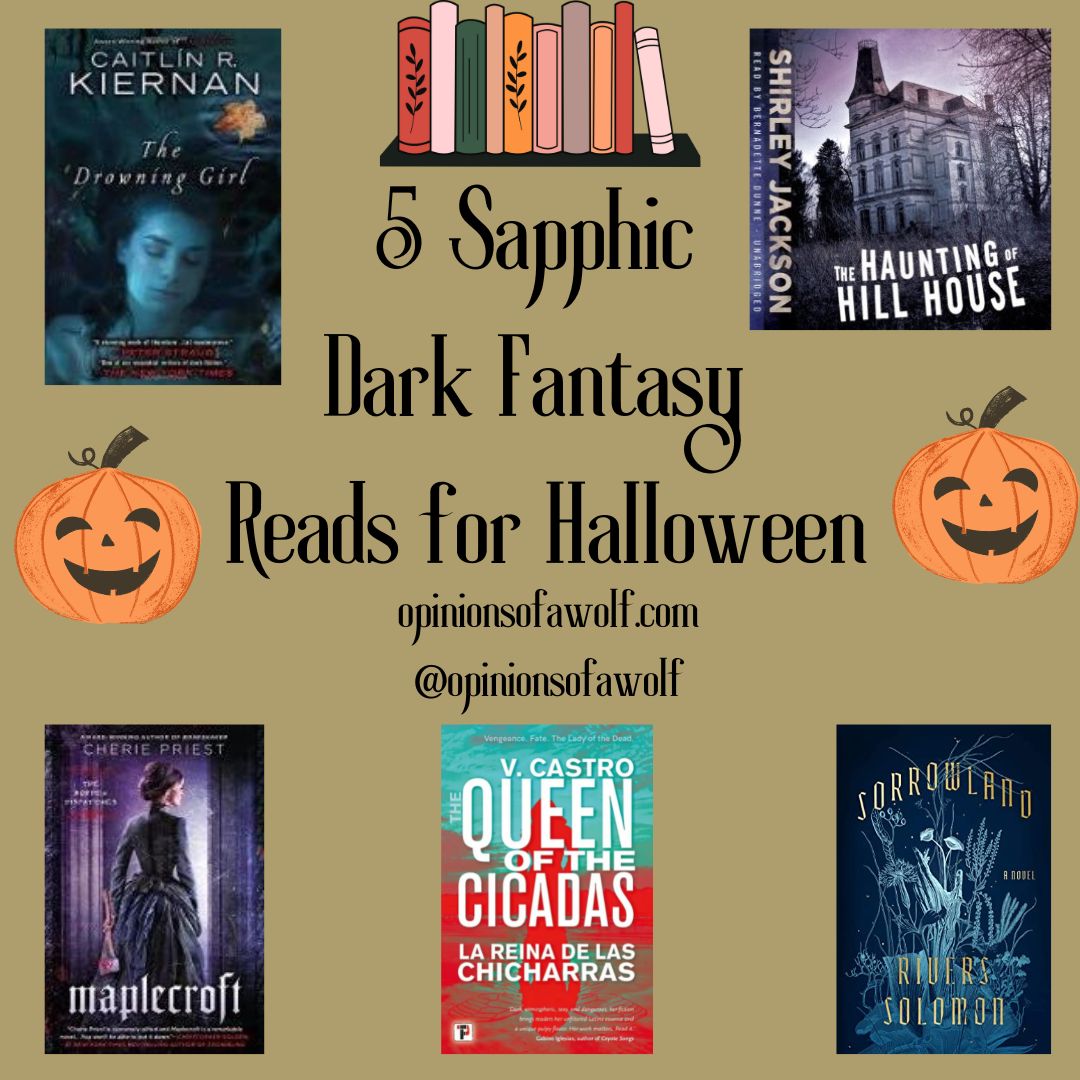
I am running A Very Sapphic Halloween Reading Challenge, which isn’t just for reading and reviewing new books but also for highlighting books you’ve read before (or hope to read) that fit the challenge. Something Halloweeny featuring women loving women.
This is my first list of suggested reads – 5 dark fantasies.
The Drowning Girl by Caitlin R. Kiernan
India Morgan Phelps, Imp to her friends, is sure that there were two different Eva Cannings who came into her life and changed her world. And one of them was a mermaid (or perhaps a siren?) and the other was a werewolf. But Imp’s ex-girlfriend, Abalyn, insists that no, there was only ever one Eva Canning, and she definitely wasn’t a mermaid or a werewolf. Dr. Ogilvy wants Imp to figure out for herself what actually happened. But that’s awfully hard when you have schizophrenia.
A beautiful thing about this book is how it’s up to the reader to decide if fantastical things actually happened or if they’re all symptoms of Imp’s schizophrenia. Told in the first person from Imp’s perspective, it’s a uniquely different mystery. (my full review)
The Haunting of Hill House by Shirley Jackson
Dr. Montague is a scholar of the occult, and he invites three other people to stay with him in Hill House, which is notorious for being haunted. There’s jovial Theodora, timid Eleanor, and the future heir of the house, Luke. What starts as a light-hearted adventure quickly turns sinister in this horror classic.
This is considered a sapphic classic, but it was published in the 1950s so the sapphic part is pure subtext, due to censorship at the time. A haunted house story that’s not too scary to most modern readers but a fun, quick read. (my full review)
Maplecroft by Cherie Priest
“Lizzie Borden took an axe; gave her mother forty whacks….”
Any New Englander knows the nursery rhyme based on the true crime story of Mr. and Mrs. Borden who were murdered with an axe in 1892. In spite of being tried and acquitted for the murders, their daughter (in the case of Mrs. Borden, step-daughter), was widely believed to actually be responsible for the murders. In this book, she definitely was, but maybe not for the reasons you might think.
A darkness is trying to take over Fall River, Massachusetts, and Lizzie and her ailing sister Emma are all that might stand between the town and oblivion, with Lizzie’s parents being the first casualties in the battle.
Lizzie Borden’s axe murder actually had to do with an eldritch horror, plus Lizzie has a girlfriend, Nance. Think Stranger Things but in the 1890s and the lesbian is the main character instead of the sidekick. (my full review)
The Queen of the Cicadas / La Reina de las Chicharras by V. Castro
You’ve heard of Bloody Mary and Candyman but have you heard of La Reina de las Chicharras? The legacy says she’s a Mexican farmworker named Milagros who was brutally murdered in 1950s Texas then given new supernatural life by the Aztec goddess of death, Mictecacíhuatl. In 2018, Belinda Alvarez arrives in Texas for a friend’s wedding on the farm that inspired the legacy of La Reina de las Chicharras. But is it just a legacy or is it real?
This struck me as a Latina version of Candyman, where the wrongs instigating the righteous vengeance are colonization and taking advantage of migrant farm workers. I can’t reveal the sapphic content without spoilering, but trust me, it’s there. (my full review)
Sorrowland by Rivers Solomon
Vern desperately flees the strict, religious, Black Power compound she was raised on while she is heavily pregnant with twins. Giving birth shortly thereafter and raising her babies in the woods, she finds herself transforming inexplicably. But what is she transforming into? Why? And can she protect her children from both the compound and the world?
This is a beautifully grotesque book that reminded me of watching season 1 of Hannibal – but with a Black lead with albinism who is a woman who loves women. (my full review)
Do you have suggested sapphic dark fantasy reads not on this list? Let us know in the comments!
If you found this list helpful, please consider tipping me on ko-fi, checking out my digital items available in my ko-fi shop, buying one of my publications, or using one of my referral/coupon codes. Thank you for your support!
Book Review: Buffalo Is the New Buffalo by Chelsea Vowel

Summary:
Inspired by classic and contemporary speculative fiction, this collection of eight short stories explores science fiction tropes through a Metis lens: Nanites babble to babies in Cree, virtual reality teaches transformation, foxes take human form and wreak havoc on hearts, buffalo roam free, and beings grapple with the thorny problem of healing from colonialism.
Review:
This collection contains nine short stories by Indigenous (Métis) author Chelsea Vowel. The Métis are a recognized Indigenous people with a unique culture descended from the pairings of Indigenous with European fur traders (usually, but not always, First Nations women with French men). Most of the stories are set in the same region of Canada, and all of the stories are speculative, containing some fantastical element, whether they are set in the past, present, or future.
The author is queer, and queerness is clearly present in five of the nine stories. These include: a historical woman figure who identifies as a woman, is interested in women, and dresses in male clothing; a woman character who becomes interested in a fox presenting as a woman; a woman character who is in lockdown without her girlfriend who ended up trapped in another town after she went to visit her family; a queer poly family raising a child together in a collective; and a nonbinary femme-presenting character who uses Métis gender-neutral pronouns.
My favorite story of the collection is “Maggie-Sue.” This is the story where an Indigenous woman becomes interested in a beautiful Cree woman she sees but realizes is actually a fox disguised as a woman (this is revealed very early on, so not a spoiler). I loved everything about the fox woman, the mystical adventure the main character goes on, and the ending was a delight to imagine. I also really appreciated the play on words in the title (which I won’t reveal, because it’s more fun for you to realize it when you’re reading it yourself). I thought this story also offered solid critique on the difficulties of being a survivor of ongoing colonization on your ancestral lands, without that criticism ever feeling like telling instead of showing or like academic language sneaking in where a character wouldn’t use it.
The latter is my main complaint for the story I liked least – “Unsettled.” There is a scene where five characters, none of whom are established as academics, sit around having a highly academic conversation for many pages. The story felt more like an academic thought experiment than a story with unique characters and perspectives. I also struggled a little bit with the first story in the book, “Buffalo Bird.” its pacing was slow, which is a challenge for me. I think I would have liked it more further into the collection. I personally need to kind of “know” a writer to trust that a story will ultimately go into an interesting place if it has a slow start.
Something else interesting about this collection is that it has footnotes throughout, where the author explains things or gives historical context. I enjoyed these and felt they added to the stories. They’re not used all the time, sometimes you as the reader do need to figure things out from context for yourself if you’re not Métis (which I, to be clear, am not). But I thought the footnotes struck a nice balance.
The other thing is after each story there’s a short reflection from the author about the story. On the one hand, I liked these because I learned more from them. As an author myself, also, it was interesting to hear from the author on what her goals were and compare them to my actual experience as the reader. On the other hand, I could see some readers not enjoying this aspect of the book, wanting to be left with their own experience with the story and leave it at that. But you can always skip over these essays if you prefer not to have the inside story.
Related to the essays, I do also want to note one additional thing. I do think that an author’s beliefs and politics tend to make it into their writing, whether they intend that or not. I’m not saying every character reflects the author’s worldview, absolutely not, but the more you read an individual author’s work, the more you come to see how they likely see the world. This is even more clear in this collection where each story is paired with a nonfiction reflective essay by the author. The author is an academic Indigenous queer woman, and definitely leans very left. I’m not saying this is a good or a bad thing. But I do think it shows through more clearly in some stories than others, and is very present in the essays. Only you, the potential reader, can know if this would be a plus, negative, or neutral for you.
Overall, this is an interesting collection of speculative short stories from a queer Indigenous woman author. I’m glad I took the time to read them and see a different way of storytelling and views on the world within the speculative framework I personally enjoy.
Please note, I calculate a rating for a short story collection by individually rating each story then reporting out the average. This came out to 3.7, so I rounded up to 4.
If you found this review helpful, please consider tipping me on ko-fi, checking out my digital items available in my ko-fi shop, buying one of my publications, or using one of my referral/coupon codes. Thank you for your support!
4 out of 5 stars
Length: 272 pages – average but on the shorter side
Source: Library
Buy It (Amazon or Bookshop.org)
 Support my work with a tip or browse my shop for curated book club guides, how to guides, cross-stitch patterns, and more!


This work by Amanda Nevius is licensed under a Creative Commons Attribution-Noncommercial-No Derivative Works 3.0 United States License.
 Opinions of a Wolf