
Archive
Book Review: The Death of Mrs. Westaway by Ruth Ware

A moody, character-driven thriller about survival, intuition, and the blurry line between opportunity and deception.
Summary:
On a day that begins like any other, Hal receives a mysterious letter bequeathing her a substantial inheritance. She realizes very quickly that the letter was sent to the wrong person—but also that the cold-reading skills she’s honed as a tarot card reader might help her claim the money.
Soon, Hal finds herself at the funeral of the deceased…where it dawns on her that there is something very, very wrong about this strange situation and the inheritance at the centre of it.
Review:
I’m a big fan of Ruth Ware. With this book, I’ve now read eight of hers (all but two—I’m currently reading her newest release), although I’ve only reviewed four on my blog. When I spotted one I hadn’t read yet at the library, I figured it would be the perfect way to scratch my summer thriller itch while waiting for her latest.
As I was reading, I wondered if it was one of her earlier books. Although the main character is quite young, the writing itself also felt like a newer author’s voice. It turns out this was her fourth book. My hunch was right! I liked it more than the other early ones I’ve read—though I enjoy all of her work.
The book does a good job of making Hal likeable and well-rounded. She doesn’t believe in the tarot, but she’s not out to scam people either. She’s just trying to survive, doing her best with what she inherited from her mother. Both the booth on the pier and the knowledge to read cards (and people). Her grief, youth, and trouble with a loan shark add a sense of urgency and vulnerability that draws you in.
It would be easy to write the Westaway family as wealthy caricatures, but each of them (with the possible exception of the housekeeper) is written with a mix of strength and flaws. Even the housekeeper gains complexity later in the book.
That said, the plot depends heavily on a coincidence: Hal’s mother and her cousin had the exact same name—Margarida Westaway. That’s a pretty specific and unusual name for two relatives to share, especially in an upper-class British family. A quick explanation or justification for that naming choice could have made the premise easier to accept.
I didn’t figure out every twist, but I had the gist pretty early on. Some elements felt like things Hal probably should’ve picked up on too. But of course, it’s easier to put things together when you’re not the one in danger. The twists were still fun, and the ending was satisfying, even if it wrapped up quickly.
I especially liked how the tarot was integrated. Hal doesn’t believe in it literally, but she respects it as something people find meaning in, and she does her best to be helpful. It also connects her to her mother—not through magic, but through memory. When she recalls how her mother approached readings, it offers a window into her grief and her past.
There’s no racial or ethnic diversity in this book. That’s a missed opportunity, especially among the secondary characters or romantic partners. One of the uncles is gay and has a bisexual partner, but the bisexual representation is frustrating. The partner cheats, and it’s presented as an even worse betrayal because it’s with a woman. Oof. Hal acknowledges she developed problem drinking habits after her mother died and by and large chooses no longer to imbibe. (There is one night when she does).
There’s no sex in the book. The violence is mild by thriller standards: one drawn-out survival fight, a few off-page murders, and a jump-scare involving a dead body.
About the twists…spoilers in this paragraph.
It was fairly easy to guess that some sort of mix-up had happened between Maud and Maggie—both nicknames for Margarida. I suspected from early on that the woman who died in the car crash wasn’t Hal’s biological mother. That twist didn’t surprise me. The others—the fate of Hal’s bio mom and her father’s identity—were partially predictable. I guessed the mother was murdered and suspected the father did it. I thought it was the grandfather, given how no one mentioned him and how angry the grandmother was about the pregnancy. So I was surprised to learn it was actually the youngest uncle, Abel. The book frames him as the golden child—the one least abused by the family matriarch, but perhaps the most like her. That worked, even if it felt a little like older sibling wish fulfillment. But this also means Hal is the child of two first cousins, and the book doesn’t address that at all. Hal doesn’t even seem fazed. I had to remind myself that cousin marriage is legal in the UK, although it’s illegal in most U.S. states. Still, I would’ve liked at least a moment of acknowledgment or emotional reaction to this knowledge.
Overall, this was a fun thriller that delivered chills and mystery without being too gory or scary. About half the twists were predictable, but the rest kept me guessing. Strong characters and the layered use of tarot added depth. It’s not a perfect read, and it lacks diversity, but it’s a solid summer pick for fans of slower-paced, atmospheric thrillers.
If you found this review helpful, please consider tipping me on ko-fi, checking out my digital items in my ko-fi shop, buying one of my publications, using one of my referral or coupon codes, signing up for my free microfiction monthly newsletter, or tuning into my podcast. Thank you for your support!
4 out of 5 stars
Length: 368 pages – average but on the longer side
Source: Library
Buy It (Amazon or Bookshop.org)
Book Review: A Cyclist’s Guide to Crime and Croissants by Ann Claire
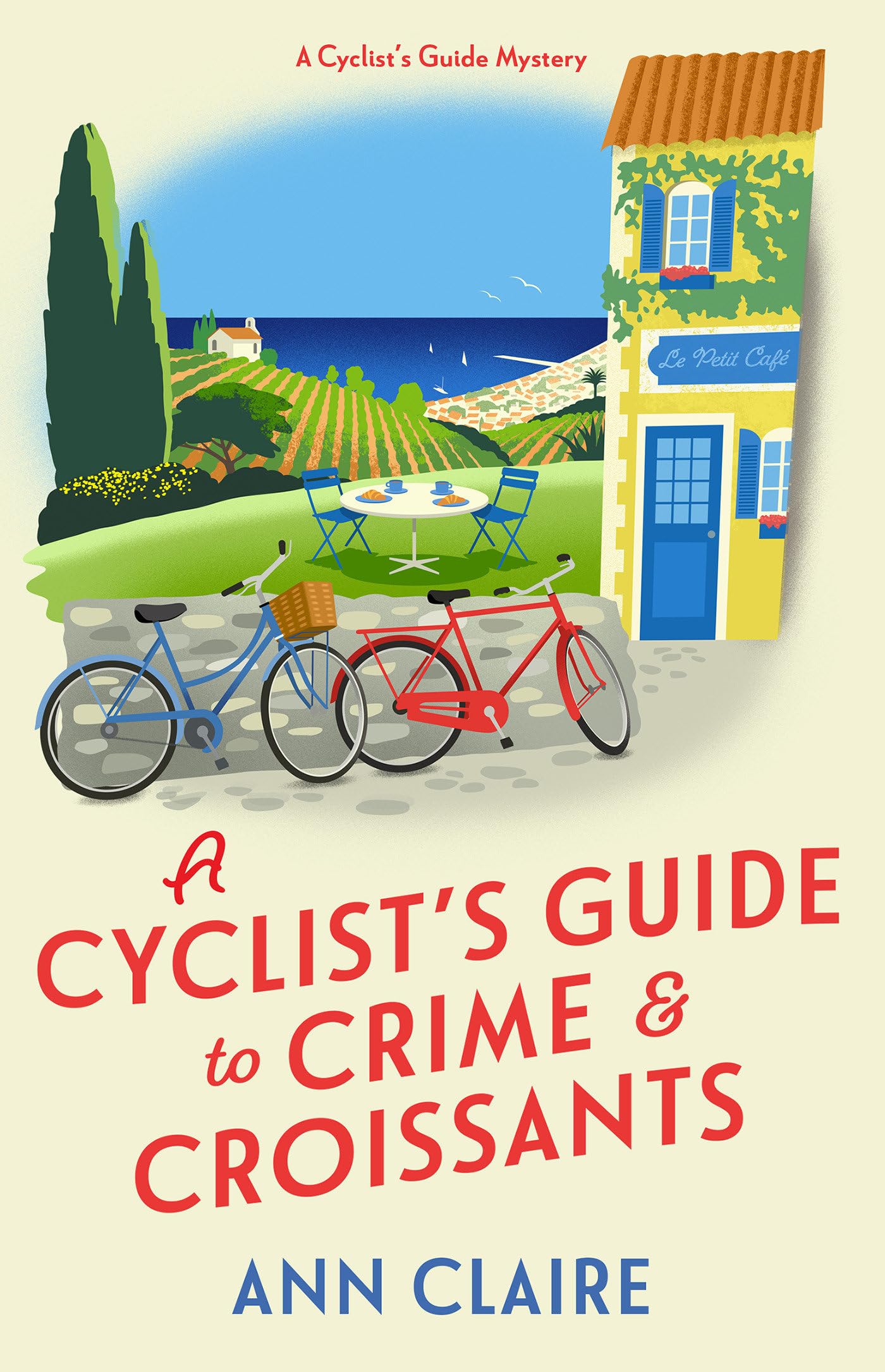
A charming cycling tour in the French countryside takes a deadly turn in this cozy mystery, perfect for fans of Emily in Paris—if Emily spoke French and solved murders between croissant breaks.
Summary:
Nine months ago, Sadie Greene shocked friends and family by ditching her sensible office job in the Chicago suburbs and buying a sight-unseen French bicycling tour company, Oui Cycle. Now she’s living the unconventional life of her dreams in the gorgeous village of Sans-Souci-sur-Mer. Sans souci means carefree, but Sadie feels enough pressure to burst a tire when hometown friends arrive for a tour, including her former boss, Dom Appleton. Sadie is determined to show them the wonders of France and cycling—and to prove she made the right move.
She hopes her meticulously planned nine-day itinerary will win them over, with its stunning seascapes, delicious wine tastings, hilltop villages, and, of course, frequent stops for croissants. When Dom drags his heels on fun, Sadie vows he’ll enjoy if it kills her. That is, until Dom ends up dead. The tragedy was no accident. Someone went out of their way to bring a permanent end to Dom’s vacation.
As more crimes—and murder—roll in, suspicions hover over Oui Cycle. To save her dream business, help her friends, and bring justice, Sadie launches her own investigation. However, mysteries mount with every turn. On an uphill battle for clues, can Sadie come to terms with her painful past while spinning closer to the truth—or will a twisted killer put the brakes on her for good?
Review:
If you’re looking for escapist literature, this cozy mystery delivers. A delightful, trope-perfect entry in the genre, it checks all the essential boxes—a murder that happens off-page? Check. A love interest suspicious of the FMC? Check. A dream career and a picturesque setting? Triple check.
One of the challenges of cozy mysteries is giving the main character an aspirational life without making them unlikable. Sadie, however, is wonderfully relatable. Her backstory is both heartwarming and tragic, making her move to France feel earned rather than enviable. She originally planned to start a bicycle tour business someday with her best friend—until tragedy struck, and her friend was killed in a hit-and-run. This loss becomes the catalyst for Sadie’s life-changing decision, and she makes it happen through a mix of financial prudence (as a former accountant) and a seller who values passion over profit. It’s a compelling, well-crafted setup.
The week of the fateful tour, Sadie’s not-quite-family but family-like friends arrive from the U.S., ostensibly to take her tour—but really, to check up on her. This dynamic adds a layer of personal drama, making the tour more than just a random mix of clients (though there are those, including a sharp-eyed reviewer). The result? Plenty of tension before the mystery even begins.
The French countryside and cuisine are absolutely lovely to read about, and you don’t have to be a cycling enthusiast to enjoy the journey. That said, I personally loved the cycling details, from the Is an e-bike cheating? debate to the hardcore Tour de France trainees Sadie encounters along the way. (If you love cycling too, check out the Bikes in Space anthology I have a short story in.)
Unlike in some cozies, the first murder (yes, first) feels eerily realistic. While I enjoy a good poisoned pie moment, this crime—especially as a cyclist—felt alarmingly plausible, adding genuine weight to the investigation.
One thing I often struggle with in cozies is the detective as a love interest—I tend to find detectives off-putting. However, this one worked for me, largely because his investigative approach felt fresh and culturally distinct. It helped maintain the escapist feel rather than making it feel like a procedural.
Speaking of characters, despite the large cast, I never once lost track of who was who. Each character felt distinct without veering into caricature. That said, the diversity felt a bit Eurocentric—the most notable examples being a Ukrainian refugee and an ex-convict. While I enjoyed both characters, I would have liked to see a bit more variety in representation given the size of the cast.
Halfway through, I was convinced I had solved the mystery. I was wrong. And once the reveal came, I could see exactly where I had been misled—not in a frustrating way, but in a deeply satisfying one.
This is a fun, immersive cozy mystery with a likeable main character, a realistic first murder, and plenty of French countryside charm. Recommended for cozy mystery fans who love an escapist read with a side of cycling, crime, and croissants.
If you found this review helpful, please consider tipping me on ko-fi, checking out my digital items available in my ko-fi shop, buying one of my publications, using one of my referral/coupon codes, or signing up for my free microfiction monthly newsletter. Thank you for your support!
4 out of 5 stars
Length: 346 pages – average but on the longer side
Source: Library
Buy It (Amazon or Bookshop.org)
Book Review: Jaws by Peter Benchley
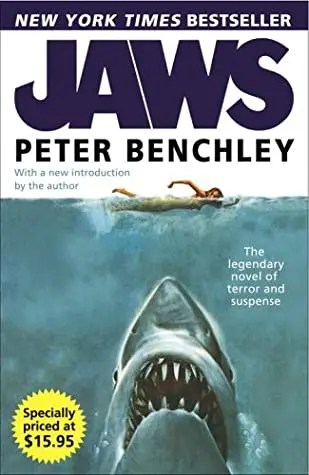
Get ready for shark week with this 1970s classic!
Summary:
A great white shark starts terrorizing a coastal town just as the money-making summer season begins. The classic, blockbuster thriller of man-eating terror that inspired the Steven Spielberg movie and made millions of beachgoers afraid to go into the water. Experience the thrill of helpless horror again—or for the first time!
Review:
As a New England girl born and raised, I can’t tell you how many times I’ve watched Jaws the movie. Everything about it is just so *chef’s kiss* perfectly small New England beach town. (The movie is set on Long Island, New York, but was filmed on Martha’s Vineyard, Massachusetts, and, let me tell you, everything about it reads New England to me.) Plus, my cat absolutely adores watching Jaws. She’s obsessed with that shark. With summer rolling around once again, I decided it was high time I read the book. The book is almost always better than the movie, right? Well, in this case, that almost really comes into play. (Spoilers ahead for both the movie and the book. If you haven’t seen this classic yet, please go watch it then come back to the book review.)
The book starts off strong with a close omniscient perspective of the shark getting ready to eat the drunk lady swimming in the ocean. The book could easily sway into anthropomorphizing territory, imagining the viciousness of the shark. But it consistently describes a creature whose instinct is to feed. What, exactly, made it come in to Amity and stick around is a mystery that is never solved. This first scene is one of the strongest in the book. But I have to admit I was hearing the absolutely classic movie soundtrack in my head while I was reading it, and we all know how essential that is at building suspense. So I’m not sure it’s safe to say I felt engaged purely because of the book.
But it didn’t take too long for the book to showcase itself as…worse than the movie. When we meet Sheriff Brody, he mentions a problem they had the previous summer where a Black gardener sexually assaulted six white women, none of whom would press charges. The only point of this from a narrative perspective is to demonstrate how the police department will keep things under wraps in order to protect the summer season. But it’s a hatefully racist way to establish this, narratively. Even if I charitably imagine that this is supposed to be pointing out the racial divide in Amity that is later even clearer in the book, there are better ways to do that than to play into this horribly racist myth of the serial Black assaulter of white women.
There are two other plot points in the book that weren’t in the movie at all. First, there’s that Brody’s wife cheats on him with Hooper because she feels some weird Feminine Mystique style ennui about her life as a housewife at a lower social class than she was before she got married. (We only see the sex in flashbacks she has about it and how strange and scary Hooper was). There is a large scene where she has lunch with Hooper first and talks about her sexual fantasies. Kind of slows down the pace of the suspense from the shark attacks.
The other additional plot point is that the mayor of the town is mixed up with the mafia because he had to take out a loan from a loan shark (har har) to pay his wife’s cancer treatment medical bills. (What on earth do other countries with nationalized health care do to justify characters taking out unwise loans? This is such a common plot device…but I digress.) The mafia wants the beaches to be kept open. This is a big motivator for why the mayor keeps insisting on it. But I don’t think this motivator is necessary. The economic pressure and need of a tourist town to keep their main tourist attraction open is more than enough motivation. Anyone who has any familiarity with a town that depends on seasonal tourism gets that. Spielberg was right to cut this from the movie. This also brings about a scene I found much more disturbing than any shark attack, which is that the mafia kills Brody’s son’s cat in front of his son, and then Brody takes the dead cat and throws it in the mayor’s face.
The final act where Quint, the old-time fisherman, takes Brody and Hooper out on his boat to hunt the shark is overall pretty good. There’s some nice tension between the three of them, and Quint really has to eat his words about the shark not being intelligent. It does not end with the 70s style bang of the movie. But I kind of liked the simplicity of the ending, leaving Brody to swim to shore and deal with the aftermath on his own without any reader audience.
I’ve seen some lists of the differences between the book and the movie with mistakes and inaccuracies on them, so I do want to clear up a couple of things. Brody is afraid of the water in the book. This is well-established; I’m not sure how people missed that. Mrs. Kintner does slap Brody in the book when she confronts him about the shark killing her son.
The version of the book I read also had an introduction by the author where we find out that he was, basically, a “summer person” himself – from a wealthy family and a legacy graduate of Harvard (his father also went to Harvard). His father was a novelist, and because of that connection, Benchley got an agent before he even had a book written. By Benchley’s own recollection, he sold the idea for Jaws and then they told him he needed to write the book, and the screenplay was sold before the book was even written. He took a first shot at the script, and Spielberg told him to throw out a lot of the stuff that I mentioned in my review as things I didn’t like. Moral of the story being privileged dude sold an admittedly solid idea based on the idea alone to someone else who directed it into it being a classic.
Overall, it was interesting to read the book behind the movie, but I also now have the perfect answer for the next time someone asks me, “When is the movie ever better than the book?”
If you found this review helpful, please consider tipping me on ko-fi, checking out my digital items available in my ko-fi shop, buying one of my publications, or using one of my referral/coupon codes. Thank you for your support!
3 out of 5 stars
Length: 320 pages – average but on the longer side
Source: Library
Buy It (Amazon or Bookshop.org)
Get the Book Club Discussion Guide
A beautifully graphic designed 2 page PDF that contains: 1 icebreaker, 9 discussion questions arranged from least to most challenging, 1 wrap-up question, and 3 read-a-like book suggestions
View a list of all my Book Club Guides.
Book Review: The Unbroken by C.L. Clark (series, #1)

Summary:
Touraine is a soldier. Stolen as a child and raised to kill and die for the empire, her only loyalty is to her fellow conscripts. But now, her company has been sent back to her homeland to stop a rebellion, and the ties of blood may be stronger than she thought.
Luca needs a turncoat. Someone desperate enough to tiptoe the bayonet’s edge between treason and orders. Someone who can sway the rebels toward peace, while Luca focuses on what really matters: getting her uncle off her throne.
Through assassinations and massacres, in bedrooms and war rooms, Touraine and Luca will haggle over the price of a nation. But some things aren’t for sale.
Review:
I don’t read high fantasy very often, but when I do, I need it to be different and unique. When I heard about a military high fantasy with a Black woman lead, a sapphic subplot, and based roughly on North Africa, I knew I needed to read it.
This book took a little while to get up to speed. There’s a lot to introduce, and. it is a chunkster to be fair. By about the 25% mark, I felt like the plot was really moving, and I was glad I hung in there. The basic plot is that Balladaire colonized Qazāl. Balladaire forbids religion. Qazāl is religious. Balladaire abducted children from Qazāl and trained them to be soldiers. They fought on behalf of Balladaire in other regions they were colonizing, and now they’ve been sent back to Qazāl to put down the rebellion. These soldiers are called the Sands. Touraine is a Sand. Luca is in her 20s and is supposed to be the queen, but her uncle is holding onto the throne until he deems her ready to take it on. Luca has a permanent injury to her leg that necessitates her walking with a cane (that has a secret sword in it). Luca is determined to prove her ability to rule via her overseeing of Qazāl.
I think for a lot of readers Touraine will be the big appeal of the book. She’s a muscular, badass soldier who is unapologetically lesbian. And she’s not the only wlw in the book. There’s a rebel couple who are married women. There’s also a minor Balladairan teenager who has a romance with a Qazāli girl. Then there’s Luca, who’s bisexual. There’s also a character partway through who is very cool and is nonbinary. My only question about this character was how, exactly, when Touraine met them, she knew their pronouns without being told. Just because I thought that would be interesting world building.
The Qazāli are varying shades of Brown and Black. The Balladairans are mostly pasty white except for a few who grew up in Qazāl and manage to have tans. The Balladairans speak a language that’s basically French, and the Qazāl’s language, names, and food all seem to be drawn from Arabic culture. The author has stated North Africa as inspiration for this tale of colonization and rebellion. I think it does a good job of exploring colonization and race without ever verging into preachy or beating you over the head with it.
So the big romance (if you can call it that?) of the book is Luca and Touraine. The author describes it as enemies-to-still-enemeis-but-horny-about-it. That said, don’t go into this book expecting on-screen sexy times. For any characters. There’s a lot of longing but nothing on-screen.
This is a violent book. It has to be as it’s military high fantasy. Please keep that in mind. There are scenes including torture, battle, and various types of warfare.
Speaking of battles, this brings me to the other interesting aspect of the book. A key part of the Qazāli religion is the use of magic. And the magic is real. Everyone acknowledges this, even the Balladairans. Luca wants to use magic without being religious. She thinks it will help her take her throne. I myself was quite fascinated by this aspect of the plot, especially when a third and a fourth culture are brought into the mix later in the book. If you like some magic in your fantasy, you’ll get it here.
The one last thing I’ll say is I think this author is quite talented at metaphor and simile descriptors. I highlighted quite a few throughout the book. I was inspired by them. Like this one:
her eyes glittered with life, sharp as a dagger beneath the ribs.
page 206
Swoon!
Overall, if you’re looking for a fresh take on high fantasy with some military mixed in and almost entirely woman leads, this read won’t disappoint.
If you found this review helpful, please consider tipping me on ko-fi, checking out my digital items available in my ko-fi shop, buying one of my publications, or using one of my referral/coupon codes. Thank you for your support!
4 out of 5 stars
Length: 528 pages – chunkster
Source: Library
Buy It (Amazon or Bookshop.org)
Get the Reading Group / Book Club Discussion Guide
A beautifully graphic designed 2 page PDF that contains: 1 icebreaker, 9 discussion questions arranged from least to most challenging, 1 wrap-up question, and 3 read-a-like book suggestions
View a list of all my Discussion Guides.
Book Review: I’ll Be You by Janelle Brown

Summary:
Two identical twin sisters and former child actors have grown apart—until one disappears, and the other is forced to confront the secrets they’ve kept from each other.
Review:
I previously read Janelle Brown’s Pretty Things and really enjoyed its delightful thriller take on Instagram influencers. I was excited to see another of her books on NetGalley and even more excited to see it using a child star identical twins plot. I smashed that request button, let me tell you, and this did not disappoint. In fact, between the two sisters, it covered two of my other favorite plots – a person with addiction in recovery and a person falling for a cult.
Imagine if the Olsen twins were identical (they’re not) and had a falling out right after they stopped acting. That’s the basic set-up of this book. Sam continues to try to act and also continues to fall into a hole of addiction. Elli pursues a regular life, going to college, setting up a florist business, and marrying. We find this all out in flashbacks, as the book starts with a bang with Sam, who we quickly find out is just past a year in recovery, getting a phone call from her parents to come help take care of her niece. Elli brought her newly adopted toddler daughter to them to go on a quick spa retreat in Ojai, but is gone longer than expected. Sam is shocked by all of this because she and Elli haven’t spoken in over a year for ominous reasons we don’t know yet.
I loved this book. I was immediately enamored with Sam. What a tough situation to get plopped in your lap just over a year into recovery. She suspects something is amiss with Ellie, but Ellie has always been the stable one and Sam the untrustworthy addict, so her parents don’t take her concerns seriously. But we, the readers, quickly see that Sam is likely right. There’s something fishy going on. Why would Ellie and her husband suddenly separate right when they adopt after years of infertility? How likely is it that a woman who struggled with infertility for years would suddenly disappear to a retreat for more than a week, barely speaking to those caring for her long hoped-for daughter? Why won’t Sam and Elli’s mom and dad admit something is off? There’s a lot of delicious suspense immediately.
Most of the beginning of the book is from Sam’s perspective, but partway through we swap to Elli’s. I wasn’t sure how I’d feel about this, because I was so invested in Sam, but it worked. Eventually, we swap back to Sam’s toward the end. Sam’s characterization is just so strong and relatable to me, whereas Elli’s is a more difficult character for me to relate to. But the reason it worked is Sam needs to come to understand Elli and so, getting inside Elli’s head and perspective helped me see that, so that I started to root for Sam’s attempts to rebond with Elli in a way I hadn’t before.
The only reason this is getting four stars and not five from me is because of one scene where a secondary lesbian character is biphobic. It was hurtful to me to read that scene, and I just didn’t think it was necessary to the plot of the book. I’m ok with characters being imperfect when it serves needs of character and plot development, but the exact same plot device could have worked without the biphobia. (Essentially, this character exacts revenge on her ex-wife. While the revenge is spurred on by multiple things the ex-wife did, the tipping point is that she got together with a man after the divorce, and the character is extra upset because it’s a man and she’d “hid” being bisexual from her. Ick. We could have just….had something else be the tipping point. There are plenty of options. An example of biphobia I would have been ok with seeing would have been if Sam and Elli’s big fight was about one of them being bisexual and the other not being able to handle it. That’s important character development. This wasn’t.)
Overall, this was a fun, different read with a main character I really enjoyed and a different take on some common thriller plot devices. I recommend it, and I think I myself might go back and read more of Janelle Brown’s back catalog.
If you found this review helpful, please consider tipping me on ko-fi, checking out my digital items available in my ko-fi shop, buying one of my publications, or using one of my referral/coupon codes. Thank you for your support!
4 out of 5 stars
Length: 368 pages – average but on the longer side
Source: NetGalley
Buy It (Amazon or Bookshop.org)
Book Review: Atomic Habits: An Easy & Proven Way to Build Good Habits & Break Bad Ones by James Clear
Summary:
James Clear, one of the world’s leading experts on habit formation, reveals practical strategies that will teach you exactly how to form good habits, break bad ones, and master the tiny behaviors that lead to remarkable results.
Review:
This book is well-loved (just look at its rating on GoodReads), and I had heard a lot of good things about it on decluttering and organizing YouTube channels. So I was surprised to find that I myself felt very meh about the book. I want you to have the context that I am an outlier opinion in this case.
This book is basically a collection of tips on how to become more consistent with your good habits and drop your bad ones. A lot of the tips aren’t off-base, it’s just that I already knew them myself. Things like make the bad habit inconvenient and the good one convenient. For example, change your commute route so it doesn’t go directly by the liquor store (bad habit becomes inconvenient) and select a gym that is on your commute (make the good habit convenient). I probably should have read the four rules he states before reading the book itself, and I would have realized I knew these things already. The four rules are:
- Make it obvious
- Make it attractive
- Make it easy
- Make it satisfying
With bad habits being the inverse of all four.
The two tips that I did get out of this that were meaningful to me were first, habit stacking. So take a habit you already do regularly well and attach another habit you want to have to it. So I have a cup of tea every night. If I was interested in a regular meditation practice, I could decide that I meditate right after I’ve had my tea. That’s habit stacking. I like that it attaches something new to something you already do well. A sound idea. The second thing I got was that being something – like being a musician – isn’t about the achievement (recording an album), it’s about what you do every day (music things like play an instrument, compose music, study music theory). This focus meant a lot to me, and made me do better about writing regularly. A writer writes! Simple but helpful.
So let’s talk about the things I didn’t like, because I haven’t seen people talk about that very much. First, a lot of the examples are about sports and fitness. Not all of them, but a lot of them. I would have liked greater variety. Especially since a lot of the examples are about sports teams, and even the author has a footnote in the first chapter that directs to his website about how the British bicycle team he spends so long talking about actually started winning because they were doping. Given the large amount of doping and cheating in professional sports, I just think more regular, everyday people examples would have been more meaningful. I would have preferred him interviewing regular people who did something simple with their habits that radically changed their lives. There’s a brief glimpse of this when he mentions having lunch with someone who successfully quit smoking and asking them how they did it, but that’s the only instance. I wish the whole book had been that.
Second, I found the advice to aim for streaks (never ever missing a day if you can avoid it) troubling. Human beings need rest days to avoid burnout. It’s not healthy to do some things every day (like his very well-loved example of working out). I recommend those who read this book read Laziness Does Not Exist, as well as the work of The Nap Ministry, to provide some balance to the “do it every day” mantra in this book. I’m not saying working hard and consistency aren’t important, but human beings need rest as well. I honestly hope the author has become less tough on himself about maintaining his streaks.
I hope this review helps you sort out if this book is right for you. But I also do hope you’ll give it some balance with the two reads recommended above.
3 out of 5 stars
Length: 319 pages – average but on the longer side
Source: Library
Buy It (Amazon or Bookshop.org)
If you found this review helpful, please consider tipping me on ko-fi, checking out my digital items available in my ko-fi shop, buying one of my publications, or using one of my referral/coupon codes. Thank you for your support!
Book Review: The Night Train to Berlin by Melanie Hudson

Summary:
A train journey into the past. A love that echoes through time….
Paddington Station, present day:
A young woman boards the sleeper train to Cornwall with only a beautiful emerald silk evening dress and an old, well-read diary full of sketches. Ellie Nightingale is a shy violinist who plays like her heart is broken. But when she meets fellow passenger Joe she feels like she has been given that rarest of gifts…a second chance.
Paddington Station, 1944:
Beneath the shadow of the war which rages across Europe, Alex and Eliza meet by chance. She is a gutsy painter desperate to get to the frontline as a war artist and he is a wounded RAF pilot now commissioned as a war correspondent. With time slipping away they make only one promise: to meet in Berlin when this is all over. But this is a time when promises are hard to keep, and hope is all you can hold in your heart.
Review:
This book tells two love stories by alternating between the two different timelines – present day and 1944. It strongly hints that present day Ellie and Joe are reincarnations of 1944 Eliza and Alex.
I liked both storylines for the majority of the book, although the 1944 appealed more to me. It had more action and covered a larger period of time. The present day storyline is basically just the day of the night party train and the day immediately after. Because so much more was happening in 1944 with such greater risk to Eliza and Alex, I found myself wanting to skip over the present day to go to the past. Plus, the present day takes on greater meaning the more you get to know Eliza and Alex. For this reason, I think it would have been better to have completely told Eliza and Alex’s story and then end the book with an epilogue short version of Ellie and Joe’s.
There are also two things that I think it’s important to know before picking up the book. First, there is no train to Berlin. The train to Berlin in the title is a metaphor. Eliza and Alex meet on a night train to Cornwall and then later promise to see each other in Berlin alongside the liberating forces. (Eliza as a nurse and war artist, Alex as a war correspondent). But of course the liberators didn’t take trains. There are two trains in this book. One is the train to Cornwall ridden at two different time periods. The other is a train in Europe but its destination is not Berlin.
Second, we do not actually get closure on Eliza and Alex’s story. We never find out exactly what happened to them – either as a couple or how and when they died. There’s a passing mention that Ellie’s grandmother (great-grandmother?) who was friends with Eliza inherited the Cornwall property from her a few years ago. It could be implied that she passed a few years ago or it could be understood to mean something different. The other confusing thing about this is if Ellie is Eliza reincarnated, Eliza passing a few years ago when Ellie is in her 20s at the moment doesn’t make sense for a reincarnation. So there’s a lot of loose ends with regards to Eliza and Alex that are frustrating.
I’m not a complete stickler for total historic accuracy in historic fiction and even less so with a historic romance, but I will mention there was one plot point in particular that was so unlikely given what we know about WWII that it did make me grumpy. I can’t discuss in detail without plot spoiling. Perhaps you would feel more able to give it a pass than me. It comes toward the very end of the book.
So, overall, while I enjoyed the experience of the read right up until the end, I did feel like it could have been a better story with some rearrangement and a less metaphorical title.
3 out of 5 stars
Length: 400 pages – average but on the longer side
Source: NetGalley
Buy It (Amazon or Bookshop.org)
If you found this review helpful, please consider tipping me on ko-fi, checking out my digital items available in my ko-fi shop, buying one of my publications, or using one of my referral/coupon codes. Thank you for your support!
Book Review: Rock Paper Scissors by Alice Feeney

Summary:
Things have been wrong with Mr and Mrs Wright for a long time. When Adam and Amelia win a weekend away to Scotland, it might be just what their marriage needs. Self-confessed workaholic and screenwriter Adam Wright has lived with face blindness his whole life. He can’t recognize friends or family, or even his own wife.
Every anniversary the couple exchange traditional gifts – paper, cotton, pottery, tin – and each year Adam’s wife writes him a letter that she never lets him read. Until now. They both know this weekend will make or break their marriage, but they didn’t randomly win this trip. One of them is lying, and someone doesn’t want them to live happily ever after.
Ten years of marriage. Ten years of secrets. And an anniversary they will never forget.
Review:
I have a thing for the themes for each anniversary year of marriage. I also have a thing for thrillers about marriages. So when I saw this one incorporating both, I knew I just had to read it. I can’t be the only one this appealed to because I waited for a few months for it at the library. This was definitely a unique and fun take on the thriller about a marriage theme.
The telling alternates between the anniversary letters Mrs. Wright writes to her husband and the present day Mrs. Wright going on the trip with Mr. Wright to Scotland. They are seeing a marriage counselor who suggest a trip away, and Mrs. Wright wins a weekend trip to a converted chapel in Scotland. One of the stronger scenes in the book is the late-night arrival at this Air BNB style home. If you have ever arrived late at night at an Air BNB or other vacation rental where you have to let yourself in and hope it lives up to your expectations, this scene will really set your spine to tingling!
Much as I was enjoying the present day explorations of the spooky getaway, I also really enjoyed the anniversary letters from Mrs. Wright. They were the perfect interlude because very quickly it becomes clear she is keeping something from him. So you end up with two different mysteries. What is going on at the weekend stay? And what is Mrs. Wright keeping from Mr. Wright?
I wasn’t sure at first how I’d feel about the face blindness aspect. But it is a real condition, and I like how the perspective sometimes shifts to Mr. Wright’s. We see how he sees his wife, and how he recognizes her anyway. I also really enjoy how important the title is to the book and how often it comes into play.
Now, this is a thriller so of course there is a twist. It is a major one, and I really wasn’t seeing it coming. I was a bit miffed because it was one of those situations where the only reason I didn’t see it coming was some information was withheld from the reader. But I so enjoyed the process of getting to that point that I ultimately didn’t care.
Overall, this was a fun entry into the thriller category. It delightfully combines a marriage on the rocks with a creepy vacation rental for a new feeling plot.
4 out of 5 stars
Length: 297 pages – average but on the shorter side
Source: Library
Buy It (Amazon or Bookshop.org)
If you found this review helpful, please consider tipping me on ko-fi, checking out my digital items available in my ko-fi shop, buying one of my publications, or using one of my referral/coupon codes. Thank you for your support!
Book Review: Nothing But Blackened Teeth by Cassandra Khaw
Summary:
A Heian-era mansion stands abandoned, its foundations resting on the bones of a bride and its walls packed with the remains of the girls sacrificed to keep her company.
It’s the perfect wedding venue for a group of thrill-seeking friends.
But a night of food, drinks, and games quickly spirals into a nightmare. For lurking in the shadows is the ghost bride with a black smile and a hungry heart.
And she gets lonely down there in the dirt.
Review:
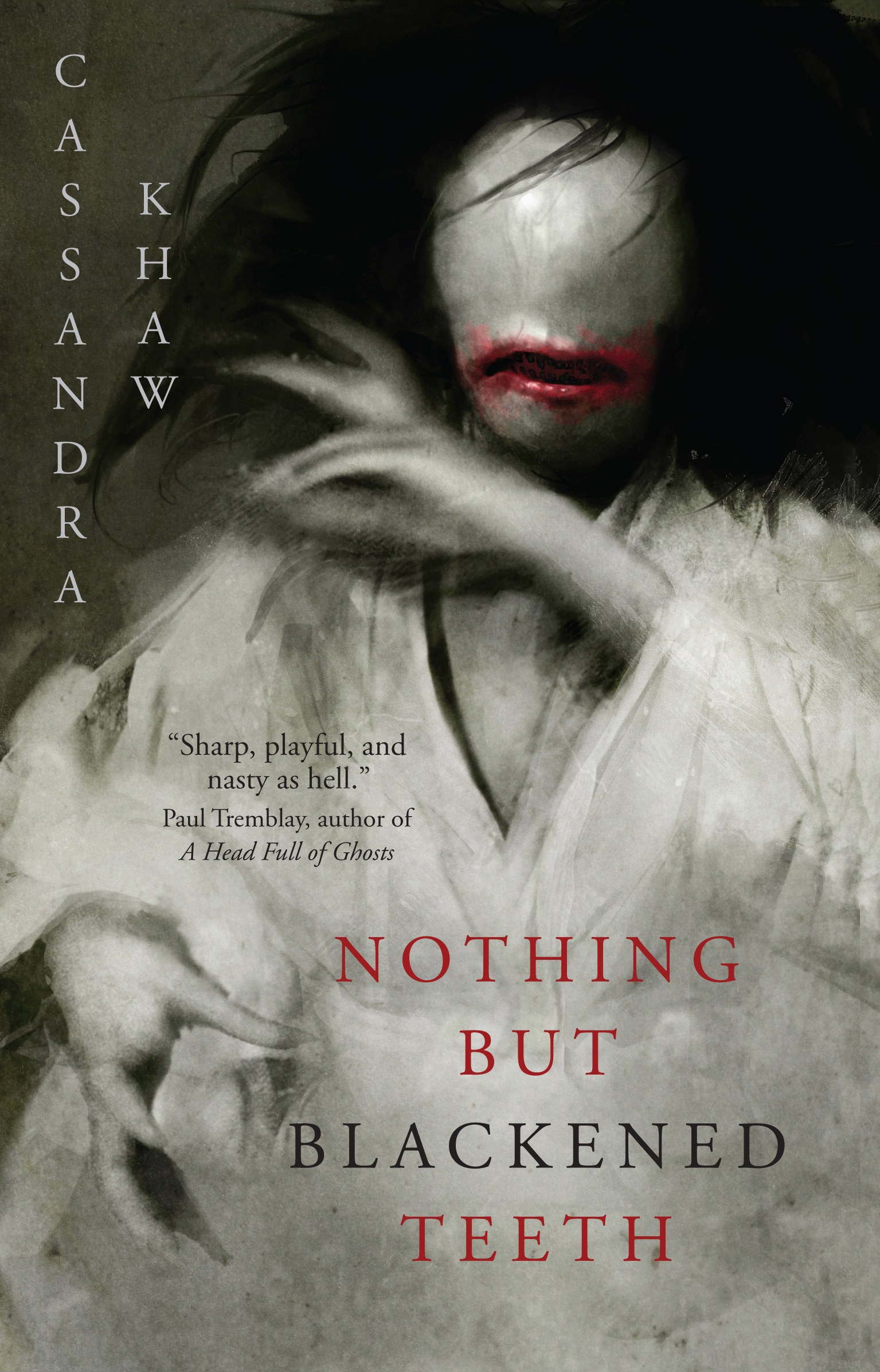
I thought this cover was deliciously creepy in a way that reminded me of The Ring, and I was ready for a quick spine-tingling thriller set in Japan. Unfortunately, for me, the cover was the only part of the book that elicited any real response from me.
Let’s start with the good. Representation is strong in this book. It’s a group of four racially diverse friends. The main character is bisexual, says the word, and isn’t demonized in the book. Since it’s common for thrillers and horror to demonize queer characters, this was nice. The writing is poetic, which is a bit unusual in horror. The idea of a bride being so into haunted houses that she wants to be married in a house where the haunting is a bride was also fun. So why didn’t it work for me?
For horror to work for me, I need to know enough about the characters to kind of care about what happens to them. This jumps so quickly into the haunted house moment with the friends that I just….never really cared about any of them. To be honest, I still kind of easily get them mixed up in my head. By the time we know any of their motivations, a lot of the thrills and gore have already happened but it’s too late for me to care about them. It wasn’t even that they were a collection of common horror tropes so I knew what was going on and could sort of care. (I’m thinking about the tropes used in Scream or The Cabin in the Woods). It seems to me that part of the goal was to subvert tropes but in order for that to work, I need to really know the characters for the tropes to be subverted and for me to still care about the characters. Tropes work because they fill in the blanks for us. The cheerleader may be ditzy but she really cares about her friends, so we know she’s really actually upset when she can’t find one of them. But if the trope has been subverted just enough that we know that the cheerleader doesn’t’ care about her friends but we also don’t know what she actually cares about then all understanding of what meaning and impact the plot has on her is lost.
Others who don’t need strong character development to get into the thrills of a horror will likely enjoy this story more than I did, particularly if the basic plot summary given above appeals to you.
2 out of 5 stars
Length: 128 pages – novella/short nonfiction
Source: NetGalley
Buy It (Amazon or Bookshop.org)
If you found this review helpful, please consider tipping me on ko-fi, checking out my digital items available in my ko-fi shop, buying one of my publications, or using one of my referral/coupon codes. Thank you for your support!
Book Review: Winter Counts by David Heska Wanbli Weiden

Summary:
Virgil Wounded Horse does his best to find his way making a life and a living on the Rosebud Indian Reservation (the Lakota people) in South Dakota – newly sober from alcohol, the legal guardian of his teenage nephew, and working as a hired vigilante. When heroin finds its way onto the reservation and directly impacts his nephew, he finds himself working to stop the threat of the cartels to his people alongside his ex-girlfriend.
Review:
This is simultaneously a wholesome and gritty thriller. Wholesome in that Virgil’s commitment to his sobriety, his family, and his people is full of honor and family values in the face of so many challenges. Gritty in that there are colorful depictions of violence as Virgil does his vigilante work and pursues the cartel. In a way it reminds me of Breaking Bad in the early seasons – someone doing something outside of the law for his family – only it’s outside of the law to stop the drugs, not to make them.
There was a lot I enjoyed here. The different setting and voice for this gritty mystery kept me engaged in a genre I’ve read a lot in. The mystery is solid. I had my suspicions but I didn’t have everything figured out before the end. So, yes, it’s not quite as simple as an outside cartel but it’s not a super obvious answer either. I also really like how the ex-girlfriend becomes such a key part of the story. Virgil listens to and respects her, even when he doesn’t immediately agree with her, which was so refreshing to read. I similarly like that we come into Virgil’s life after he’s already sober. This allows the book to explore him putting his life back together as a sober person and dealing with some really tough shit – demonstrating that things don’t get easy automatically just because you’re sober. I appreciated very much how thoughtfully the author shared his Lakota culture with the readers while simultaneously respecting what aspects of it need to stay private and sacred. As a person who has the Sioux Chef book, I appreciated so much the inclusion of Indigenous cuisine via an Indigenous chef and food truck coming to the reservation.
While I wouldn’t call the depictions and discussions of violence gratuitous as they are necessary to the plot, they are graphic. I thought it never went further than it needed to. However, it is important for potential readers to know they are there. There are discussions of off-scene cartel vengeance and rape of women and underaged girls. There are on-scene descriptions of fist-fights and gun fights.
Those who like grittier thrillers and either want a unique setting in the genre or want a mystery investigator who is sober will enjoy this read. I hope we’ll see more of Virgil in the future.
4 out of 5 stars
Length: 336 pages – average but on the longer side
Source: Library
Buy It (Amazon or Bookshop.org)
If you found this review helpful, please consider tipping me on ko-fi, checking out my digital items available in my ko-fi shop, buying one of my publications, or using one of my referral/coupon codes. Thank you for your support!
 Support my work with a tip or browse my shop for curated book club guides, how to guides, cross-stitch patterns, and more!


This work by Amanda Nevius is licensed under a Creative Commons Attribution-Noncommercial-No Derivative Works 3.0 United States License.
 Opinions of a Wolf