
Archive
Stories That Heal: 5 Books for Mental Health Awareness Month
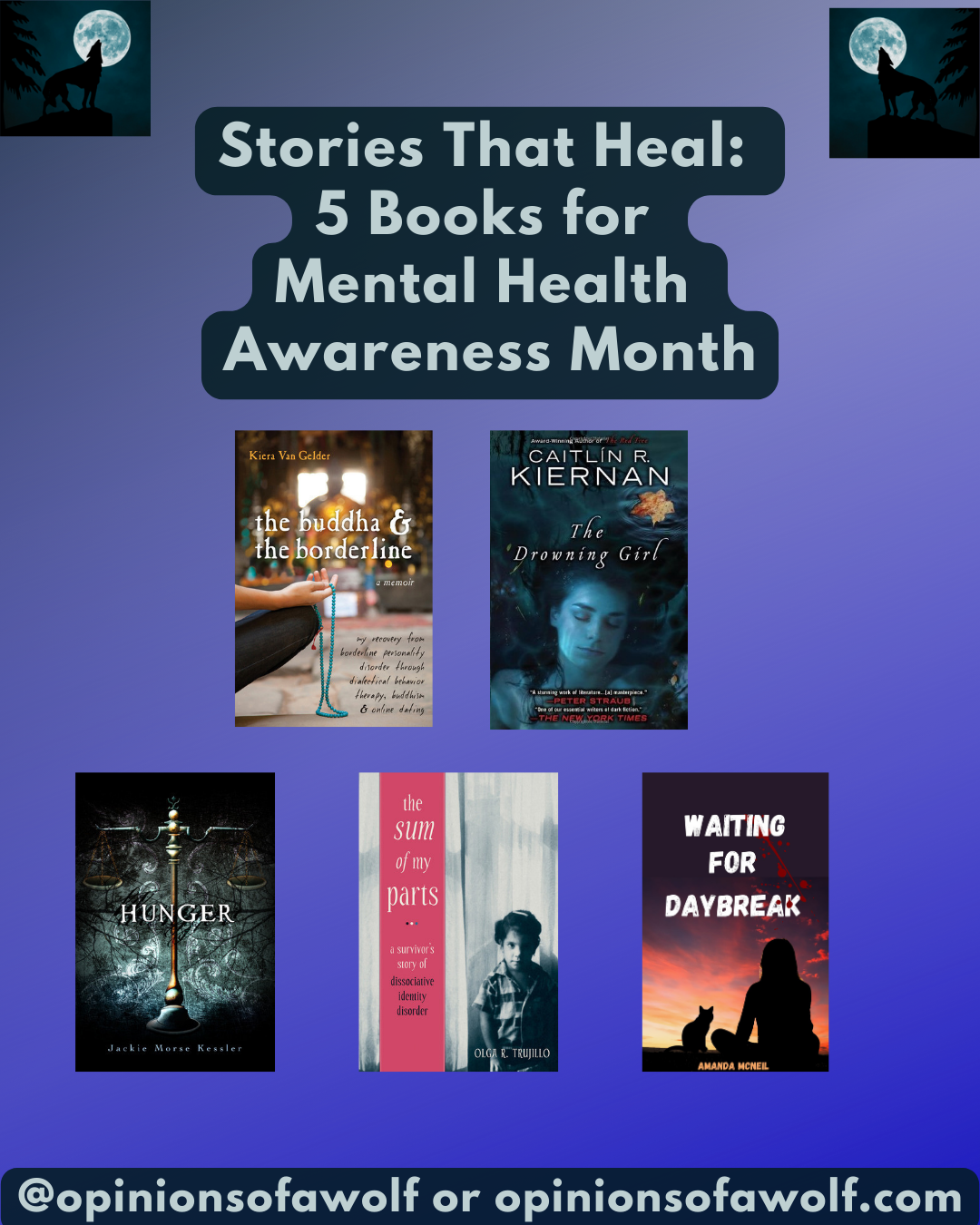
May is Mental Health Awareness Month—an annual observance founded by Mental Health America in 1949 to highlight the importance of mental wellbeing, educate the public, reduce stigma, and promote support for those affected by mental health conditions.
As someone who believes in the power of books to change lives, I thought this was the perfect time to share a mental health–focused reading list. Whether you frequently read books centered on mental health or are exploring this space for the first time, I hope you’ll find something here that resonates. This list includes a mix of fiction and nonfiction across genres—something for every reader.
The Buddha and the Borderline: My Recovery from Borderline Personality Disorder through Dialectical Behavior Therapy, Buddhism, and Online Dating by Kiera Van Gelder
(Amazon, Bookshop.org)
memoir
In this candid memoir set largely in Boston, Kiera Van Gelder traces her journey through Borderline Personality Disorder—from self-harm and addiction to healing through Dialectical Behavior Therapy and Buddhism. It’s an honest, hopeful account of finding stability and meaning after years of chaos.
(Read full review)
The Drowning Girl by Caitlin R. Kiernan
(Amazon, Bookshop.org)
literary fantasy, LGBTQIA+
In this haunting literary mystery, India Morgan Phelps—Imp to her friends—tries to untangle what really happened the summer she met Eva Canning. Was Eva a mermaid? A werewolf? Or is Imp’s memory altered by her schizophrenia? Told in lyrical, first-person prose, The Drowning Girl explores mental illness, identity, and unreliable memory, with nuanced queer representation and a mystery that unfolds entirely from within.
(Read full review)
Hunger by Jackie Morse Kessler
(Amazon, not available on Bookshop.org)
fantasy, YA
In this early 2010s YA standout, Hunger blends biting fantasy with raw realism to explore anorexia through a supernatural lens. When teen Lisabeth Lewis is visited by Death and becomes Famine—one of the Four Horsemen of the Apocalypse—she’s forced to confront the eating disorder that controls her life. With Buffy the Vampire Slayer-style humor and emotional honesty, this novel offers a powerful, metaphor-rich take on the inner voice of anorexia and the path to healing.
(Read full review)
The Sum of My Parts: A Survivor’s Story of Dissociative Identity Disorder by Olga Trujillo, JD
(Amazon, Bookshop.org)
memoir
In this powerful memoir, Olga Trujillo—once a successful attorney in D.C.—recounts their journey through the diagnosis, treatment, and recovery process of Dissociative Identity Disorder. As long-repressed memories of childhood abuse begin to surface, Olga works to integrate their parts and reclaim their life. With compassion, clarity, and survivor-centered care, this memoir offers both insight and hope to anyone seeking to understand trauma, dissociation, or the long path to healing.
(Read full review)
(Note: At the time I wrote my original review, Trujillo had not yet come out as nonbinary, so older references use previous pronouns.)
Waiting for Daybreak by Amanda McNeil
(Amazon, Bookshop.org)
zombie horror
In my own novel, Waiting for Daybreak, a young woman with Borderline Personality Disorder unexpectedly finds sobriety from alcoholism and strength when a zombie outbreak turns Boston upside down. Frieda has spent years battling emotional chaos and isolation—but when a mysterious virus brings society to a halt, she discovers survival suits her better than daily life ever did. As she sets out to save her sick cat, her solitary routine shatters, and she’s forced to reengage with a world that no longer plays by the rules. A character-driven post-apocalypse, Waiting for Daybreak explores mental illness, addiction recovery, and the fragile resilience that can grow in even the bleakest moments.
(See what readers are saying)
I hope you’ve found something here that speaks to you. If you have a favorite book that explores mental health—fiction or nonfiction—I’d love to hear about it in the comments!
Book Review: A Bánh Mì for Two by Trinity Nguyen
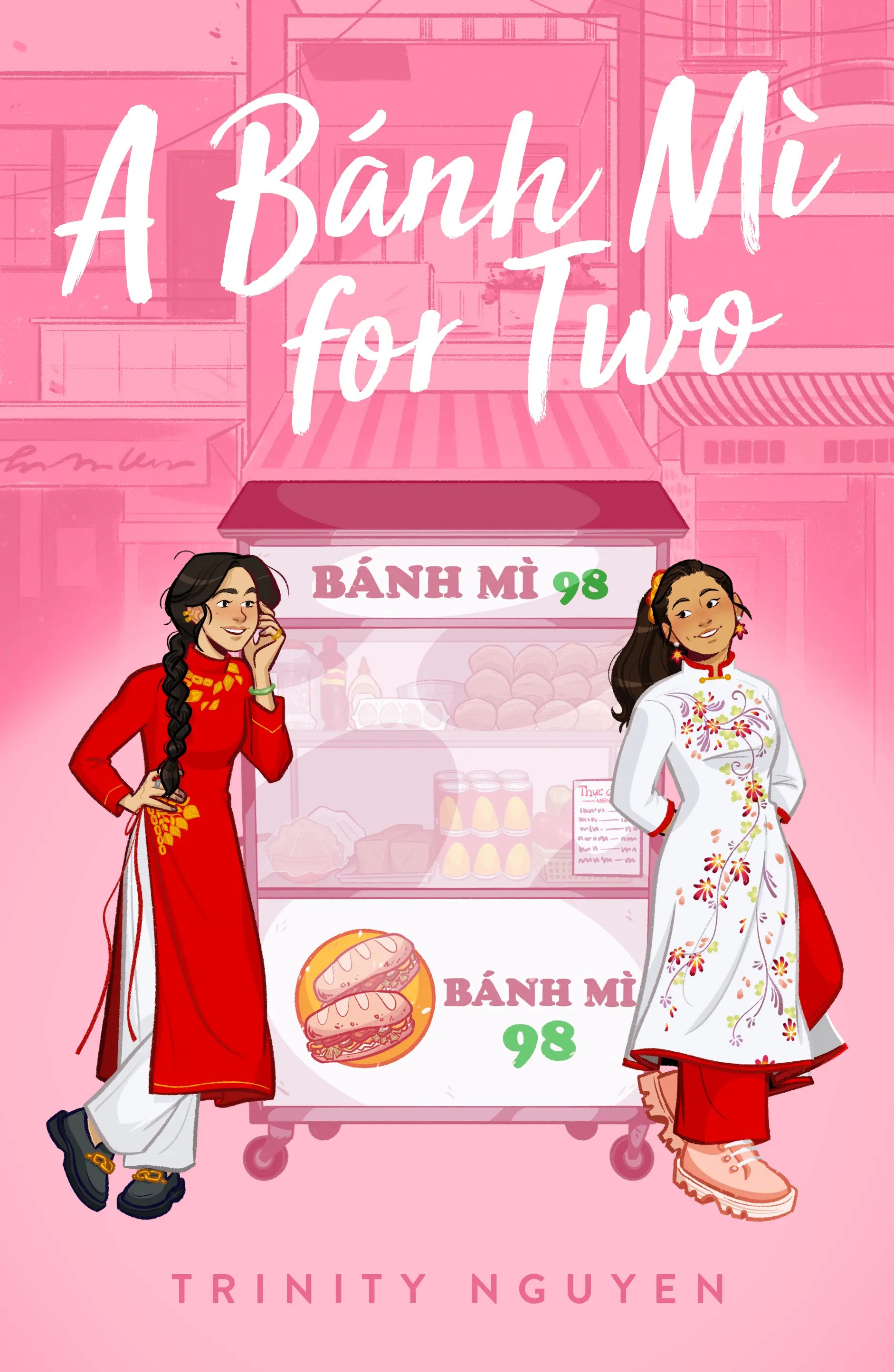
A sweet, closed-door sapphic romance set in Sài Gòn, where two foodie 18-year-olds fall for each other while uncovering family secrets and rekindling a love of food writing.
Summary:
In Sài Gòn, Lan is always trying to be the perfect daughter, dependable and willing to care for her widowed mother and their bánh mì stall. Her secret passion, however, is A Bánh Mì for Two, the food blog she started with her father but has stopped updating since his passing.
Meanwhile, Vietnamese American Vivi Huynh, has never been to Việt Nam. Her parents rarely talk about the homeland that clearly haunts them. So Vivi secretly goes to Vietnam for a study abroad program her freshman year of college. She’s determined to figure out why her parents left, and to try everything she’s seen on her favorite food blog, A Bánh Mì for Two.
When Vivi and Lan meet in Sài Gòn, they strike a deal. Lan will show Vivi around the city, helping her piece together her mother’s story through crumbling photographs and old memories. Vivi will help Lan start writing again so she can enter a food blogging contest. And slowly, as they explore the city and their pasts, Vivi and Lan fall in love.
Review:
I love a sweet, closed-door sapphic romance (see my review of Hani and Ishu’s Guide to Fake Dating), so when I heard about A Bánh Mì for Two, it was an easy add to my wishlist. The focus on food blogging and Vietnamese street food—both eating it and running a street food cart—was just the icing on the cake. This story strikes a delicate yet exquisite balance between lighthearted sweetness and the very real multigenerational trauma caused by the Vietnam War (referred to in Vietnam as The War Against the Americans to Save the Nation).
Told in alternating first-person perspectives between Lan and Vivi, the book avoids the common pitfall of muddled voices. While both characters are kind and thoughtful, they each have distinct ways of seeing the world, which keeps their narration clear and engaging. The romance is a sweet, slow burn, beginning with Vivi’s admiration of Lan’s food blog and blossoming into real-world chemistry after a chance encounter in Sài Gòn.
I especially appreciated the queer representation. There’s no on-page angst about being queer. Vivi does talk briefly with her friend Cindy (a Mexican American character) about how coming out can be complicated with conservative parents, but by the time the story begins, both girls’ families are accepting. It was also refreshing to see Vivi clearly identify as bisexual—representation that could’ve been easily overlooked since her only relationship in the book is with Lan. It’s affirming and intentional, which I loved.
The food descriptions are vivid but never overdone. They strike just the right balance between informing the reader (especially for dishes that might be unfamiliar) and keeping the flow natural. (I’ve eaten many a bánh mì in my life, and still found the food writing delightful!) I also really appreciated that this is a story about two 18-year-olds, and college isn’t presented as the only post–high school option. Lan’s mom encourages her to pursue school if she wants to, but also supports her jumping right into a career—a rare and welcome take in YA-adjacent fiction.
Vivi’s experience as a Vietnamese American studying abroad in Vietnam adds a beautiful emotional layer. She’s not a tourist—she’s searching for a kind of homecoming. She’s exploring why her mother kept so many details about Vietnam and their family a secret. This process is a powerful lens for the reader to learn about the war’s impact on Vietnamese families without the book ever feeling preachy. The historical context emerges naturally—through conversations, shared meals, and street encounters. It’s excellent writing.
The romantic progression between Lan and Vivi is tender and believable. One of my favorite parts was the motorbike rides around Sài Gòn—evocative, cinematic, and intimate. Even the third-act conflict felt justified. It wasn’t a contrived misunderstanding but a believable clash of cultural differences and personal pain. No one is villainized, and the resolution feels earned.
That said, a few elements pulled me out of the story. For example, Vivi’s study abroad program is mentioned as her reason for being in Vietnam, but we never actually see her attend class or study. This absence feels like a missed opportunity—readers might expect the study abroad setting to include some academic context. Similarly, while the book opens with several references to Vivi lying to her mom about her location—including photoshopping photos—the tension fades away later in the book. I found it a bit hard to believe that her mom wouldn’t catch on sooner.
The book is richly diverse, featuring Vietnamese and Vietnamese American characters, a Mexican American side character, and a sapphic romance at the center. Lan’s mother has a chronic illness, and her father passed away young from a stroke. The book also explores difficult family dynamics, grief, and healing across generations.
Overall, this is a fun, sweet sapphic romance featuring the beloved tropes of slow burn and study abroad, while offering thoughtful reflections on Vietnamese culture, family history, and the legacy of war. It’s beautifully steeped in food, healing, and love. Recommended for anyone looking for a sweet, queer romance with emotional depth, cross-cultural exploration, and heartwarming food moments.
If you found this review helpful, please consider tipping me on ko-fi, checking out my digital items in my ko-fi shop, buying one of my publications, using one of my referral or coupon codes, signing up for my free microfiction monthly newsletter, or tuning into my podcast. Thank you for your support!
4 out of 5 stars
Length: 224 pages – average but on the shorter side
Source: Library
Buy It (Amazon or Bookshop.org)
Book Review: The Importance of Being Earnest by Oscar Wilde

This witty farce cleverly comments on romance and class while offering a glimpse into the sharp mind of a writer who was silenced by society for his homosexuality.
Summary:
Cecily Cardew and Gwendolen Fairfax are both in love with the same mythical suitor. Jack Worthing has wooed Gwendolen as Ernest while Algernon has also posed as Ernest to win the heart of Jack’s ward, Cecily. When all four arrive at Jack’s country home on the same weekend the “rivals” to fight for Ernest’s undivided attention and the “Ernests” to claim their beloveds pandemonium breaks loose. Only a senile nursemaid and an old, discarded hand-bag can save the day!
Review:
I wasn’t sure if a play from 1895 could still make me laugh out loud, but this had me literally laughing out loud throughout. Wilde’s sharp wit transcends time, offering humor that still feels fresh and fun.
The bulk of the humor revolves around romance and relationships, themes that are just as relatable today. One of the young women insists she can only marry a man named Ernest because, well, it’s just such a perfect name. Honestly, it feels like something an influencer might say now. Ridiculous? Yes. But her love interest plays along—an endearing and absurd romance that hits just right. The second couple’s drama, involving letters and the oddity of never having met in person, feels like it could be pulled straight from a modern reality TV show like 90 Day Fiancé. It’s both comical and oddly relatable, even today.
Then, there’s Wilde’s satirical take on class—an aspect of the play that’s still tragically relevant. The scene where the two young women exchange polite (but cutting) quips over tea is perhaps my favorite. The tension between societal expectations and personal desires couldn’t be more brilliantly portrayed.
The final twist? Whip-smart and unexpected, it’s a game-changing moment that had me thinking, “This could fit perfectly into a psychological thriller.” It’s brilliant… and hilarious.
I listened to this as an audiobook (with a live reading featuring James Marsters—swoon!), and I highly recommend experiencing plays this way. The clever dialogue really shines in an audio format, bringing Wilde’s wordplay and humor to life in a way you can’t always capture on the page.
As for diversity, it’s worth noting that Wilde’s characters are overwhelmingly upper-crust white English folk. However, it’s important to remember that Wilde wrote this play before being imprisoned for “gross indecency” (a term used at the time to criminalize homosexuality). The Importance of Being Earnest was his last play, and it showcases his sharpest writing before homophobia curtailed his career. Reading it today offers a poignant reminder of his legacy and the oppressive forces that silenced him.
Overall, this remains a clever, sharp, and incredibly funny play—one that continues to satirize the British class system with a witty edge. It’s a must-read for fans of intellectual humor, fans of Wilde, and anyone who appreciates supporting LGBTQIA+ writers who defied the odds in their time.
If you found this review helpful, please consider tipping me on ko-fi, checking out my digital items available in my ko-fi shop, buying one of my publications, using one of my referral/coupon codes, or signing up for my free microfiction monthly newsletter. Thank you for your support!
5 out of 5 stars
Length: 89 pages – novella/short nonfiction
Source: Audible
Buy It (Amazon or Bookshop.org)
Book Review: Model Home by Rivers Solomon

When Ezri’s parents die under mysterious circumstances, they return to their Texan childhood home—possibly haunted—in a gated community where their family is the only Black family.
Summary:
The three Maxwell siblings keep their distance from the lily-white gated enclave outside Dallas where they grew up. When their family moved there, they were the only Black family in the neighborhood. The neighbors acted nice enough, but right away bad things, scary things—the strange and the unexplainable—began to happen in their house. Maybe it was some cosmic trial, a demonic rite of passage into the upper-middle class. Whatever it was, the Maxwells, steered by their formidable mother, stayed put, unwilling to abandon their home, terrors and trauma be damned.
As adults, the siblings could finally get away from the horrors of home, leaving their parents all alone in the house. But when news of their parents’ death arrives, Ezri is forced to return to Texas with their sisters, Eve and Emanuelle, to reckon with their family’s past and present, and to find out what happened while they were away. It was not a “natural” death for their parents . . . but was it supernatural?
Review:
I’ve read most of Rivers Solomon’s books—they’re auto-reads for me at this point. I love their unique perspective and creative twists on speculative fiction. Solomon’s books always challenge me, so even though haunted house stories aren’t my favorite subgenre, I picked it up—and I’m glad I did. This turned out to be a queer psychological thriller that was hard to put down, keeping me up late reading.
The mystery starts early, with Ezri receiving texts from “mom,” but they suspect it’s the “other mother”—the ghost that haunted the family home in a gated community when they were children. It doesn’t take long before Ezri and discovers their parents dead in the backyard in what initially seems like a murder-suicide—but the siblings suspect it’s something far more complicated.
I appreciated how Solomon depicted the family dynamics under stress—three siblings thrown together for an unexpectedly long visit during a family tragedy. It’s the messy, real stuff of love and tension between people who care about each other but don’t always get along perfectly in a pressure cooker situation. The haunting also impacted each sibling differently, not just because of their age but due to the way their parents parented them, shaped by birth order.
I can’t discuss the most shocking part of the book without spoiling the twist. Suffice it to say, it was dark, gritty, and far less supernatural than anything else I’ve read by Solomon. That’s what made it so powerful—it felt so close to being like other psychological thrillers I’ve read but conveyed something profoundly different. It was deeply rooted in the Black experience in America, and it left me almost breathless.
Along with being a story about a Black family, Ezri is nonbinary, and both they and their child have diabetes. I really appreciated how Ezri’s gender identity was never an issue for their family—even when they were a child. This was refreshing and grounded in a sense of acceptance and love.
Please note that this book includes an explicit sex scene that is consensual. It also discusses predation on a minor and child sexual abuse (CSA).
Due to these sensitive topics, this was not a five-star read for me. While the book was beautifully written, I reserve five-star ratings for books I feel personally connected to. Books with such content usually don’t end up in my favorites category. (Grown by Tiffany D. Jackson was a big exception for me.)
Overall, this is a unique take on both the haunted house and psychological thriller genres. It offers a scathingly insightful analysis of being Black in America, while giving voice to a nonbinary sibling. Highly recommended for readers looking for a Black perspective on the haunted American house.
If you found this review helpful, please consider tipping me on ko-fi, checking out my digital items available in my ko-fi shop, buying one of my publications, using one of my referral/coupon codes, or signing up for my free microfiction monthly newsletter. Thank you for your support!
4 out of 5 stars
Length: 304 pages – average but on the longer side
Source: Library
Buy It (Amazon or Bookshop.org)
Book Review: How Far the Light Reaches: A Life in Ten Sea Creatures by Sabrina Imbler

A powerful blend of memoir and marine biology exploring environmentalism, queer theory, and biracial identity through the lens of deep-sea creatures and personal reflection.
Summary:
A queer, mixed race writer working in a largely white, male field, science and conservation journalist Sabrina Imbler has always been drawn to the mystery of life in the sea, and particularly to creatures living in hostile or remote environments. Each essay in their debut collection profiles one such creature: the mother octopus who starves herself while watching over her eggs, the Chinese sturgeon whose migration route has been decimated by pollution and dams, the bizarre Bobbitt worm (named after Lorena), and other uncanny creatures lurking in the deep ocean, far below where the light reaches. Imbler discovers that some of the most radical models of family, community, and care can be found in the sea, from gelatinous chains that are both individual organisms and colonies of clones to deep-sea crabs that have no need for the sun, nourished instead by the chemicals and heat throbbing from the core of the Earth. Exploring themes of adaptation, survival, sexuality, and care, and weaving the wonders of marine biology with stories of their own family, relationships, and coming of age, How Far the Light Reaches is a book that invites us to envision wilder, grander, and more abundant possibilities for the way we live.
Review:
A queer memoir intertwined with fascinating ocean facts? Yes, please! This is a beautifully written exploration where each chapter examines a unique sea creature and, surprisingly, connects it to the author’s own life.
I learned so much about marine biology in an easily digestible way, and here are three of my favorite facts:
- Octopuses die after spawning and starve themselves while incubating their eggs.
- Hydrothermal vents come and go across the ocean floor, creating temporary ecosystems.
- Selps, a type of jellyfish, move together, but at different speeds.
What really stood out to me, though, was Sabrina Imbler’s introspective and self-aware reflections on their life. As a white person, I was moved by how candid they were about their experiences of being biracial. I appreciated how they expressed that being mixed-race is an identity that doesn’t need to be “resolved”—“I am Chinese. I am white.” This honest exploration of their mixed-race identity resonated with me far more than their exploration of queerness, which, while meaningful, didn’t linger as strongly in my memory. If you’re drawn to memoirs that delve deeper into queer identity, check out my review of A Queer and Pleasant Danger.)
Please be aware that this book addresses the sensitive topics of racism, environmental injustice, and animal abuse. Sabrina also explores an instance of sexual violence they experienced as a youth, reflecting on how it shifted from being a “joke” to something they realized was deeply troubling.
I listened to the audiobook version, narrated by Sabrina themselves, which was stellar. Their narration felt like listening to a close friend, making the experience even more immersive.
Overall, this is an incredibly moving and educational memoir. It’s a unique blend of personal reflection and marine biology, offering readers a fresh way to explore the world. Highly recommended for those interested in memoirs with a scientific twist and a deep dive into the complexities of identity.e of the author’s favorite subjects – marine biology. Recommended to those interested in a unique storytelling method in a memoir, as well as those with a personal interest in marine biology.
If you found this review helpful, please consider tipping me on ko-fi, checking out my digital items available in my ko-fi shop, buying one of my publications, using one of my referral/coupon codes, or signing up for my free microfiction monthly newsletter. Thank you for your support!
5 out of 5 stars
Length: 263 pages – average but on the shorter side
Source: Library
Buy It (Amazon or Bookshop.org)
Book Review: A Botanical Daughter by Noah Medlock
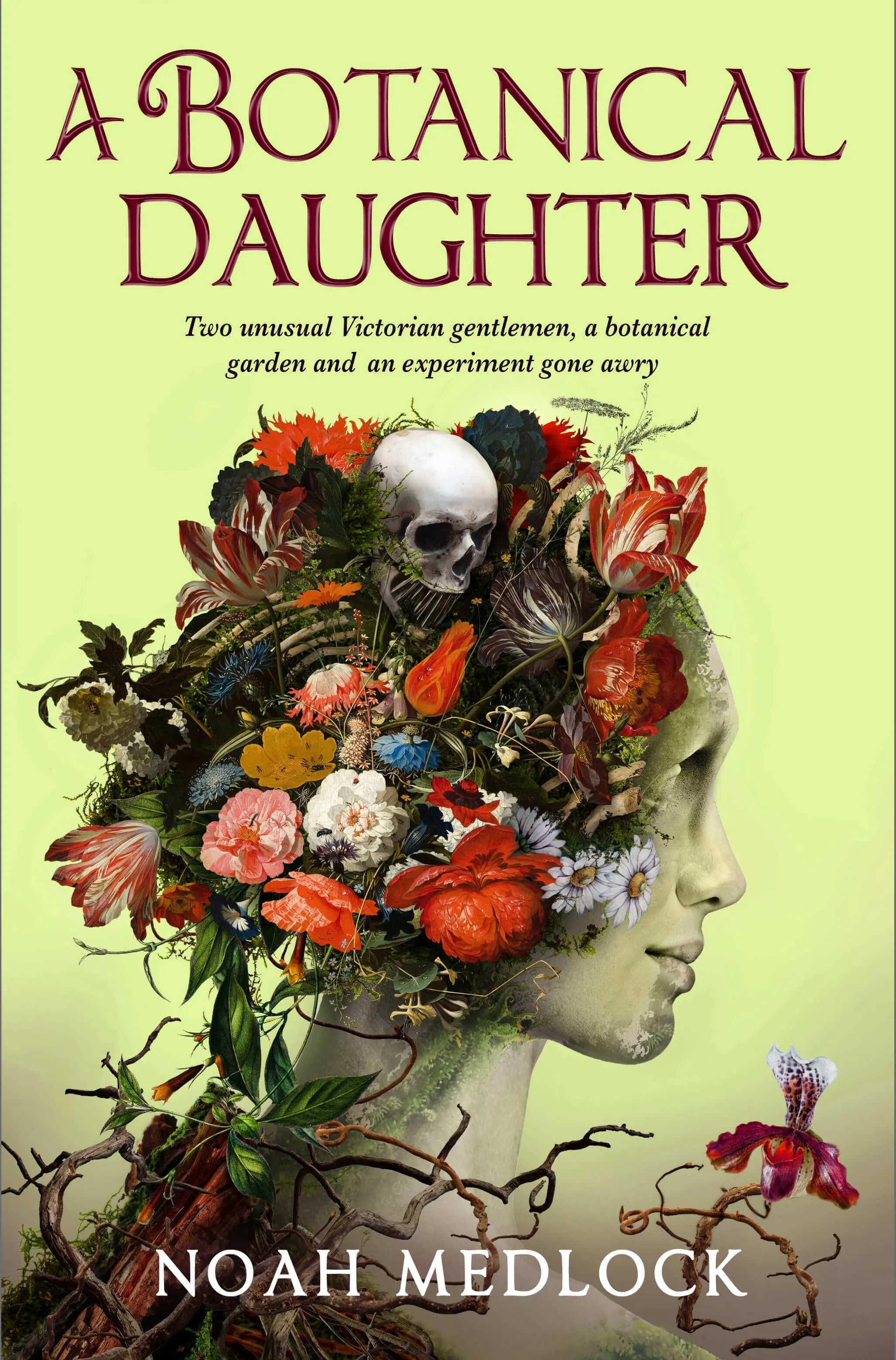
Imagine Frankenstein’s monster as a woman made of plants, with two gay dads and a woman love interest.
Summary:
It is an unusual thing, to live in a botanical garden. But Simon and Gregor are an unusual pair of gentlemen. Hidden away in their glass sanctuary from the disapproving tattle of Victorian London, they are free to follow their own interests without interference. For Simon, this means long hours in the dark basement workshop, working his taxidermical art. Gregor’s business is exotic plants – lucrative, but harmless enough. Until his latest acquisition, a strange fungus which shows signs of intellect beyond any plant he’s seen, inspires him to attempt a masterwork: true intelligent life from plant matter.
Driven by the glory he’ll earn from the Royal Horticultural Society for such an achievement, Gregor ignores the flaws in his plan: that intelligence cannot be controlled; that plants cannot be reasoned with; and that the only way his plant-beast will flourish is if he uses a recently deceased corpse for the substrate.
The experiment – or Chloe, as she is named – outstrips even Gregor’s expectations, entangling their strange household. But as Gregor’s experiment flourishes, he wilts under the cost of keeping it hidden from jealous eyes. The mycelium grows apace in this sultry greenhouse. But who is cultivating whom?
Review:
I absolutely loved the concept behind this retelling. It offers a biopunk take on Frankenstein with a blend of Victorian elements that’s both intriguing and thought-provoking.
As a gardener (and botanical garden member), I found the descriptions of the greenhouse and botanical garden both realistic and captivating. It was charming to see the couple living inside the greenhouse—who hasn’t daydreamed about that as a gardener? The contrast between the m/m and w/w relationships was also a standout, especially since neither would have been accepted in the historical time period.
However, the writing style didn’t suit my tastes. It was much too flowery (pun intended!) for what I typically enjoy reading. In fairness, I’m not particularly fond of Victorian literature, which this retelling modernizes while maintaining that tone. I struggled to connect with the two main characters and never quite understood their motivations. Though I’m a queer person and this is queer literature, I found myself disagreeing with the book’s overarching themes—it’s okay for queer people to have differing perspectives, and this is where I do.
Diversity is limited to sexuality. There is no diversity of race, ethnicity, or ability.
There are several violent scenes, including on-screen blood splatter, which is fairly graphic. There’s also a lengthy, explicit description of the w/w relationship, which was too intense for my taste, so I skimmed that section.
Overall, this is a unique take on Frankenstein with queer characters and a botanical twist. If you’re intrigued by the premise, I recommend reading the first few pages to see if the writing style resonates with you. Just be aware of the graphic violence and intimate chapter.
If you found this review helpful, please consider tipping me on ko-fi, checking out my digital items available in my ko-fi shop, buying one of my publications, using one of my referral/coupon codes, or signing up for my free microfiction monthly newsletter. Thank you for your support!
3 out of 5 stars
Length: 384 pages – average but on the longer side
Source: NetGalley
Buy It (Amazon or Bookshop.org)
Book Review: Welcome to Forever by Nathan Tavares
Two men trapped in looping artificial realities, always find each other—maybe even save the world.
Summary:
Fox is a memory editor – one of the best – gifted with the skill to create real life in the digital world. When he wakes up in Field of Reeds Center for Memory Reconstruction with no idea how he got there, the therapists tell him he was a victim in a terrorist bombing by Khadija Banks, the pioneer of memory editing technology turned revolutionary. A bombing which shredded the memory archives of all its victims, including his husband Gabe.
Thrust into reconstructions of his memories exploded from the fragments that survived the blast, Fox tries to rebuild his life, his marriage and himself. But he quickly realises his world is changing, unreliable, and echoing around itself over and over.
As he unearths endless cycles of meeting Gabe, falling in love and breaking up, Fox digs deep into his past, his time in the refugee nation of Aaru, and the exact nature of his relationship with Khadija. Because, in a world tearing itself apart to forget all its sadness, saving the man he loves might be the key to saving us all.
Review:
This book is one to read if you’re after gorgeous writing. The prose is immersive, with sentences that invite you to sink into them and reflect.
The character of Fox is rich in complexity. Each chapter peels back another layer of his personality, revealing depth and nuance. However, Gabe doesn’t receive the same level of development. While this is understandable—since we spend far more time in Fox’s mind than we do with Gabe in the present—it still makes their dynamic feel uneven.
Each chapter and memory journey felt like its own vignette. I found myself struggling with the overarching story, as so much time was spent on each memory that, by the end, I found myself asking, “What was the set-up again?” The book’s pacing, which focuses heavily on memory, made it hard for me to connect with the main plot.
At first, I felt the ending was spot on, but then the “Coda Excisions”—a chapter after the final one—left me confused. For me, it diminished the emotional impact of the conclusion.
Diversity is a standout feature of this book. The primary relationship is m/m, and there’s a secondary wlw relationship. All three of the main characters are people of color, and one speaks with a stutter, adding further nuance to the representation.
In terms of content:
- There’s some swearing.
- Intimacy is handled artistically—focused more on emotions than explicit details.
- One character experiences childhood exploitation, and it’s treated with the appropriate weight and sensitivity.
- Both main characters are orphaned.
- There are a few intense scenes: a bomb threat, a natural disaster resembling a hurricane, and a workplace shooting.
Overall, if you’re less concerned with plot structure and more interested in the emotional journey and immersive writing, this book may resonate with you. I recommend reading the first few chapters to see if the style suits you, and then deciding whether to continue.
If you found this review helpful, please consider tipping me on ko-fi, checking out my digital items available in my ko-fi shop, buying one of my publications, using one of my referral/coupon codes, or signing up for my free microfiction monthly newsletter. Thank you for your support!
3 out of 5 stars
Length: 435 pages – average but on the longer side
Source: NetGalley
Buy It (Amazon or Bookshop.org)
Book Review: Amen Maxine by Faith Gardner

You move cross-country with your brand-new husband and newborn to start a new life only for your digital assistant to inform you that your husband is going to try to kill you.
Summary:
Welcome to Silicon Valley, where the weather is perfect, the income is high … and Rowena Snyder is miserable. A transplant from New York, Rowena moved into her husband Jacob’s idyllic childhood home with their new baby. But suburbia isn’t Rowena’s cup of Starbucks. And she’s got serious anxiety and depression to boot.
Jacob, worried about their marriage, scores a new product currently in beta testing from his tech job: Maxine, a “digital friend” that bonds with an individual by continually gathering their personal data. Along with functioning like an upscale digital assistant, Maxine has “advice” and “prediction” modes that have shown promise for patients with mental health issues. To Rowena’s shock, the device turns out to be not just helpful, but eerily accurate, predicting events before they occur.
It’s a godsend until Maxine offers a series of increasingly bone-chilling predictions that will change Rowena’s life forever.
This domestic suspense novel asks, who do you trust more—your mind, your man, or your machine?
Review:
This book had me nodding my head in understanding while also absolutely cackling. The main character, Rowena, has some flavor of anxiety disorder. How she feels about the world and the reassurance she seeks was quite relatable to me. But she’s also really droll and fun to see interact with her world. When her husband brings home a digital assistant from his job that’s in beta testing for helping people with depression or anxiety, she’s skeptical and reticent to use it. Until she needs directions on the least anxiety-provoking way to go for an errand. Then she’s sold. But just when she’s getting comfortable with using Maxine and getting out into the world more, it tells her that her husband is planning to kill her.
The first 50% of the book was the perfect blend of suspense and humor. I loved that the way Rowena has to confirm changes to the digital assistant is to say “Amen Maxine.” It lends itself to some pretty funny dialogue. I also liked how the book explores in a not banging you over the head with it way the risks of using technology to treat mental health. Is it really working or is it making things worse? This part of the book was a solid five stars to me.
The last half of the book lost the sense of humor and became somehow both darker and less unique than the beginning. I feel like I would have enjoyed it more if it wasn’t in such contrast to the beginning. But the ending twist was still a surprise, and I was left feeling like I’d read a unique story. I received the print book as a gift, and I didn’t even realize it was indie published. I thought it was a small press. It’s quite professionally done.
I would be remiss not to mention that the main character is bisexual. She’s wonderful representation with her bisexuality being a part of her and her life, but not something she dwells upon. I also liked how she naturally seeks out other queer people after her move for friendship.
One thing that surprised me when I finished it and added it to my GoodReads is that the title has now changed. The author recently changed the title to The Prediction. Personally I like Amen Maxine better but I hope that the change for presumably marketing reasons is beneficial to her. But if you are interested in the book – look for The Prediction by Faith Gardner or use my direct link provided.
Overall, this was a fun psychological thriller with an interesting main character and a unique plot. If you’re a usual reader of thrillers, you’ll likely enjoy it. If you don’t usually read thrillers but are intrigued by the idea of a maybe evil digital assistant, give it a try.
If you found this review helpful, please consider tipping me on ko-fi, checking out my digital items available in my ko-fi shop, buying one of my publications, using one of my referral/coupon codes, or signing up for my free microfiction monthly newsletter. Thank you for your support!
4 out of 5 stars
Length: 262 pages – average but on the shorter side
Source: gift
Buy It (Amazon, not available on Bookshop.org)
Book Review: The Haunting of Alejandra by V. Castro

Alejandra, deep in the throes of postpartum depression, starts to see the specter of the Mexican folk demon La Llorona.
Summary:
Alejandra no longer knows who she is. To her husband, she is a wife, and to her children, a mother. To her own adoptive mother, she is a daughter. But they cannot see who Alejandra has become: a woman struggling with a darkness that threatens to consume her.
Nor can they see what Alejandra sees. In times of despair, a ghostly vision appears to her, the apparition of a crying woman in a ragged white gown.
When Alejandra visits a therapist, she begins exploring her family’s history, starting with the biological mother she never knew. As she goes deeper into the lives of the women in her family, she learns that heartbreak and tragedy are not the only things she has in common with her ancestors.
Because the crying woman was with them, too. She is La Llorona, the vengeful and murderous mother of Mexican legend. And she will not leave until Alejandra follows her mother, her grandmother, and all the women who came before her into the darkness.
But Alejandra has inherited more than just pain. She has inherited the strength and the courage of her foremothers—and she will have to summon everything they have given her to banish La Llorona forever.
Review:
The concept for this book is super original. A family with a genetic predisposition to postpartum depression is also haunted by an interdimensional being who takes advantage of that among the first-born daughters. It tackles both intergenerational trauma (especially of the colonized) and postpartum depression through a speculative lens. This speculative horror book also shows the main character going on a healing journey.
I particularly appreciated that the postpartum depression wasn’t a mere symptom of the haunting. Alejandra has postpartum depression. The being essentially targets the negative things Alejandra’s brain is already telling her. An example from the very beginning of the book is Alejandra is crying in the shower because she is so sad, and the being shows up and starts suggesting her family would be better off without her. An idea Alejandra has probably already had, but now she’s hearing it from this being that she thinks only she can see. This strategy becomes clearer when we see the flashbacks to Alejandra’s ancestors. The being also sometimes takes advantage of physical ailments but it primarily targets mental ones. I appreciated how this meant the story still took the reality of postpartum depression seriously while also tackling the issue of the multi-generational haunting. The story is told both in the present and through extended flashback chapters to previous generations.
The main character is Chicana married to a white man. In the flashbacks to the previous generations we see the racism her grandmother endured in the 1950s, and we also learn some about Mexican history (both recent and in immediate colonization by the Spanish) through two ancestors further back. The main character is bisexual, and there is a significantly important trans side character in a historic time period flashback. I particularly appreciated seeing a trans person represented in a historical time period.
The writing was at times a little clunky, especially towards the end. It just felt like I was reading a book, as opposed to getting lost in it, and it felt like different characters sounded the same. Again, this wasn’t throughout the book but limited to occasional scenes especially toward the end of the book. I also found it an odd choice to inform the reader the present-day was 2020 and then never acknowledge any of the 2020 issues. (For example, expected the mother with postpartum depression to end up dealing with distance learning for her two school-age children. But nothing ever came up.) Everything else could have stayed the same and been in 2019, so I’m not sure why it wasn’t 2019. I also felt that the husband character was treated in a two-dimensional way, as was the marriage. Marriage is very complex and yet complexity was only allowed to the postpartum depression and not the marriage. While I enjoyed this read, I did prefer the author’s previous book, The Queen of the Cicadas / La Reina de las Chicarras (review). One reason that is also evident in the title, was that book had more Spanish in it, which let me practice my Spanish more.
Overall this is a really unique read that explores postpartum depression and intergenerational trauma through a speculative lens. It’s a plot that will keep you guessing and intrigued.
If you found this review helpful, please consider tipping me on ko-fi, checking out my digital items available in my ko-fi shop, buying one of my publications, using one of my referral/coupon codes, or signing up for my free microfiction monthly newsletter. Thank you for your support!
4 out of 5 stars
Length: 272 pages – average but on the shorter side
Source: NetGalley
Buy It (Amazon or Bookshop.org)
Book Review: Killing Me by Michelle Gagnon
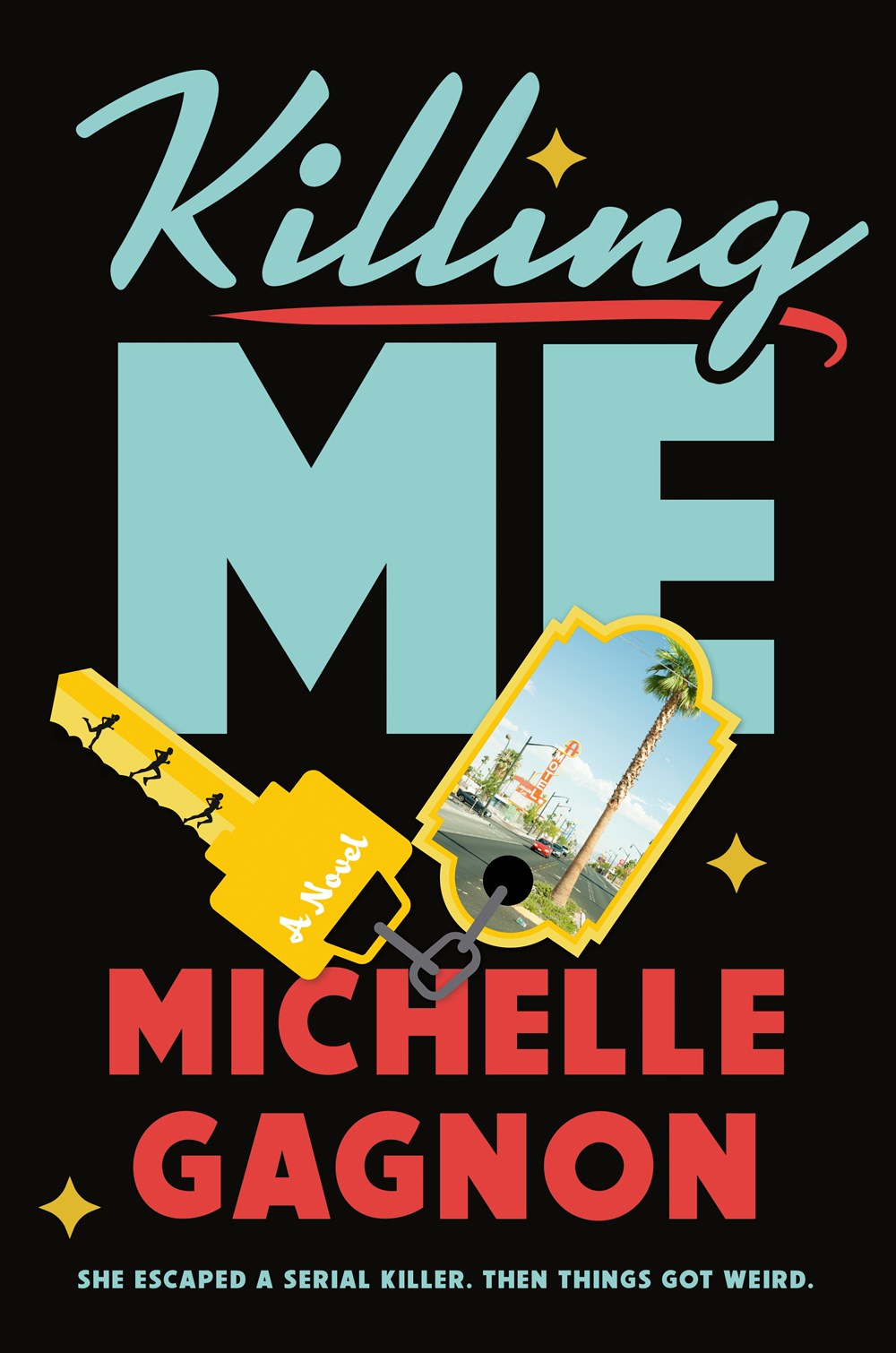
A laugh out loud thriller about women out-smarting a serial killer.
Summary:
Amber Jamison cannot believe she’s about to become the latest victim of a serial killer-she’s savvy and street smart, so when she gets pushed into, of all things, a white windowless van, she’s more angry than afraid. Things get even weirder when she’s miraculously saved by a mysterious woman…who promptly disappears. Who was she? And why is she hunting serial killers?
Review:
When I saw this on NetGalley, I was intrigued by the Final Girls-esque vibe – the women who would be the killer’s victims turning on him. I was skeptical I would find it humorous because, honestly, my funny bone is a little particular. But I actually found myself chortling on page one.
If you’re the type of person with an internal dialogue of self-deprecating humor about bizarre situations you find yourself in, then you’ll probably enjoy the sense of humor in this book. Regardless, you’ll be able to tell quickly if it’s for you or not, because the humor comes so quickly in the book, and that style is what’s present throughout the rest.
This is primarily told in the first person from Amber’s perspective, and she’s dry, acerbic, self-deprecating, but also whip-smart. (There are a few third person chapters that let us see things Amber doesn’t know about.) Amber is simultaneously problematic (she’s a con artist) and easy to root for. She’s richly three-dimensional. The main secondary characters are also rich and well-imagined. It would have been so easy to see a caricature of a sex worker, seedy motel owner, an Evangelical roommate, etc… yet they all are allowed to be more than what they might seem to be at first.
The Las Vegas setting rang very true to me. It depicted both the tourist bits and the seedier local areas quite well. I especially loved the run-down yet beloved film noir stylized motel as compared to the one recently made over to appeal to Gen Z and Millennials. That had me chortling.
I also really appreciated that this is a book whose main character is a lesbian but the plot has absolutely nothing to do with her being a lesbian. You could have almost the exact same book with a heterosexual main character. It’s just Amber so happens to like women. I like having this type of representation. It doesn’t always have to be about the difficulties of coming out or a romance to feature queer people.
The mystery itself was decent. The plot was certainly unique compared to other thrillers I’ve read, and I did not guess the ending. There was one twist that annoyed me only because it was solely a twist because Amber held something back from the reader. But I was willing to forgive it because she sort of breaks the fourth wall and acknowledges that she did it…which was funny.
I hope there’s a sequel, because I think there’s a lot left to explore with Amber, and she has a very interesting set-up at the end of the book.
Overall, I really recommend this to thriller lovers looking for something different. The humor and the plot really deliver.
If you found this review helpful, please consider tipping me on ko-fi, checking out my digital items available in my ko-fi shop, buying one of my publications, or using one of my referral/coupon codes. Thank you for your support!
4 out of 5 stars
Length: 336 pages – average but on the longer side
Source: NetGalley
Buy It (Amazon or Bookshop.org)
 Support my work with a tip or browse my shop for curated book club guides, how to guides, cross-stitch patterns, and more!


This work by Amanda Nevius is licensed under a Creative Commons Attribution-Noncommercial-No Derivative Works 3.0 United States License.
 Opinions of a Wolf