
Archive
Book Review: Remember Me? by Sophie Kinsella
 Summary:
The last thing Lexi remembers she’s a 24 year old in the year 2004 with bad teeth, a bad boyfriend, and at the bottom of the totem pole in a new job where she hasn’t been working long enough to be able to get the annual bonus. When she wakes up in hospital, though, she’s told that the year is 2007, she’s 28, the boss of her department, and married to a millionaire! She’s told she was in a car accident that gave her amnesia, and now she has to piece together just how she got to this place in her life, especially when not everything is as rosy as it seems at first. Her millionaire husband is controlling, her once best friends give her the cold shoulder, and everyone at work seems to think that she’s a bitch.
Review:
True story. I spotted this sitting on top of a neighbor’s recycling bin and snatched it up as soon as I recognized the author’s name. I was a big fan of Sophie Kinsella’s in high school, and I just couldn’t bear to see a perfectly nice condition hardcover of one of her books get recycled. I wondered if I would enjoy her contemporary romance as much now as a late 20-something as I did as a teen. I’m happy to say I certainly enjoyed this one just as much, although in a slightly different way than I used to.
I wonder how much I would have appreciated this book a few years ago. As a late-20 something myself, I laughed out loud at how the 24 year old version of me would react if she was plunked into my current life. A lot really does change in 4 years in your 20s, especially with regards to your career and your love life. The plot kind of reminded me a bit of the plot of one of my favorite romcoms 13 Going On 30. Someone who is (or perceives of themselves as) much younger and less experienced than the person whose life they are now living. How that affects them and how they react to it is really interesting. Both stories show how important actually going through the growing pains really are. You can’t just suddenly handle a more adult life; you have to grow into it.
I also appreciated that, although Lexi’s husband is drop-dead gorgeous, both she and he believe she should not sleep with him until she is comfortable with him again. She may be married to him, but she doesn’t remember who he is, and she shouldn’t do anything until she’s ready. If she ever is. Her husband is definitely controlling of her when it comes to how their household is run and how they spend money, but he is very respectful of her sexually. He doesn’t touch her unless invited to, and he stops when she says to. I was really happy to see this focus on positive, enthusiastic consent portrayed in the book.
The exploration of Lexi’s career path from lower level to high-powered boss is fascinating. Lexi is torn up that now that she’s a boss those under her think she’s a bitch. There’s a nuanced exploration of how women in power are often perceived of as bitches, even if they’re just being assertive. However, there’s also a nice exploration of how to still be true to yourself when in power. You don’t necessarily have to lead in the traditional “masculine” way if you don’t want to. This combined with the exploration of aging gave a depth to the romance that kicked it up a notch for me.
It says a lot for how much the book made me like Lexi that I was able to get past one plot point that usually spoils romances for me. However, that plot point did knock the book down from 5 to 4 stars for me.
*spoilers*
It turns out that 28 year old Lexi is cheating on her husband. 24 year old Lexi is just as horrified by this as I always am by cheating. The exploration of how she wound up cheating on him didn’t make it ok to me, but I did appreciate that 24 year old Lexi took agency and addressed the situation, rather than lingering in married but cheating land. I appreciated that Lexi was able to acknowledge her mistakes, forgive herself for them, and grow and change.
*end spoilers*
Overall, fans of contemporary romance will enjoy this fun take on the amnesia plot. The plot doesn’t just cover a romance, it also covers the growing pains of being in your 20s, the challenges women face when they become the boss, and how to learn from your mistakes.
If you found this review helpful, please consider tipping me on ko-fi, checking out my digital items available in my ko-fi shop, buying one of my publications, or using one of my referral/coupon codes. Thank you for your support!
4 out of 5 stars
Length: 389 pages – average but on the longer side
Source: Rescued from a recycling bin
Buy It (Amazon or Bookshop.org)
Counts For:
Bottom of TBR Pile Challenge
Book Review: The Poisonwood Bible by Barbara Kingsolver
 Summary:
In 1959 Nathan Price took his wife and four young daughters on a mission to the Congo to spread the Evangelical Baptist message. Nathan, abusive and stubborn, refuses to listen to anyone around him–not the chief of the village he’s living in, not their Congolese maid, not the organizers of the mission, and certainly not his wife or daughters. When the Congo’s fight for independence from Belgium arrives, Nathan refuses to return to the United States with lasting consequences on all of the Prices.
Review:
I was told by several people that as a deconvert from the Evangelical Baptist faith I was raised in, I would enjoy this secularly published take on an Evangelical mission to Africa. While I did enjoy the beginning of the book for its honest look at what missions are actually like, the character development becomes increasingly more lackluster and flat throughout the book, working in direct contrast with an increasingly complex plot and souring the whole book. Additionally, although the book avoids having a Christian slanted take to missions, it certainly does not manage to tell the neutral story I was hoping for. The author’s slant is more and more apparent as the book goes on, and it ends up being quite heavy-handed by the end.
The beginning of the book is excellent. Rather than giving Nathan the voice, all of the story telling is from the point of view of one of the women in his life whom he silences–Orleanna (his wife), Rachel, Leah, Adah, and Ruth May. It is so powerful to see him through their eyes. To see him striving so hard to maintain control over everyone and simultaneously hear from their thoughts that he can never truly control them. It’s empowering and simultaneously heartbreaking.
It’s also interesting to see how Nathan’s stubbornness and know-it-all nature prevents him from ever truly connecting to or even helping the people in the village he’s working in. He thinks his way is always the best, completely missing that he and the villagers could actually trade knowledge and information and all end up better. Because they are, in his mind, backwards and unsaved, he refuses to ever listen to them. His refusal to ever bend causes the mission to break. For instance, he insists on baptism in the river, even though the villagers are afraid to go in the river because of crocodiles. He could have made a compromise, perhaps a tub of water in the church, but he continues to insist on the river, leading the villagers to believe he is out to get their children killed by crocodiles. It’s a gentle and subtle message, unlike others in the book, that could be applied to many aspects of many lives. Be willing to listen, grow, and learn.
Once the Congo rebellion starts though, the book begins a slow slide off the rails. The voices of the women change from developing toward a well-rounded presentation of their characters to flat cardboard cut-out versions of their original selves. For instance, Rachel goes from being a femme teenager frustrated with being stuck in the jungle to a cardboard cut-out racist white supremacist. While being a white supremacist is obviously wrong, Rachel isn’t well-rounded enough to let her still be human. She is instead a monster, which is a disservice to us all. It is only by seeing how those who seem monstrous are just humans gone wrong can we learn something. The same is true of the rest of the women, although they are all taken in different directions toward different stereotypes. One loses her mental health, another becomes a scholar, etc… But they all become stereotypes rather than older versions of their well-rounded younger selves.
Similarly, although the multiple different perspectives work well for a bunch of different sets of eyes seeing the same situations play out in the same village, when the daughters grow up, the multiple perspectives become instead individual perspectives of their own individual lives with some periodic judgment from one sister to another on how she’s choosing to live her life. Instead of giving a richly varied representation of one situation, the reader instead gets a slanted viewpoint of several different situations. It again renders the story flat instead of well-rounded. I found myself thinking many times that the book would have been better if it had just ended at the end of the section that takes part in the daughters’ childhoods.
The plot and character shifts both line up with a tone shift that goes from neutrally presenting what occurs in the village to having a decided political slant. It feels as if the point goes from telling a good story to convincing the reader to feel a certain way. I think it’s interesting that this slant and the weaker writing go hand-in-hand. It’s a good reminder that if you focus on telling a good story, a message may come across on its own anyway, but don’t try to force a story to fit a message you want to tell. That hurts the story.
Overall, the beginning of the book is quite strong, featuring an interesting plot and characters but about 2/3 of the way through, it loses its strength, falling into caricature and message pushing that hurt the story as a whole. Recommended to readers who are quite interested in the beginning and wouldn’t mind skimming the end.
If you found this review helpful, please consider tipping me on ko-fi, checking out my digital items available in my ko-fi shop, buying one of my publications, or using one of my referral/coupon codes. Thank you for your support!
3 out of 5 stars
Length: 546 pages – chunkster
Source: PaperBackSwap

Counts For:
Bottom of TBR Pile Challenge
Book Review: Cowboys and Aliens by Scott Mitchell Rosenberg (Graphic Novel)
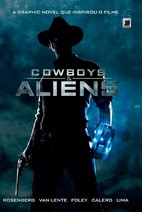 Summary:
In the American Wild West, invading aliens show up, intent to colonize the planet and enslave or destroy the humans. The warring white settlers and Native Americans must put aside their own battle for control of the land and defend it from offworlders.
Review:
This was given as a gift to me, because when the movie Cowboys and Aliens came out in 2011, I was super into the idea of two of my favorite things being combined–a western and scifi. A friend gifted this to me, and it languished on my TBR Pile for years. I finally picked it up, and while I enjoyed the read and the art, I did not enjoy it as much as the movie, finding it to be too heavy-handed and obvious in its message, as well as a bit too stereotypical in how it handled its Native American characters.
The art is bright and colorful with easy-to-follow panels. The book opens with a clearly laid out parallel between the colonizing alien species and the white settlers in America. It’s clever to make a group actively colonizing another group suddenly the victim of colonizers themselves. However, the direct juxtaposition jumping back and forth between the two visually is too heavy-handed. Readers know about colonization on our own planet. Just tell the story of the aliens and let us see the white settler characters slowly realize that they’re doing the same thing to others. Instead, the readers are shown several times both the parallels between the two and one of the white settlers suddenly dramatically realizing the similarities in the situations.
The Native American characters aren’t horribly handed, however they are treated a bit too much magically for my taste. Thankfully, how they help fight the aliens mostly comes from ingenuity, not magic.
Both of those things said, the aliens in the story are diverse and interestingly drawn. Seeing Native Americans and white settlers battle the aliens with a combination of their own gear and stolen alien items was really fun to read. Just not as much fun or as well-developed of a plot as it was in the movie.
Overall, this is a quick graphic novel that would be a fun read for either hardcore fans of the movie or those interested in the basic idea but who prefer graphic novels to movies.
If you found this review helpful, please consider tipping me on ko-fi, checking out my digital items available in my ko-fi shop, buying one of my publications, or using one of my referral/coupon codes. Thank you for your support!
3 out of 5 stars
Length: 112 pages – novella
Source: Gift

Counts For:
Bottom of TBR Pile Challenge
Book Review: Anarchism and Other Essays by Emma Goldman
 Summary:
Emma Goldman was a Russian immigrant to the United States who embraced Anarchism and became an impassioned orator and pioneer in the movement for birth control. She was deported in 1919 for her antiwar activities and spent the remainder of her life moving among multiple countries. This book is a collection of a variety of her essays and includes a contemporaneous biographical sketch and preface. You may read more about Emma Goldman and her life here.
Review:
I picked up this essay collection due to my interest in both US and women’s history. It then languished on my TBR pile for years until I heard about how the Emma Goldman Archive at UC Berkeley was going to lose its funding (source). The archive is currently still running thanks to charitable donations, (source) but I still wanted to invest some time in learning more about this important female historical figure, and what better way than by reading her own papers.
The essays in this collection are: Anarchism: What It Really Stands For, Minorities Versus Majorities, The Psychology of Political Violence, Prisons: A Social Crime and Failure, Patriotism: A Menace to Liberty, Francisco Ferrer and the Modern School, The Hypocrisy of Puritanism, The Traffic in Women, Woman Suffrage, The Tragedy of Woman’s Emancipation, Marriage and Love, and The Modern Drama: A Powerful Dissenter of Radical Thought.
The thing to understand about Anarchism (the historic early 20th century kind anyway, I won’t venture to talk about modern Anarchism as I have not studied it at all) is that the basis of Anarchist belief is that there should be no government and no religion.
Anarchism is the only philosophy which brings to man the consciousness of himself; which maintains that God, the State, and society are non-existent, that their promises are null and void, since they can be fulfilled only through man’s subordination. (page 38)
Emma took this to the conclusion that fighting for rights within the governmental power structure was pointless since the government shouldn’t be involved anyway. Modern readers may thus be surprised at how against women getting the right to vote she was. The reasoning behind it, though was that she thought it was a pointless fight. Like putting frosting on a shit cake. It won’t make the cake any less shitty. It’s interesting reading these papers how much faith Emma had in human nature to do good. It’s the power structures she considered evil.
My lack of faith in the majority is dictated by my faith in the potentialities of the individual. (page 34)
What I found most interesting in reading these essays, beyond getting a firmer understanding of Anarchism, is how most of them are still highly relatable today. They have not been particularly dated. Only “Francisco Ferrer and the Modern School” and “The Modern Drama: A Powerful Dissenter of Radical Thought” came across as dated and a bit difficult to read to me. The rest could have been pulled straight from a social justice Tumblr account, with just a few names and places changed. The three essays on women were the most interesting to me, particularly for the rather prophetic predictions that Emma made about the direction women’s rights were heading. In particular, one section discusses that women winning the right to work will just make everything more difficult because women are still seen as the primary caregivers and homemakers. They will just end up working just as much at home and out and about. Emma also pointed out that society would come to expect two incomes, making it impossible for women to not work even if they want to. This has certainly come to pass. Emma’s solution to this is more individual freedom, and her passage of advice to women still rings true today:
Her development, her freedom, her independence, must come from and through herself. First, by asserting herself as a personality, and not as a sex commodity. Second, by refusing the right to anyone over her body; by refusing to bear children, unless she wants them; by refusing to be a servant to God, the State, society, the husband, the family, etc.; by making her life simpler, but deeper and richer. That is, by trying to learn the meaning and substance of life in all its complexities, by freeing herself from the fear of public opinion and public condemnation. (page 132)
Sections that would probably stir up the strongest feelings among modern readers include frequent rants against the Catholic church, hatred of all patriotism or nationalism, very strong anti-military positions, and a strong negative view of marriage. However, if the modern reader keeps in mind that Emma was for 100% individual freedom and individuality, it’s easier to see that it’s not an individual institution she had something against, but rather institutions in general. Think of her as an extreme libertarian, and it’s easier to understand. In the case of marriage, for instance, it’s not that Emma was against love or being part of a couple, but rather against the state being involved in that love.
One aspect I think was missing from these essays was more from Emma on what she thought the ideal world would really look like. How would things work once total individual freedom was won? This is not touched upon very much, beyond Emma’s belief that crime would disappear without crooked institutions and there would be no more war. I found her belief in innate human goodness to be overly optimistic, verging on naive. But I also found it to be endearing that she had so much faith in humanity.
Overall, the modern reader will still find most of these essays highly readable and may be surprised by how modern many of them feel. Readers will realize how little some things change through time and also will come away with a better understanding of the stance of the often feared and misunderstood Anarchists.
If you found this review helpful, please consider tipping me on ko-fi, checking out my digital items available in my ko-fi shop, buying one of my publications, or using one of my referral/coupon codes. Thank you for your support!
4 out of 5 stars
Length: 291 pages – average but on the shorter side
Source: Purchased
Buy It (Amazon or Bookshop.org)
Book Review: Mark of the Harbinger: Fall of Eden by Chris R. McCarthy
 Summary:
Humanity, desperate to save themselves from oncoming meteors that will destroy Earth, builds two spaceships and binds them together into one unit. They fill it with the best and brightest of humanity then send it off into space, with nanobots working to keep them all perpetually the same age they were when entering the ship, hoping that they will find another habitable planet. But over the thousands of years of searching, the two ships have slowly evolved into one of beauty, order, and plenty of food. The other has become a prison ship, full of starvation and degradation. Both ruled by an artificial intelligence known as Ark. When a man awakes on the prison ship, he must discover who he is and why he has been awakened.
Review:
The basic idea of a ship full of thousands of people wandering outer space for thousands of years and how that impacts their culture is a good one. But it is unfortunately supported by weak characterization, quite a bit of telling instead of showing (often in the form a conversational infodump), questionable science, and aggravating plot twists.
I am not a scifi reader who expects everything to be Asimov or heavy on the science. I enjoy the broad range that scifi has to offer. But I do expect a scifi that takes itself seriously, as this one does, to have: a plot that makes sense, at least two characters who are well-rounded and richly presented, and any science within it to be accurate or at least plausible. This scifi definitely takes itself seriously, but it fails on these marks.
The book opens with a first person narration of the nameless hero (later named Harbinger) believing he is being dissected by an alien race. It takes quite a bit of time to find out that he was cryogenically frozen on this ship, and the rebels of the prison ship have woken him up. If this wasn’t a review copy, I probably would have given up before Harbinger figures this out, because the reader has zero reason to care about this character who is being dissected, apparently. It’s quite jarring to open up the book that way, and it’s hard to read with no investment in any of the characters at all. It’s a rough beginning.
Harbinger has amnesia, so he can’t help the rebels figure out why exactly he was on the ship. But they do discover that he has superhuman powers, just as the rebels were hoping, so they want him to help them fight for access back to Echelon–the ship that is not a prison (There are names for both ships, but I honestly can’t remember what the name of the prison ship was.) The rebel character who works closest with Harbinger is a woman named Leema. Harbinger gets slightly more characterization than Leema, because we are inside his head. But both come across as flat. Their actions appear to exist entirely as plot devices and not out of real, rich motivation. For instance, Leema seems mostly to exist to give Harbinger information, to have sex with, then to spur him to make certain decision. She doesn’t come across as a person so much as a plot device. The same can be said for the leader of the rebels, Argus, an older man who calls people “son.” He simply does not feel real. He feels like a plot device who pops in whenever it’s necessary to make something happen to Harbinger.
The writing often relies on conversational infodump, which is a shame, because when there are action sequences, they are interesting and exciting. The periodic action sequences are what kept me reading. They are well-written, particularly the fight scenes. But when the characters talk, the conversation doesn’t feel real. It feels like the author is speaking directly to the reader through the characters, often to provide background information. This is known as an infodump, and it’s frustrating to read. It would be better to work this information into the plot, rather than have characters sit in a room and say it at each other for chapters at a time.
The science is a bit shaky. For instance, the spaceship is decorated with marble. Real marble. Real marble is incredibly heavy, and there’s a weight limit that spaceships can handle. It’s hard to imagine a people desperate to save humanity from meteors wasting precious weight space on marble decorations. Similarly, Harbinger is never fully explained. He appears to be human and bleeds but can’t feel pain, has superhuman strength, can only be killed by cutting off his head. Is he a robot? Or a genetically modified humanoid? Maybe a clone? Leema explains “his kind” being created but she seems to know very little about it, which makes it odd that she and the rebels knew enough to know how to break him free from Ark by cutting into him and adjusting things inside his body. The core of the idea is good but it’s just not explained enough. That is really what makes some of the science in the book weak. It’s not gone into in enough depth to make enough sense.
Finally, the plot makes quite a few quick zany twists, most of which I was willing to give a pass. The final twist, however, made me want to throw my kindle against the wall. (I didn’t, because I like my kindle). I’m sure the final plot twist was intended to make the reader want to continue on to the next book in the series, but it actually just left me feeling deeply unsatisfied and frustrated. If I had to put my finger on what made it so frustrating, I’d say that it felt forced, not organic.
Overall, this book consists of a good basic idea that suffers from infodumping, weak characters, and being forced to stick to a plot that doesn’t feel organic. Rich characters who drove an organic plot free of infodumps could have made this into an interesting world and cultural exploration. Instead, it’s a frustrating read.
If you found this review helpful, please consider tipping me on ko-fi, checking out my digital items available in my ko-fi shop, buying one of my publications, or using one of my referral/coupon codes. Thank you for your support!
2 out of 5 stars
Length: 274 pages – average but on the shorter side
Source: kindle copy from author in exchange for my honest review

Book Review: Late Eclipses by Seanan McGuire (Series, #4)
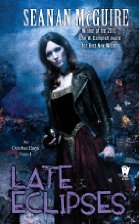 Summary:
One of Toby’s oldest friends is in dire trouble. Lily of the Tea Gardens is slowly fading away, and no one knows what’s causing it. On top of that, one of Toby’s worst nemeses whose name is feared throughout Fae, Oleander, is back. Are the two related or is something else going on? And can Toby save the day without losing herself?
Review:
I picked this book up expecting it to be another mystery of the week entry in the series, but what I found was a surprising development in the overarching plot that kept my heart in my throat but also left me dubious about the possible directions the next book could take.
The plot starts out similarly to the previous entry in the series. Someone close to Toby is in danger. In this case, it’s Lily, and she’s sick, slowly fading out of existence. Over the course of the book, others close to Toby end up sick as well, as it soon becomes clear (this is really not a spoiler, it’s revealed early on) that someone is poisoning them. When Oleander showed up, I nearly groaned at how obvious it felt that she is the one to blame for all of this. But it’s not quite that straight-forward, and there’s also a sub-plot of Toby possibly going crazy….which changelings are known to do in this world. The book then isn’t just about Toby trying to solve the mystery, it’s also about her trying to determine if her blood has doomed her to sink into insanity. This gives the plot enough depth to keep it interesting.
Long-standing characters receive more depth of character development and new ones are added. Toby cotinues to have the wit that keeps the book upbeat even when things are grim. One quote in particular I think would work pretty well as a fitspo positive argument:
I promised myself that if I lived, I’d start working out. Better cranky and alive than cheerful and dead. (loc 1815)
As for the plot twist, I can’t talk about it much without spoilers. The spoiler free review would be that I am concerned the big overarching plot twist moves things a bit too far into one hero to save us land, which isn’t a fantasy plot I personally usually enjoy. For the spoiler version of this, see the next paragraph.
*spoilers*
It is revealed that Toby is not the type of Fae she thought, she is rather a very rare type of Fae. This type of Fae is capable of changing the make-up of their own blood. She can thus morph into more Fae, changeling, or human as she desires. It also turns out her mother is from the first born, which makes her kind of Fae royalty. My issue with this is one of the things I like so much about the series is that Toby lacks the magical powers to the extent the Fae have. She also doesn’t fit into the human world. But she fights for her right to be in the world she chooses to live in, and her value in the Fae world is due to how hard she tries and her brains, not her blood. This plot development feels like it’s making it all about her blood. Her power is due to whose daughter she is, not who she herself is. That’s just not a message I’m as fond of.
*end spoilers*
Overall, this is an action-packed entry in the series that visits another mystery with enough different sub-plots and twists to keep it interesting. Fans of the series will be surprised by the big overarching plot development toward the end of the book and will be eager to pick up the next one to see where this plot development goes.
If you found this review helpful, please consider tipping me on ko-fi, checking out my digital items available in my ko-fi shop, buying one of my publications, or using one of my referral/coupon codes. Thank you for your support!
4 out of 5 stars
Length: 372 pages – average but on the longer side
Source: Library

Previous Books in Series:
Rosemary and Rue, review
A Local Habitation, review
An Artificial Night, review
Book Review: Peyton Place by Grace Metalious
 Summary:
Peyton Place appears to be a picturesque small town in New Hampshire. But over the course of the novel, the secret passions, lies, and cruelties of its various inhabitants are revealed. From a single mother lying both about her daughter’s age and being a widow to the school janitor who drinks to dull the ache of his wife’s cheating to what exactly is buried in the sheep pen in the Cross’s yard. Small town life is anything but simple and picturesque.
Review:
This book was first recommended to me on either LibraryThing or GoodReads for being similar to The Group (review), another book written in the mid 1900s featuring an ensemble cast. I wound up ultimately picking it up because I read that it was quite scandalous when it first came out and it was the inspiration behind the first successful nighttime American soap opera of the same name (source). Additionally, I grew up in Vermont but spent a lot of time in New Hampshire, since I grew up on the Vermont border with New Hampshire. I even went to high school in New Hampshire (public school, my town in Vermont was too small for a high school so bussed us out to other ones nearby). I was curious to see if any element of the book would successfully evoke New Hampshire to me. I often find that books set in New Hampshire just don’t ring true with the New Hampshire I know. What I found was a book that almost gave me chills at how well it depicted a typical New Hampshire small town, but also was nowhere near what I would in my modern mind describe as scandalous, although I can see why it was at the time.
The story explores the intersecting lives of many town folk in the 1940s and 1950s, but primarily focuses on Constance MacKenzie, her daughter Allison, and her daughter’s friend from the wrong side of the tracks, Selena Cross. Constance is a frigid woman who has tamped down her sexuality in an attempt to raise her daughter who she conceived out of wedlock while having an affair with a married man in the right way. She has gone so far as to lie about her daughter’s age and to lie about being a widow to help her daughter seem “acceptable.” Allison grows up over the course of the novel, first having typical teenage angst, then moving away to NYC to become a writer. Selena Cross suffers from a good-for-nothing stepfather, living in a shack, and living with a mother who is not all mentally there. Through their eyes and lives we see snippets of the lives of many others in the town.
Here are the things that were considered scandalous when the book was first published: rape of a stepdaughter by a stepfather (you can probably guess who), abortion (which was illegal at the time), men locking themselves in a basement to go on a bender for weeks at a time. Things that were probably also considered scandalous but to less of a degree: teenage sex, out of wedlock sex, middle school aged boy spying on a couple having sex, murder in self-defense. I had to sit here and think for a bit to remember what was possibly deemed scandalous. It mostly just seemed like a very eventful book to me, and honestly I was just a bit surprised that nothing more scandalous happened. (Apparently, Metalious originally wrote the book with having a father rape a daughter, but the publisher made her change it because America wasn’t ready yet. Oh my how times have changed. Source). The only part of the book that really bothered me at all in the way that perhaps people were once scandalized was the depicted of Constance’s relationship with her new boyfriend. Basically she is frigid and he has to get her to open up and accept her sexuality in order to be her true self. That’s a fine plot, but the way it’s done often verges on the border of “she said no but ignore it because she really means yes.” I understand in the 1950s when this was written that it was progressive to have a woman character learning to open up and embrace her sexuality, so I shouldn’t be too harsh with modern critiques. Certainly the character herself deems what occurred between her and her boyfriend as lovemaking. But I definitely don’t think this portion aged well, and it soured my enjoyment of that particular chapter, and Constance’s plot as a whole.
I found the two abortion plots to be particularly poignant and important. Even though abortion is now legal, a lot of the arguments for and against it in the book are still heard today. I found the two abortions in the book to be an important reminder of why it’s important for abortion to be legal and also why it’s important to educate about safe sex at the same time.
What really made me enjoy the book though was its depiction of small town New Hampshire life. It just rang as so very true to me, right own to the scandals. I think too often people get this idealistic picture of small town life, and that is just not the reality for people who actually live there. People in small towns are just as human as people in cities. The real difference is that it’s hard to change your reputation in a small town. Similarly, small towns are more able to be a law in and of themselves. If the people agree on something, no outsiders can make them change their tune. That can both be a blessing and a curse. If you are interested in New Hampshire, this book certainly presents it in an unvarnished way. From the scenery to the proximity of Vermont to the mills and the problems with the mills to the way the small towns block out those who aren’t from here. If what the reader is looking for is a real representation of small town New Hampshire, they should certainly look no further.
One side-note: I find the story of the author’s life and how her book was received to be quite fascinating. For instance, how it was mostly received as chick lit, in spite of the fact that if the same story had been written by a man it would have been considered serious literature. I also find how the author found the information to inspire the story, as well as how she reacted to fame to be fascinating. If you want to read more about the former, I recommend picking up this edition of the book, as it has a great foreword talking about the history of the book from a women’s studies perspective. If you’re interested in the latter, I recommend reading this article from Vanity Fair about her life.
Overall, it is easy to see how this book was scandalous in its time, although it mostly holds no shock value today. Readers interested in small town New Hampshire life with a side of multiple overlapping juicy plots will not be disappointed.
If you found this review helpful, please consider tipping me on ko-fi, checking out my digital items available in my ko-fi shop, buying one of my publications, or using one of my referral/coupon codes. Thank you for your support!
4 out of 5 stars
Length: 384 pages – average but on the longer side
Source: PaperBackSwap

Counts For:
Bottom of TBR Pile Challenge
Book Review: Fated by S.G. Browne
 Summary:
Fabio is not a fan of his job as Fate. He never gets to actually influence the idiotic humans in his charge (everyone off the path of Destiny). He just gets to show up at the moment of their fateful decisions. Falling in love with a human (who just so happens to be on the path of Destiny) breaks rule #1, and once you break one rule, you may as well break others…. Soon, Fabio is interfering in his charges’ fateful decisions, but just how long can he do this without causing havoc and escaping Jerry’s (God’s) notice?
Review:
I remember I first acquired this because I really enjoyed Browne’s other novel, Breathers: A Zombie’s Lament (review). Although this book uses a similar irreverent tune, it just doesn’t work out as well given the content. Add in a few writing quirks and an ending that made me simultaneously scratch my head and go ewww, this just didn’t work for me.
The first thing that bothered me about the book is a quirk Fabio (our narrator) has to describe each and every character we encounter in the following way: “The thing about [name] is, s/he is [character flaw].” It’s cutesie the first few times. By the twentieth time it’s irritating and by the thirtieth you’re kind of wondering what the heck is wrong with Fabio that he’s been alive for this many thousands of years and still can’t seem to come up with a more creative way to talk.
The book’s mythology firmly asserts that Christianity is right. Although there’s a mysterious aside about how the Greek/Roman mythological gods and goddesses did exist but stopped being important once people stopped believing in them. So, in spite of Jerry and all of his servants all asserting that Jesus is the Son of God and Christianity is right, there’s also this idea that something else once existed when people believed in it. There is also an immortal character of Karma, who we are told exists mostly because of the many people in India who believe in him. You can probably spot the problem with these co-existing ideas. If immortal ideas/people exist because of belief, why would the only ones in existence be the Christian God and Karma, currently? There are clearly other religions in the world that people currently believe in, so…….My issue isn’t with the author choosing to assert that the Christian God is the one that is true in this world (although some readers might be bothered by it). My issue is that the book simultaneously does this and says that other gods/ideas can exist with belief, but then limits these to only ancient Greek/Roman gods and goddesses and modern-day Karma. This doesn’t work within the logic of the world that the author set up. It really bugged me.
There is also the problem that the immortal characters (well, and the human ones, but let’s focus on the immortal ones) are divided up in a very gender normative way. Destiny, Lust, and Lady Luck, Secrecy, and Honesty are all women. Sloth, Gluttony, Death, Fate, Karma, oh yeah and GOD are all men. Lust is an overwrought caricature of the evil temptress woman. Honesty is basically the most feminine innocent woman you could meet. It’s the classic virgin/whore dichotomy (oh and don’t forget the Virgin Mary, who’s also obviously mentioned quite a bit). It’s not exactly better for the men, being stuck with either being a lazy slob, someone who violently kills everyone, or Fate himself. Even if the reader is personally ok with gender normativity, this collection of characters is just expected and dull. There’s nothing that really throws the reader a curveball or strikes as creative. Right down to God going by the name Jerry and having a bureaucratic office in the sky.
Then we have the human who Fabio falls in love with, who is basically the manic pixie dream girl (a female character who exists only to show up and show a depressed male character the meaning of life. Full exploration of this trope), which I’ve talked about before in other reviews (not surprisingly in books by men set in fantastical settings and that are supposed to be funny, but I digress). Just like with gender normativity, this trope is just lazy. The only motivator to the male character (who is first person and depressed and dull) is for a magical woman to show up and fix his life (often while her own gets ruined). There’s no real characterization of the female character, and frankly it undersells the male character too. This book takes it a whole step further. The spoiler paragraph below goes into more depth about the problematic treatment of women in the book.
*spoilers*
Sara, the manic pixie dream girl, shows up and Fabio falls in love with her. She falls in love with him too. Fabio reveals to her who he is. She loves him anyway. They’re very happy together. Fabio finds out that Sara is on the path of Destiny because she’s supposed to be the mother of the second Son of God. So God is going to show up and bang his girlfriend at some point. He is very upset about this. God finds out about Fabio both telling a human who he is and interfering with human fates and punishes him by both turning him mortal and wiping him from Sara’s memory. Sara believes that Fabio was a one-night stand. Fabio proceeds to stalk her, forcing her to get a restraining order, which he then violates. It’s unclear if this is supposed to be seen as romantic, exactly, but it is clear that the reader is supposed to empathize with Fabio. Sara wouldn’t really want him to stay away from her if she just understood, which is problematic because of how it mirrors the logic of many stalkers. It gets worse though. Fabio in despair throws himself off a bridge, committing suicide. He then comes to realizing that he has been reformed as the fetus inside Sara’s uterus–the result of the one-night stand between her and God. He is the second Son of God. And he’s ok with this because he at least gets to be close to Sara. So Sara doesn’t just exist purely as a prop for Fabio’s character development, she’s also the woman who is banged once and thrown away by God to be forced to bring his second Son into the world who also just so happens to be the same dude as her ex-lover she has the restraining order against. It’s just so many levels of denying women any agency or rights or treating women as anything but passive vessels to be used by men and male gods however they want that it just made my head explode with rage when I read it. Most of this what the fuckery occurs in the last couple of chapters.
*end spoilers*
This is a book whose idea I felt had promise but the directions the author chose to take it just ruined it for me. Readers who won’t be bothered by a book with logical inconsistencies, gender normative representations of immortals, and the problematic characterizations and plots for women may enjoy the book for its irreverent humor about fate and destiny. Any readers who would be bothered by those things, though, should steer clear.
If you found this review helpful, please consider tipping me on ko-fi, checking out my digital items available in my ko-fi shop, buying one of my publications, or using one of my referral/coupon codes. Thank you for your support!
2 out of 5 stars
Length: 352 pages – average but on the longer side
Source: PaperBackSwap

Counts For:
Bottom of TBR Pile Challenge
Announcement: I Am Open to Review Requests Now Through December 30th for Review in 2016
 Hooray!!
I am happy to announce that as of now I am open to review requests for books to be reviewed in 2016!!!
Now through December 30th, feel free to fill out the submission form if you are interested in being reviewed right here on Opinions of a Wolf at some point during 2016.
Here’s how it’s going to work:
- You lovely indie authors and indie publishers read my review policies to determine if your book is a good match for me.
- If it is, fill out the submission form. I do NOT accept submissions via comments or emails.
- Between December 1st and 30th, I go over the submissions and determine which ones I will accept. The number I accept will depend upon both the number that interest me, and the number I feel comfortable committing my time to in 2016.
- I send out acceptance emails to all the accepted authors/publishers anytime between December 1st and January 8th.
- By January 15th, accepted authors/publishers reply to this email either with a copy of the ebook or confirmation that they have sent out the print book to me. If I do not hear back from accepted authors/publishers by January 15th, the review acceptance will be rescinded.
- By January 31st, I will write a post right here announcing the books I have accepted for review. This means that if you are accepted for review, you have the potential for three instances of publicity: 1) the announcement 2) the review 3) a giveaway (if you request one AND your book receives 3 stars or more in the review). You may view 2015’s announcement post here. I highly recommend checking it out, as it reveals some interesting data on genres that have many versus few submissions.
I would like to note that I strongly encourage women writers and GLBTQA writers to submit to me, particularly in genres that do not normally publish works by these authors. I was quite disappointed last year to get only 38% of my submissions from female authors. I would like to get at least 50% of my submissions from women authors. Although I received 14% of my submissions from authors who self-identified as GLBTQA, I would like to see this grow to at least 25%. Please help me get the word out that I am actively seeking works by these authors.
If you are interested in the full breakdown of submissions I received last year and what was ultimately accepted, check out my 2015 accepted review copies post.
Thank you for your interest in submitting your books to Opinions of a Wolf! I’m looking forward to reading through all of the submissions, and I can’t wait to see what review copies I’ll be reading in 2016!
Book Review: Love in the Time of Global Warming by Francesca Lia Block (Series, #1) (Audiobook narrated by Julia Whelan)
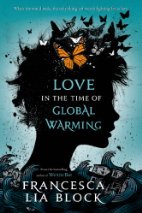 Summary:
Pen’s life was destroyed when an Earthshaker took away her family (even their dog) and destroyed the Los Angeles she once knew. She’s now on a quest to save them from the monstrous giants that rose up after (or with?) the Earthshaker. Along the way she finds other teens who’ve miraculously survived, each with secrets and talents of their own.
Review:
This book left me completely torn. I loved, oh how I loved, the representation of both bisexual (Pen) and trans (Hex, her boyfriend) teens. But the story to go with these teens failed to live up to both these wonderful characters and the beautiful title.
Let’s talk about the good first, because I don’t want it to be overshadowed by what didn’t work. Pen is a bookish teenager who generally prefers to stay in reading the Encyclopedia or The Odyssey to going out to parties. But she still has two close friends. She’s not a loner. She’s brave, open, loving, and sometimes makes rather short-sighted decisions. And it is gradually revealed throughout the book that she is also bisexual. The scenes exploring Pen’s bisexuality, and how it’s hard for her to be out about it, in spite of being completely comfortable with herself, are wonderfully done. Pen acknowledges that even though her parents have always told her that it doesn’t matter a whit if she is straight, lesbian, bisexual, or trans, that the world at large doesn’t always think that, and that’s part of what makes being out hard for her. The world is not always the welcoming place her family is.
The book early on establishes that Pen currently has a crush on a boy, so the reader may perhaps be surprised when she reminisces about an earlier crush on a girl, and how she first realized she liked girls too.
Thinking of how I once kissed Moira on the lips. We were drunk and dancing, and our lips just brushed for that electroshock nanosecond, and then she smiled at some boys who were watching us, laughed, and danced away from me like it was a joke. But I’d had an epiphany, even though I hadn’t fully accepted it at the time. I wanted to kiss girls. And it was no joke. (loc 2:14:53)
Similarly, Pen struggles with self-editing her past when telling Hex about her life before the Earthshaker. She is not sure if he’ll understand or accept the fact that she’s perfectly capable of having crushes on girls as well as boys like himself, so she edits herself when speaking to him. She’s telling him a story about a party she didn’t go to, and the picture that her friends sent her of a boy with her friend, Moira:
I went to sleep staring at the last image wondering not what his mouth tasted like but hers. This part, this last, I don’t tell Hex, although I trust him enough to tell him anything. Don’t I? So I’m not sure why I don’t. Because I don’t want him to know I had a crush on a girl? Or because I have a crush on him. (loc 1:39:44)
It’s rare to see a book explore so eloquently what it is to be bisexual, and these feelings Pen has while not universal still explore the difficulty of coming out and being out as a bisexual person, and they were so wonderful to see in a book that I had to restrain myself from jumping up and shouting “Yes!” when they showed up on my audiobook on the bus.
Similarly, Hex, Pen’s love interest and eventual boyfriend (this is not a spoiler, when Hex shows up he may as well have a giant neon “future boyfriend” sign over his head), is a FTM transman. Hex is just as nervous about being out to Pen and their other travel companions as Pen is about being out to him, probably more. Being cis myself, I can’t say as definitively about the quality of FTM representation as I could about bisexuality, however, the author certainly tries to broach topics that I believe would be of interest to a trans YA reader reading this book: acceptance (or not) by family members and impact on romantic relationships with other teens. Hex comes out to Pen as a transman only because she has fallen for him, and he wants her to know precisely who he is before anything more *ahem* romantic happens. Pen immediately accepts him and tells him he is clearly a boy to her, and this changes nothing about how she feels about him. They then have to navigate their sex life. Hex, like many trans people, is uncomfortable with his body. He would rather touch Pen than allow Pen to touch him. Eventually, they reach an arrangement that both supports and asserts Hex’s maleness and allows Pen to give the pleasure back to him that she wants to. I was glad to see a YA book “go there.” I frankly haven’t seen much of that even in adult literature including a trans person. It both addresses the “how do they….” question some YA readers would certainly have after learning about Hex and also serves a purpose in the story to demonstrate a mature, healthy, loving relationship between the two characters.
In addition to Hex and Pen, they also wind up with two male travel companions who become a couple. The characters themselves point out at one point how odd it is that the minority before the Earthshakers is now the majority (none of them are straight AND cis). I was glad the author acknowledged the quirk and had the characters process why that may be. The answer they decide upon is a positive one, rather than the potentially negative one of punishment.
So now let’s talk about what didn’t work. The plot and the setting. The book is meant to be a magical realism style story told in a non-linear way. This could have worked if in the end the overarching plot, when reassessed by the reader from beginning to end, made sense. But it doesn’t. For most of the book, Pen refers to everything in fantastical ways, such as saying “Earthshaker” for what appears to the reader to be an earthquake. Why is she saying “Earthshaker”? Was there something different about it? Does she just like prettying up her language? What is going on with that? Later it is revealed that an earthquake seems to have happened when some genetically engineered giants escaped (showed up? were released?). The whole world basically goes to shit overnight, though, and it just doesn’t seem logical that that would happen from just a few giants escaping. Similarly, there are other fantastical creatures who are never explained.
Similarly, although it is indicated early on that this is a modern retelling of The Odyssey, it doesn’t line up well with the original. In the original, Odysseus is trying to come home after a war and keeps getting swept into side-quests. In this book, Pen starts out at home and then quests away from home. It would have made more sense for Pen to be somewhere away from home (maybe on a school trip or something), have the disaster occur, and then have her have to find her way home encountering fantastical things along the way. Starting her at home just doesn’t work.
Several elements feel like they are just thrown in because they look pretty or work with the scene even though they don’t work with the book as a whole. For instance, butterflies appearing around people who can be trusted pops up in the middle of the book, but isn’t particularly present at the beginning or the end. Similarly, some characters are revealed to have magical powers toward the end of the book, with no foreshadowing about that, only to have them….not use them much beyond the scene where it’s revealed.
Also, I’m sorry, but the whole some evil scientist genetically engineered giants to be his children and now the giants are out to destroy us but also the whole world inexplicably now resembles a myth just really doesn’t work. First, it makes no sense why a scientist would even want to engineer a giant. To be his children? Really? Why would anyone want giant children? Second, to give the mystical elements that started this whole thing a scientific explanation but then leave the rest fantastical doesn’t work. Either they’re all explained by science or they’re all fantastical. I really felt the book went way downhill for me when there was suddenly a “scientific” explanation for the giants. But just the giants and nothing else.
Finally, we need to talk about the name of the book. It’s a beautiful title but it’s really wasted on this book. First, global warming doesn’t come into play in the book at all, so why is it mentioned in the title? Second, it’s clearly a send-up to Love in the Time of Cholera, but it has nothing in common with that book save both having elements of magical realism in them. It feels as if the author came up with a title that sounded pretty and couldn’t bring herself to let go of it in spite of it not fitting the book she actually wrote.
Overall, this is a short read featuring four well-rounded and written teen characters on the LGBTQ spectrum. YA readers looking for positive representations of bisexual and trans characters, in particular, and who don’t mind some inexplicable fantasy elements will enjoy this quick read. Readers who will easily be bothered by the title not matching the content, a mixture of magical realism and scientific explanations for things, and/or nonlinear plots that when told linearly don’t make sense should probably look elsewhere, in spite of the positive representations of underrepresented letters in the LGBTQ spectrum.
If you found this review helpful, please consider tipping me on ko-fi, checking out my digital items available in my ko-fi shop, buying one of my publications, or using one of my referral/coupon codes. Thank you for your support!
3 out of 5 stars
Length: 240 pages – average but on the shorter side
Source: Audible

 Support my work with a tip or browse my shop for curated book club guides, how to guides, cross-stitch patterns, and more!


This work by Amanda Nevius is licensed under a Creative Commons Attribution-Noncommercial-No Derivative Works 3.0 United States License.
 Opinions of a Wolf