
Archive
Book Review: The Left Hand of Darkness by Ursula K. Le Guin (Bottom of TBR Pile Challenge)
 Summary:
On the planet Winter, everyone is born intersex, morphing into one sex or the other during their mating cycle. The Ekumen of Known Worlds has sent a representative, Genly Ai, to make first contact. The Known Worlds have discovered that they are all related with the same ancestors who colonized the planets years ago. Genly Ai is at first horrified by the intersex nature of the Gethenians but slowly begins to adapt as he works the political situation on the planet to reach a state of belief in what this one man from his one ship is saying. A state of belief that is necessary to bring this planet into the Ekumen.
Review:
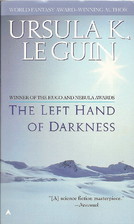
I picked this up when I saw it on sale at a local brick and mortar bookstore for two reasons. I’d never read an Ursula K. Le Guin book, which felt like sacrilege as a young feminist scifi author myself, so she was already on my radar. But why this book? Honestly, I liked the cover. It’s such a pretty cover! So many scifi/fantasy books seem to be set on a hot planet, but this is set on an icy one, and I really liked that. So when I picked it up, I had no idea that it’s considered to be a gender theory scifi. It’s presented as a book about a planet totally lacking in gender. You’ll notice that in my own summary that is not how I present it. Why not? Frankly, a gender-free society is not what I found in this book, which was a big disappointment.
The Gethenians really are not a gender free society, and Le Guin also doesn’t present them that way. It is definitely an intersex society, but it’s intersex people who predominantly present as male/masculine. Now, in case you’ve never had it explained, gender is a construct and sex is your body parts. So you could have an intersex gendered female society or an intersex gender neutral society or an intersex gender male society. The last one is what we have in this book. At first it seems that this might just be Genly Ai’s misperception (the off-world ethnologist). He mentions that he can’t help seeing the Gethenians as male, although sometimes he sees more “feminine features” in them. Perhaps. But when the narration changes from Genly’s viewpoint to a Gethenian one, we get the exact same presentation of everyone as a gendered he. There is no gender neutral pronoun used. There is no perception by the Gethenians of being free of gender. Indeed, instead of seeing themselves as gender-neutral or gender-queer, they see themselves as male until their mating cycle when some of them turn into women for a bit. (They also stay female long enough to be pregnant). Genly points out after a couple of years on this planet that he’s forgotten what it’s like to be around women. Not what it’s like to be around gender constructs. What it’s like to be around women. This is, thus, not a gender neutral society. It’s a society of male-identifying intersex persons who are free of sex-drive most of the time, and who sometimes grow vaginas/breasts for the purpose of reproduction but for nothing else. It is definitely interesting to see an exploration of this type of society, but it’s decidedly not an exploration of a gender-neutral society or really much gender theory at all. It is much more an exploration of the sex drive and a world without female-identifying persons. Now I’m not saying this isn’t a valid exploration or that it’s not well-done. I am saying that the presentation and marketing of this book gets it all wrong, which makes me wonder did Le Guin think she was exploring a gender neutral society and accidentally make an intersex male gendered one instead? Or did the publishers completely misunderstand everything about gender and sexuality and mismarket her book as something it is not? I have no idea, but the potential reader should know that they are not getting an exploration of gender and queerness from a famous scifi/fantasy author when they pick up this book.
Moving beyond the queer theory and mismarketing of it, how is the rest of the book? Well, the imagining of the world is stunning and clearly presented. The idea that planets were all settled by common ancestors and then forgotten about only to be rediscovered later (very Stargate SG1) is subtly introduced into the plot without an info-dump. The world of Winter contains multiple cultures and peoples (something often left out in scifi). The planet even has its own way to mark the passing of time and has evolved to handle the coldness of the planet without Le Guin just copying an Earth culture from a cold area, like the Inuit. No, this is all a unique way of approaching the demands of the climate. It’s also interesting to note that different skin colors are present on Winter, showing that a mixed-race group originally colonized the planet, although their bone structure and height has changed with time and evolution. The world building is so complex that I’m having difficulty explaining just how awesomely complex it is to you, so that should say something I suppose.
The plot is very political. Genly is here on Winter to get the planet as a whole to unify enough to become part of the Ekumen. Thus there is typical political intrigue across a couple of nations and various amounts of striving for power. There’s nothing incredibly unique about this element of the book but it is clearly done and is not completely predictable.
There is an interesting character development where Genly has a friendship that could take a turn for the romantic. How that line is walked could be endlessly analyzed. I will just say to keep it spoiler free that I appreciated what Le Guin did with the relationship, and it was a unique one to see in literature.
Overall, this is a richly imagined scifi world where the setting is much more the focus of the book than the more typical political intrigue/first contact plot. Do not be misled by the marketing to think that this is a book exploring a world free of gender. Rather it is a male-gendered intersex world. Thus, it is a book that will appeal to scifi lovers who prefer world-building over plot but don’t go into it expecting a scifi exploration of gender theory.
4 out of 5 stars
Source: Harvard Books

Book Review: Dead in the Family by Charlaine Harris (Series, #10) (Bottom of TBR Pile Challenge)
 Summary:
With the Fae war at an end, Sookie tries to return to some semblance of normal, working on both physical and emotional rehab. Although she has feelings for Eric, she is uncomfortable with his insistence that she is his wife, even if she technically is by vampire law. Plus, his maker and his new vampire-brother show up, putting a strain on the relationship. Meanwhile, the ramifications of the shifters coming out are beginning to be felt, and Sookie’s fae cousin, Claude, moves in with her, missing the presence of other fairies.
Review:
I just need to take a moment to point out two things. 1) The last time I read/reviewed a Sookie Stackhouse book was in October of 2010. This is why I started the Bottom of TBR Pile Challenge for myself. Books (even series books!) were getting lost in the pile! 2) Every time I look at that cover I think for a brief moment that Eric is bald. Something is just off in that painting. Now, on to the book.
Even though I read it almost three years ago (seriously, holy shit), I still clearly remember really enjoying the ninth book of the series. It was action-packed with lots of development of both plot and character. It reinvigorated the series for me so much so that even this much later, I was excited to pick up the next book. I should have known it would fizzle some after the action of the last book. It’s not easy to keep that much tension and action going, and it’s not like there weren’t any lulls earlier in the series. What I can mostly say about this book is that nothing much happens. Seriously. It’s longer than some of the books but less happens. I suppose technically things do happen. Eric’s maker shows up with a new vampire-brother for Eric, the hemophiliac Romanov brother, who is just not quite right in the head. This leads to some interesting development of Eric’s background, but not a ton. And it just isn’t all that intriguing. Similarly, even though logically it should be very interesting that Claude shows up at Sookie’s and the weres sniff out two fairies around, but it just isn’t. They sound interesting on the surface, but when you’re reading the book it mostly feels like you’re hanging out at Sookie’s house eating a cookie and wondering if the calories are worth it to listen to her yammer on.
I think the crux of the problem might be that neither Sookie nor Harris is comfortable with Sookie being with Eric, in spite of the reader liking Sookie being with Eric. If it’s not within the character for her to be with Eric, then a break-up needs to happen, regardless of what the readers like seeing. It’s important to keep characters acting within character. Interestingly, Sookie has started to notice that she is aging and thinking about what it will be like to slowly grow old and die. She seems to be seriously considering her vampire options. But we all know Sookie doesn’t want to be a vampire. Sookie wants children. If she gives that up to be a vampire, it will make the series take an incredibly dark turn. The next book will be an important one. It’s basically a shit or get off the pot moment for character development, and in spite of the ho hum nature of this entry in the series, I am interested to see if things pick up in the next book in this regard. They tend not to slump for long in Sookie Stackhouse-land.
There’s not too terribly much else to say about the book. Weaknesses that are there earlier in the series are still there. Sookie isn’t very smart and is kind of annoying. The sex scenes continue to be cringe-inducing. But the world is complex and fun to visit, even when not much is happening there. Sookie does need to start taking some agency soon though, or being stuck with her first person narration may become a bit too much to handle. Readers of the series will be disappointed by this dull entry, although it won’t come as a surprise since lulls happen earlier in the series. Enough happens to keep some interest up to keep going with it though.
3 out of 5 stars
Source: PaperBackSwap

Previous Books in Series:
Dead Until Dark
Living Dead in Dallas
Club Dead
Dead To The World
Dead as a Doornail
Definitely Dead
All Together Dead
From Dead to Worse
Dead And Gone
Book Review: Mulliner Nights by P.G. Wodehouse (Series, #3) (Bottom of the TBR Pile Challenge)
 Summary:
Mr. Mulliner has a wide variety of eclectic relatives, and he’s more than happy to tell snippets of their life stories over a pint at the local pub. From a freewheeling artist brought into line by a judgmental cat to a timid fellow who accidentally subscribes to a correspondence course on how to get a backbone to a private detective with such a disturbing smile that criminals readily confess their hijinks keep the patrons of Angler’s Rest in stitches.
Review:
This made it onto my tbr pile thanks to a visit to Harvard Books’ used books and remainders cellar. This was in the remainders pile, and three things drew me to it. 1) It was under $5, 2) The cover has a cat drunk on whiskey on it, 3) I had just read Love Among the Chickens
Don’t worry about this being the third in a series. The only connection among the short stories is the main characters are all a Mulliner (or married to one). It was completely unnecessary to have read the first two books in the series to get into this collection, although I intend now to read all of the Mulliner books. I really appreciated how Wodehouse sets up a structure to hold his short story collection together in one unit. Although they are all self-contained tales, their being together in one collection actually makes sense. They have more in common than just the author. They are literally a family of stories. This helped it hold my interest in a way that many short story collections can’t.
This collection consists of 9 short stories, most of which have some sort of love element. One person wants to be with (or marry) another and must overcome some sort of obstacle (usually caused by British upper-class culture) in order to be with them. Hilarity ensues. My favorite of these was “The Story of Webster,” the cover’s drunk cat. In this a freewheeling artist has his religious uncle drop his cat off with him while he goes on assignment to Africa. The judgmental, sullen cat soon starts to reign in the young artist, much to his and his girlfriend’s chagrin. Everything about this, from the early 20th century fashion and dialogue to the witty commentary on cats and culture works perfectly, particularly for this cat-lover. The story that I thought worked least-well, and unfortunately wraps up the book, is “Gala Night.” A pastor Mulliner accidentally helps a young couple who enjoys dancing to acquire the young woman’s parents’ approval of their union. I didn’t like the religious Mulliner. He just wasn’t funny to me. Similarly the catalyst of a mysterious mood enhancing drink just lacked the creativity found in the other stories. Fortunately, most of the stories fell much closer to the hilarity of the whiskey drinking cat. However, a couple did fall a bit flat for me, which is why while I greatly enjoyed the book, I wouldn’t say I was totally in love with it.
Overall, this is a wonderfully witty collection of short stories held together by an elderly Mulliner who enjoys telling (possibly tall) tales about his family over a pint in the local pub. If you enjoy a dry wit and slapstick humor to top off a cute love story, this collection is for you.
4 out of 5 stars
Source: Harvard Books

Previous Books in Series:
Meet Mr. Mulliner
Mr. Mulliner Speaking


Book Review: The Isle of Blood by Rick Yancey (Audiobook narrated by Steven Boyer) (Series, #3)
 Summary:
Will Henry states that this is a story that Dr. Warthrop did not want told…and proceeds to tell it anyway. When a British man shows up with a package being delivered under duress, Dr. Warthrop is ecstatic to realize it is the nest of the Magnificum–the holy grail of monstrumology. Dr. Warthrop decides to leave Will Henry in New York while he pursues this beast. But when his monstrumologist companion returns claiming that Warthrop is dead, Will Henry and two fellow monstrumologists travel to Europe to track him–or his body–down.
Review:
Not as engaging or thought-provoking as the first two books in the series, I can only hope that this third entry is suffering from the common penultimate book malady where the book which must set everything up for the finale of the series can sometimes drag.
There are two problems in this entry that make it fail to be as engaging or thrilling as the first two books. First, Will Henry is left behind in New York for a significant portion of the novel. We are thus left with a whiny teenager bemoaning Warthrop’s choice to be responsible for once and keep him out of danger. We also are left with very little action for far too large a portion of the book. The second issue is perhaps a bit of a spoiler but suffice to say that the monster is disappointing and its disappointment is easily predicted. If we had a lot of action with a disappointing monster, that’s still engaging. If we had less excitement with a surprising, phenomenal monster, that’s still thrilling. The combination of the two, though, prevents this thriller from being as thrilling and engaging as it should be.
Of course there are other elements that still worked, which is why I kept reading it. Yancey’s writing is, as ever, beautiful to read (or listen to) and contains much depth.
“So many times we express our fear as anger…, and now I think I wasn’t angry at all, but afraid. Terribly, terribly afraid.”
The settings are unique, and the characters are strong and leap off of the pages. Will Henry becomes more fully fleshed-out in this entry as we start to see his descent into a love affair with monstrumology. We also get to see Warthrop at what he himself perceives of as his lowest point. It’s a dark bit of characterization but it works very well for the story Yancey is telling.
Overall, I was a bit disappointed, purely because the first two entries in the series were so phenomenal. The third book is still a very good book. Fans might be a bit disappointed, depending on how attached they are to the unique thriller aspect of the series, but the characters and writing still make this well worth the time. Fans will remain in eager anticipation of the final entry in the series.
4 out of 5 stars
Source: Audible

Previous Books in Series
The Monstrumologist
The Curse of the Wendigo
Book Review: Oddkins: A Fable for All Ages by Dean Koontz
 Summary:
Isaac Bodkins is a magical toymaker. He makes toys that actually come alive and seek out children who need them the most, such as children who have lost a parent or who are facing abuse. When he dies before he has a chance to tell his chosen heir about her purpose, evil has a chance to take over again. His toys, the Oddkins, must set out to tell her before evil manages to land its own new evil toymaker that would create living toys to torture children. Evil sends out his evil toys in an attempt to stop the Oddkins on their dangerous cross-town mission.
Review:
The person who loaned me this book told me it was marketed as a fable for all ages but really might be a bit too scary for the youngest among us. Person also knew that I love me some fables, not to mention talking animals or toys, so I was excited to get into this book. Alas, it wasn’t ultimately my style, but it is a well-written book I could see working for a lot of people.
The plot is a quest where each member of the questing group gets at least one chance to shine. Although I was fairly certain that good would ultimately triumph over evil, I still was left worried for the main characters periodically, and I also was unable to predict the details of the triumph. Since the toymaker lived in the countryside outside of the city, the quest consists of time in both the country and the city. This kept situations varied and engaging.
Since this is a fable and most of the characters are in fact magical toys, they are not what one would describe as three-dimensional. However, their two dimensions work for the story. For instance, the teddy bear leader of the good toys is brave and strong and true but he also has to work at being brave. He is not just naturally brave. Similarly, although the two potential inheritors of toymaking are good and evil, they both get background information given to them. The evil one was in prison and only takes pleasure from causing others pain. The good one ran a toy store and was recently widowed and looking for something more in her life.
So why didn’t I love it? Well, some things said were just too clearly religious for me. There’s a lot of talk of afterlife, and the evil toys are driven by who is clearly Satan. There are also times where the good toys stop and make statements to each other that are clearly the author preaching to the reader through them. For instance
God’s world is full of magic, isn’t it? Not just the secret kind of magic of which we’re a part, but the simple magic of everyday life-magic. (location 1358)
Given that this happens rather frequently and given that the evil is clearly represented to be Satan, I just found the whole book to be a bit too heavy-handed in the religion department for me. A reader who does follow Christianity might not be bothered, but even then, the preachiness within a book isn’t for everyone.
Overall this is a well-written fable that is engaging and unique. It is a bit heavy-handed in its presentation of various religious beliefs for this reader, but other readers who enjoy that in their literature will probably enjoy this book.
3 out of 5 stars
Source: Borrowed

Book Review: Where the Blind Horse Sings: Love and Healing at an Animal Sanctuary by Kathy Stevens (Bottom of TBR Pile Challenge)
 Summary:
When Kathy Stevens decided to change careers mid-life, she wanted to do something that would help animals and let her teach. She landed on the idea of founding an animal sanctuary. But this book is very minimally about Kathy. It is mostly about the animals that came to find a safe haven at the sanctuary she founded. Animals like Rambo the sheep who guards other animals. Paulie a former cockfighting rooster who loves car rides. And of course a blind horse once terrified to move who now goes for trail rides.
Review:
This book wasn’t what I was expecting, which was an account of setting up and running an animal sanctuary. Instead it is a collection of short stories about individual animals who live at Catskill Animal Sanctuary, in the vein of James Herriot, although not quite to that classic’s level.
The stories are roughly grouped based on the situations that led the animals to the sanctuary, their personality, and of course some ultimate peaceful deaths at the sanctuary. I was a bit frustrated that instead of telling one animal’s story end to end, they were split up among sections. I can understand not wanting to end every chapter with an animal’s death, but I also think seeing one animal’s life in a complete story would be more touching. On the other hand, I also appreciated how clearly the different animals’ personalities were drawn without ever venturing into the land of hypothesizing. One doesn’t have to impose their own beliefs on an animal to clearly see the difference between a hurt, abused animal and a happy one. Stevens presents the difference quite clearly without venturing into speculation, which I think will give the book the broadest audience.
In spite of the dark past lives of these once abused animals, the book is a light read, both in spirit and in content. You won’t learn the nitty gritty of founding and running an animal sanctuary, which I think is too bad. It’d be nice if there was even an epilogue about more of the day to day realities of rescuing animals. On the other hand, the light, easy read gives the book a broader audience. It also features a suggested further reading list at the end, as well as links to the sanctuary’s website and invitations to visit, so those who want more can seek it out.
Overall, this is a well-written, feel-good collection of stories of the animals of Catskill Animal Sanctuary. It doesn’t provide much insider information on the running of animal rescue charities, but it does provide insight into the personalities of farm animals. Recommended to animal lovers who enjoy short stories.
4 out of 5 stars
Source: Amazon

Boston Marathon Bombings
Hello all. I just wanted to take a moment to let those of you who don’t follow me on twitter or facebook know that I and my loved ones are safe, although a student who goes to the university I am an academic librarian at is one of the (currently) three dead. My medical library serves the medical school that is affiliated with one of the Boston hospitals caring for the victims, and we also serve as the medical library for that hospital. Today is my first day back at work after my long weekend (which was pre-scheduled for Marathon Monday). Things are very subdued on-campus. My morning commute had a side of national guardsmen and extra police presence as I commute directly through part of the area that was put on lock-down after the bombings.
I am full of mixed emotions. I am incredibly grateful that myself and my loved ones are safe, but I am also full of empathy for everyone who cannot say that. I am angry that someone would attack a bunch of innocent people on a day that is about so many positive things. The Boston Marathon is about athleticism, cheering on the accomplishments of others, and fortitude. But it also takes place on Patriot’s Day. Patriot’s Day is celebrated in Massachusetts, Maine, and Wisconsin to commemorate the first battle of the American Revolutionary War. It celebrates our freedom, and in Boston, it’s about celebrating being the birthplace of our nation. And I hope that the people of Boston won’t let the events of Monday ruin our celebrations in the years to come. You defeat terrorism by refusing to be terrorized. My boyfriend and I have already made a pact that next year we are going to the marathon and we are cheering our guts out. In the meantime, I am just continuing to live my life and trying to do whatever small part I can to support those who have much tougher rows to hoe.
If your heart has been touched by what has occurred in my city, I ask you not to pray, but to do something. If you can afford it, donate to the official One Fund set up by Governor Patrick and Mayor Menino. It is a verified safe way to get the funds where they will reach those in need. If you can’t afford to donate money and are close by, donate blood. Or donate blood where you are in honor of the event. If you can’t do either of those things, or even if you do those things, then please show support in other ways. Express support online, offer a shoulder to cry on or an ear to listen. Try not to let anyone fall through the cracks. Let those around you know that somebody cares.
Book Review: The Curse of the Wendigo by Rick Yancey (Audiobook narrated by Steven Boyer) (Series, #2)
 Summary:
Will Henry, 12 year old orphan and assistant to renowned Monstrumologist, Pellinore Warthrop, is shocked to find a refined woman on Warthrop’s doorstep. She is the wife of Warthrop’s best friend who has now gone missing in rural Canada while looking for the elusive wendigo (aka werewolf). Warthrop insists that there is no such thing as a wendigo, but he agrees to go looking for his missing friend anyway, even if he believes his mission was ridiculous and an affront to monstrumology’s reputation.
Review:
I can’t believe it took me this long to get to the sequel of one of my rare 5 star reads, The Monstrumologist
Yancey does something brave for a second book in the series. Instead of following the formula that worked so well in the first book and basically doing a monster-of-the-week-in-our-town method like Buffy and so many other urban fantasies, he changes things up. There is a monster, yes, but it is entirely different from the first one. This is a monster that might not even exist, unlike the anthropophagi in the first book who are almost immediately clearly real. Additionally, Warthrop and Will must travel away from New England to go looking for the trouble. It does not come to them. Another good plot twist is that the story does not entirely take place in Canada. It moves to New York City. Thus we get both the dangers of the wilderness and the dangers of the city in one book. These plot choices mean that what makes this series a series is the characters, not the fantastical nature of their world. By the end of the book I was thinking of the series in terms of the relationship between Will and Warthrop, not in the context of what nasty beast we might meet next. It thus does what great genre fiction should do. It looks at a real life issue and dresses it up with some genre fun. And the issues addressed here are big ones. What is love and what should we be willing to sacrifice for it? Is it more loving to stay with someone at all costs or to let them go to protect them? At what point do you give up on someone?
The horror certainly felt more grotesque this time around, although it’s possible I just wasn’t remembering the anthropophagi that well. This is a bloody book full of horrible things. Precisely what I expect out of my genre. There’s not much more to say about the horror than keep it up, Yancey. Also that this might not be for you if blood and guts and profanity are not your thing. But they *are* mine and, oh, how well they are done here.
Just as with the first book, the language Yancey uses is beautiful. It’s rich, eloquent, visual, and decadent. It’s a word-lover’s book. An example:
But love has more than one face. And the yellow eye is not the only eye. There can be no desolation without abundance. And the voice of the beast is not the only voice that rides upon the high wind….It is always there. Like the hunger that can’t be satisfied, though the tiniest sip is more satisfying than the most sumptuous of feasts.
Stunning.
The characterization here remains strong for Will and grows much stronger for Warthrop. Will grows and changes as a 12 year old in this time period in his particular situation would be expected to. With Warthrop, though, we get a much clearer backstory and motivations for his actions. In the first book we came to know Will. In this one we come to know Warthrop, although Will is not left without any development. It’s a good balance. I also enjoyed the addition of two female characters, who I thought were well-written, particularly Lily, the budding young feminist determined to be the world’s first female monstrumologist. She is truly three-dimensional in spite of her rather limited screen-time compared to Will.
The pacing doesn’t build steadily from beginning to end. It rather builds to a first climax, comes back down and builds again to a second climax. This makes sense, particularly in a werewolf book, but I must admit it felt a bit odd in the moment. It almost felt like reading two books in one until it all came together in the end. In fact, this is one of those books that gets better the more you look back on the story as a whole. Be prepared to enjoy it more in retrospect that in the first reading.
The audiobook narrator, Boyer, has a tough book to work with. There are a wide range of characters of multiple nationalities to act out (Canadian, German, French, New York, Massachusetts, etc…). Additionally, at least three different languages are spoken (English, French, and German). I’m not fluent in anything but English, but I did take German in university, and I can say that his German accent is at least passable. He also does an excellent job creating a unique voice for each character. I only rarely got lost, and that was generally due to rapid-fire conversation where each character only had a word or two. I must say, though, that he does mispronounce a few words, which detracts from Yancey’s gorgeous writing. I blame the audiobook director for this, though. S/he should have realized and corrected this. Overall, though, the mispronounced words are only in a couple of locations and do not deeply affect the reading of the book.
Overall this is an excellent follow-up to a remarkable first book in the series. It brings to the table that which made the first so powerful: YA horror with rich language set in a historic time period. But it also changes things up enough to avoid falling into the monster-of-the-week trap. The entries in the series are part of a larger story, and that can be seen. Fans of the first book should pick up the second book asap.
5 out of 5 stars
Source: Audible

Previous Books in Series
The Monstrumologist
Friday Fun! (Where the Hell Has This Weekly Meme Been Anyway?)
Hello my lovely readers!
So, I knew I hadn’t written a Friday Fun post in a while, but was floored to see it hadn’t happened since November 16, 2012.
o_O
I know we all hate it when bloggers talk about their crazy busy lives, even though it’s true, because, hello, we all have busy lives! Suffice to say, what I thought was a busy phase is actually the new stasis of my life. I’m proud of the fact that I’m still managing to find time to blog, because I do love book blogging. But I want to continue to touch base with you all periodically. Weekly is just too overwhelming though. So I’ve decided to move Friday Fun to just occurring on the last Friday (or Saturday) of every month. Treating it more like a special event instead of a weekly meme will help me keep up and enjoy it. I hope you all enjoy the new change!
On a similar note, I am still closed to review requests, and I don’t expect that to be changing anytime soon. I still periodically request ARCs, if I’m highly interested, but that is a rare occurrence. I also, you may have noticed, switched my reading from about 50% things I felt I “should” be reading (for ARCs, to better myself, etc….) down to about 10%. This means 90% of my reading is for funsies, because frankly I need that stress relief in my life. Reading “should’s” worked great when I was in a life limbo and needing to fill the time with actual things to do that made me feel like I was accomplishing something. But now when I read, I want it to be for fun. I need it to be a stress reliever. Something that helps give me a few moments of internally-focused peace in my day. So any changes you’ve noticed in the books being reviewed here reflect that choice I made at the beginning of 2013.
As for my non-blog life! The holidays happened. I taught my first library orientation by myself for the incoming class of one of the schools affiliated with my library. I created my first library tutorials. I finished my first archival finding aid. Those have been the big-hitters in work life. In regular, non-librarian Amanda life I went on vacation with my boyfriend to an off-the-grid cabin! We snowshoed and built fires in wood stoves and generally thoroughly enjoyed ourselves. I went home to visit my dad in Vermont and learned how to make the perfect grilled cheese. I got an iPhone. I became addicted to Instagram and taking photos in general. I survived Blizzard Nemo and got my first real snowday in *years*. I learned how to play the Call of Cthulhu tabletop game. Finally, I just last week joined my gym’s 60 day fitness competition, and I am loving how much it has reinvigorated my passion for fitness. And I’m still trying to figure out how to be a part-time indie author in amongst all of this.
How was everyone’s March? Ours came in like a lion and out like a lamb, just like the old saying goes. :-)
Book Review: vN by Madeline Ashby (series, #1)
 Summary:
Amy is 5 year old robot. An exact replica–iteration–of her mother, who is in a relationship with a human male. Her parents are restricting her food to raise her slowly at a human child’s pace instead of at a robot’s. But when her grandmother shows up to her kindergarten graduation and threatens her mother, things go haywire. It quickly becomes apparent that the failsafe that makes robots love humans innately and makes them incapable of withstanding seeing violence against humans has failed to activate in Amy. She finds herself full-grown and on the run from humans and her robot aunts alike as she struggles to figure out who she is and what her existence means to humanity.
Review:
Artificial Intelligence/Robot books tend to take a bit more to draw me in than say a zombie book. It’s really hard to do AI in a way that is simultaneously scientifically/culturally believable and unique. Frankly, I need a bit more believability in an AI book than in a zombie one, since AI is real science. Plus, the book should examine their cultural place in the world, and that needs to be believable. I am pleased to say that this book gets it mostly right. It’s enjoyable, scientifically minded, culturally thought-provoking, and examines a real life issue in the context of genre, which long-time readers of this blog know is something I highly enjoy.
The first thing that made me know this is a smart book is the source of the robots (called Von Neumanns after their creator). A fundamentalist group in the American South decided that the humans left behind after Jesus’ Second Coming should have someone to help them through the Tribulation, so they invented humanoid robots to be ready to help. Clearly, the Second Coming didn’t happen, and the fundamentalists ended up selling Von Neumanns, and the Von Neumanns wind up a part of the cultural backdrop, not to mention the porn industry. As a character says to Amy:
There are only two industries in this world that ever make any kind of progress: porn, and the military. And when they hop in bed together with crazy fundamentalists, we get things like you. (location 1944)
This is the most unique and engaging origin story for robots that I’ve seen, plus it makes sense and provides cultural commentary. The Von Neumanns originated as a religious experiment, were swiped by the military and the porn industry, and became a part of everyday life. It’s just an awesome origin story for the world that Amy is in.
The characters, including the robots, are three-dimensional. Everyone has complex motivations and the main characters definitely grow and progress with time. No one is presented as pure evil or good.
The plot is similarly complex. There’s a lot going on in Amy’s world, and none of it is predictable. What is the failsafe precisely and is it a good or a bad thing? Is it a natural progression that it doesn’t work in Amy? What about how Amy’s mother and grandmother reacted to the human world around them? Did they see accurate shortcomings or were they just malfunctioning? And what about how the various humans use the Von Neumann’s? For instance, pedophiles acquire Von Neumanns and keep them young by starving them. Is this a good, harmless thing since it protects human children or have robots evolved to be far more than just a machine? The world is complex and full of tough questions, and thus is challenging and unpredictable, making for an engaging read.
What I most enjoyed though was how the whole book presents the question of nature versus nurture in a genre setting. Are we our parents with no hope of improvement or escape? Or do we have more say in the matter than just our genetics or “programming”? Amy has a psychopathic grandmother and a mother who has made questionable choices. Does this mean that Amy is evil or malfunctioning or even capable of being something different from the rest of her family? All of these questions lead to some interesting stand-offs, one of which includes my favorite quote of the book:
An iteration isn’t a copy, Mother. It’s just the latest version. I’m your upgrade. That’s why I did what I did. Because I’m just better than you. (location 2581)
All that said, there were two things that kept this back from five stars for me. First, some of the writing style choices Ashby uses drew me out of the story a bit. They are periodically highly artistic in a way that didn’t jibe with the story for me. I get why she made those choices, but as a reader they aren’t ones that generally work for me. Second, one thing that really drew me out of the story is the fact that the robot’s boobs don’t move. This is mentioned at one point as being a way to tell if a woman is robot or not. This drew me out of the world very hard while I laughed uproariously. I’m sorry, but machines designed by men would simply not have hard plastic boobs. Their boobs would bounce, dammit. This would at least be in the top 10 list of robot requirements. It simply wasn’t a realistic design choice, and it pulled me out of the story to such an extent that it lost the believability for a bit for me.
Overall, this is a creatively written and complex scifi artificial intelligence story that examines not just what makes us human but also individuality and uniqueness separate from parents and family. Some of the more artistic writing choices and high levels of violence might not appeal to all audiences, but if you’re an AI or scifi lover with an interest in nature versus nurture and stories featuring strong female leads, you should definitely give this a go.
4 out of 5 stars
Source: NetGalley

 Support my work with a tip or browse my shop for curated book club guides, how to guides, cross-stitch patterns, and more!


This work by Amanda Nevius is licensed under a Creative Commons Attribution-Noncommercial-No Derivative Works 3.0 United States License.
 Opinions of a Wolf