
Archive
Book Review: Deeper than the Dead by Tami Hoag (Series, #1) (Bottom of TBR Pile Challenge)
 Summary:
When four children stumble upon the displayed body of a dead woman, they and their teacher are pulled into the investigation. But when this murder is connected to others, that makes it a potential serial killer, and that means the FBI wants to get involved. Quietly. Of course, it’s only 1985, the edge of modern forensics, so they must pursue their murderer with a combination of science and old-fashioned detective work.
Review:
I wish I could remember how this thriller made it into my TBR Pile. It’s a unique entry into the serial killer/forensics sector of the genre due to the time period Hoag chose to set it in. She states in her author’s introduction that she wanted to set her thriller in the 80s due to a personal nostalgia for the time but only after starting her research did she realize what an important time period it was for forensics. I think it’s yet another example of an author following her interests and getting a unique work out of it.
The plot alternates perspectives between the four children, their teacher, the older FBI agent on the case, and the killer (without revealing who the killer is), all in the third person. The changing perspectives help keep the plot complex and moving, as well as give us multiple plausible theories on who the killer is. That said. I was still able to predict the killer, and I honestly felt the killer to be a bit stereotypical.
The serial killings themselves are all of young women who either are currently at or have recently left the local halfway house. The murder/torture methods are sufficiently grotesque without going over the top. Fans of the genre will be satisfied.
The characters are a bit two-dimensional, particularly the older FBI agent, the young cop on the force, and all of the murder suspects. I also, frankly, didn’t appreciate the fact that an expert in the field calls one of the mothers a crazy borderline. She was presented as entirely the flat, evil representation of people with BPD that we problematically see in the media. This is why writing two-dimensional characters can be problematic. We only see the woman being overly dramatic and demanding. We never see her softer or redeeming qualities. I’d have less of a problem with this presentation of this woman with BPD in the book if it was a first person narration or a third person narration that maintained one perspective. Then it could be argued that this is that one character’s perception of the woman. But given that multiple perspectives are offered, presenting so many people in a two-dimensional way is rather inexcusable, and it’s irresponsible to write mental illness in this way. I’m not saying every character with a mental illness needs to be written in a positive light, but they should be written as three-dimensional human beings, not monsters (with, perhaps, the exception of sociopathy).
This is a book, then, with an interesting idea and fairly good plot but shaky characterization. Some people don’t mind that in their thrillers. I admit I speed-read, eager to find out who the killer was. But I also was bothered by the flatness of the characters. If you think this won’t bother you, then you will probably enjoy this book. Those with a mental illness should be warned that the representation of mental illness in the book could be upsetting or triggering.
3 out of 5 stars
Source: PaperBackSwap

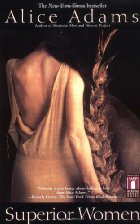
Book Review: Superior Women by Alice Adams (Bottom of TBR Pile Challenge)
 Summary:
When Californian Megan Greene runs has a steamy affair in the summer of 1943 with a Harvard student visiting the west coast for the summer, she decides to follow him back to the east coast and attend Radcliffe. There she meets four other women, three of whom it might be more accurate to call frenemies than friends. Their lives and destinies repeatedly intertwine throughout the tumultuous changes of mid-20th century America.
Review:
I kept my eye out for this book when it was named as a read-a-like to my 2011 5 star read The Group
The book covers 1940s to 1980s America, yet as the decades move on, less and less is said. The 1940s are expressed clearly with exquisite detail, and I was excited to see what would happen with the 1950s and the 1960s. But the 1950s slowed down, the 1960s were barely touched upon, the 1970s were jumped over almost entirely, and the 1980s were the final chapter of the book. The pacing was all off. I wanted to know these women in as much detail in the latter decades as in the first. Instead of feeling like I knew them more and more intimately, they increasingly became strangers to me.
One thing that I think really works against the book is it is neither an ensemble nor a one character piece. Most of the book is told about Megan, but not all of it. We get snippets of the other characters, meaning perspectives that Megan is not privy to, but not enough to ever truly know them. Since most of the book is about Megan, these bits away from her feel sort of like the story is robbing us of more time with the main character we are interested in. Similarly, reading the blurb and the title, I thought this was going to be an ensemble book, which is not what we get either. I wanted to know much more about two of the characters in particular, Peg, who comes out as a lesbian at some point in the 1960s, and Cathy, who has an affair with a priest. These two stories are wonderfully intriguing, particularly Peg’s since her love of her life is met on a mission to register black voters in the American south, and her love interest is a Latina woman. There is so much meat to that storyline, and yet it is barely touched upon while we instead listen to Megan hem and haw about her job, and Lavinia try to figure out how best to cheat on her husband. The balance of telling this ensemble piece was just entirely off.
Similarly, while big issues and events of mid-20th century America were briefly touched upon, the book never really presented a truly personal look at any of them. For instance, Megan has a friend who is bashed in a drive-by gay bashing but we never get to see Megan emotionally deal with this stark reality. She hears about it, calls him, and moves on. Similarly, as previously mentioned, Peg comes out as a lesbian, and we see a snippet of her depression caused by living the lie of being straight, but we never get to understand the emotions or impetus behind her bravely coming out and living in a visible, inter-racial lesbian relationship in the south. It is disappointing because we get a taste of really encountering these historical issues, but we never actually get to.
In spite of all these problems, I still enjoyed reading the book well enough. The plot, while frustrating, does progress forward in an interesting fashion. The characters, although frequently two-dimensional, are bright and vivid. I came away with the perspective I always have with historical fiction about women’s history. That I am grateful I was born in a different time, because we women have much more opportunities available to us now. So I appreciated my visit to that time period but it was a bit disappointing.
Overall, if you are a huge fan of historical fiction about women’s issues, this is an interesting book to add to your repertoire. It is a good comparison to others that did it differently or better, and it is still fun to visit those time periods. If this type of literature is not generally your cup of tea, though, I would suggest you instead read stronger competitors in that genre, such as The Group
3.5 out of 5 stars

Book Review: The Left Hand of Darkness by Ursula K. Le Guin (Bottom of TBR Pile Challenge)
 Summary:
On the planet Winter, everyone is born intersex, morphing into one sex or the other during their mating cycle. The Ekumen of Known Worlds has sent a representative, Genly Ai, to make first contact. The Known Worlds have discovered that they are all related with the same ancestors who colonized the planets years ago. Genly Ai is at first horrified by the intersex nature of the Gethenians but slowly begins to adapt as he works the political situation on the planet to reach a state of belief in what this one man from his one ship is saying. A state of belief that is necessary to bring this planet into the Ekumen.
Review:
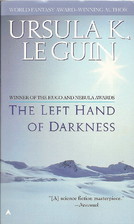
I picked this up when I saw it on sale at a local brick and mortar bookstore for two reasons. I’d never read an Ursula K. Le Guin book, which felt like sacrilege as a young feminist scifi author myself, so she was already on my radar. But why this book? Honestly, I liked the cover. It’s such a pretty cover! So many scifi/fantasy books seem to be set on a hot planet, but this is set on an icy one, and I really liked that. So when I picked it up, I had no idea that it’s considered to be a gender theory scifi. It’s presented as a book about a planet totally lacking in gender. You’ll notice that in my own summary that is not how I present it. Why not? Frankly, a gender-free society is not what I found in this book, which was a big disappointment.
The Gethenians really are not a gender free society, and Le Guin also doesn’t present them that way. It is definitely an intersex society, but it’s intersex people who predominantly present as male/masculine. Now, in case you’ve never had it explained, gender is a construct and sex is your body parts. So you could have an intersex gendered female society or an intersex gender neutral society or an intersex gender male society. The last one is what we have in this book. At first it seems that this might just be Genly Ai’s misperception (the off-world ethnologist). He mentions that he can’t help seeing the Gethenians as male, although sometimes he sees more “feminine features” in them. Perhaps. But when the narration changes from Genly’s viewpoint to a Gethenian one, we get the exact same presentation of everyone as a gendered he. There is no gender neutral pronoun used. There is no perception by the Gethenians of being free of gender. Indeed, instead of seeing themselves as gender-neutral or gender-queer, they see themselves as male until their mating cycle when some of them turn into women for a bit. (They also stay female long enough to be pregnant). Genly points out after a couple of years on this planet that he’s forgotten what it’s like to be around women. Not what it’s like to be around gender constructs. What it’s like to be around women. This is, thus, not a gender neutral society. It’s a society of male-identifying intersex persons who are free of sex-drive most of the time, and who sometimes grow vaginas/breasts for the purpose of reproduction but for nothing else. It is definitely interesting to see an exploration of this type of society, but it’s decidedly not an exploration of a gender-neutral society or really much gender theory at all. It is much more an exploration of the sex drive and a world without female-identifying persons. Now I’m not saying this isn’t a valid exploration or that it’s not well-done. I am saying that the presentation and marketing of this book gets it all wrong, which makes me wonder did Le Guin think she was exploring a gender neutral society and accidentally make an intersex male gendered one instead? Or did the publishers completely misunderstand everything about gender and sexuality and mismarket her book as something it is not? I have no idea, but the potential reader should know that they are not getting an exploration of gender and queerness from a famous scifi/fantasy author when they pick up this book.
Moving beyond the queer theory and mismarketing of it, how is the rest of the book? Well, the imagining of the world is stunning and clearly presented. The idea that planets were all settled by common ancestors and then forgotten about only to be rediscovered later (very Stargate SG1) is subtly introduced into the plot without an info-dump. The world of Winter contains multiple cultures and peoples (something often left out in scifi). The planet even has its own way to mark the passing of time and has evolved to handle the coldness of the planet without Le Guin just copying an Earth culture from a cold area, like the Inuit. No, this is all a unique way of approaching the demands of the climate. It’s also interesting to note that different skin colors are present on Winter, showing that a mixed-race group originally colonized the planet, although their bone structure and height has changed with time and evolution. The world building is so complex that I’m having difficulty explaining just how awesomely complex it is to you, so that should say something I suppose.
The plot is very political. Genly is here on Winter to get the planet as a whole to unify enough to become part of the Ekumen. Thus there is typical political intrigue across a couple of nations and various amounts of striving for power. There’s nothing incredibly unique about this element of the book but it is clearly done and is not completely predictable.
There is an interesting character development where Genly has a friendship that could take a turn for the romantic. How that line is walked could be endlessly analyzed. I will just say to keep it spoiler free that I appreciated what Le Guin did with the relationship, and it was a unique one to see in literature.
Overall, this is a richly imagined scifi world where the setting is much more the focus of the book than the more typical political intrigue/first contact plot. Do not be misled by the marketing to think that this is a book exploring a world free of gender. Rather it is a male-gendered intersex world. Thus, it is a book that will appeal to scifi lovers who prefer world-building over plot but don’t go into it expecting a scifi exploration of gender theory.
4 out of 5 stars
Source: Harvard Books

Book Review: Dead in the Family by Charlaine Harris (Series, #10) (Bottom of TBR Pile Challenge)
 Summary:
With the Fae war at an end, Sookie tries to return to some semblance of normal, working on both physical and emotional rehab. Although she has feelings for Eric, she is uncomfortable with his insistence that she is his wife, even if she technically is by vampire law. Plus, his maker and his new vampire-brother show up, putting a strain on the relationship. Meanwhile, the ramifications of the shifters coming out are beginning to be felt, and Sookie’s fae cousin, Claude, moves in with her, missing the presence of other fairies.
Review:
I just need to take a moment to point out two things. 1) The last time I read/reviewed a Sookie Stackhouse book was in October of 2010. This is why I started the Bottom of TBR Pile Challenge for myself. Books (even series books!) were getting lost in the pile! 2) Every time I look at that cover I think for a brief moment that Eric is bald. Something is just off in that painting. Now, on to the book.
Even though I read it almost three years ago (seriously, holy shit), I still clearly remember really enjoying the ninth book of the series. It was action-packed with lots of development of both plot and character. It reinvigorated the series for me so much so that even this much later, I was excited to pick up the next book. I should have known it would fizzle some after the action of the last book. It’s not easy to keep that much tension and action going, and it’s not like there weren’t any lulls earlier in the series. What I can mostly say about this book is that nothing much happens. Seriously. It’s longer than some of the books but less happens. I suppose technically things do happen. Eric’s maker shows up with a new vampire-brother for Eric, the hemophiliac Romanov brother, who is just not quite right in the head. This leads to some interesting development of Eric’s background, but not a ton. And it just isn’t all that intriguing. Similarly, even though logically it should be very interesting that Claude shows up at Sookie’s and the weres sniff out two fairies around, but it just isn’t. They sound interesting on the surface, but when you’re reading the book it mostly feels like you’re hanging out at Sookie’s house eating a cookie and wondering if the calories are worth it to listen to her yammer on.
I think the crux of the problem might be that neither Sookie nor Harris is comfortable with Sookie being with Eric, in spite of the reader liking Sookie being with Eric. If it’s not within the character for her to be with Eric, then a break-up needs to happen, regardless of what the readers like seeing. It’s important to keep characters acting within character. Interestingly, Sookie has started to notice that she is aging and thinking about what it will be like to slowly grow old and die. She seems to be seriously considering her vampire options. But we all know Sookie doesn’t want to be a vampire. Sookie wants children. If she gives that up to be a vampire, it will make the series take an incredibly dark turn. The next book will be an important one. It’s basically a shit or get off the pot moment for character development, and in spite of the ho hum nature of this entry in the series, I am interested to see if things pick up in the next book in this regard. They tend not to slump for long in Sookie Stackhouse-land.
There’s not too terribly much else to say about the book. Weaknesses that are there earlier in the series are still there. Sookie isn’t very smart and is kind of annoying. The sex scenes continue to be cringe-inducing. But the world is complex and fun to visit, even when not much is happening there. Sookie does need to start taking some agency soon though, or being stuck with her first person narration may become a bit too much to handle. Readers of the series will be disappointed by this dull entry, although it won’t come as a surprise since lulls happen earlier in the series. Enough happens to keep some interest up to keep going with it though.
3 out of 5 stars
Source: PaperBackSwap

Previous Books in Series:
Dead Until Dark
Living Dead in Dallas
Club Dead
Dead To The World
Dead as a Doornail
Definitely Dead
All Together Dead
From Dead to Worse
Dead And Gone
Book Review: Mulliner Nights by P.G. Wodehouse (Series, #3) (Bottom of the TBR Pile Challenge)
 Summary:
Mr. Mulliner has a wide variety of eclectic relatives, and he’s more than happy to tell snippets of their life stories over a pint at the local pub. From a freewheeling artist brought into line by a judgmental cat to a timid fellow who accidentally subscribes to a correspondence course on how to get a backbone to a private detective with such a disturbing smile that criminals readily confess their hijinks keep the patrons of Angler’s Rest in stitches.
Review:
This made it onto my tbr pile thanks to a visit to Harvard Books’ used books and remainders cellar. This was in the remainders pile, and three things drew me to it. 1) It was under $5, 2) The cover has a cat drunk on whiskey on it, 3) I had just read Love Among the Chickens
Don’t worry about this being the third in a series. The only connection among the short stories is the main characters are all a Mulliner (or married to one). It was completely unnecessary to have read the first two books in the series to get into this collection, although I intend now to read all of the Mulliner books. I really appreciated how Wodehouse sets up a structure to hold his short story collection together in one unit. Although they are all self-contained tales, their being together in one collection actually makes sense. They have more in common than just the author. They are literally a family of stories. This helped it hold my interest in a way that many short story collections can’t.
This collection consists of 9 short stories, most of which have some sort of love element. One person wants to be with (or marry) another and must overcome some sort of obstacle (usually caused by British upper-class culture) in order to be with them. Hilarity ensues. My favorite of these was “The Story of Webster,” the cover’s drunk cat. In this a freewheeling artist has his religious uncle drop his cat off with him while he goes on assignment to Africa. The judgmental, sullen cat soon starts to reign in the young artist, much to his and his girlfriend’s chagrin. Everything about this, from the early 20th century fashion and dialogue to the witty commentary on cats and culture works perfectly, particularly for this cat-lover. The story that I thought worked least-well, and unfortunately wraps up the book, is “Gala Night.” A pastor Mulliner accidentally helps a young couple who enjoys dancing to acquire the young woman’s parents’ approval of their union. I didn’t like the religious Mulliner. He just wasn’t funny to me. Similarly the catalyst of a mysterious mood enhancing drink just lacked the creativity found in the other stories. Fortunately, most of the stories fell much closer to the hilarity of the whiskey drinking cat. However, a couple did fall a bit flat for me, which is why while I greatly enjoyed the book, I wouldn’t say I was totally in love with it.
Overall, this is a wonderfully witty collection of short stories held together by an elderly Mulliner who enjoys telling (possibly tall) tales about his family over a pint in the local pub. If you enjoy a dry wit and slapstick humor to top off a cute love story, this collection is for you.
4 out of 5 stars
Source: Harvard Books

Previous Books in Series:
Meet Mr. Mulliner
Mr. Mulliner Speaking


Book Review: Where the Blind Horse Sings: Love and Healing at an Animal Sanctuary by Kathy Stevens (Bottom of TBR Pile Challenge)
 Summary:
When Kathy Stevens decided to change careers mid-life, she wanted to do something that would help animals and let her teach. She landed on the idea of founding an animal sanctuary. But this book is very minimally about Kathy. It is mostly about the animals that came to find a safe haven at the sanctuary she founded. Animals like Rambo the sheep who guards other animals. Paulie a former cockfighting rooster who loves car rides. And of course a blind horse once terrified to move who now goes for trail rides.
Review:
This book wasn’t what I was expecting, which was an account of setting up and running an animal sanctuary. Instead it is a collection of short stories about individual animals who live at Catskill Animal Sanctuary, in the vein of James Herriot, although not quite to that classic’s level.
The stories are roughly grouped based on the situations that led the animals to the sanctuary, their personality, and of course some ultimate peaceful deaths at the sanctuary. I was a bit frustrated that instead of telling one animal’s story end to end, they were split up among sections. I can understand not wanting to end every chapter with an animal’s death, but I also think seeing one animal’s life in a complete story would be more touching. On the other hand, I also appreciated how clearly the different animals’ personalities were drawn without ever venturing into the land of hypothesizing. One doesn’t have to impose their own beliefs on an animal to clearly see the difference between a hurt, abused animal and a happy one. Stevens presents the difference quite clearly without venturing into speculation, which I think will give the book the broadest audience.
In spite of the dark past lives of these once abused animals, the book is a light read, both in spirit and in content. You won’t learn the nitty gritty of founding and running an animal sanctuary, which I think is too bad. It’d be nice if there was even an epilogue about more of the day to day realities of rescuing animals. On the other hand, the light, easy read gives the book a broader audience. It also features a suggested further reading list at the end, as well as links to the sanctuary’s website and invitations to visit, so those who want more can seek it out.
Overall, this is a well-written, feel-good collection of stories of the animals of Catskill Animal Sanctuary. It doesn’t provide much insider information on the running of animal rescue charities, but it does provide insight into the personalities of farm animals. Recommended to animal lovers who enjoy short stories.
4 out of 5 stars
Source: Amazon

Book Review: Dagon by Fred Chappell (Bottom of TBR Pile Challenge)
 Summary:
Peter doesn’t know much about his father’s side of the family as his mother left him when he was little. Now, a married pastor, he returns to his father’s parents’ house, a recent inheritance. Slowly he discovers the cultist history of his family and begins his descent into madness.
Review:
There aren’t that many books in the Lovecraft mythos, so when I spot one, I almost always add it to my wishlist and pick it up if I spot it. (I’m a big fan of the mythos, and my current work in progress is set in it). I spotted this one during one of Better World Books’ periodic sales and got it for just a couple of dollars. The problem with the world of Lovecraftian horror is this. The mythos is great, but a lot of the books/movies set in it are a swing and a miss. Which is sad for me as a reader, because I know that this is an author with the same funky interest as me, so I want it to work. I want it to work very much. It just doesn’t always. This, unfortunately, falls solidly in the swing and a miss category for me.
The germ of the story is a great idea. An ostensibly mainstream “good” man following his roots and falling into a dark god worshiping cult. Brilliant. The execution is weak, however. The cover of my copy of the book claims that it is a “novel of blinding terror.” This is just not the case. In some ways I feel that Chappell just tried too hard. The entire first chapter is meant to set the scene with extremely heavy-handed gothic language, but it is just painful to read. The first chapter describes one room of the house. Excessive energy is spent trying to make even the throw pillows seem malicious. It is too over-the-top and becomes laughable. Thankfully, the next chapter abandons the excessive language, but it is still never scary. It is titillating at a couple of points. Engaging as well. But never terrifying.
Part of the problem is that the book fails to build suspense from beginning to end. It builds up in part one to a singular event, but then immediately crashes back down to a period in part two in which Peter lies around in a depressed funk. While this might be realistic, it does nothing to build the suspense. The suspense thus must start all over again. This may be acceptable in a long work (and even then I’m dubious), but in such a short book it’s just jarring and ruins the suspense.
I also found the ultimate payoff to be a bit disappointing. While we find out one or two things about Peter’s family, we don’t get enough details to truly experience shock or horror. Similarly, the ultimate final descent of Peter was a bit disappointing. He doesn’t engage in any agency or become a committed cultist. A lot of cult things are done to him, but he doesn’t really have the descent into madness promised. He is tortured and made into a slave and has the mental and emotional breakdown such experiences could make someone experience, but he himself doesn’t turn into a raving Dagonite, for instance.
That said, there are some things that worked in the book. As stated previously, the germ of the idea is great. Peter’s nemesis/mentor, the tenant farmer family’s daughter, is delightfully powerful and sinister. A couple of scenes were a great mix of titillation and horror, and the final climax was definitely a surprise.
Overall, then, it’s a book that tries to be a terrifying, gothic horror, but instead is a titillating grotesque bit of southern literature. Fans of the Lovecraftian mythos will appreciate it for this, although the Lovecraftian elements themselves are sparse and a bit disappointing. Recommended for big fans of grotesque, fantastical horror who don’t mind it leaning a bit more toward the grotesque than the scary side of horror.
3 out of 5 stars
Source: Better World Books

Book Review: Blonde Bombshell by Tom Holt (Bottom of TBR Pile Challenge)
 Summary:
A sentient bomb is hurtling through outer space toward Earth, better known to the bomb creators as Dirt. You see, Dirt’s music is making the inhabitants of Ostar (a canine species) completely loony. But the bomb stops in its tracks and orbits around Dirt to try to figure out whatever happened to the *first* bomb that the Ostars sent out. Dirt doesn’t seem to have any sophisticated defense system to speak of, so what gives? Meanwhile, Lucy Pavlov, the creator of new computer programming protocols that led to a leap in technology, is seeing unicorns in her forest. Also a bank security executive is trying to figure out just how, exactly, money is teleporting out of banks. In between getting very drunk and trying to forget about that one time aliens stole his dog.
Review:
This made it onto my TBR pile thanks to multiple comparisons to Douglas Adams’ Hitchhiker’s Guide to the Galaxy
The plot is complex without being confusing. It revolves around three people (well, one is a bomb) who are connected in mysterious ways they just don’t know yet. It kept me guessing, managed to surprise me a few times, and had some delightfully creative elements, such as the fact that the bomb can create probes to send down to Earth that appear to humans like organic matter. Or even the fact that the bomb can sit there and slowly decide whether or not to go off. Clever.
I also appreciated an imagined future where people have handheld devices that are given a simple name rather than compounding a bunch of words together. The former makes more sense since in reality that is what companies do. (For instance, Google Glass or iPad as opposed to handheldpersonaldevice. Don’t laugh. I’ve seen something very similar to that in scifi). In this book the iPhone device is the Warthog. With no further explanation given. This is scifi done well. The reader can tell what a Warthog is from how the characters use it. Holt never over-explains.
The characters were rather two-dimensional, but that works well for the humor, not to mention for the fact that one of them is a bomb. If a character has a good heart but is a lazy drunk because aliens stole his dog, well that’s enough for the reader to know in a book like this. Motivation enough is present for the characters to be recognizable as people and to move the plot forward.
As for the humor, I found it quite witty, although not quite as gut-wrenching as Hitchhiker’s Guide to the Galaxy
Now, I was a bit let-down by the ending. I didn’t really like the final plot twist. It kind of….creeped me out a bit and left me on a bit of a down note instead of the delightful upswing I felt throughout the rest of the book. I think other people might enjoy it more than me. It really depends on your feelings about people and pets and having pets. It’s not enough of a let-down to keep me from recommending or enjoying the book. It was just enough to keep it from 5 stars.
Overall, this is a delightfully witty piece of scifi with a unique plot. Recommended to scifi humor fans, particularly those who enjoy Douglas Adams.
4 out of 5 stars
Source: PaperBackSwap

Book Review: The Long Quiche Goodbye by Avery Aames (Series, #1) (Bottom of TBR Pile Challenge)
 Summary:
Charlotte Bessette is ecstatic that her slightly eccentric French grandfather and grandmother have handed over the running of their small town cheese shop to her and her cousin, Matt. She and Matt have redecorated the place for the 21st century and have added a wine annex. Everyone is excited for the grand re-opening but when their landlord turns up dead on their doorstep stabbed with one of their cheese knives and Charlotte’s grandmother standing over him, both the shop and the family are at risk.
Review:
Cozies are, by their very nature, absolutely ridiculous and difficult to explain. I generally default to an explanation like, “It’s murder! With arts and crafts and cooking! But not too much blood and no sex! And the titles are puns!” At this point the person I’m talking to generally looks at me like I’m nuts and wanders off. But even though the cozy genre is ridiculous and tough to explain, there are things that work for it and things that don’t. This book is definitely a cozy but it combines the cozy elements oddly, making it fall short of awesome into the decidedly meh category.
Most cozies have a moderately ridiculous plot involving a dead body being found and a woman ultimately amateur investigating the crime. The crime in this one was odd. A landlord who nobody likes is stabbed directly in front of the cheese shop on grand reopening night. Oh, and he’s stabbed with a cheese knife. Sometimes I think authors just don’t research and realize how hard it actually is to stab someone in the chest. A cheese knife wouldn’t cut it. (See what I did there?) So that had me rolling my eyes from the start. The ultimate whodunit was also a bit bizarre and had me scratching my head. It made some sense but it also sort of felt a bit like the author just chose whoever would be the most surprising as the killer, instead of really thinking through the logic and motivation. It’s also a bit problematic to have the murder victim be some sleaze everybody in town hates. This felt like a choice to give the mystery more easy suspects rather than, again, based on thinking through logic, motivation, and real crimes.
Then there’s the issue of the main character, Charlotte, who ultimately investigates. She doesn’t really have the get up and go gumption necessary for someone to start investigating something on her own. She’s….kind of snooty and prissy. A good cozy main character should be into her arts and crafts but also possess a lot of independent spirit and gumption. Charlotte is surrounded by people like that–her grandmother, her shop employee–but she herself isn’t like that at all. Yes, her grandmother is accused of a crime she didn’t commit and that’s a big impetus to do something, but it just feels out of character for Charlotte to do investigation. Similarly, Charlotte’s romantic interest felt forced and fake, which was awkward. In a genre where we get no sex scenes, the romance should be very well done, which it was there, but it wasn’t truly engaging.
The quirky characters in the town, besides Charlotte and her love interest, were interesting and just the right blend of quirks and reality to suit a cozy. Similarly, I was glad to see some cheese-heavy recipes in the back. I also thought the pun title was great and played in well to the mystery without giving too much away.
Personally, I think there are better, more engaging and funny cozy series out there to invest my time in. However, if you are a huge cozy fan and don’t mind the oddly snooty, timid main character and a slightly silly mystery plot, then you should give it a go. The cheese angle is certainly unique.
3 out of 5 stars
Source: PaperBackSwap

Book Review: The Outside Boy by Jeanine Cummins (Bottom of TBR Pile Challenge)
 Summary:
Christy is a Traveller, what Irish gypsies call themselves, in the 1950s. He’s eleven, and his family is about to stay in one town for a whole 40 days and 40 nights for Lent so he and his cousin, Martin, can get ready for confirmation. Christy has always thought his mam died giving birth to him, but when his grandda dies, he finds a newspaper clipping that shows his mam holding him when he’s months old. Thus begins a quest to find out who he really is.
Review:
The particular copy I read I won on a book blog somewhere (I’m afraid I didn’t write down the name), but I also received an ARC during one of the holiday swaps one year. It’s interesting to me, then, that this book wound up on my tbr pile both because I was interested and because someone else thought I would enjoy it. And of course I did.
It is honestly, immediately abundantly clear that Christy’s mother isn’t a Pavee (a Traveller). I was thus skeptical that the story would hold my interest, since predictable ones don’t tend to. I am pleased to say that I was wrong about this on both counts. Although it’s true that Christy’s mother isn’t a Traveller, everything else about her and Christy’s history is actually quite surprising and moving. I’m glad I stuck with it.
The book examines many different issues, some universal and others specific to Irish history. There of course is the issue of identity. Who we are and what makes us that. Is it nature or nurture? The often tough relationship between fathers and sons during the son’s adolescence is also wonderfully presented. Of course a book about gypsies also addresses prejudice, stereotyping, and the norm. Cummins doesn’t sugar coat things. She shows the positive and negative aspects of Traveller culture, which is as it should be. No culture is all perfect or all bad. What the book does a great job of doing is showing how kids learn prejudice and how multiculturalism can enrich everyone’s lives. Some people are one way and some another, and neither is necessarily bad. The book also touches on the animosity between Protestants and Catholics in Ireland, as well as the very real issue of Irish society stealing babies from single mothers in that time period. I know that sounds like a lot, and honestly I’m surprised now that it’s all listed out at how much was touched upon. Cummins strikes the perfect balance of touching on real issues without ever seeming pushy or forced.
Although the storyline and characters are good, it didn’t 100% draw me in. I think it moves a bit too slowly for me in the first half or so of the book. I also, honestly, struggled to like Christy. I eventually came to understand his viewpoint and choices, but I still find him kind of annoying. His father, on the other hand, is incredibly interesting and wonderful, and I kind of wish we had a book about him instead of about Christy. But, some readers enjoy more slowly paced books and others might relate better to Christy than I did. It just personally is what made it a book I liked but didn’t love.
Overall, this book is an interesting entry in historic Irish fiction. It looks at Ireland in the 1950s through the eyes of a small band of gypsies, which is certainly a unique viewpoint. The writing is fluid, if a bit slow-moving, and the plot is not as predictable as it seems at first. Recommended to fans of historic fiction and works set in Ireland.
4 out of 5 stars
Length: 360 pages – average but on the longer side
Source: Won on a book blog (If it was yours, let me know, and I’ll link to you!)
Buy It
If you found this review helpful, please consider tipping me on ko-fi, checking out my digital items available in my ko-fi shop, buying one of my publications, or using one of my referral/coupon codes. Thank you for your support!
 Support my work with a tip or browse my shop for curated book club guides, how to guides, cross-stitch patterns, and more!


This work by Amanda Nevius is licensed under a Creative Commons Attribution-Noncommercial-No Derivative Works 3.0 United States License.
 Opinions of a Wolf