
Archive
Book Review: The Death of Mrs. Westaway by Ruth Ware

A moody, character-driven thriller about survival, intuition, and the blurry line between opportunity and deception.
Summary:
On a day that begins like any other, Hal receives a mysterious letter bequeathing her a substantial inheritance. She realizes very quickly that the letter was sent to the wrong person—but also that the cold-reading skills she’s honed as a tarot card reader might help her claim the money.
Soon, Hal finds herself at the funeral of the deceased…where it dawns on her that there is something very, very wrong about this strange situation and the inheritance at the centre of it.
Review:
I’m a big fan of Ruth Ware. With this book, I’ve now read eight of hers (all but two—I’m currently reading her newest release), although I’ve only reviewed four on my blog. When I spotted one I hadn’t read yet at the library, I figured it would be the perfect way to scratch my summer thriller itch while waiting for her latest.
As I was reading, I wondered if it was one of her earlier books. Although the main character is quite young, the writing itself also felt like a newer author’s voice. It turns out this was her fourth book. My hunch was right! I liked it more than the other early ones I’ve read—though I enjoy all of her work.
The book does a good job of making Hal likeable and well-rounded. She doesn’t believe in the tarot, but she’s not out to scam people either. She’s just trying to survive, doing her best with what she inherited from her mother. Both the booth on the pier and the knowledge to read cards (and people). Her grief, youth, and trouble with a loan shark add a sense of urgency and vulnerability that draws you in.
It would be easy to write the Westaway family as wealthy caricatures, but each of them (with the possible exception of the housekeeper) is written with a mix of strength and flaws. Even the housekeeper gains complexity later in the book.
That said, the plot depends heavily on a coincidence: Hal’s mother and her cousin had the exact same name—Margarida Westaway. That’s a pretty specific and unusual name for two relatives to share, especially in an upper-class British family. A quick explanation or justification for that naming choice could have made the premise easier to accept.
I didn’t figure out every twist, but I had the gist pretty early on. Some elements felt like things Hal probably should’ve picked up on too. But of course, it’s easier to put things together when you’re not the one in danger. The twists were still fun, and the ending was satisfying, even if it wrapped up quickly.
I especially liked how the tarot was integrated. Hal doesn’t believe in it literally, but she respects it as something people find meaning in, and she does her best to be helpful. It also connects her to her mother—not through magic, but through memory. When she recalls how her mother approached readings, it offers a window into her grief and her past.
There’s no racial or ethnic diversity in this book. That’s a missed opportunity, especially among the secondary characters or romantic partners. One of the uncles is gay and has a bisexual partner, but the bisexual representation is frustrating. The partner cheats, and it’s presented as an even worse betrayal because it’s with a woman. Oof. Hal acknowledges she developed problem drinking habits after her mother died and by and large chooses no longer to imbibe. (There is one night when she does).
There’s no sex in the book. The violence is mild by thriller standards: one drawn-out survival fight, a few off-page murders, and a jump-scare involving a dead body.
About the twists…spoilers in this paragraph.
It was fairly easy to guess that some sort of mix-up had happened between Maud and Maggie—both nicknames for Margarida. I suspected from early on that the woman who died in the car crash wasn’t Hal’s biological mother. That twist didn’t surprise me. The others—the fate of Hal’s bio mom and her father’s identity—were partially predictable. I guessed the mother was murdered and suspected the father did it. I thought it was the grandfather, given how no one mentioned him and how angry the grandmother was about the pregnancy. So I was surprised to learn it was actually the youngest uncle, Abel. The book frames him as the golden child—the one least abused by the family matriarch, but perhaps the most like her. That worked, even if it felt a little like older sibling wish fulfillment. But this also means Hal is the child of two first cousins, and the book doesn’t address that at all. Hal doesn’t even seem fazed. I had to remind myself that cousin marriage is legal in the UK, although it’s illegal in most U.S. states. Still, I would’ve liked at least a moment of acknowledgment or emotional reaction to this knowledge.
Overall, this was a fun thriller that delivered chills and mystery without being too gory or scary. About half the twists were predictable, but the rest kept me guessing. Strong characters and the layered use of tarot added depth. It’s not a perfect read, and it lacks diversity, but it’s a solid summer pick for fans of slower-paced, atmospheric thrillers.
If you found this review helpful, please consider tipping me on ko-fi, checking out my digital items in my ko-fi shop, buying one of my publications, using one of my referral or coupon codes, signing up for my free microfiction monthly newsletter, or tuning into my podcast. Thank you for your support!
4 out of 5 stars
Length: 368 pages – average but on the longer side
Source: Library
Buy It (Amazon or Bookshop.org)
Book Review: A Bánh Mì for Two by Trinity Nguyen
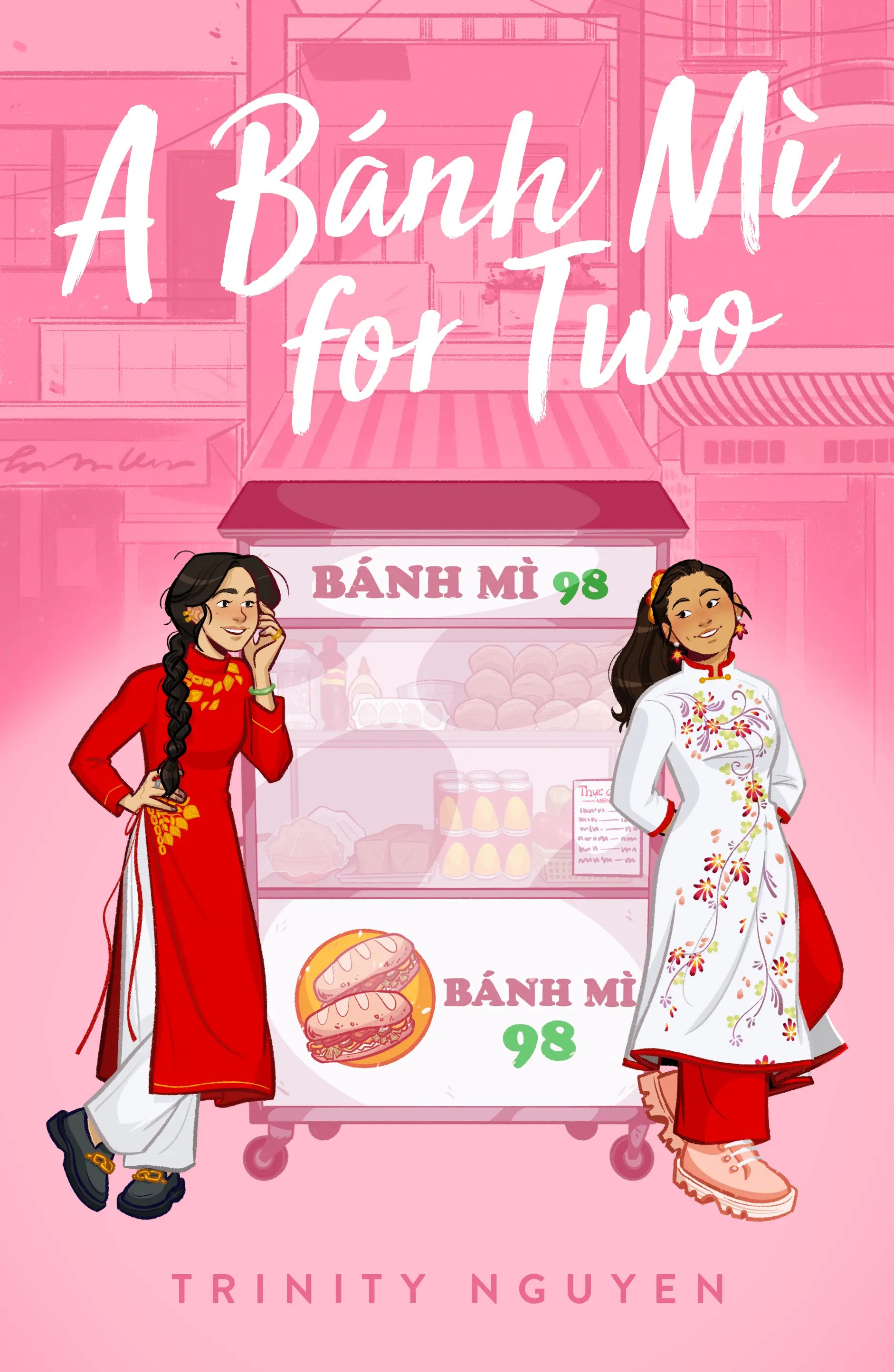
A sweet, closed-door sapphic romance set in Sài Gòn, where two foodie 18-year-olds fall for each other while uncovering family secrets and rekindling a love of food writing.
Summary:
In Sài Gòn, Lan is always trying to be the perfect daughter, dependable and willing to care for her widowed mother and their bánh mì stall. Her secret passion, however, is A Bánh Mì for Two, the food blog she started with her father but has stopped updating since his passing.
Meanwhile, Vietnamese American Vivi Huynh, has never been to Việt Nam. Her parents rarely talk about the homeland that clearly haunts them. So Vivi secretly goes to Vietnam for a study abroad program her freshman year of college. She’s determined to figure out why her parents left, and to try everything she’s seen on her favorite food blog, A Bánh Mì for Two.
When Vivi and Lan meet in Sài Gòn, they strike a deal. Lan will show Vivi around the city, helping her piece together her mother’s story through crumbling photographs and old memories. Vivi will help Lan start writing again so she can enter a food blogging contest. And slowly, as they explore the city and their pasts, Vivi and Lan fall in love.
Review:
I love a sweet, closed-door sapphic romance (see my review of Hani and Ishu’s Guide to Fake Dating), so when I heard about A Bánh Mì for Two, it was an easy add to my wishlist. The focus on food blogging and Vietnamese street food—both eating it and running a street food cart—was just the icing on the cake. This story strikes a delicate yet exquisite balance between lighthearted sweetness and the very real multigenerational trauma caused by the Vietnam War (referred to in Vietnam as The War Against the Americans to Save the Nation).
Told in alternating first-person perspectives between Lan and Vivi, the book avoids the common pitfall of muddled voices. While both characters are kind and thoughtful, they each have distinct ways of seeing the world, which keeps their narration clear and engaging. The romance is a sweet, slow burn, beginning with Vivi’s admiration of Lan’s food blog and blossoming into real-world chemistry after a chance encounter in Sài Gòn.
I especially appreciated the queer representation. There’s no on-page angst about being queer. Vivi does talk briefly with her friend Cindy (a Mexican American character) about how coming out can be complicated with conservative parents, but by the time the story begins, both girls’ families are accepting. It was also refreshing to see Vivi clearly identify as bisexual—representation that could’ve been easily overlooked since her only relationship in the book is with Lan. It’s affirming and intentional, which I loved.
The food descriptions are vivid but never overdone. They strike just the right balance between informing the reader (especially for dishes that might be unfamiliar) and keeping the flow natural. (I’ve eaten many a bánh mì in my life, and still found the food writing delightful!) I also really appreciated that this is a story about two 18-year-olds, and college isn’t presented as the only post–high school option. Lan’s mom encourages her to pursue school if she wants to, but also supports her jumping right into a career—a rare and welcome take in YA-adjacent fiction.
Vivi’s experience as a Vietnamese American studying abroad in Vietnam adds a beautiful emotional layer. She’s not a tourist—she’s searching for a kind of homecoming. She’s exploring why her mother kept so many details about Vietnam and their family a secret. This process is a powerful lens for the reader to learn about the war’s impact on Vietnamese families without the book ever feeling preachy. The historical context emerges naturally—through conversations, shared meals, and street encounters. It’s excellent writing.
The romantic progression between Lan and Vivi is tender and believable. One of my favorite parts was the motorbike rides around Sài Gòn—evocative, cinematic, and intimate. Even the third-act conflict felt justified. It wasn’t a contrived misunderstanding but a believable clash of cultural differences and personal pain. No one is villainized, and the resolution feels earned.
That said, a few elements pulled me out of the story. For example, Vivi’s study abroad program is mentioned as her reason for being in Vietnam, but we never actually see her attend class or study. This absence feels like a missed opportunity—readers might expect the study abroad setting to include some academic context. Similarly, while the book opens with several references to Vivi lying to her mom about her location—including photoshopping photos—the tension fades away later in the book. I found it a bit hard to believe that her mom wouldn’t catch on sooner.
The book is richly diverse, featuring Vietnamese and Vietnamese American characters, a Mexican American side character, and a sapphic romance at the center. Lan’s mother has a chronic illness, and her father passed away young from a stroke. The book also explores difficult family dynamics, grief, and healing across generations.
Overall, this is a fun, sweet sapphic romance featuring the beloved tropes of slow burn and study abroad, while offering thoughtful reflections on Vietnamese culture, family history, and the legacy of war. It’s beautifully steeped in food, healing, and love. Recommended for anyone looking for a sweet, queer romance with emotional depth, cross-cultural exploration, and heartwarming food moments.
If you found this review helpful, please consider tipping me on ko-fi, checking out my digital items in my ko-fi shop, buying one of my publications, using one of my referral or coupon codes, signing up for my free microfiction monthly newsletter, or tuning into my podcast. Thank you for your support!
4 out of 5 stars
Length: 224 pages – average but on the shorter side
Source: Library
Buy It (Amazon or Bookshop.org)
Book Review: Darling Girls by Sally Hepworth

When bones are discovered beneath their childhood home, three adult, Australian foster sisters are forced to confront their past as key witnesses—or prime suspects—in a dark family secret.
Summary:
For as long as they can remember, Jessica, Norah, and Alicia have been told how lucky they are. As young girls they were rescued from family tragedies and raised by a loving foster mother, Miss Fairchild, on an idyllic farming estate and given an elusive second chance at a happy family life.
But their childhood wasn’t the fairy tale everyone thinks it was. Miss Fairchild had rules. Miss Fairchild could be unpredictable. And Miss Fairchild was never, ever to be crossed. In a moment of desperation, the three broke away from Miss Fairchild and thought they were free. Even though they never saw her again, she was always somewhere in the shadows of their minds. When a body is discovered under the home they grew up in, the foster sisters find themselves thrust into the spotlight as key witnesses. Or are they prime suspects?
Review:
I’ve read most of Sally Hepworth’s books and enjoyed them, so I was excited to receive a review copy of her newest release.
The story features three narrators, each alternating between the present and their childhood. While that could be confusing, it’s actually well-executed, with the shifts between timelines feeling seamless. The timing of these shifts works well, never feeling contrived for the sake of holding back secrets for a twist.
And those twists? They’re big, and one in particular made me gasp out loud. While they were surprising, they made perfect sense, leaving me thinking, “I should have seen that coming.” That said, I did feel a bit frustrated by the final twist. I’m starting to tire of a specific depiction of women that seems to be a recurring theme in psychological thrillers, and this book doesn’t escape that trope.
In terms of representation, there’s a lack of racial or ethnic diversity. However, the book does feature one bisexual sister pursuing a relationship with a woman, and one sister dealing with substance use issues, while another has anger management struggles. I found the portrayal of foster care and the foster system is both realistic and sensitive, and especially appreciated learning that Hepworth conducted research with adults raised in the foster system. As someone who works in addiction and recovery, I found the representation of substance use disorder to be authentic and tasteful.
Overall, this is a gripping psychological thriller set in Australia, with enough twists and intriguing characters to keep you turning the pages. While readers may not relate to all of the characters, the juicy plot is sure to keep them engaged. Recommended for fans of psychological thrillers.
If you found this review helpful, please consider tipping me on ko-fi, checking out my digital items available in my ko-fi shop, buying one of my publications, using one of my referral/coupon codes, or signing up for my free microfiction monthly newsletter. Thank you for your support!
4 out of 5 stars
Length: 359 pages – average but on the longer side
Source: NetGalley
Buy It (Amazon or Bookshop.org)
Book Review: Rouge by Mona Awad

When Belle’s semi-estranged mother dies falling off a cliff in California, she comes from Montreal for the funeral and soon finds herself sucked into the same “spa” her mother was frequenting before her death.
Summary:
For as long as she can remember, Belle has been insidiously obsessed with her skin and skincare videos. When her estranged mother Noelle mysteriously dies, Belle finds herself back in Southern California, dealing with her mother’s considerable debts and grappling with lingering questions about her death. The stakes escalate when a strange woman in red appears at the funeral, offering a tantalizing clue about her mother’s demise, followed by a cryptic video about a transformative spa experience. With the help of a pair of red shoes, Belle is lured into the barbed embrace of La Maison de Méduse, the same lavish, culty spa to which her mother was devoted. There, Belle discovers the frightening secret behind her (and her mother’s) obsession with the mirror—and the great shimmering depths (and demons) that lurk on the other side of the glass.
Review:
Imagine a woman gets pulled into the world of Eyes Wide Shut, only there’s a lot less clarity about what exactly is going on.
The first 10% of the book and the last 25% had me very interested. The middle felt a little repetitive and slow. On the plus side, this book put me to sleep so easily. I can’t remember the last time I fell asleep so quickly when reading. Maybe not a huge positive to say about a horror book, but something about the language and the setting lulled me right to sleep. I only started to be able to make progress when I began to skim. I think the lengthy descriptions of the skin care routine just wasn’t particularly interesting to me as someone who simply doesn’t do skincare.
The main character is half Egyptian, half white. Her Egyptian father died so she lives with her white mother. A lot of the book is about the conflicts that arise for her as a woman of color with a white mother. I liked how the book illuminated the mistakes Belle’s mother made as a white woman raising an Egyptian daughter while also showing how she still loved her daughter and was trying. It’s a delicate balance to strike, and it was well done. She is also bisexual. This is established by her dating two siblings, which wasn’t my favorite way of revealing that. It’s a little too close to the bisexual as cheater trope.
What exactly was going on at the spa and how it ties back to Belle’s childhood remains a little confusing to me, even after reading the ending. I think I understand it. But I suppose what confuses me the most (minor spoiler) is how this society could target people from the other side of the continent many years in advance, and what made them target those specific people. That was a bit fuzzy to me. (Read more about what others thought about the confusing bits here. Be warned – there’s a lot of spoilers in that link!) I also agree with others who say the romance subplot wasn’t needed. I would have been quite happy with full focus on Belle and her mother.
I really enjoyed the way the sentences were put together, even if I thought the story overall could have been tightened. The story itself is interesting, although definitely drawing inspiration from others that I felt were creepier and with a more straight-forward big bad.
Recommended to those willing to dive into scenes of a character’s skin-care routine and atmospherically vague reveals that let you choose what you think happened. I am certain these readers are out there, and I hope they find this book. It feels almost like a love letter to that audience.
If you found this review helpful, please consider tipping me on ko-fi, checking out my digital items available in my ko-fi shop, buying one of my publications, using one of my referral/coupon codes, or signing up for my free microfiction monthly newsletter. Thank you for your support!
3 out of 5 stars
Length: 384 pages – average but on the longer side
Source: Library
Buy It (Amazon or Bookshop.org)
Announcement: Sign Up to Get FREE Advanced Reader Copies (ARCs) of My Upcoming 2024 Releases!

I’m so excited to announce that sign ups are now open to receive Advanced Reader Copies of my upcoming 2024 book releases! You can sign up for all of them, one, or a couple.
My releases planned for 2024 are:
- A sweet sapphic short story collection (June)
- A pro-environmentalism scifi novel that also confronts grief and disordered eating (late summer)
- The sequel to Ecstatic Evil a m/f paranormal romance (fall)
This list and schedule are subject to change!
Although difficult topics may be addressed in my books, I strive for my work to end on an uplifting note.
- Any scifi or fantasy I write would be rated PG13 or less if it was a movie.
- Please note that any romance I write is closed door.
- I’m a queer, bisexual author. Sometimes my romances are m/f, sometimes sapphic, sometimes other queer pairings or mentions of poly relationships. Most of my stories have queer people somewhere in them, even if they aren’t the main characters. If that’s not cool with you, please don’t sign up.
- All of my books start with a content note. You can see examples by reading the free samples available for Bloemetje, Ecstatic Evil, and Waiting for Daybreak.
If you sign up to receive an ARC, you will receive:
- an email from me without any attachments letting you know the book is coming soon and to keep an eye out on your inbox and spam (approximately 2 to 3 weeks prior to publication date)
- an epub file of the book to your email address provided 1 to 2 weeks prior to publication date
In exchange for the free book you will:
- post an honest review of the book wherever you review books (ie Amazon, GoodReads, Storygraph, a blog, Instagram, TikTok, etc…)
- not share the epub file with anyone else
If you decide not to read the book after receiving it due to the content note or it just not turning out to be a match for you, that’s ok!
*If you change your mind about receiving ARC(s) after signing up, just email me at mcneil.author [at] gmail [dot] com, and I’ll remove you from my list.
Book Review: Death Valley by Melissa Broder

A woman dealing (or not dealing) with her husband’s and father’s medical conditions arrives in the desert to research her newest novel and has a fantastical experience.
Summary:
A woman arrives alone at a Best Western seeking respite from an emptiness that plagues her. She has fled to the California high desert to escape a cloud of sorrow—for both her father in the ICU and a husband whose illness is worsening. What the motel provides, however, is not peace but a path, thanks to a receptionist who recommends a nearby hike.
Out on the sun-scorched trail, the woman encounters a towering cactus whose size and shape mean it should not exist in California. Yet the cactus is there, with a gash through its side that beckons like a familiar door. So she enters it. What awaits her inside this mystical succulent sets her on a journey at once desolate and rich, hilarious and poignant.
Review:
I didn’t expect this to be a book that kept me up late at night because I needed to know how the plot resolved. I have not personally tended to experience much forward momentum in magical realism. But this was such a perfect mix of adventure plot and emotional magical realism that I simply couldn’t stop reading.
I love a cactus. This is a fact I don’t usually admit to because they’re so popular in design nowadays, and I’d rather support an underdog.
location 206
The main character was easy to bond with initially, which is critical to a plot that relies on the reader believing her experiences in the desert – even when they become fantastical. She’s a bisexual woman in long-term recovery from drugs and alcohol. She’s trying to finish her novel. Her husband has had a mysterious chronic illness for several years, and her father has been in the hospital for a long time after a car accident. The hospital keeps telling them that he’s dying, and then he wakes up and improves (only to have something else go wrong.) It’s a lot for anyone to handle. She has a dry wit that we hear inside her head but that rarely makes it outside. We can see how she’s barely keeping it together, and yet she continues to try because of how much she loves her loved ones.
Since my husband got sick, my words don’t mean what they are supposed to mean.
location 289
It’s interesting what a beautiful depiction of a marriage this book is when so little in it features the spouses together. Yet through the main character we see how her marriage and loving her husband, as she would say, isn’t just a feeling. It’s a choice. Perhaps some people would find it gauche to have a whole book focusing in on the impact of a chronic illness on the spouse who doesn’t have it. But that’s the rub of a marriage. What happens to one person is happening to both.
The setting of the book is also gorgeous. I’m not sure I’d have appreciate it as much as I did if I had never been to the desert. The beauty and danger and overwhelmingness of the desert is all encapsulated so beautifully from the coolness of her room in the Best Western to the magical cactus and everything in between. (Plus there’s both desert bunnies and multiple types of cactus from saguaro to teddy-bear cholla.)
If I was reading a review of this book, my main question would be – ok, ok, but how about the magical realism? Does it work? Yes, it works really well. By the time I finished the book, I couldn’t imagine the main character’s arc happening any other way. It makes sense in the context of that trip and that world, and that’s all that really matters. I wasn’t questioning it. I was on board from the first magical moment partway into the book.
Overall, this is an engaging story of one woman’s trip into the desert intertwined with her inner journey of continuing to choose to love her husband every day. It’s beautiful representation of the complexities of in sickness and in health. Recommended to readers interested in that journey with an open mind to magical realism.
If you found this review helpful, please consider tipping me on ko-fi, checking out my digital items available in my ko-fi shop, buying one of my publications, using one of my referral/coupon codes, or signing up for my free microfiction monthly newsletter. Thank you for your support!
5 out of 5 stars
Length: 240 pages – average but on the shorter side
Source: NetGalley
Buy It (Amazon or Bookshop.org)
Book Review: Amen Maxine by Faith Gardner

You move cross-country with your brand-new husband and newborn to start a new life only for your digital assistant to inform you that your husband is going to try to kill you.
Summary:
Welcome to Silicon Valley, where the weather is perfect, the income is high … and Rowena Snyder is miserable. A transplant from New York, Rowena moved into her husband Jacob’s idyllic childhood home with their new baby. But suburbia isn’t Rowena’s cup of Starbucks. And she’s got serious anxiety and depression to boot.
Jacob, worried about their marriage, scores a new product currently in beta testing from his tech job: Maxine, a “digital friend” that bonds with an individual by continually gathering their personal data. Along with functioning like an upscale digital assistant, Maxine has “advice” and “prediction” modes that have shown promise for patients with mental health issues. To Rowena’s shock, the device turns out to be not just helpful, but eerily accurate, predicting events before they occur.
It’s a godsend until Maxine offers a series of increasingly bone-chilling predictions that will change Rowena’s life forever.
This domestic suspense novel asks, who do you trust more—your mind, your man, or your machine?
Review:
This book had me nodding my head in understanding while also absolutely cackling. The main character, Rowena, has some flavor of anxiety disorder. How she feels about the world and the reassurance she seeks was quite relatable to me. But she’s also really droll and fun to see interact with her world. When her husband brings home a digital assistant from his job that’s in beta testing for helping people with depression or anxiety, she’s skeptical and reticent to use it. Until she needs directions on the least anxiety-provoking way to go for an errand. Then she’s sold. But just when she’s getting comfortable with using Maxine and getting out into the world more, it tells her that her husband is planning to kill her.
The first 50% of the book was the perfect blend of suspense and humor. I loved that the way Rowena has to confirm changes to the digital assistant is to say “Amen Maxine.” It lends itself to some pretty funny dialogue. I also liked how the book explores in a not banging you over the head with it way the risks of using technology to treat mental health. Is it really working or is it making things worse? This part of the book was a solid five stars to me.
The last half of the book lost the sense of humor and became somehow both darker and less unique than the beginning. I feel like I would have enjoyed it more if it wasn’t in such contrast to the beginning. But the ending twist was still a surprise, and I was left feeling like I’d read a unique story. I received the print book as a gift, and I didn’t even realize it was indie published. I thought it was a small press. It’s quite professionally done.
I would be remiss not to mention that the main character is bisexual. She’s wonderful representation with her bisexuality being a part of her and her life, but not something she dwells upon. I also liked how she naturally seeks out other queer people after her move for friendship.
One thing that surprised me when I finished it and added it to my GoodReads is that the title has now changed. The author recently changed the title to The Prediction. Personally I like Amen Maxine better but I hope that the change for presumably marketing reasons is beneficial to her. But if you are interested in the book – look for The Prediction by Faith Gardner or use my direct link provided.
Overall, this was a fun psychological thriller with an interesting main character and a unique plot. If you’re a usual reader of thrillers, you’ll likely enjoy it. If you don’t usually read thrillers but are intrigued by the idea of a maybe evil digital assistant, give it a try.
If you found this review helpful, please consider tipping me on ko-fi, checking out my digital items available in my ko-fi shop, buying one of my publications, using one of my referral/coupon codes, or signing up for my free microfiction monthly newsletter. Thank you for your support!
4 out of 5 stars
Length: 262 pages – average but on the shorter side
Source: gift
Buy It (Amazon, not available on Bookshop.org)
Book Review: The Haunting of Alejandra by V. Castro

Alejandra, deep in the throes of postpartum depression, starts to see the specter of the Mexican folk demon La Llorona.
Summary:
Alejandra no longer knows who she is. To her husband, she is a wife, and to her children, a mother. To her own adoptive mother, she is a daughter. But they cannot see who Alejandra has become: a woman struggling with a darkness that threatens to consume her.
Nor can they see what Alejandra sees. In times of despair, a ghostly vision appears to her, the apparition of a crying woman in a ragged white gown.
When Alejandra visits a therapist, she begins exploring her family’s history, starting with the biological mother she never knew. As she goes deeper into the lives of the women in her family, she learns that heartbreak and tragedy are not the only things she has in common with her ancestors.
Because the crying woman was with them, too. She is La Llorona, the vengeful and murderous mother of Mexican legend. And she will not leave until Alejandra follows her mother, her grandmother, and all the women who came before her into the darkness.
But Alejandra has inherited more than just pain. She has inherited the strength and the courage of her foremothers—and she will have to summon everything they have given her to banish La Llorona forever.
Review:
The concept for this book is super original. A family with a genetic predisposition to postpartum depression is also haunted by an interdimensional being who takes advantage of that among the first-born daughters. It tackles both intergenerational trauma (especially of the colonized) and postpartum depression through a speculative lens. This speculative horror book also shows the main character going on a healing journey.
I particularly appreciated that the postpartum depression wasn’t a mere symptom of the haunting. Alejandra has postpartum depression. The being essentially targets the negative things Alejandra’s brain is already telling her. An example from the very beginning of the book is Alejandra is crying in the shower because she is so sad, and the being shows up and starts suggesting her family would be better off without her. An idea Alejandra has probably already had, but now she’s hearing it from this being that she thinks only she can see. This strategy becomes clearer when we see the flashbacks to Alejandra’s ancestors. The being also sometimes takes advantage of physical ailments but it primarily targets mental ones. I appreciated how this meant the story still took the reality of postpartum depression seriously while also tackling the issue of the multi-generational haunting. The story is told both in the present and through extended flashback chapters to previous generations.
The main character is Chicana married to a white man. In the flashbacks to the previous generations we see the racism her grandmother endured in the 1950s, and we also learn some about Mexican history (both recent and in immediate colonization by the Spanish) through two ancestors further back. The main character is bisexual, and there is a significantly important trans side character in a historic time period flashback. I particularly appreciated seeing a trans person represented in a historical time period.
The writing was at times a little clunky, especially towards the end. It just felt like I was reading a book, as opposed to getting lost in it, and it felt like different characters sounded the same. Again, this wasn’t throughout the book but limited to occasional scenes especially toward the end of the book. I also found it an odd choice to inform the reader the present-day was 2020 and then never acknowledge any of the 2020 issues. (For example, expected the mother with postpartum depression to end up dealing with distance learning for her two school-age children. But nothing ever came up.) Everything else could have stayed the same and been in 2019, so I’m not sure why it wasn’t 2019. I also felt that the husband character was treated in a two-dimensional way, as was the marriage. Marriage is very complex and yet complexity was only allowed to the postpartum depression and not the marriage. While I enjoyed this read, I did prefer the author’s previous book, The Queen of the Cicadas / La Reina de las Chicarras (review). One reason that is also evident in the title, was that book had more Spanish in it, which let me practice my Spanish more.
Overall this is a really unique read that explores postpartum depression and intergenerational trauma through a speculative lens. It’s a plot that will keep you guessing and intrigued.
If you found this review helpful, please consider tipping me on ko-fi, checking out my digital items available in my ko-fi shop, buying one of my publications, using one of my referral/coupon codes, or signing up for my free microfiction monthly newsletter. Thank you for your support!
4 out of 5 stars
Length: 272 pages – average but on the shorter side
Source: NetGalley
Buy It (Amazon or Bookshop.org)
Book Review: Wanderlust by Elle Everhart

In this romcom that tackles hard topics, Dylan wins a trip around the world, the only catch is she has to go with a man she ghosted months ago.
Summary:
Feeling stuck at work and tired of London’s dreary weather, magazine writer Dylan Coughlan impulsively rings a radio station one day only to win a once-in-a-lifetime trip around the world. The catch? Her travel partner must be a contact randomly selected on her phone. And of course this stressful game of contact roulette lands on a number listed only as Jack the Posho, an uptight, unbearably posh guy she met on a night out and accidentally ghosted.
The two couldn’t be more different, and as the trip kicks off, Jack seems like he’d sooner fling himself into the sun than have a conversation with Dylan. But more is hinging on this trip than the chance to see the world. For the past two years, Dylan’s been relegated to writing quizzes (and only quizzes) at her lifestyle magazine after an article about her past abortion went viral—and not in the good way. If she’s able to make a series about their trip successful, her overbearing boss will give her a chance at a permanent column. Dylan’s willing to do anything to make the series a hit, even if it means embellishing her and Jack’s relationship to satisfy readers. But as the column’s popularity grows, so does the bond between Dylan and Jack, and Dylan is forced to consider if the one thing she thought she always wanted is worth the price she’ll have to pay to get there.
Review:
I picked this up off the library’s new book shelf because the romcom set-up sounded great. I was pleasantly surprised in chapter one to find that Dylan identifies as both queer and bisexual. Yay for more representation! But I actually ended up not liking Dylan particularly much by the end of the book.
Let’s start with the good. I found the romance sweet. It’s a classic grumpy/sunshine and organized/disorganized (Oscar and Felix for us olds out there). I liked how Dylan teased Jack for being posh and how he clearly didn’t mind the teasing. I was intrigued by why Jack was willing to drop everything to go on a trip around the world with someone who ghosted him who he also seemed to not like very much. And I was rooting for Dylan to find success blogging about her trip. The first destination was Australia, and it was definitely written the best. I could really visualize Australia, and I felt like we saw the characters spend an appropriate amount of time there.
In contrast, for a book about a trip around the world, a lot of the locations really breezed by. For example, India was less than a chapter. In South Africa we saw them at a dock. In New York we hear Jack excited about the Empire State Building but then don’t see the characters go there. It was a little bizarre for a book ostensibly about a trip around the world with a magazine writer. It was a let-down after the Australia chapters, especially.
The book deals with a couple of tough topics that might be a turn-off to some readers. Dylan wrote about her own abortion around the time Ireland was looking at its abortion policies. Her piece went viral, and she ended up being cyberbullied and doxxed. These topics aren’t mentioned in passing. They come up repeatedly in the book. Kind of heavy for a romcom. While the blurb I gave you talks about it, the blurb on the back of the print book I got from the library doesn’t mention it at all. It’s clear from looking at reviews that readers would have preferred knowing in advance, and I am glad the blurb was updated accordingly.
To me, Dylan started out likeable enough but became less likeable as the book progressed. The first glimmer I got of this was early on in Australia when Jack is nervous doing an activity, and she’s irritated at him because him looking and seeming anxious (while still doing the activity!) is impinging on her own enjoyment of the activity. This would be like saying your flight is ruined because a person in the seat next to you seems a little nervous during the flight but doesn’t talk about it and causes no issues. She has basically no empathy for Jack and is clearly self-centered. Which was jarring. As the book continues, it becomes increasingly clear that she acts without thinking. Ok sometimes people do that. But when it’s a recurring character trait that impacts other people (and hers does), that’s an issue. Especially for a character who’s almost 30. I also found how she spoke to her mother to be really terrible. She wasn’t trying to have a conversation with her mother (even though her mother was clearly trying to do so). She was giving her a speech without any interest in reconciliation. I don’t personally think her mother messed up enough to warrant that. And I didn’t like seeing it played up as some big empowering scene for Dylan. I thought it was quite sad, actually.
For readers wondering about the spice, this was an odd mix. The vast majority of the book is low spice/slow burn. Then there is one very spicy scene that takes up two chapters. (This scene also managed to make me like Dylan even less, and the score was already pretty low at that point). I found it jarring to go from all of the heat being from like a hand on the low of your back to a detailed spicy scene. I would have preferred a fade out and maybe some post-activities snuggling and pillow talk. It just fits the vibe of the rest of the book better.
Overall, the idea for the set-up for this romcom is stellar. Jack is a great leading man. But he’s set up with a leading lady who’s not particularly likeable, and the romcom is dragged down by some heavy topics.
If you found this review helpful, please consider tipping me on ko-fi, checking out my digital items available in my ko-fi shop, buying one of my publications, using one of my referral/coupon codes, or signing up for my free microfiction monthly newsletter. Thank you for your support!
3 out of 5 stars
Length: 368 pages – average but on the longer side
Source: Library
Buy It (Amazon or Bookshop.org)
Book Review: Hani and Ishu’s Guide to Fake Dating by Adiba Jaigirdar

In this Bangladeshi-Irish YA romance, Hani needs to convince her two best friends that she’s really bisexual. She lies and tells them she’s dating academically focused and acerbic Ishu who agrees to fake date in exchange for help being elected Head Girl.
Summary:
Everyone likes Humaira “Hani” Khan—she’s easy going and one of the most popular girls at school. But when she comes out to her friends as bisexual, they invalidate her identity, saying she can’t be bi if she’s only dated guys. Panicked, Hani blurts out that she’s in a relationship…with a girl her friends absolutely hate—Ishita “Ishu” Dey. Ishu is the complete opposite of Hani. She’s an academic overachiever who hopes that becoming head girl will set her on the right track for college. But Ishita agrees to help Hani, if Hani will help her become more popular so that she stands a chance of being elected head girl.
Despite their mutually beneficial pact, they start developing real feelings for each other. But relationships are complicated, and some people will do anything to stop two Bengali girls from achieving happily ever after.
Review:
I have a soft spot for Irish literature, and when I heard about this book by a Bangladeshi-Irish queer Muslim author with a bisexual main character, it landed on my tbr list very quickly. This was a quick read with an easy to follow story and a sweet, very low spice romance.
I enjoyed Hani and Ishu each separately as character. They take turns narrating in the first person, and I never lost track of who was speaking. This book uses the grumpy/sweet trope quite well. Ishu is only grumpy because she’s focused and willing to speak her mind. Hani quickly sees through that. Hani and Ishu’s cultures are intertwined beautifully in the book. I like it when a book doesn’t feel the need to stop and explain cultural things to the reader. It’s on us to look it up if we want to, and that’s when I really learn things. (Like when Hani makes Ishu porota for breakfast. I looked that up right away. Yum!)
As a bisexual person, I appreciated how the story highlights the specific issues for Hani in coming out as bisexual. It’s clear that her friends would have fairly rapidly accepted her as a lesbian, but they view bisexual as being either confused or attention-seeking. They also don’t believe her because they’ve never seen her date a girl. This is a very realistic depiction of biphobia. Hani is quite confident about who she is and what labels she chooses. In contrast, Ishu is uninterested in labels, although she’s definitely attracted to Hani. It’s not clear if she’s only ever been interested in girls or more or if it’s just that Hani is the first person she’s ever been interested in. But that doesn’t matter to Ishu, and it doesn’t matter to Hani either.
When this book first came out, it was praised for depicting a queer Muslim character. (This article goes into depth about representation for South Asian queer women and interviews the author as well.) There is a perception that you cannot be both queer and Muslim. Both Muslims and non-Muslims hold this viewpoint. Yet people like Jaigirdar are both and depicting this in her books is important to Jaigirdar. Thus, we see Hani engaging with her faith. She goes to the Mosque. She reads the Quran. She eats halal. There is also a perception among many non-Muslims that if someone is serious about Islam and a woman then they will wear the hijab. But it is possible for someone to be devoutly engaging with her faith and also not wearing hijab. The author depicts this in Hani, as well as how she must struggle against the perception that she must not be a “serious” Muslim because she doesn’t wear hijab.
So this book covers a lot of seriously important representation well, and the romance is sweet and believable. What didn’t work for me was the secondary characters. Whereas Hani and Ishu felt well-rounded and interesting, everyone else felt flat and two-dimensional. There also were some kind of big issues that Hani and Ishu seemed to just gloss over. Now, they’re teenagers, so maybe that’s realistic. But Ishu having to hide the relationship from her parents long-term was concerning to me. Also, we never see the characters talk about being in an interfaith relationship. We do hear that Ishu appreciates Hani’s devotion to her faith as part of her. But Ishu is atheist, and we never really hear Hani’s thoughts on that.
Overall, this was a fun read with a lot of important representation. Recommended to readers who enjoy the fake dating and/or grumpy/sweet tropes.
If you found this review helpful, please consider tipping me on ko-fi, checking out my digital items available in my ko-fi shop, buying one of my publications, or using one of my referral/coupon codes. Thank you for your support!
3 out of 5 stars
Length: 352 pages – average but on the longer side
Source: Library
Buy It (Amazon or Bookshop.org)
Get the Reading Group / Book Club Discussion Guide
A beautifully graphic designed 2 page PDF that contains: 1 icebreaker, 9 discussion questions arranged from least to most challenging, 1 wrap-up question, and 3 read-a-like book suggestions
View a list of all my Discussion Guides.
 Support my work with a tip or browse my shop for curated book club guides, how to guides, cross-stitch patterns, and more!


This work by Amanda Nevius is licensed under a Creative Commons Attribution-Noncommercial-No Derivative Works 3.0 United States License.
 Opinions of a Wolf